Resource Libraries
Pregnancy, Hormones, and Periodontal Disease: What Every Woman Should Know
Why do gums sometimes bleed more during pregnancy, even when brushing habits haven't changed? Explore the research connecting hormones, periodontal disease, and pregnancy outcomes.
Part 7 of the 10-Part Periodontal Disease Series
This is Part 7 of my 10-part series exploring periodontal disease and how it affects our health. I've also written a much larger HERE for anyone who wants to explore all the research in one place. Each article in this series covers a different part of periodontal health and can stand on its own. You don't need to read the previous articles to understand this one, although you're certainly welcome to explore the entire series!
One quick note about the research references: I'm keeping the same reference numbers used in my periodontal disease master article so you can find the original studies in either place. That's why the numbers may skip around. New studies added specifically for this series are labeled [A1], [A2], and so on, with their complete references included at the end.
Why can your gums suddenly start bleeding when NOTHING has changed?
Imagine a woman who's been brushing and flossing exactly the same way for years. She hasn't changed her toothpaste. She hasn't changed her diet. She's still going to the dentist regularly. But suddenly, her gums are bleeding. Maybe they're swollen or tender, too. She visits her hygienist, who tells her she needs to brush and floss better. Except she HASN'T changed how she cares for her teeth!
So what happened? Well, she might be pregnant. She might be going through puberty (well, at that point it would be a young girl who is experiencing these changes, not exactly a full grown woman). Or she might simply be at a different point in her menstrual cycle. And any one of those things can change how her gums respond to bacteria and inflammation.
Our hormones influence an enormous number of things happening inside our bodies. They affect blood flow, immune activity, connective tissue, and how our cells respond to different substances. Our gums are living tissue, so they're affected by those changes, too. And researchers have shown that hormonal changes can influence gingival inflammation even when the amount of plaque on someone's teeth hasn't changed significantly. [64] [65]. That's important, because women OFTEN get blamed for bleeding gums when their bodies are responding to hormonal changes that have absolutely nothing to do with whether they've suddenly become lazy about brushing.
I've said this before and I will say it again. Shame is a lousy diagnostic instrument. It doesn't measure anything, and it certainly doesn't remove biofilm. So let's look at what's actually happening.
What do hormones have to do with periodontal health?
Two hormones that play particularly important roles in women's reproductive health are estrogen and progesterone. Their levels change throughout puberty, the menstrual cycle, and pregnancy. And both influence biological processes that affect our gums. Estrogen helps regulate connective tissues, blood vessels, immune responses, and bone metabolism. Progesterone also influences blood vessel behavior and how tissues respond to inflammation.
When hormone levels change, the gums may react differently to the same bacterial communities they've been living with for years. That means a person may experience more swelling or bleeding without having accumulated more plaque. And there are studies showing exactly that.
What happens during the menstrual cycle?
In 2004, researchers followed 18 women through different phases of their menstrual cycles. They measured the amount of plaque on their teeth and evaluated their gum health. And they found that the amount of plaque remained relatively stable, but the inflammation in their gums changed! [65]. The researchers found changes in gum inflammation around ovulation and before menstruation. So the women weren't necessarily developing more plaque. Their gums were responding differently as their hormones changed.
Another study examined changes in periodontal health and oral bacteria during different menstrual phases. The researchers found that hormonal changes had a greater effect on gingival inflammation among women who already had gingivitis. [64]. That's an important distinction. If someone already has inflamed gums, hormonal changes may make that inflammation more noticeable. And if someone has otherwise healthy gums, those same hormonal changes may produce much less of a response. We're looking at interactions between the microorganisms living in the mouth and the person's hormonal and immune environment. And those interactions become even more visible during pregnancy.
Pregnancy changes an enormous amount of biology
I've often said that pregnancy can be a harbinger of health problems a woman may struggle with later in life. If a woman develops gestational diabetes, she's at greater risk of developing Type 2 diabetes later. If she develops preeclampsia, she's at greater risk of hypertension and cardiovascular disease as she gets older. And pregnancy-related blood clots can sometimes reveal underlying and heretofore undetected blood clotting disorders that deserve future attention. That last instance happened to me. My blood sugar and blood pressure were beautiful during my pregnancies. But I developed a DVT (deep vein thrombosis). during my second pregnancy that resulted in my youngest being born 7 weeks early. Because of that, I now know that my biggest risks as I get older will involve more blood clots or pulmonary embolisms. So that means I'm doing my best to thin my blood down and keep it there, given my increased risk.
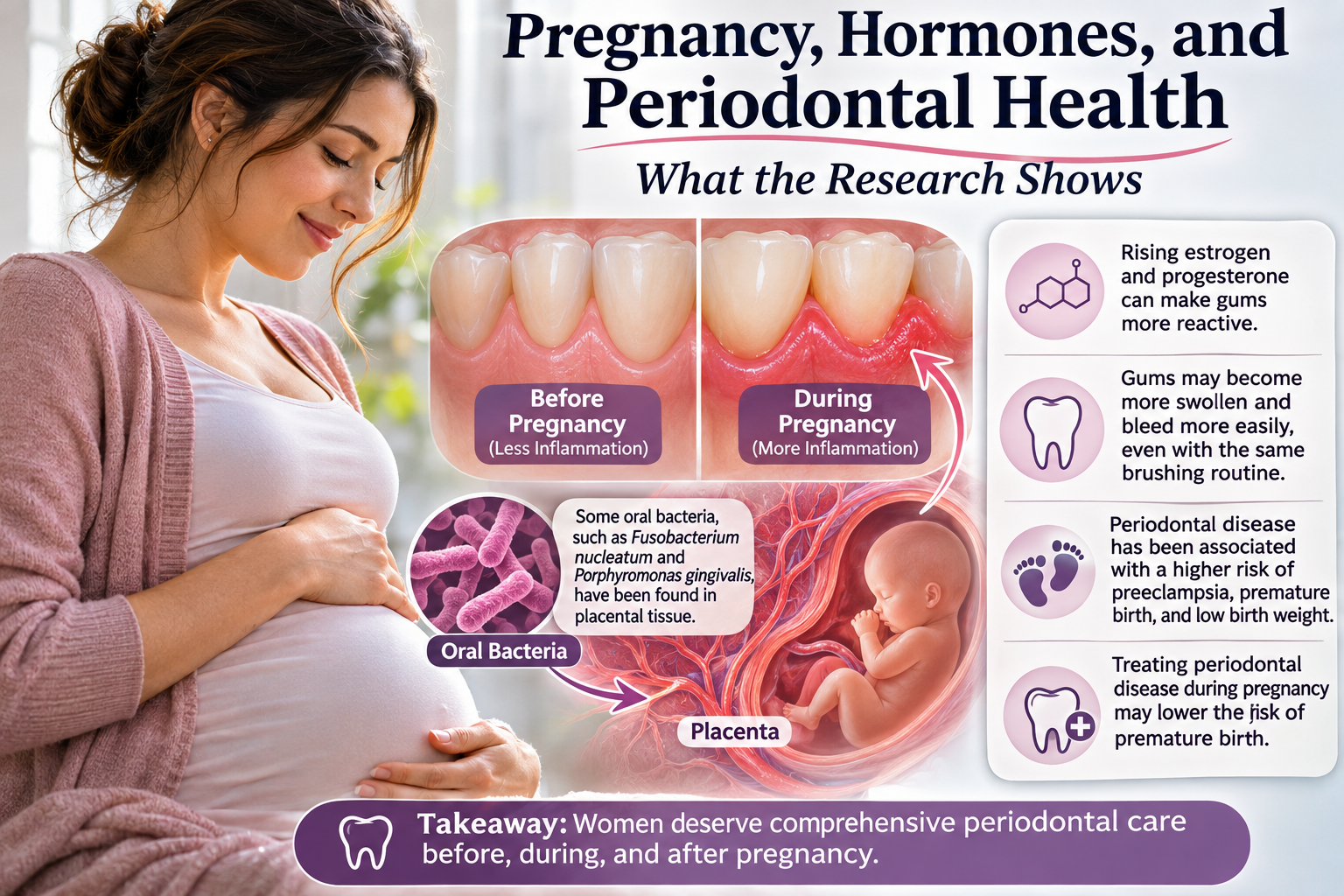
Pregnancy places extraordinary demands on the body. It changes blood volume, hormones, metabolism, immune responses, and the way many tissues behave. And our gums are part of that process. During pregnancy, estrogen and progesterone levels rise dramatically. These changes can make the gums more reactive to bacteria. The tissue may become swollen, tender, or bleed more easily. And the change can be quite noticeable, even in a woman who hasn't changed how she brushes or flosses. Researchers call this pregnancy gingivitis.
But it's important to understand that gingivitis and periodontitis are different conditions. With gingivitis, the gums become inflamed, but the supporting attachment and bone haven't necessarily been destroyed. Periodontitis involves actual damage to the tissues and bone holding the teeth in place. So if a pregnant woman suddenly develops bleeding gums, we need to examine what's happening instead of assuming she has periodontal bone loss or telling her she's doing a terrible job taking care of her teeth.
What researchers found when they followed gum changes during pregnancy
In 2010, researchers examined changes in women's gum health during pregnancy, including hormone levels and inflammatory measurements. They found that gum inflammation increased during pregnancy even when plaque levels remained relatively low. [66]. Another study published in 2016 examined pregnant women with otherwise healthy periodontal tissues. The researchers measured hormone levels, bleeding, and certain inflammatory substances. They found that the gums became more inflamed during pregnancy, but not every inflammatory marker increased along with the bleeding. [67]. That's another reminder that the immune system is complicated. Our tissues can respond to hormonal changes in several ways, and those responses don't all follow exactly the same pattern. But the research becomes even more interesting when we compare pregnant women with women who aren't pregnant.
A newer study involving 616 women
In 2025, researchers published a study involving 616 women in the Democratic Republic of the Congo. Of those women, 307 were pregnant, while 309 were not pregnant. The researchers measured several things, including gum bleeding, plaque, pocket depths, attachment levels, and how much periodontal treatment the women needed. [A18]. And they found differences between the two groups. Among pregnant women, 26% had periodontal pockets deeper than 4 mm. Among nonpregnant women, the figure was 19%.
So let's do some Mom Math. Imagine 100 pregnant women and 100 women who aren't pregnant. In the pregnant group, approximately 26 women would have pockets deeper than 4 mm. In the nonpregnant group, approximately 19 would. That's seven additional women out of every 100 with those deeper pocket measurements.
The researchers also found that 26% of pregnant women needed more advanced periodontal treatment, compared with 18% of the women who weren't pregnant. And when they compared women in different stages of pregnancy, they found that localized gingivitis was particularly common during the second trimester, while periodontitis was most common among women in the third trimester. After accounting for several other factors, pregnancy was associated with approximately 2.87 times the odds of having periodontitis.
Now, this study compared different women at different points in pregnancy. The researchers weren't following the same women from conception through delivery. But it adds another piece of evidence showing that periodontal health can change considerably during pregnancy. And it gives us a very practical reason to pay attention to those changes throughout all three trimesters. Because we're talking about a period in a woman's life when the health of her entire body deserves special attention.
Could periodontal disease affect pregnancy outcomes?
Now we're getting into research that goes well beyond bleeding gums. Researchers have spent decades investigating whether periodontal disease during pregnancy is associated with problems such as:
-
Preterm birth, which means a baby is born before 37 weeks of pregnancy.
-
Low birth weight, which means a baby weighs less than 5 pounds, 8 ounces at birth.
-
Preeclampsia, a potentially serious pregnancy complication involving high blood pressure and signs that organs such as the kidneys or liver may be affected.
And several studies have found relationships between periodontal disease and these complications. [68] [69]. That has led scientists to investigate whether bacteria and inflammatory substances associated with periodontal infection could influence the tissues involved in pregnancy.
What did researchers find about preeclampsia?
In 2013, researchers published a meta-analysis combining findings from 15 studies examining periodontal disease and preeclampsia. They found that women with periodontitis had approximately 2.17 times the odds of developing preeclampsia compared with women without periodontitis. [69]
Now, let's do some Mom Math. Imagine a group of 100 women, and five develop preeclampsia. That means five have the condition and 95 don't. The risk is 5%. But the ODDS are five to 95.
To calculate what 2.17 times those odds would mean, we first divide: 5 ÷ 95 = 0.0526
Then multiply by 2.17: 0.0526 × 2.17 = 0.1141
Now we convert those odds back into a percentage: 0.1141 ÷ 1.1141 = 0.1024. That's approximately 10.2%. So in our hypothetical example, about 10 out of every 100 women would develop preeclampsia instead of five. That's roughly twice as many women! These are imaginary starting numbers to help explain the math, rather than the actual rates measured in the studies. But they show why a reported odds ratio of 2.17 deserves attention. And there's newer research involving premature birth, too.
What did researchers find about premature birth?
A systematic review published online in 2025 and appearing in a 2026 journal issue examined 11 studies comparing pregnant women with and without clinically measured periodontitis. These researchers specifically required periodontal disease to be identified through a full-mouth exam rather than relying entirely on someone's recollection of having gum disease. And when they combined the findings, they reported approximately 2.38 times the odds of preterm birth among women with periodontitis. [A19]. That's important because they're examining the relationship between actual periodontal disease and pregnancy outcomes. But researchers have also investigated something else. What happens when we TREAT the periodontal disease during pregnancy? And that's where the clinical trials become especially useful.
What happened when researchers treated periodontal disease during pregnancy?
In a review published online in 2019 and appearing in print in 2021, researchers combined 20 randomized clinical trials involving 8,171 pregnant women. They wanted to find out whether treating periodontal disease during pregnancy influenced outcomes for mothers and babies. [A20]. And they reported several interesting things.
First, periodontal treatment was associated with a 22% lower relative risk of preterm birth. They also found an association with lower perinatal mortality, meaning fewer babies died shortly before or after birth. And babies in the periodontal-treatment groups weighed an average of approximately 201 grams more than babies in the comparison groups. Now, 201 grams might not sound like much. But that's almost half a pound. For a baby who's born prematurely or has a very low birth weight, differences in weight can matter.
The researchers also calculated something called the number needed to treat. That tells us how many people need to receive a treatment, on average, to prevent one additional unwanted outcome. For preterm birth, their estimate was approximately 37 women. So let's translate that. If the treatment effect applied to a comparable group, treating 37 pregnant women with periodontal disease would prevent approximately one additional preterm birth. That's one baby that could be helped for every 37 women who have periodontal disease. It doesn't sound like much. Until you are the mama of that one baby. And it gives us a reason to continue investigating how effective periodontal care may influence pregnancy outcomes. But a newer review has helped us understand why those findings need further study.
What did the newer treatment research find?
In a study published online in December 2025 and appearing in a 2026 issue of the American Journal of Obstetrics & Gynecology MFM, researchers examined 14 randomized clinical trials involving 8,316 pregnant women. [A21]. They compared different approaches to treating periodontal disease and other dental conditions during pregnancy. When the researchers combined the results, they found that treatment was associated with an estimated 15% lower relative risk of preterm birth. So let's do some Mom Math again.
The researchers estimated that, for every 1,000 pregnant women receiving periodontal treatment, there might be approximately 20 fewer premature births compared with women receiving minimal treatment or no treatment. That's potentially 20 families who might avoid the medical challenges associated with a premature birth. The researchers' statistical range included the possibility of little or no benefit, and the results became less certain when they looked only at the strongest trials. So while the research suggests that periodontal treatment during pregnancy may improve birth outcomes, we still need larger, carefully designed trials to understand how much it helps and which treatment approaches work best. What we DO know is that treating periodontal disease can improve the health of a pregnant woman's gums and supporting tissues. And that's an important reason to provide appropriate dental care during pregnancy.
How could oral bacteria interact with the placenta?
Now let's look at some of the laboratory research that has scientists asking these questions. One of the bacteria we've discussed throughout this series is Fusobacterium nucleatum, or F. nucleatum. This organism commonly lives in the mouth and is associated with periodontal disease. Researchers have also found it in colorectal tumors, where a protein on its surface helps it attach to certain cancer cells. That protein is called Fap2. And scientists have discovered that Fap2 can also interact with tissues involved in pregnancy.
In a 2022 study, researchers investigated how F. nucleatum attaches to placental tissue. [70]. The placenta is the organ that develops during pregnancy to help deliver oxygen and nutrients to the growing baby. It's an incredibly important part of maintaining a healthy pregnancy. And researchers found that Fap2 could recognize certain sugar structures present on placental tissue. Those structures are called Gal-GalNAc. You don't need to memorize that name.
The important part is that the bacterium has a protein that can recognize and attach to particular structures on human cells. Think of it as a docking mechanism. The researchers showed how this interaction could help F. nucleatum attach to placental tissue in their experimental models. That's important because it gives scientists a specific biological mechanism to investigate when they're studying how oral bacteria might reach and interact with tissues involved in pregnancy. And F. nucleatum isn't the only periodontal bacterium researchers have found associated with placental tissue.
Another periodontal bacterium found in placental and umbilical tissue
In 2016, researchers published a study examining Porphyromonas gingivalis in placental and umbilical cord tissue. Remember, P. gingivalis is one of the bacteria in Socransky's red complex and has been extensively studied for its ability to interfere with immune responses. The researchers identified material associated with this bacterium in tissues from pregnancies involving complications. [71]. They examined where the bacterial material was located and investigated its relationship with pregnancy outcomes. We're talking about researchers finding substances associated with a periodontal bacterium in tissues that are directly involved in supporting a developing baby. That gives us another reason to investigate how bacteria from the mouth may interact with the rest of the body. And it helps explain why scientists have become so interested in the relationships between periodontal disease, maternal inflammation, and pregnancy complications.
Why I'd rather address periodontal disease BEFORE pregnancy
One of the things I'd love to see become more common is periodontal screening as part of preconception healthcare. When someone is planning to become pregnant, we often talk about nutrition, medications, vitamins, blood sugar, and other aspects of their health. But how often do we ask whether they have active periodontal disease?
If a woman has deep, inflamed periodontal pockets, I'd rather identify and address those problems BEFORE pregnancy whenever possible. That gives us an opportunity to treat the infection, evaluate how the tissues respond, and establish an effective maintenance plan before her body begins experiencing the enormous hormonal changes associated with pregnancy. And if she's already pregnant, that doesn't mean she should simply wait until after the baby is born.
Why leaving a pregnant woman with an active dental infection can be dangerous for her AND her baby
Pregnant women deserve appropriate dental care throughout their pregnancies. That includes proper exams, professional cleaning, treatment of active infections, and adequate pain control when treatment requires it. Unfortunately, some women are STILL told they shouldn't have dental treatment while they're pregnant. Some are even told they shouldn't receive local anesthetic for pain control!
INSANE.
They're told they should simply put up with whatever infection they have until the baby is born. Folks? That is INSANE. And there's research showing exactly why leaving those infections untreated can be dangerous. So let's take a look at it!
Can periodontal disease during pregnancy affect a child's risk of allergies?
In 2016, researchers in Taiwan published a study following children for up to NINE YEARS. They compared 42,217 children born to women who had periodontal disease during pregnancy with 42,334 children born to women without the infections being investigated. That's more than 84,000 CHILDREN! [A22]. And the researchers discovered some pretty significant differences.
Among children whose mothers had periodontal disease during pregnancy:
-
46.8% developed allergic rhinitis, compared with 39.5% in the comparison group.
-
24.2% developed allergic conjunctivitis, compared with 18.3%.
-
40.4% developed eczema, compared with 34.8%.
So let's do some Mom Math. Imagine we have 1,000 children whose mothers had periodontal disease during pregnancy and 1,000 children whose mothers didn't have the infections being studied. Using the allergic rhinitis percentages:
Approximately 468 children in the periodontal-disease group would develop allergic rhinitis. In the comparison group, approximately 395 children would develop it. That's 73 additional children out of every 1,000! For allergic conjunctivitis, the difference would be approximately 59 additional children per 1,000. And for eczema, approximately 56 additional children per 1,000. Those are meaningful differences!
The researchers also adjusted their results for several factors, and the associations remained statistically significant. The study relied on insurance records, so the researchers couldn't measure every factor that influences childhood allergies, including family history, diet, and environmental exposures. But it gives us another reason to investigate how chronic maternal inflammation and oral infections may influence a child's developing immune system. And remember, we're not talking about allergies that appeared only while the mother was pregnant. We're talking about differences in children's health that researchers followed for YEARS after they were born!
Researchers traced a fatal fetal infection back to bacteria living beneath a mother's gums
Now we're going to look at something even more serious. In 2010, researchers published a case involving a pregnant woman who had pregnancy-associated gingivitis. Near the end of her pregnancy, she developed an upper respiratory infection. Several days later, her baby was stillborn. The researchers identified Fusobacterium nucleatum in the placenta and fetus. [A23]
You might remember that bacterium from our earlier discussion of the oral microbiome. It's an organism commonly found in the mouth and associated with periodontal disease. But here's what made this case especially important. The researchers examined bacterial samples from different parts of the mother's body. And they found the SAME STRAIN of F. nucleatum underneath her gums that they identified in the pregnancy! They didn't find that strain in the samples collected from her vagina, rectum, or plaque above the gumline.
The findings connected the bacterial infection in the pregnancy to a specific organism living underneath the mother's gums. That's powerful evidence that oral bacteria can reach the placenta and contribute to a devastating pregnancy outcome. And it gives us a concrete example of why we need to pay attention to infections inside the mouth during pregnancy.
What about an abscessed tooth?
Now let's talk about a different type of oral infection. Periodontal disease involves the tissues supporting the teeth. But a dead or severely infected tooth can also develop an abscess around its root. Sometimes those infections remain localized for a time. Other times, the infection can spread into surrounding tissues, including the jaw, face, and neck. And when that happens during pregnancy, both the mother and baby can be in danger.
In 2021, researchers published a review examining 69 reported cases of severe dental infections during pregnancy. [A24]. Among those cases, they found:
-
Nine fetal deaths.
-
Four maternal deaths.
-
Three premature births.
-
Two babies with low birth weight.
Now, these weren't 69 ordinary dental abscesses. These were severe infections serious enough to be described in published medical case reports. So the findings don't tell us how often a typical dental abscess will develop into a life-threatening infection. But they DO show what can happen when an infection originating from a tooth spreads into deeper tissues. And the researchers described infections that required surgery and antibiotics to bring them under control.
We also have a 2014 case report involving a pregnant woman whose dental infection spread into the deep spaces of her neck. That's a condition called Ludwig's Angina. I have seen ONE of those in all of my years of dentistry, and it can be life threatening. Sure enough in this case, the infection became life-threatening for the mother, and the baby died. [A25]
We're talking about infections that began with dental disease and progressed into medical emergencies. That's why I find it so troubling when pregnant women are told to simply live with an abscessed tooth until after delivery. An active infection deserves an exam and appropriate treatment. Pregnancy is a reason to consider the needs of BOTH patients when planning that treatment. It certainly isn't a reason to ignore the infection.
And what about local anesthetic? Is it actually safe during pregnancy?
This is another area where we have research that deserves attention. In 2015, researchers followed 210 pregnancies in which women received local anesthetics during dental care. They compared those pregnancies with 794 pregnancies in a control group. And they found no statistically significant differences in miscarriage, major birth defects, gestational age at delivery, or birth weight. [A26]
A newer review, published in a 2026 journal issue, examined five studies involving 1,954 patients. Lidocaine with epinephrine was the local anesthetic used most often in those studies. And once again, the researchers found no significant increase in the pregnancy complications they examined among women receiving local anesthesia. [A27]. So we're looking at research showing that severe dental infections can have devastating consequences, alongside research supporting the safety of appropriate dental treatment and local anesthetic during pregnancy. I'm specifically mentioning that it was anesthetic WITH epinephrine used, because virtually ALL of the ObGyn's we've ever done a medical consultation with all said to use only anesthetic without epinephrine. The studies are telling us otherwise. So the best we can do is ask our patients to advocate for themselves. The study is listed in the reference section of this paper. We WANT our patients to be able to have dental care even when they are pregnant.
And the American Dental Association and the American College of Obstetricians and Gynecologists both support providing necessary dental care during pregnancy. For my crunchy granola readers, that isn't very reassuring. I get it. But I'm asking you to trust the actual research, not necessarily the organizations if you don't subscribe to their agendas.
That includes treating periodontal infections, infected teeth, and other problems requiring prompt attention. I am profoundly opposed to expecting patients to endure painful dental treatment without appropriate anesthesia. Pregnancy doesn't change that. A pregnant woman deserves to have her infection treated, her pain properly controlled, and her medical history considered throughout the process. If she has a high-risk pregnancy, clotting concerns, blood pressure problems, or other conditions that affect treatment, her dentist and obstetric team should work together to develop an appropriate plan. A pregnant woman shouldn't have to choose between protecting her baby and receiving the dental care she needs. Because protecting HER health is part of protecting her baby's health, too.
What if pregnancy makes brushing and flossing difficult?
There's another practical issue we need to talk about. Some women experience significant nausea and vomiting during pregnancy. I've had several friends who had Hyperemesis Gravidarum, and it's NO JOKE. For others, the smell or taste of toothpaste becomes unbearable. And some develop such a sensitive gag reflex that brushing their back teeth becomes a daily struggle.
Now imagine telling someone who's vomiting several times a day that she just needs to brush better. How helpful is THAT? If a patient is struggling with nausea, sensory sensitivities, or an unusually strong gag reflex, we need to help her find a routine she can actually tolerate. That may mean changing the toothpaste, using a smaller toothbrush, adjusting when she brushes, or finding other ways to disrupt plaque without triggering more nausea.
Frequent vomiting also exposes teeth to stomach acid, which can contribute to enamel erosion and increased decay rates. Rinsing with water or a mild baking soda solution after vomiting can help neutralize some of that acid. It's generally better to wait a little while before brushing rather than immediately scrubbing softened enamel. And if the woman is experiencing significant dry mouth, reflux, or problems eating, those deserve attention, too.
The goal is to help her maintain her oral health in a way that works with what her body is going through. And the key is to return the mouth to an alkaline state if it becomes impossible to brush properly. If nothing else, rinsing with baking soda after eating or vomiting, or when a mama is experiencing heartburn or reflux will help put the mouth into an alkaline state.
We aren't cookie cutters.
What happens AFTER the baby is born?
Hormone levels change dramatically after delivery. As those levels shift, some of the gum inflammation associated with pregnancy may begin improving. But if a woman already had periodontitis before or during pregnancy, the supporting attachment and bone that were lost don't automatically return when her hormones change. She still needs appropriate periodontal treatment and maintenance. And once a baby arrives, life changes pretty dramatically.
Sleep becomes a luxury. Meals happen whenever they happen. And finding time to brush, floss, shower, eat, or do anything else can become a challenge. So I'd much rather help a new mother develop a manageable oral-care routine than hand her a complicated list of things she's supposed to do perfectly while caring for a newborn. And if she needs more frequent professional periodontal care, we'll work with her to find something realistic.
What I want women to understand about pregnancy and periodontal health
Our hormones affect our gums. That's normal biology. And researchers have shown that changing hormone levels can influence gingival inflammation even when plaque levels haven't changed significantly. Pregnancy can make those changes much more noticeable. But periodontal health also deserves attention because the research has found relationships between periodontitis and several pregnancy complications, including preterm birth, low birth weight, and preeclampsia.
We've also looked at studies showing how periodontal bacteria can interact with placental tissue and how treating periodontal disease during pregnancy may influence some birth outcomes. For me, the practical message is straightforward. Women deserve comprehensive periodontal care before, during, and after pregnancy. They deserve explanations that help them understand what's happening with their bodies. And they deserve treatment that addresses their actual needs without guilt, shame, or unnecessary fear.
Pregnancy is already an enormous amount of work. We don't need to make women feel guilty about their gums on top of everything else!
Coming Next in the Periodontal Disease Series
Account required
Sign in to see more
Create an account or sign in to unlock the full list.