Resource Libraries
Understanding Meridians: The Body's Bioelectrical Superhighway
What dental meridians are, how root canal teeth and incomplete extractions block bioelectrical flow, and how laser debridement and EAV testing restore it.
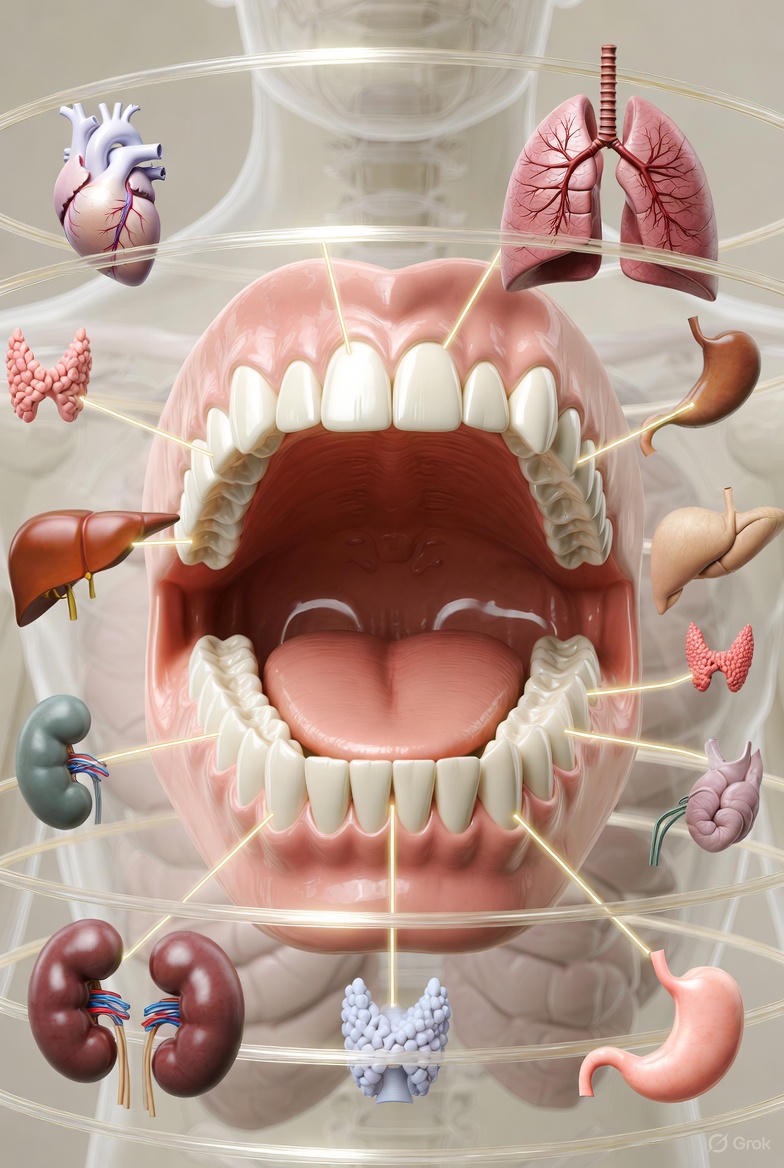
We've talked a LOT about meridians in our Facebook group, and judging by the questions I keep getting, there's still quite a bit of confusion about what they are, how they relate to our teeth, and what I mean when I talk about reestablishing a meridian during surgery. And I get it! It's not exactly something most people learned about in high school biology. And that's part of what makes this subject so fascinating, because we're learning more and more about how our bodies use electrical signals, how connective tissues interact, and how problems in one part of the body may affect other parts.
And as y'all know by now, I'm a science girl. I love understanding WHY something happens, and I particularly love it when research helps explain something I've been seeing in my patients for years. So let's talk about meridians, bioelectricity, and what actually happens in MY office when we're performing biological dental surgery. And yes, I'm going to bring the science!
First, Your Body Really IS Electrical
I think the easiest place to start is with something most of us already understand. Your heart produces electrical activity that we can measure with an EKG. Your brain produces electrical activity that we can measure with an EEG. Your nerves use electrical signals to communicate, and your muscles depend on those signals to contract. But I'm betting you might not have known that your body also uses electrical signals to help heal itself.
In 2006, researchers published a study in Nature showing that naturally occurring electrical fields help direct cells toward damaged tissue during wound healing. When they changed those electrical signals in their experiments, they changed how the cells moved and how the wounds healed. [1]. Think about that! Your body is using tiny electrical differences to help coordinate tissue repair. That honestly makes sense to me - because we are bioelectric beings. So why wouldn't our body use that bioelectricity to coordinate repair?
And this isn't just something that happens in the skin. In 2024, researchers published a review specifically examining bioelectricity in dental medicine. They reviewed 288 scientific publications involving electrical signals, cell activity, bone development, healing, and possible applications in dentistry. [2]. They discussed how electrical signals influence the movement and behavior of cells, including cells involved in building and repairing tissues. That's a huge part of biology that most people have probably never thought about.
We're used to talking about blood flow, inflammation, immune responses, oxygen, and nutrition when we discuss healing. But electrical signaling is part of that process, too. And I think we're going to discover a LOT more about it in the coming decades.
So What Exactly Is a Meridian?
Meridians are part of a traditional system used to describe relationships between different areas of the body. If you've ever seen an acupuncture chart, you've probably noticed lines running through different regions, with names like the lung meridian, kidney meridian, or large intestine meridian. In biological dentistry, we also use tooth-organ meridian charts to explore possible relationships between particular teeth and other areas of the body. And one of the reasons this interests me so much is that researchers have actually investigated whether the locations described by these traditional maps correspond with anything we can identify anatomically or measure electrically.
In 2002, Dr. Helene Langevin and her colleague Jason Yandow studied acupuncture points and the connective tissues underneath them. They found that approximately 80% of the acupuncture points they examined corresponded with connective tissue planes between or within muscles. [3]. That makes sense to me. Acupuncture has been around for over 5000 years. The Chinese can do surgery without any kind of anesthesia using acupuncture! So why wouldn't the acupuncture points be connected the way they discovered? Because fascia, the connective tissue network surrounding muscles, nerves, blood vessels, and other structures, extends throughout the body.
We've talked about fascia in some of my other articles, particularly when discussing tongue ties and the connections between the mouth and the rest of the body. And now we're finding research that gives us another way to investigate those relationships. But the anatomy isn't the only interesting part.
Researchers Have Actually Measured Electrical Differences Along Meridian Pathways
In 2005, researchers measured electrical resistance along areas associated with acupuncture meridians and compared those readings with nearby tissues. They found that electrical resistance along the Pericardium meridian was significantly lower than in the nearby comparison area. [4]. Then, in 2010, another study examined 28 healthy volunteers and found significantly lower electrical resistance along the Large Intestine meridian compared with surrounding tissue. The researchers also used ultrasound to examine the connective tissue underneath those areas. They found that collagen-rich tissue was associated with lower electrical resistance. [5]. Now, THAT'S interesting.
We're talking about researchers using actual electrical measurements and ultrasound to investigate relationships between tissue structure and electrical behavior. And there's more. In 2021, researcher Sheng-Xing Ma published a review examining why certain acupuncture points may have lower electrical resistance than surrounding skin. The research discussed relationships involving nitric oxide, nerve-related chemicals, and other biological substances that may influence electrical activity at these points. [6]
So we have studies investigating connective tissue, electrical resistance, nerve-related activity, and the biological characteristics of acupuncture points. And that's an absolutely valid scientific foundation for continuing to investigate meridians. We're beginning to understand more about the physical structures and electrical properties involved, rather than simply describing everything using terminology that people may not understand.
Here's How I Explain the Meridian System to My Patients
I'm a sensory/kinesthetic person, so I like to explain things in ways that make you understand the sensory system. And one of my favorites involves a fourteen-lane superhighway. Picture seven lanes going one direction and seven going the other. Because I'm from Houston, I'm describing I-10. Now, if you've ever driven in Houston during rush hour, you already know that this analogy has the potential to become VERY unpleasant.
Imagine one car breaks down in the middle of the night on the Katy Freeway (I-10 West). There's barely anybody on the freeway, so the other cars simply move around it. Traffic slows down a little because of the Lookie Lous, but the system keeps functioning with barely a blip. That's how I think about someone who has a localized dental problem but otherwise has a pretty healthy body that's managing its daily demands reasonably well.
Now imagine that exact same car breaks down during rush hour. Suddenly everybody's trying to squeeze into the remaining lanes, people are honking their horns, somebody's driving on the shoulder because apparently the rules don't apply to them, and traffic backs up for miles. That's the same broken-down car, but now the circumstances are completely different because the demand of the traffic on the freeway is different.
That's how I explain what can happen when someone already has several health problems and then develops another issue. Maybe they're dealing with chronic inflammation, poor sleep, an autoimmune condition, or another source of physical stress. Their body is already working pretty hard. And now we've added another problem to the mix.
But let's make the situation even MORE exciting. Imagine a multiple-car accident during rush hour, with several lanes blocked and ambulances trying to get through. WHAT A NIGHTMARE! That's how I picture someone dealing with several oral problems at the same time. Maybe they have multiple infected teeth, significant periodontal disease, old extraction sites that haven't healed properly, and other health problems requiring attention.
And then, because apparently we haven't made this miserable enough already, let's put the whole thing in the middle of a Category 5 hurricane evacuation. Every lane is packed. People are running out of gas. Cars are overheating. Nobody can move, and the hurricane is getting closer. If you've ever watched an evacuation from a major hurricane, you know exactly what I'm talking about.
This is my way of helping people picture what happens when multiple problems are affecting the same biological system. It's an analogy, of course, rather than a literal picture of fourteen electrical wires running through the body. But I think it helps explain something I've seen many times over the years.
Some people tolerate a surprising amount of dental disease without noticing much beyond the immediate problem. Other people are already dealing with complicated medical conditions, and an additional oral problem can become one more burden on a system that's struggling. We're not cookie cutters, and our bodies don't all respond the same way.
Why Would a Dental Problem Affect the Rest of the Body?
I wish medicine and dentistry had understood and addressed a LONG time ago that your mouth is part of your body! I know. Shocking concept, right? But for decades, we've treated the mouth as though it were somehow separate from the rest of our anatomy. Dentists take care of teeth. Physicians take care of everything else. And I think that division has created some pretty significant blind spots in healthcare.
The mouth contains blood vessels, nerves, immune cells, bacteria, connective tissues, and living bone. When someone has a chronic oral infection or significant inflammation, those processes don't necessarily remain isolated from everything else happening in the body. In 2022, researchers published an enormous review in Nature Communications examining the relationship between oral health and other medical conditions. They analyzed previously published research involving a wide range of diseases and identified strong associations between oral health problems and numerous systemic conditions, including cardiovascular disease, diabetes, certain cancers, and inflammatory disorders. [7]
That's a LOT of science supporting the importance of looking at oral health as part of overall health. And it's one of the reasons I believe biological dentists and integrative medical professionals need to work together. My job is to investigate and address the oral contributions to a patient's health problems. A physician's job is to investigate and manage the medical conditions affecting the rest of the body. And when we're working together, we're much better equipped to understand the person we're trying to help.
What About Old Extraction Sites and Cavitations?
This is another subject that deserves a much bigger conversation. Sometimes a tooth is extracted, the gums close over the area, and everything appears to heal normally. But the appearance of the gum tissue doesn't necessarily tell us everything about the bone underneath it. There are situations where the jawbone develops areas of abnormal healing, inflammation, or tissue changes that aren't immediately obvious from looking inside the mouth. And some researchers have been investigating the inflammatory activity associated with these areas.
In 2019, Dr. Johann Lechner and colleagues published a study involving jawbone samples from 449 patients with fatty, degenerative changes in the jawbone. They measured an inflammatory signaling chemical called RANTES, also known as CCL5. The researchers found that the affected jawbone samples had levels of this inflammatory chemical that were substantially higher than those found in healthy comparison tissue, reaching as much as thirty times the comparison levels in their analysis. [8]
THIRTY TIMES!
RANTES is one of the chemical messengers involved in how our immune system communicates. I find this research particularly interesting because it demonstrates that tissue can have measurable inflammatory activity even when the problem isn't immediately obvious during a routine dental exam. I have other articles about cavitations within this platform, but this article is devoted to meridians, so I won't deflect the spotlight. We will discuss it here because they go together, but it will have it's own article. And that brings us to something incredibly important.
A Regular X-ray Doesn't Always Show What's Happening Inside the Jawbone
I LOVE CBCT technology. I use it because it gives me a three-dimensional view of the bone and surrounding structures, and sometimes it reveals things that aren't apparent on a conventional dental X-ray. In 2021, researchers compared conventional imaging with CBCT in patients who had certain kinds of jawbone disease. The regular images correctly predicted the diagnosis in approximately 74% of cases, while CBCT increased that figure to approximately 90%. [9]. That's a significant improvement!
And it helps explain why we sometimes identify problems on a CBCT that weren't recognized on an earlier X-ray. I've seen situations like this in my own practice. One patient had a previous wisdom tooth extraction site that looked relatively normal on a conventional X-ray. But when we examined the area using CBCT, there was a large defect inside the jawbone. And when I went in surgically to perform an open bone biopsy, the defect was much larger than the small opening I'd made to access it.
I'm not particularly interested in filleting people open just because I can. I want to accomplish the surgery with as little unnecessary trauma as reasonably possible. But sometimes we discover that the problem beneath the surface is much more extensive than the outside appearance suggests. In that case, I thoroughly cleaned the site and used a compatible grafting material because the defect needed additional structural support. And we followed the area as it healed. This is why I think careful exams, appropriate imaging, and understanding the biological condition of the tissues are so important.
What I Actually Do During Biological Dental Surgery
Every biological dentist develops protocols based on their education, training, equipment, and experience. So I'm going to explain what this looks like in MY practice. Two of the technologies I use are the Fotona LightWalker laser and the BioScan Ivory system from IHTBio.com. And they do two very different jobs.
The Fotona is part of my surgical treatment. I use it to help prepare, clean, debride, and manage tissues during many procedures. The BioScan Ivory is an electrodermal measurement device that allows my team to record readings at specific points before and during treatment. I use these tools alongside my clinical evaluation, imaging, and the other surgical techniques involved in treating the patient. And there's actually research supporting the use of the Fotona LightWalker during extraction-site healing.
Why I Love My Fotona LightWalker Laser
In 2021, researchers published a clinical trial involving 53 tooth extractions. Some extraction sites received the usual treatment, while others received additional treatment using the Fotona LightWalker system. The laser protocol included cleaning the socket, managing the surrounding tissues, and using light energy to support healing. Four months later, the researchers found significantly greater improvements in bone density in the laser-treated areas. [10]. That's pretty exciting!
Because when I'm removing a tooth or cleaning an area of unhealthy bone, I want to give that site every reasonable opportunity to heal properly. The LightWalker allows me to work with tissues in a way that fits my surgical approach. And I love that we have clinical research examining the effects of laser-assisted treatment on bone healing.
Let's Talk About the Periodontal Ligament
I've used this analogy before, but it's one of my favorites. Imagine a trampoline. You've got the jumping surface in the middle, a metal frame around the outside, and a whole collection of springs connecting the two. Now imagine that each of those springs is a gazillion times smaller. That's kind of how I explain the periodontal ligament. The tooth is the jumping surface, the surrounding bone is the frame, and the periodontal ligament is the collection of itty-bitty, teeny-tiny fibers that connect the two.
When you chew, the ligament helps absorb and distribute the forces involved. It's also living tissue, with cells, nerves, blood vessels, and other structures that participate in the normal function of a natural tooth. When a tooth is extracted, we're literally ripping those "springs" in half. Half of the ligament comes out with the tooth. The other half of that ligament stays in the surrounding bone - unless and until it's physically removed.
In my practice, socket debridement is an important part of my surgical protocol, and I use the Fotona laser to help remove tissue that needs to be removed and clean the surgical area. My goal is to remove unhealthy tissue thoroughly and support appropriate healing. Because when we're dealing with an extraction site that has infection, abnormal tissue, or a previous healing problem, I want to do everything reasonably possible to address the underlying issue.
What About PRF and Bone Grafting?
This is another part of biological dentistry that I absolutely LOVE. PRF stands for platelet-rich fibrin. We make it using the patient's own blood, which is processed to create a fibrin-rich material containing platelets and other components involved in healing. It's amazing what we can accomplish using the body's own biological resources. In 2025, researchers reviewed 21 studies involving 701 patients and found that PRF helped improve soft-tissue healing, reduce postoperative pain, and lower the risk of dry socket after extractions. [11]. That's exactly the kind of research I love seeing.
Whenever appropriate, I want to use materials and techniques that support the body's natural ability to repair itself. When there's a large bone defect, we may need additional grafting material to support the area. And when we're choosing those materials, I want to consider the patient's history, the properties of the graft, and any known compatibility concerns.
Now Let's Talk About My BioScan Ivory
This is the piece of equipment that generates some of the most interesting questions. The BioScan Ivory is made by IHTBio, and it uses a system based on electroacupuncture according to Voll, commonly called EAV. Essentially, we're measuring electrical responses through the skin at selected points. I believe in the technology so much that I own TWO of these machines. The system uses a scale from 0 to 100, with 50 as the center of the range we work toward. The idea is that 50 is a perfect middle between 0 and 100, meaning it's balanced both above and below that number. It's based on acupuncture's yin and yang, which basically are like positive and negative forces that must be in balance in the body. Regardless, my training has taught me that we seek a perfect 50, but 48-52 are within the normal range. I pay attention to changes in those measurements throughout treatment.
But what I find especially interesting is that researchers have actually investigated how consistently electrical measurements can be taken at acupuncture points. In 2011, researchers studied a different electrodermal device called the AcuGraph. They found that the instrument measured known electrical resistances accurately and that measurements taken by the same operator at selected acupuncture points showed reasonably good consistency.
Measurements varied more when different operators performed the testing, which demonstrates why careful technique matters. [12]. It's technique sensitive. I have hopes that the technology will become foolproof within the next few years, just as EEG and EKG have. It supports the idea that we're dealing with electrical measurements that can be studied systematically. And it gives us a foundation for asking more questions about how those measurements relate to what's happening in the tissues.
What Happens With the BioScan During Surgery?
Here's how we use it in my office. One of my team members takes the electrical readings before treatment begins. Then, as I'm working on the surgical site, they continue monitoring the selected points and documenting changes. I may be removing a tooth that day, or cleaning a prior extraction socket out. As I clean debride the surgical site, we watch measure the reading. A surgical site will start out with a low reading (below 47). Most of the time, the readings are in the 20's and 30's for infected root canal teeth or prior extraction sites that haven't properly healed. I've seen numbers as low as the single digits for infected root canal teeth. Regardless, our goal is to clean that socket up until the bioelectricity is able to pass through again and the numbers read within normal range.
My preferred target is 50. Every. Single. Time.
I find the patterns interesting, especially when we see readings change during treatment. And I've observed clinical situations where patients have reported noticeable improvements in symptoms following surgery. Some feel changes quickly. Others notice gradual improvements. And some don't notice a significant change outside the original area we treated. Those observations are part of what keeps me interested in investigating this relationship.
I would LOVE to see carefully designed research that compares BioScan measurements before, during, and after surgery with the actual tissue findings, healing results, and patient outcomes. Because the published electrodermal studies give us an interesting scientific foundation, and the next step is understanding how those findings apply to specific dental procedures.
For now, all I can do is record what my patients tell me after their procedures. What people feel in their bodies can be so subjective that research in this arena is difficult. People aren't cookie cutters...
Account required
Sign in to see more
Create an account or sign in to unlock the full list.