Resource Libraries
Burning Mouth Syndrome in Menopause: A Research Blind Spot
Why burning mouth syndrome strikes women over 50, how estrogen loss, dry mouth, reflux and B12 deficiency drive it, and why it is wrongly called psychiatric.
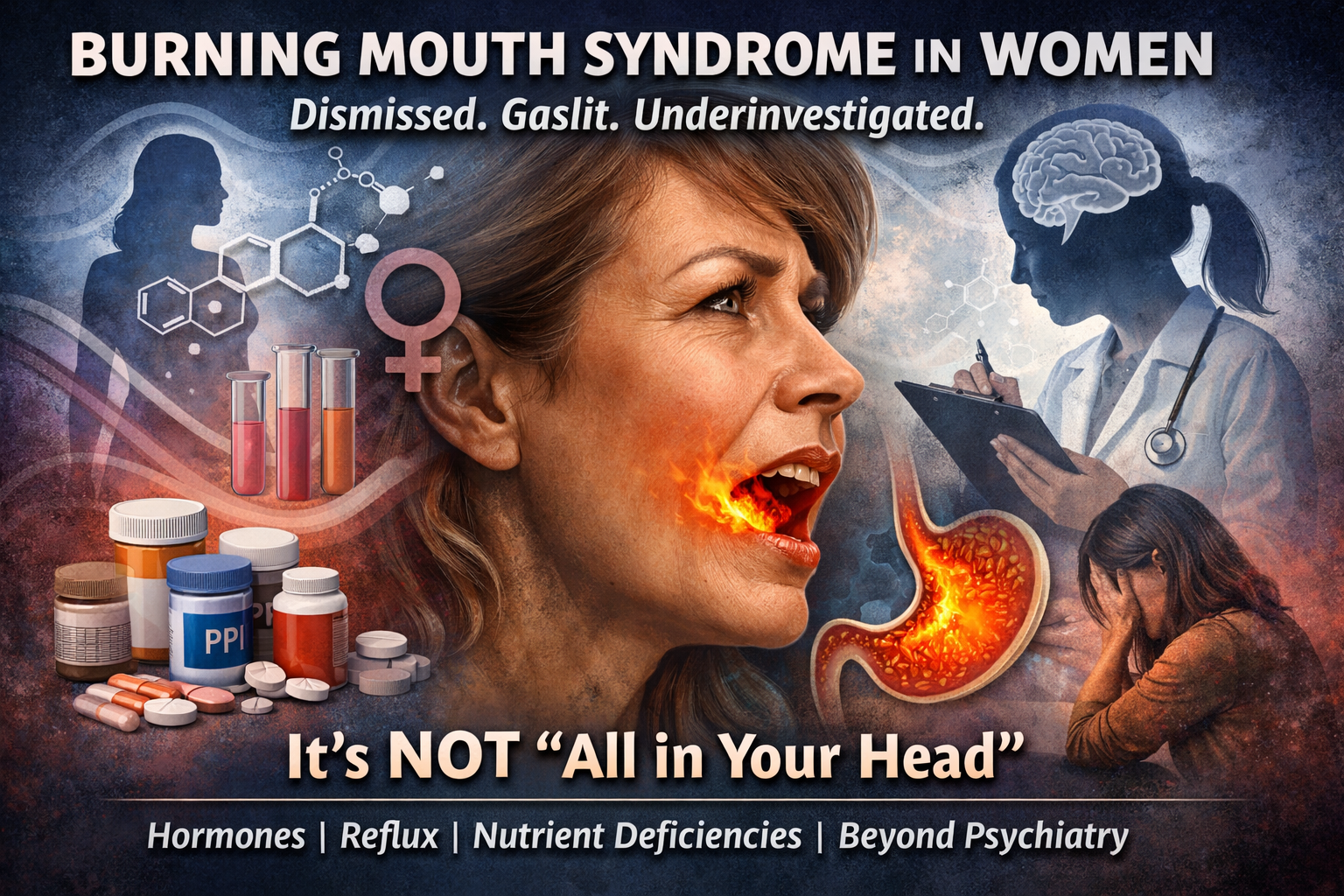
Burning Mouth Syndrome in Midlife Women: A Research Blind Spot Hiding in Plain Sight
A research-backed critique of how a female-predominant pain condition became a symptom-management problem instead of a biologic investigation
Burning mouth syndrome (We are going to call it BMS for the duration of this article) is one of those diagnoses that makes women feel crazy and makes medicine look lazy. It disproportionately affects peri- and postmenopausal women. That part is not controversial. The literature says it openly. And yet, for a condition so concentrated in women during and after hormonal transition, the research still feels much more comfortable describing symptoms than seriously sorting out biologic drivers and targeted upstream care.
That matters because once a condition gets framed mainly as a chronic pain problem, the conversation tends to drift downstream fast.
Symptom management.
Coping. Medications.
Behavioral strategies.
Neuropathic labels.
Maybe some of those tools have a place for some people. But that is not the same thing as a mature biologic investigation. And women notice the difference. They know when they are being worked up versus managed around.
The pattern is obvious. The response has not been.
Burning mouth syndrome is not evenly distributed across the population. It is far more common in midlife and older women, especially around and after menopause. A 2024 systematic review on sex hormones in BMS stated that the condition mostly affects peri- or postmenopausal women and found altered sex hormones, especially estradiol, in patients with BMS. At the same time, the authors also concluded that hormone fluctuations have not yet been clearly linked to symptom intensity, which is exactly the sort of muddy conclusion that should be provoking better research, not clinical complacency.
That is the blind spot hiding in plain sight. The hormonal signal is obvious enough to be acknowledged in review after review, but the treatment literature still has not done a good job answering the next logical question: which women are actually hormone-responsive, and how would we know? Instead, too many women get dropped into a broad BMS bucket that may include several different biologic subtypes wearing the same label.
A female-predominant condition should not still be this underdeveloped.
The problem is not that hormone therapy has already been proven to fix burning mouth syndrome and is being deliberately withheld. That would be easier to argue, but it would not be accurate. The problem is that a condition clustering so heavily in peri- and postmenopausal women still lacks a well-developed, hormone-aware treatment literature. The field has acknowledged hormonal plausibility without doing enough work to identify who might actually benefit from hormone-directed evaluation or intervention.
And this is where many women understandably get angry. If men had a painful oral condition that clustered this tightly around a major endocrine transition, it is hard to imagine the field would be this satisfied with ambiguity for this long. That is an inference, not a provable fact. But the research gap itself is not an inference. It is visible.
The biologic story is broader than “neuropathic pain.”
Recent reviews describe BMS as multifactorial, involving neurological, hormonal, salivary, reflux-related, and sometimes psychological contributors. That means the current syndrome label may be collecting together patients with very different root problems. Some may be predominantly neuropathic. Some may be dryness-predominant. Some may have significant laryngopharyngeal reflux. Some may have nutrient deficiencies, metabolic issues, medication-related xerostomia, or mixed patterns. Treating all of those women like they have the same problem is a setup for mediocre care.
This is one reason the usual conversation feels so unsatisfying. Women are told they have BMS as though that explains something. Sometimes it just labels the failure to explain something. And when a label gets used as a stopping point instead of a starting point, women end up with pain management before they get a serious attempt at biologic clarification.
Reflux deserves a much bigger place in this conversation.
One of the most interesting and under-discussed findings in this area is the reflux data. In a 2021 study of primary BMS patients, 93.8% had more than one pharyngeal reflux event, and measures of burning improved after reflux-targeted treatment. That does not prove reflux explains every case. It does mean reflux belongs in the room a whole lot more often than it currently is.
And this is where the article can be genuinely useful without wandering into speculation. There is stronger evidence for evaluating identifiable pathology such as laryngopharyngeal reflux than there is for telling women to reinterpret their pain or accept a psych-heavy narrative as the main framework. Even where the treatment literature is still imperfect, investigating reflux, dryness, nutrient status, glucose abnormalities, medication burden, and menopausal context is a far more biologically coherent starting point.
1. Epidemiology and Female Predominance
Before we get into the mechanisms and the treatment failures and all the places this literature gets frustrating, let’s start with the part that should have gotten everyone’s attention a long time ago: who is actually getting this condition? Women. Mostly midlife and postmenopausal women. When a disease clusters this strongly in one sex and around one hormonal transition, It's not random background noise. We need to pay attention and figure out what changed. We need to be asking what the body is trying to tell us. And weI want to know why the research response has been so underwhelming when the pattern is sitting there in plain sight. (Well, I'm pretty sure the research response has been underwhelming because of the institutionalized sexism surrounding women and medical research....)
This is one of the things that makes BMS so frustrating. The epidemiology is not subtle. The female predominance is not subtle. The postmenopausal concentration is not subtle. And yet the condition still gets handled like some oddball symptom cluster instead of what it really looks like: a meaningful biologic pattern that should have triggered much more serious investigation by now.
And this is not some tiny niche issue either. The prevalence numbers are high enough that this should not be living in the shadows. It is not rare enough to excuse ignorance. It is not vague enough to excuse passivity. It is not evenly distributed enough to pretend sex and hormones do not matter.
So the epidemiology is not just trivia here. It is the first giant clue. It tells us right away that this condition has a pattern. And once a condition has a pattern, good science is supposed to follow the pattern, not politely look away from it. That is what bothers me so much here. The literature knows where this condition lives. It just has not done enough with that knowledge.
Evidence:
Kohorst JJ, Bruce AJ, Torgerson RR, Schenck LA, Davis MD
PMID: 25176397
https://pubmed.ncbi.nlm.nih.gov/25176397
This Mayo Clinic study found burning mouth syndrome affects women five times more than men. The highest rates occur in postmenopausal women aged 70-79. After age 50, rates climb sharply in both sexes. This is the first population-based study to measure how common BMS actually is.
Wu S, Zhang W, Yan J, et al.
PMID: 33818878
https://pubmed.ncbi.nlm.nih.gov/33818878
This worldwide analysis found BMS affects about 1.7% of the general population and nearly 8% of clinical patients. Women over 50 are the most affected group. Rates vary by region, with Europe showing the highest prevalence. The condition is far more common than many doctors realize.
Jääskeläinen SK, Woda A
PMID: 28569120
https://pubmed.ncbi.nlm.nih.gov/28569120
This review states BMS is "most frequent in postmenopausal women, with general population prevalence of around 1%." The authors propose a "novel comprehensive hypothesis" linking hormonal, neuropathic, and genetic factors—but note this "will aid in future research." Future research that has not yet materialized.
2. The Hormonal Connection: Acknowledged but Underinvestigated
This is one of the most maddening parts of the whole burning mouth syndrome conversation.
The hormonal connection is not some fringe idea from the internet. It's actually in the literature. Menopause keeps showing up. Estradiol keeps showing up. Estrogen receptors in oral tissues keep showing up. Review after review keeps acknowledging that hormonal changes may leave oral tissues and small nerve fibers more vulnerable. So the signal is there. And yet the research still has this weird half-committed quality to it. They're willing to say hormones may matter. They're willing to say menopause may matter. They're willing to say hormone-related treatment might help some women. But then they stop short of doing the real work to sort out which women are actually hormone-responsive, what kind of hormone changes matter most, and how we should be evaluating that clinically. That is the blind spot.
Because if a condition overwhelmingly affects women in hormonal transition, and the literature keeps admitting hormones may be part of the story, then why is the medical community still acting like the hormonal question is some vague side issue instead of one of the main things that should have been chased down by now? It's completely asinine. I get that it's multifactorial. But the medical community has a tendency to try to put a bandaid on any condition affecting women and send us on our way. The gaslighting of women is quite serious.
I'm not saying compounded bioidentical hormones have already been proven to fix burning mouth syndrome and the system is just maliciously hiding the answer. I'm saying the field has acknowledged hormonal plausibility without doing nearly enough to build a serious hormone-aware treatment framework around it. Those are two different statements. But it still results in the medical gaslighting.
Because women live inside that gap. They are the ones whose mouths are burning while the literature keeps saying, in essence, “Yes, hormones might matter, but we haven’t really sorted that out.”
Well then sort it out!
That is the part I keep coming back to. If the hormonal signal is strong enough to keep getting mentioned in the literature, then the next obvious question is not, “How fast can we give these women a symptom-management label?” The next obvious question is, “Which women are actually hormone-responsive, and why haven't we still done enough work to find out?” That is a major research failure.
And honestly, when that failure lands mostly on midlife women, during menopause, in a condition that already has this obvious a sex pattern, I don't think it's unfair to say that institutionalized sexism is probably part of why this has been allowed to stay so underdeveloped.
Evidence:
Jääskeläinen SK
PMID: 29257770
https://pubmed.ncbi.nlm.nih.gov/29257770
This paper proposes that BMS happens when declining estrogen leaves small nerve fibers and brain structures vulnerable to damage. Menopause brings both lower protective hormones and higher stress hormones—a combination that may trigger nerve damage. Yet this hormonal theory remains largely untested in treatment trials.
Brauwers KG, Bueno VM, Calcia TBB, Daroit NB
PMID: 39164889
https://pubmed.ncbi.nlm.nih.gov/39164889
This systematic review found that estrogen levels are often altered in BMS patients, but results across studies are contradictory. Surprisingly, hormone changes did not correlate with symptom severity. The authors conclude hormones may be a promising treatment target, but research is lacking.
Imamura Y, Shinozaki T, Okada-Ogawa A, et al.
PMID: 30892737
https://pubmed.ncbi.nlm.nih.gov/30892737/
This review acknowledges that hormone replacement therapy "may address the causes of BMS" since estrogen protects nerves. However, it is not recommended as first-line treatment due to side effects and lack of clinical trial evidence. The hormonal mechanism is recognized but not pursued therapeutically.
Brauwers KG, Bueno VM, Calcia TBB, Daroit NB
PMID: 39164889
https://pubmed.ncbi.nlm.nih.gov/39164889
This 2024 systematic review confirms BMS "mostly affects peri- or postmenopausal women" and found altered sex hormones, especially estradiol, in patients with BMS. The authors concluded that hormonal alterations "may be a promising target on BMS management"—yet this remains underinvestigated.
Ciesielska A, Kusiak A, Ossowska A, Grzybowska ME
PMID: 35010513
https://pubmed.ncbi.nlm.nih.gov/35010513/
This review explains that declining estrogen affects the oral mucosa similarly to vaginal mucosa—both have estrogen receptors. Estrogen deficiency leads to mucosal thinning, atrophy, and increased vulnerability to burning mouth syndrome. Menopausal women "should receive special preventive and therapeutic care" for oral symptoms.
3. The Research Gap: Symptom Management Over Root Cause Investigation
This is where lazy answers really start falling apart. When you read through the treatment literature on burning mouth syndrome, what you keep seeing is a field that is much more comfortable managing symptoms than figuring out causes. Which, to be honest, is Big Pharma's strong suit. They aren't really interested in curing anything. They want us as lifelong customers, right? The evidence is weak. The trials are low quality. The reviews keep admitting that the mechanisms are still poorly understood. And yet women are still getting funneled into a treatment conversation that leans heavily toward symptom control instead of identifying and addressing root cause. That's a problem.
I get why clinicians want to offer something when a woman is sitting there miserable. I do. But reaching for something is not the same thing as doing a serious biologic investigation. And women know the difference. We know when somebody is trying to figure out what is wrong, and we know when somebody is trying to help them live with it without really explaining it. And in my own experience, most doctors are trained to just get people out the door. Root cause isn't how medicine is taught nowadays. That's quite unfortunate. That difference matters. Because once a condition gets framed mainly as a chronic pain problem, the whole conversation tends to drift downstream fast. Medications. Coping strategies. Psych language. Pain modulation. Behavior therapy. The behavior therapy genuinely angers me, to be honest. But that is not the same thing as having a mature model of the disease. It's not the same thing as saying we understand what is going on. And honestly, I think women feel that gap very clearly.
We feel when the label arrives before the biology has been sorted out. We've dealt with that kind of gaslighting our entire lives, so we KNOW when we are being patted on the head and told to be a good little girl and behave. We feel when the workup is thin. We feel when the answer is basically, “We don't really know, so here is something to help you tolerate it.” That is exactly why this diagnosis feels so unsatisfying.
I feel the same way about the diagnosis of trigeminal neuralgia, by the way. It's a lazy diagnosis and equally lazy treatment. They give medicine to make you not CARE that you are having horrible neuropathic pain. No root cause anything. Because the label often closes the case faster than it opens one. It gives the appearance of explanation without always delivering much real explanation. And then the woman gets handed a patchwork of borrowed pain strategies instead of a real attempt to match treatment to actual drivers. That would be frustrating in any condition. In a female-predominant condition with this obvious a menopausal signal, it's even more frustrating. Because the field is basically admitting, over and over again, that the mechanisms are not well sorted out. And instead of responding to that by getting more curious, a lot of the system responds by getting more comfortable with symptom management.
That is backwards. This is what I keep seeing when I read this literature: the women are not the problem. The women are describing a biologic reality the research still hasn't done a very good job of untangling. And instead of taking that as a call to investigate harder, too much of the field has treated it like a reason to manage the symptoms and move on.
That is not good enough.
Evidence:
McMillan R, Forssell H, Buchanan JA, et al. (Cochrane Review)
PMID: 27855478
https://pubmed.ncbi.nlm.nih.gov/27855478
This Cochrane review examined 23 clinical trials and found the evidence quality was "very low" for all treatments. Only one study was properly designed. The authors concluded there is insufficient evidence to support or refute any BMS treatment. Better research is desperately needed.
Sangalli L, Mirfarsi S, Kramer JM, Eisa E, Miller CS
PMID: 40815383
https://pubmed.ncbi.nlm.nih.gov/40815383
This 2025 review states BMS management remains a "significant clinical challenge" because the underlying causes are unclear. Current treatments focus on symptom control—benzodiazepines, antidepressants, pain-coping therapy—rather than addressing root causes. The best approach should target underlying mechanisms, but those mechanisms remain poorly understood.
Ritchie A, Kramer JM
PMID: 29913093
https://pubmed.ncbi.nlm.nih.gov/29913093
This paper notes that "evidence-based treatment strategies for BMS are lacking." The authors identify circadian rhythm dysfunction as a potentially important but overlooked driver of disease. Current treatments are borrowed from other pain conditions rather than developed specifically for BMS biology.
4. Women Are Not Asking for Magic. They Are Asking for a Real Workup.
Most women with burning mouth symptoms are not demanding that every case be blamed on hormones. We are asking clinicians and researchers to stop acting like hormonal context is some little side note in a condition that shows up overwhelmingly in women during hormonal transition. We are asking for
Our dryness to matter.
Our reflux to matter.
Our deficiencies to matter.
Our medication burden to matter.
Our menopause to matter.
Our lived pattern to matter.
We are not just “smaller men.” We are 50% of the population of this planet, and our needs are distinct and different from men. We are asking to be treated as our own thing, instead of just “different” men.
This is one of the biggest reasons I’m writing this article. The label "burning mouth syndrome" should be a diagnosis of exclusion. In plain English, that means the treatable stuff should have been looked for first.
Reflux.
Dry mouth.
Salivary changes.
Nutrient deficiencies.
Medication burden.
Metabolic problems.
Hormonal context.
Thyroid issues.
Blood sugar problems.
GI issues.
Local irritants.
All of it. But in real life, a lot of women get the label much too early. Because a very large percentage of women with burning mouth symptoms do not have some mysterious, untouchable primary BMS. They have identifiable underlying causes. And when those causes are actually found and treated, a lot of them improve. That should completely change how seriously we take the workup.
Right now, the VAST majority of women are getting funneled into a lazy sequence. Their mouth burns. Nobody sees an obvious lesion. Basic labs are thin or nonexistent. Hormonal context gets brushed aside. Reflux never gets explored. Dry mouth gets treated like a minor complaint. Then somebody says “burning mouth syndrome” like they have explained something meaningful, when really they have just named the failure to explain it. That is not good enough.
So before anybody starts talking about “coping,” a biologically serious evaluation should already be on the table. Quite frankly, the doctors that just want to prescribe antidepressants and antianxiety medicines and tell us to go to therapy are the laziest doctors. Women know when we are being dismissed. We know when somebody is genuinely investigating and when somebody is just trying to move us along. We know when our symptoms are being treated like an inconvenience or like it's all in our head. We know when the workup is thin. We know when the answer is basically, “Well, that’s frustrating, here’s something to help you tolerate it.” That is part of why women are so angry about this kind of thing. It is not just the pain itself. It is the pattern of being minimized, simplified, and managed around.
At minimum, a serious workup means looking at peri- and postmenopausal context, oral dryness, salivary function, reflux or upper aerodigestive symptoms, medication burden, fasting glucose or broader metabolic issues, and targeted nutrient testing instead of one lazy token lab and a shrug. It means actually taking a history that matters. It means asking what changed and when. It means paying attention when a woman says, “This started around menopause,” or “This gets worse when my mouth is dry,” or “I also have reflux,” or “I’m on six medications now and never used to be.” Those are clues.
And if a woman’s mouth is burning and her body is dropping clues all over the place, then medicine needs pay way better attention. The right thing to do is ACTUALLY investigate. This condition is not happening in a vacuum. It's happening in women with
hormonal changes,
mucosal changes,
salivary changes,
metabolic changes,
medication changes,
GI changes, and
nervous system changes.
That is a bigger picture. And if we refuse to look at the bigger picture, then we are going to keep missing what is actually driving symptoms in a whole lot of women. Women are not asking for magic. We are asking for somebody to care enough to look.
Evidence:
Wu S, Zhang W, Wang X, He C, Yan Z
PMID: 36167586
https://pubmed.ncbi.nlm.nih.gov/36167586
This study of 583 patients found 70% of those with burning mouth symptoms did NOT have true primary BMS—they had identifiable underlying causes. When those causes were treated, 76% achieved complete or partial remission. The authors concluded: "It is imperative for dentists and physicians to strengthen their collaborative relationships and focus on both systemic and oral conditions."
Sangalli L, Mirfarsi S, Kramer JM, Eisa E, Miller CS
PMID: 40815383
https://pubmed.ncbi.nlm.nih.gov/40815383
This 2025 review states that "differentiating between primary (idiopathic) and secondary (associated with identifiable underlying conditions) BMS is critical for guiding treatment." The best approach should be "tailored to the underlying etiopathogenetic mechanisms, and individualized to address patient contributing factors." That requires a real workup.
Ritchie A, Kramer JM
PMID: 29913093
https://pubmed.ncbi.nlm.nih.gov/29913093
This review states BMS is "a diagnosis of exclusion, and all underlying pathoses associated with allodynia must be ruled out prior to rendering the diagnosis." That means reflux, dryness, deficiencies, medications, and hormonal context should all be investigated before labeling someone with "primary" BMS.
Gurvits GE, Tan A
PMID: 23429751
https://pubmed.ncbi.nlm.nih.gov/23429751
This review states that "clinical diagnosis relies on careful history taking, physical examination and laboratory analysis." Associated conditions to evaluate include gastrointestinal disorders, urogenital issues, metabolic disorders, and drug reactions. BMS has "clear predisposition to peri-/post menopausal females"—that context should inform the workup.
5. Salivary Changes and Dryness Matter
Dry mouth gets minimized way too often, and I think that is partly because the phrase itself sounds so harmless. “Dry mouth” sounds like a nuisance. It sounds like maybe you need to drink more water or stop complaining. It does not sound like the kind of thing that could wreck somebody’s quality of life, alter the entire environment of the mouth, and be deeply relevant to a chronic burning sensation. But women who are actually living with it know better.
Because dryness changes everything.
It changes comfort.
It changes tissue tolerance.
It changes eating.
It changes sleep.
It changes speech.
It changes what the mouth can handle.
It changes how normal the mouth feels.
And when the mouth stops feeling normal, women notice. Dryness gets treated like some little side complaint in women with burning mouth symptoms. A lot of these women are dry. Some have objectively low salivary flow. Some have mucosal changes. Some have vaginal dryness too, which makes the hormonal piece even harder to ignore. Some are on multiple medications that reduce saliva even further. Some have reflux on top of that. And then everybody acts surprised that the mouth feels irritated, fragile, raw, or like it is on fire. Make that make sense. If men were suffering from this, there would be a trillion dollar research initiative to correct the problem yesterday.
Saliva is not decorative. It is not optional. It is not just there to keep the mouth from feeling sticky. It is one of the built-in protective systems of the mouth. It lubricates the tissues. It helps buffer irritation. It affects taste. It supports the oral microbiome. It changes how the mouth responds to friction, acid, chemical irritation, and daily life. So when saliva falls off, the operating conditions in the mouth change. If the operating conditions change, then the experience of the mouth changes too. And for some women, the burning may not be some mysterious isolated pain syndrome floating around in space. It may be happening in a mouth that is drier, thinner, more vulnerable, more chemically irritated, and less protected than it used to be. That is a very different picture.
And I think this is one of the places where conventional medicine really drops the ball. Dryness gets mentioned, maybe acknowledged, and then the conversation moves on to something that sounds more impressive. A pain diagnosis. A neuropathic label. A medication discussion. Something that makes everybody feel like they are doing something serious. Meanwhile one of the most basic changes in the environment of the mouth never really gets centered.
If a woman’s mouth is burning and dry, dryness should not be in the footnotes. It should be one of the first things on the list. And I am not just talking about whether she feels dry, although that matters too. I am also talking about what is causing the dryness. Is it menopause? Is it medication burden? Is it mouth breathing? Is it poor sleep? Is it chronic stress chemistry? Is it reflux? Is it dehydration? Is it several of those at once? Because that is how real medicine is supposed to work. Not just naming the symptom, but asking why the symptom is happening.
Women usually tell us the story if somebody bothers to ask the right questions. We will say their mouth feels sticky. We will say food feels different. We will say they are waking up dry. We will say the burning is worse later in the day. We will say they need water constantly. We will say things changed after menopause. We will say things changed after a new medication. We will say things changed after reflux got worse. Those are not trivial details. Those are clues.
This is one of the places where the overlap with women’s health is so obvious it almost feels embarrassing that the literature and the clinics have not done better with it. Oral dryness. Vaginal dryness. Mucosal thinning. Hormonal decline. Menopause. Pain. Altered resilience. It is all part of the same general physiologic season, and yet women are too often treated like these are unrelated little inconveniences instead of interconnected pieces of a larger pattern. That is crazy.
Dryness is not some little side issue. It is one of the most biologically plausible, clinically relevant, and repeatedly documented contributors in this entire conversation. If a woman’s mouth is dry and burning, I don't want the dryness waved away. I want it investigated. I want salivary flow considered. I want medication burden considered. I want hormonal context considered. I want reflux considered. I want the whole terrain looked at. Because it's not hard to imagine that burning symptoms may show up or worsen in that environment. And if that is true, then pretending dryness is secondary or unimportant is not just lazy. It is bad medicine.
Evidence:
Werfalli S, Drangsholt M, Johnsen JM, et al.
PMID: 33640241
https://pubmed.ncbi.nlm.nih.gov/33640241
This case-control study found BMS patients had significantly lower unstimulated saliva flow rates than controls (p < 0.001) and higher rates of xerostomia (p = 0.001), gastrointestinal disease (p < 0.001), and vaginal dryness (p = 0.01). Oral and vaginal dryness are common in BMS—both deserve attention.
Poon R, Su N, Ching V, Darling M, Grushka M
PMID: 25303607
https://pubmed.ncbi.nlm.nih.gov/25303607
This study found BMS patients have significantly decreased unstimulated salivary flow compared to controls. Salivary flow was further reduced by medications that cause dry mouth. The authors concluded "hyposalivation may play a role in causing dry mouth in BMS, which may respond to treatment with a sialogogue."
Rojas-Ramirez MV, Eldomiaty W, Sangalli L, et al.
PMID: 37316427
https://pubmed.ncbi.nlm.nih.gov/37316427
This study of 124 patients with oral burning found 77.7% reported xerostomia and 46% had hyposalivation. When treated with a dry mouth management protocol, pain significantly improved between visits (p < 0.001). Addressing dryness is not a side issue—it is part of the solution.
6. Medication Burden Matters
This is another one that gets brushed aside way too easily. If a woman is taking several medications a day, and multiple ones are known to dry out the mouth, alter taste, irritate tissues, or change how the oral environment functions, that matters. A lot. And yet medication review really just gets checked off and then ignored instead being part of an actual investigation. That's a mistake.
Because medication-induced dryness is a very real, very common, biologically plausible contributor sitting there in plain sight. Literally 90% of medications cause dryness. And it's not limited to the mouth! If nobody bothers to take that seriously, then of course women end up with vague labels and thin explanations.
This is where I think conventional medicine really shows its habits. A woman shows up with a burning mouth, and the system wants to jump straight to a syndrome label or a chronic pain frame. Meanwhile, she may be taking an antidepressant, a bladder medication, a sleep aid, an antihypertensive, an antihistamine, or any number of other medications that are well known to reduce saliva and change oral comfort. And then the mouth is dry, irritated, and burning. And somehow we’re surprised?
That’s what I mean when I say this stuff gets mishandled. Because if the medication list is capable of changing the terrain of the mouth, then the medication list is not some little side note. It is part of the main story. Maybe not the whole story. But DEFINITELY part of it. And women deserve better than having that part ignored because medication-induced dryness is “common.” Common does not mean harmless. Common does not mean irrelevant. And common does not mean we get to stop being curious.
I sincerely hope you as the reader are seeing the pattern here, as it exposes how often BMS gets treated like a mysterious pain disorder before anybody has really asked what changed in the woman’s life or body. Did symptoms start after menopause? Did they start after a medication change? Did they start after multiple medications got layered on? Did the dryness show up first? Did taste change? Did reflux get worse at the same time? Those are not throwaway questions. Those are clues. If a woman is on several drying medications and nobody has even mentioned that as a possible contributor, that is not thorough medicine. That is just the normal conventional practice of laziness.
Now, I’m not pretending every medication can simply be stopped. Obviously not. That's not my job. It's not my place as a dentist. I'm not going to practice medicine without a license. Some women need what they need. But that’s not the point. The point is that medication burden belongs in the workup. It belongs in the conversation. It belongs in the differential. And if it’s contributing to the problem, women deserve to know that. If the mouth is burning in a dry, chemically altered environment created in part by medications, calling it “just BMS” without unpacking that is not impressive. It’s incomplete.
And that’s what keeps bothering me in this literature. Too many women are getting labeled before the actual terrain of their mouth has been taken seriously. Medication burden is part of that terrain. It needs to stop being treated like background noise.
Evidence:
Stoopler ET, Villa A, Bindakhil M, Díaz DLO, Sollecito TP (JAMA Review)
PMID: N/A (JAMA 2024)
https://jamanetwork.com/journals/jama/fullarticle/10.1001/jama.2024.0953
This 2024 JAMA review found that using more than 3 medications per day was associated with dry mouth (odds ratio 2.9). Medications with the strongest associations included urological drugs (OR up to 18.9), antidepressants (OR 4.7), and psycholeptics (OR 2.6). Medication review should be part of every BMS workup.
Tan ECK, Lexomboon D, Sandborgh-Englund G, Haasum Y, Johnell K
PMID: 29071719
https://pubmed.ncbi.nlm.nih.gov/29071719
This systematic review of older adults found urological medications had the highest risk of causing dry mouth (OR 5.91), followed by antidepressants (OR 4.74) and psycholeptics (OR 2.59). Many BMS patients are on multiple medications—each one should be evaluated for its contribution to oral symptoms.
Plemons JM, Al-Hashimi I, Marek CL (American Dental Association)
PMID: 25082939
https://pubmed.ncbi.nlm.nih.gov/25082939
This ADA report states "more than 500 drugs are known to cause oral dryness" and that "the likelihood of decreased salivary flow rates increases in the presence of numerous diseases and medications." Medications with anticholinergic properties directly inhibit salivary flow. Medication burden is a modifiable factor.
7. The Deficiency Story Is Real, But It Is Not Simple
This is another area where lazy answers fall apart. When I learned about burning mouth syndrome, the response I was given was that it was due to a B12 deficiency. Maybe. Sometimes. I used to think that too, because that is what I was told. That became my pat answer when patients came to me asking. I was guilty of oversimplifying it myself. One thing about writing these resource library articles is that I end up learning right along with everyone else. And the data says the story is much bigger than that. We as women deserve the whole truth, not the shortcut version. Because once an oversimplification gets repeated enough times, people start treating it like the whole truth. And in this case, it clearly is not.
Burning mouth syndrome is often casually linked to B12 deficiency, almost like that is the obvious place everybody should start and stop. But when I actually dug into the research, that actually didn't reflect the research. The Mayo Clinic series is a great example. In that group of 659 BMS patients, the most common abnormalities were low vitamin D3 and low vitamin B2, both at 15%. Zinc and vitamin B6 were each low in 5.7%. Elevated fasting glucose showed up in 23.7%. And low B12? Only 0.8%. So right there, that told me this is not a one-deficiency story.
Women deserve better than one lazy lab and a shrug. We deserve better than being told to take some B12 and circle back if they are still miserable. We deserve better than having a complicated symptom pattern reduced to one popular talking point that happens to be easy to remember.
When I looked at the broader literature, I kept seeing the same thing over and over again.
Iron deficiency shows up.
Anemia shows up.
Zinc deficiency shows up.
Vitamin D deficiency shows up.
B2 deficiency shows up.
Elevated homocysteine shows up.
Thyroid issues show up.
Elevated blood sugar shows up.
Reflux shows up.
Autoimmune stomach problems show up too, and that one is a big deal, because if the stomach is not functioning normally, nutrient absorption may be a mess even if the diet looks decent on paper.
So now we are not talking about one vitamin. We are talking about a bigger metabolic and nutritional picture that can look very different from woman to woman. Sometimes a lot. Some women really do improve when the right deficiency gets found and corrected. But that is exactly the point. Conventional medicine is not even looking for deficiencies, much less the right deficiency.
What I keep seeing in this literature is a pattern that says the metabolic and nutritional side of BMS is broader, messier, and more interesting than people tend to admit. Which means the workup needs to be broader too. CBC. Iron studies. Ferritin. Folate. B12. B6. Zinc. Vitamin D. Homocysteine. Glucose. Thyroid. And of course Hormones! Maybe more, depending on the case. Because if a woman’s mouth is burning and her body is dropping clues all over the place, we need to pay attention.
Evidence:
Morr Verenzuela CS, Davis MDP, Bruce AJ, Torgerson RR
PMID: 28436021
https://pubmed.ncbi.nlm.nih.gov/28436021/
This Mayo Clinic decade-long study of 659 BMS patients found the most common deficiencies were vitamin D (15%) and vitamin B2 (15%), followed by zinc (5.7%) and B6 (5.7%). Vitamin B12 deficiency was found in only 0.8% of patients. Elevated fasting glucose appeared in 23.7%. The authors recommend screening for multiple nutrients—not just B12.
Chiang CP, Wu YH, Wu YC, et al.
PMID: 31679908
https://pubmed.ncbi.nlm.nih.gov/31679908
This study of 884 BMS patients found multiple abnormalities: 20% had anemia, 16% had iron deficiency, 19% had elevated homocysteine, and 12% had antibodies suggesting autoimmune stomach problems. Vitamin B12 deficiency was present in only 4.8%. The pattern suggests a complex metabolic picture—not a single missing vitamin.
Lin HP, Wang YP, Chen HM, et al.
PMID: 23787008
https://pubmed.ncbi.nlm.nih.gov/23787008
This study of 399 BMS patients found 22% had anemia, 20% had iron deficiency, 22% had elevated homocysteine, and 13% had gastric parietal cell antibodies (suggesting autoimmune gastritis). Vitamin B12 deficiency was found in only 2.5%. The authors concluded multiple metabolic factors are associated with BMS—not just one vitamin.
Egido-Moreno S, Valls-Roca-Umbert J, Perez-Sayans M, et al.
PMID: 36173716
https://pubmed.ncbi.nlm.nih.gov/36173716
This systematic review found thyroid abnormalities are significantly associated with BMS, with an odds ratio of 3.31. Most affected patients had hypothyroidism (80%). Thyroid dysfunction is another metabolic factor that can contribute to burning mouth symptoms—yet another reason a single-nutrient approach is insufficient.
Sun A, Lin HP, Wang YP, et al.
PMID: 23297780
https://pubmed.ncbi.nlm.nih.gov/23297780
This study treated 399 BMS patients with vitamin supplements tailored to their specific deficiencies. Of 177 patients who achieved complete remission, their elevated homocysteine levels normalized after treatment. Homocysteine is elevated when B12, folate, or B6 are low—so it serves as a marker of overall nutritional status, not just one vitamin.
Chiang ML, Wu YH, Chang JY, et al.
PMID: 32888843
https://pubmed.ncbi.nlm.nih.gov/32888843
This study found that BMS patients with gastric parietal cell antibodies (suggesting autoimmune gastritis) had significantly higher rates of B12 deficiency and elevated homocysteine than other BMS patients. The antibodies interfere with B12 absorption. This subgroup needs different treatment than patients with dietary deficiency—one size does not fit all.
Cho GS, Han MW, Lee B, et al.
PMID: 20618611
https://pubmed.ncbi.nlm.nih.gov/20618611
This study found 27% of BMS patients had zinc deficiency. When given zinc supplements (14.1 mg/day for 6 months), their pain scores dropped from 8.1 to 4.1—compared to minimal change in controls. The authors concluded zinc deficiency "might play a role in some patients with BMS" and that replacement therapy is effective in those patients.
Gu Y, Baldwin S, Canning C
PMID: 37810154
https://pubmed.ncbi.nlm.nih.gov/37810154
This study found 75% of secondary BMS patients had low vitamin D levels. When combined with oral dryness and fungal overgrowth, the risk of BMS increased dramatically. The authors propose that vitamin D deficiency creates conditions that allow other problems to cause symptoms. Vitamin D alone may not be the cause—but it may be part of the picture.
Sun A, Wu KM, Wang YP, et al.
PMID: 23772971
https://pubmed.ncbi.nlm.nih.gov/23772971
This review states that "vitamin, zinc, or hormone replacement therapy has been found to be effective for reducing the oral burning or pain symptom in some BMS patients with deficiency of the corresponding factor." The key word is "corresponding"—treatment works when it matches the actual deficiency. That requires testing, not guessing.
8. Reflux Deserves a Much Bigger Place in This Conversation
Ok, so I’m excited to tell you about this one. Because the reflux data are not tiny. If nearly 94% of primary BMS patients have pharyngeal reflux events on testing, that is not some side plot. That is a giant clue. And then when you see that reflux treatment improves symptoms, and GI treatment turns out to be one of the most effective intervention categories in these patients, it becomes pretty obvious that reflux and GI workup should be in the room much earlier than they usually are.
This matters a lot because I think reflux gets missed in women all the time. And part of the reason is that people still tend to picture reflux as obvious heartburn. But a lot of women do not have that classic picture. They have
Throat clearing.
Hoarseness.
A sour taste.
Chronic irritation.
Account required
Sign in to see more
Create an account or sign in to unlock the full list.