Resource Libraries
How to Brush Toddler Teeth When They Refuse
How to brush a toddler's teeth when they refuse, including the knee-to-knee position, sensory strategies for neurodivergent toddlers, and how to keep it calm.
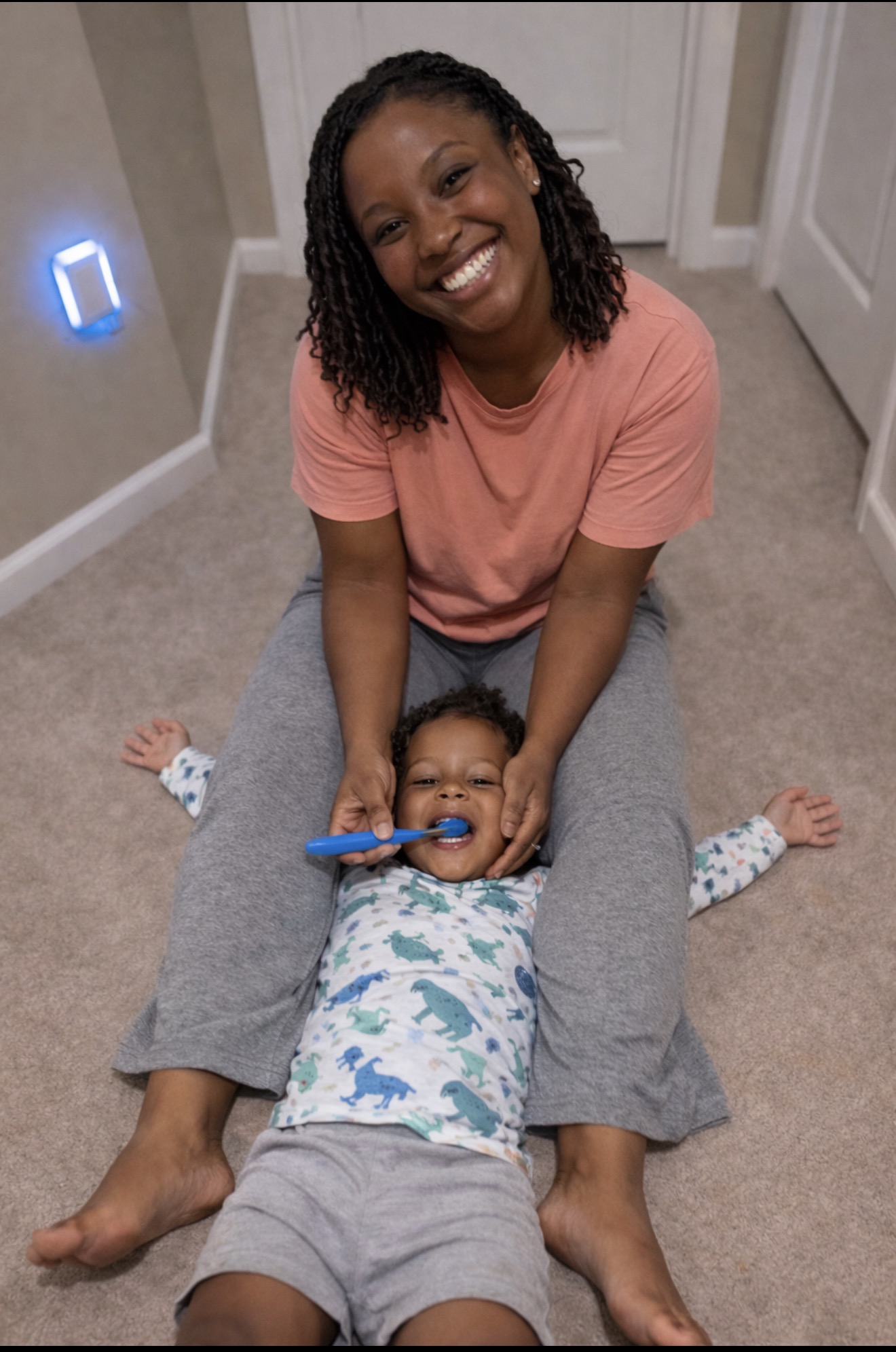
Brushing Toddlers' Teeth, Including Neurodivergent Toddlers - And Why Sometimes "NO" Isn't an Option
Let's be honest. Brushing a toddler's teeth isn't always a sweet bonding moment filled with unicorn toothpaste and giggles. Sometimes it's you against a 26-pound feral woodland creature who has somehow developed the strength of a grown man, the flexibility of an Olympic gymnast, and absolutely NO intention of letting you anywhere near those six little teeth. And if your toddler or child is neurodivergent or has significant sensory sensitivities, you may be facing an entirely different level of difficulty.
The toothbrush feels funny. The toothpaste tastes horrible. The bathroom lights are too bright. The bristles tickle. The foam makes them gag. And someone keeps trying to put things inside their mouth when they would really prefer that EVERYONE LEAVE THEM ALONE! I get it!
But baby teeth matter, and protecting them from cavities is part of taking care of your child's health. We don't stop changing diapers because our toddlers object. We figure out how to accomplish the task as comfortably and efficiently as possible. And I think we need to approach brushing the same way. The trick is understanding WHY your child is struggling and finding a way to get the job done that works for THEIR needs.
Sometimes It's Not the Toothbrush. It's the TOOTHPASTE!
This is probably one of the easiest things to change, and I think parents underestimate how important it can be. For a child with sensory sensitivities, toothpaste can be an absolute nightmare. Think about the flavors we routinely put in toothpaste. Peppermint, spearmint, wintergreen, cinnamon, and all sorts of other ingredients that create strong tastes, smells, cooling sensations, or tingling. But for some kids, it's even mild flavors like berry or vanilla. Now imagine experiencing those sensations ten times more intensely than someone else. And that's before we even talk about the foam or texture!
In 2012, researchers found that autistic children had significantly more difficulty with the sensory aspects of oral care than children who weren't autistic. [1]. Then, in a study published in 2025, researchers actually interviewed autistic children about their experiences with brushing and dental care. One of the descriptions was so striking that they used it in the title of their study: An "explosion in the mouth." [2]. Good grief! Imagine being a toddler who experiences toothpaste that way but doesn't have the words to explain it. Of COURSE they're going to fight you! So before assuming your child simply refuses to cooperate, try changing what you're putting on the toothbrush.
Fluoride-Free Toothpastes I Would Consider
You already know that I'm a biological dentist, and I prefer using fluoride-free toothpaste with ingredients that support healthy enamel. One of my favorite ingredients is hydroxyapatite, which is the same mineral our tooth enamel is made from. And there's good science supporting its use.
In 2021, researchers compared a fluoride-free micro-hydroxyapatite toothpaste with a fluoride toothpaste in 207 young children over approximately one year. They found that the hydroxyapatite toothpaste performed just as well in the study's main measurement of cavity development. [3]. That's pretty exciting, because it gives families another scientifically studied option for protecting children's teeth. OraBiologics promotes both Living Well with Dr. Michelle and RiseWell products, and I think both companies offer some good choices.
Living Well with Dr. Michelle Kids Remineralizing Toothpaste, Mixed Berry
This fluoride-free toothpaste contains hydroxyapatite, Dr. Michelle's PROtektin blend, calcium carbonate, zinc, and SilverSol. It's free of SLS and artificial flavors, and it has a naturally sweetened mixed berry flavor. This could be a wonderful option for children who enjoy berry flavors and tolerate a smooth toothpaste.
Living Well With Dr. Michelle Oral Care Products
RiseWell Kids Hydroxyapatite Toothpaste, Birthday Cake
This one has hydroxyapatite, xylitol, calcium carbonate, and a vanilla-based flavor. It's fluoride-free, SLS-free, and doesn't contain artificial flavors or colors. If your toddler loves vanilla or cake-like flavors, this might be worth trying.
RiseWell Flavorless Hydroxyapatite Toothpaste
And THIS is the one I find particularly interesting for sensory-sensitive children. RiseWell makes a completely flavorless version without added flavors, essential oils, or botanical extracts. It contains hydroxyapatite and xylitol, but eliminates the flavoring that can be such a problem for some people. It's not specifically marketed as a kids' toothpaste, but the company provides instructions for using a rice-sized amount for children. For a child who can't tolerate berry, vanilla, mint, or anything else that tastes like toothpaste, I think having a flavorless option is FANTASTIC.
RiseWell Flavorless Hydroxyapatite Toothpaste
Now, remember that even natural flavors are still FLAVORS. A child who doesn't like strawberries isn't necessarily going to enjoy strawberry toothpaste simply because it's natural. And a child who hates the sensation of toothpaste may not care whether it's flavored like birthday cake or filet mignon. Sometimes the flavorless version is exactly what they need.
Use a tiny, rice-sized smear for toddlers under three, with an age-appropriate product and adult supervision. And if your child is currently refusing toothpaste altogether, starting with a soft toothbrush and water is better than abandoning brushing while you're finding something they tolerate.
Sometimes You Need to Change the Toothbrush or the Environment
Here's another idea worth pursuing. Some kids love electric toothbrushes. Others act like you've brought a chainsaw into their mouths.
If the electric toothbrush is the trigger, try an extra-soft manual toothbrush with a small head. Some children prefer the toothbrush warmed with a little water. Others tolerate a firmer, steady touch better than light, tickling movements.
There are also some new toothbrushes that are arch-shaped so that brushing can be accomplished in 30 seconds. For some kids, that is the best thing ever. And who says brushing has to happen in the bathroom? Maybe your child hates those bright lights. Maybe they can't stand the sound of running water. Maybe they feel more comfortable sitting on your lap while watching their favorite show. Then brush their teeth THERE! The bathroom isn't going to be offended.
And don't underestimate the value of making it fun. Let them brush your teeth first. Brush a favorite stuffed animal's teeth. Sing a silly song. Give them a choice between two toothbrushes.
Dr. Harvey Karp, who wrote The Happiest Toddler on the Block, compared toddlers to little Neanderthals because they're still developing emotional control and communication skills. I read his books years ago, and his techniques saved a considerable amount of my sanity when my girls were little. And I still think he was onto something!
Toddlers want control over their worlds, even when they don't have the language or understanding to explain what they're feeling. Sometimes giving them a little control over HOW brushing happens makes all the difference.
There's research supporting that approach, too. In 2022, a study involving 119 families of autistic children found that teaching parents specific ways to help with dental care improved brushing habits and reduced plaque. After six months, 78% of the families receiving parent training reported brushing twice daily, compared with 62% of the comparison group. [4]. I LOVE studies that give parents something practical they can actually use!
What If They Still Refuse?
This is where I think parents need to remember that they're the adults, and sometimes necessary healthcare isn't something a toddler gets to cancel simply because they don't feel like participating. But we can absolutely change HOW we accomplish it.
One of my favorite positions for small children is the knee-to-knee position, which we also use in pediatric dentistry. Two adults sit facing each other with their knees close together. The child sits on one adult's lap and leans back so their head is supported in the other adult's lap. That gives the person brushing a much better view of the teeth while the child remains close to someone they trust.
For some toddlers, simply lying back on the floor or bed with their head supported in a parent's lap works beautifully. Some toddlers are very wiggly, so straddling the toddler's arms with the parent's legs in that position like the photo attached to this article is a great option. You can talk to them, sing, tell them what you're doing, and work quickly and gently.
Thirty seconds is a perfectly reasonable starting point for a child who currently won't tolerate brushing at all. We can build toward thoroughly cleaning every tooth twice a day as the child becomes more comfortable. And yes, sometimes the toddler is still going to complain. A little protesting during toothbrushing doesn't automatically mean you're causing trauma. But if the child is panicking, gagging, struggling to breathe, or becoming more distressed, I want us to change the approach rather than pinning them down and turning brushing into something frightening.
The goal is to help them learn to tolerate a necessary activity, not make them terrified of having someone near their mouth. If brushing continues to be an enormous battle, a sensory-aware pediatric dentist or occupational therapist can help identify what's making it so difficult.
Account required
Sign in to see more
Create an account or sign in to unlock the full list.