Resource Libraries
Can a Tooth Infection Cause Swollen Lymph Nodes?
How a tooth abscess overloads the lymphatic system, why lymph nodes in the neck swell, and how chronic oral infection fuels body-wide inflammation.
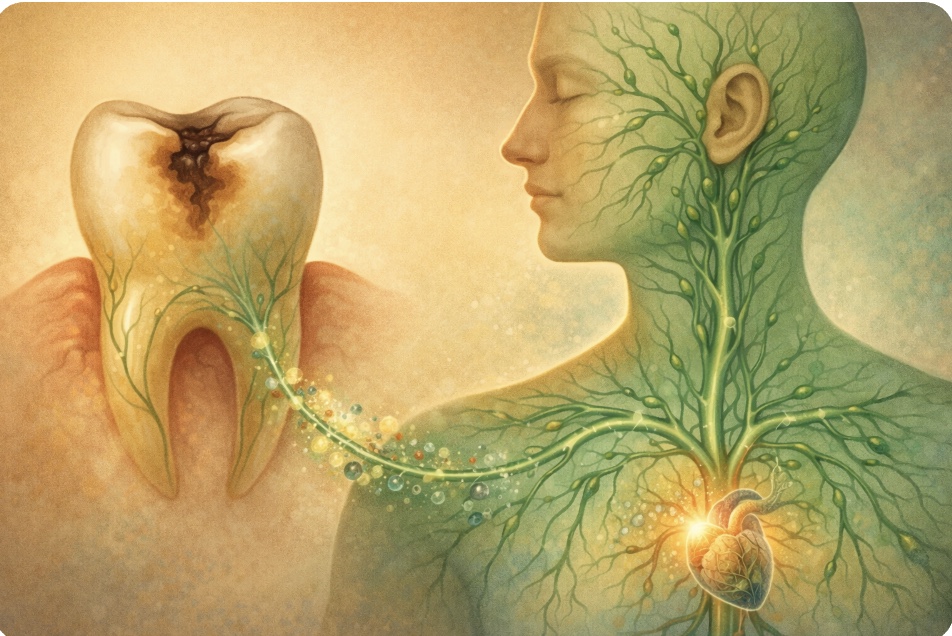
How a Dental Infection Impacts the Lymphatic System
What happens when a tooth dies, how chronic dental infections can interfere with lymphatic drainage, and why bacteria from the mouth have been found in blood clots from heart attack and stroke patients.
I've had patients come into my office with beautiful crowns, no toothaches, and absolutely no idea that they have infections hiding underneath their dental work. Some have been walking around with dead teeth for YEARS, and they're shocked when I show them what's happening around the roots. And sometimes those same patients have been dealing with health problems that nobody seems to be able to explain. They've been to doctors, had bloodwork done, tried different treatments, and spent a LOT of money trying to figure out why they don't feel well. Then somebody finally asks about their teeth.
The mouth is part of the body. We all know that, but we don't always think about what that actually means when we're talking about infections. Our teeth are surrounded by living bone, blood vessels, nerves, connective tissue, and lymphatic drainage pathways. All of these structures communicate with the rest of the body. When a tooth becomes infected, the body's immune system responds. If that infection continues for months or years, the immune system may have to keep responding for months or years, too. And one of the systems involved in managing all that inflammation is the lymphatic system.
The research on this is fascinating, especially when we start looking at what scientists have actually found inside infected teeth, nearby lymph nodes, and even blood clots removed from patients who suffered heart attacks and strokes.
A Dead Tooth Is DEAD
Dentists have a word they like to use for a dead tooth. They call it nonvital. Well, nonvital means DEAD. When the living tissue inside a tooth dies, it loses its functioning internal blood supply. The nerves and blood vessels that once occupied the pulp chamber and root canals are no longer doing their jobs. The outside of the tooth may still look perfectly normal, and the surrounding bone and gums may still be alive, but that doesn't bring the tooth back to life.
I sometimes tell patients that a dead tooth isn't Lazarus. You can surround a dead person with all the living people you want. They can hold his hands, pray over him, and do everything imaginable, but none of that changes the fact that he's dead. And if the dead tooth isn't Lazarus, it's not coming back to life. No amount of supplements, red light therapy, homeopathy, herbal remedies, castor oil packs, or nutritional support will resurrect the dead tissue inside that tooth. And a root canal doesn't bring it back to life, either.
A root canal removes the tissue inside the tooth, cleans and shapes the internal canals, and attempts to seal those spaces. The tooth remains dead internally, even though the surrounding tissues are still alive. This matters because blood flow is one of the ways our immune system gets the cells and substances it needs to fight infections into living tissues. Once the pulp dies, that internal defense is gone.
The immune system can still respond to bacteria and inflammation AROUND the roots, but it can't restore the dead pulp's circulation. And when bacteria remain inside those microscopic spaces, the body may be left dealing with an ongoing source of infection.
Your Lymphatic System Has a LOT to Do With Your Teeth
Most people have heard of lymph nodes, especially when they're sick and notice swollen glands in their neck. But lymph nodes are only one part of a much larger system. The lymphatic system is a network of tiny vessels that collect extra fluid from tissues, carry immune cells and other substances, and eventually return that fluid to the bloodstream. That fluid is called lymph.
Think of the lymphatic system as part of the body's drainage and security system. The lymphatic vessels collect fluid from tissues, and the lymph nodes help the immune system recognize and respond to things that shouldn't be there. The mouth has an extensive network of blood vessels and lymphatic drainage pathways. Fluid and inflammatory substances from the teeth and surrounding jaw tissues can move toward lymph nodes under the chin, beneath the jaw, and deeper into the neck.
A 2020 paper examined how fluid travels from dental pulp and the tissues around tooth roots. The researchers explained that fluid from these tissues can travel through spaces surrounding nerves and blood vessels, eventually reaching lymphatic vessels within the jawbone. They also described how bacterial components and inflammatory substances from infections around tooth roots can reach regional lymph nodes through those pathways. [1]. So we're talking about an actual anatomical connection.
An infected tooth isn't sitting in some imaginary little bubble, completely separated from the body's immune and drainage systems. The tissues around that tooth are connected to the rest of us.
What Happens When Inflammation Slows Lymphatic Movement?
Your lymphatic system depends on movement. Unlike blood circulation, which has the heart pushing blood through the vessels, lymphatic movement relies on several mechanisms, including muscle movement, breathing, pressure changes, and the rhythmic contractions of specialized lymphatic vessels. Those contractions help move lymph toward the lymph nodes and eventually back into circulation. But inflammation can interfere with those contractions. And researchers have actually SHOWN it.
In 2013, researchers used specialized imaging to watch lymphatic movement in mice after exposure to bacterial inflammatory substances. Within four hours, lymphatic pumping had slowed dramatically or temporarily stopped. And the changes weren't limited to the side where the inflammatory substances were introduced. The researchers also saw changes on the opposite side of the body. [2]. That's particularly interesting because it shows that inflammation in one area can affect lymphatic function elsewhere.
The researchers also tested three inflammatory substances called IL-1β, IL-6, and TNF-α. Those are cytokines, which are chemical messages that immune cells use to communicate. All three reduced lymphatic pumping activity under the experimental conditions. Another study published in 2017 examined TNF-α specifically. Researchers exposed lymphatic vessels taken from rats to that inflammatory chemical and found that the vessels contracted less frequently. [3]. A 2019 review explained how inflammation can change the structure and function of lymphatic vessels, making them larger, leakier, and sometimes less effective at moving fluid. [4]
That's a pretty big deal!
We know that infections around tooth roots can produce inflammatory chemicals, including some of the same cytokines that researchers have shown can interfere with lymphatic pumping. And we know that the lymphatic system drains the tissues around infected teeth. What we haven't measured very well is exactly how much a chronic infection around one particular tooth changes lymphatic movement in an individual person over many years.
The experiments showing reduced pumping weren't performed on people with chronic dental infections. But they give us a biological mechanism worth investigating. If an infected tooth is contributing to ongoing inflammation, and inflammation is interfering with lymphatic movement, I want to know what's happening along that drainage pathway. Because that's part of looking at the whole person.
Researchers Have Actually Measured Changes in Lymph Nodes From Dental Infections
In 2024, researchers examined 150 people between the ages of 18 and 30. Seventy-five had dental infections, and the other seventy-five didn't. They used ultrasound to look at the lymph nodes beneath the jaw and chin. [5]. The researchers found that patients with dental infections generally had more visible lymph nodes and larger nodes in certain areas. On one side, the average length of the lymph nodes beneath the jaw was approximately 9.3 millimeters in the infected group, compared with 5.5 millimeters in the group without dental infections.
Let's do a little Mom Math. Going from 5.5 millimeters to 9.3 millimeters is nearly a 70% increase in that measurement. That's not a tiny difference! Now, swollen lymph nodes aren't necessarily damaged lymph nodes. They often enlarge because the immune system is actively responding to something. But that's exactly the point. The researchers could SEE and MEASURE differences in the lymph nodes of people with dental infections.
Their study didn't measure lymphatic pumping or follow patients for decades. But it showed that dental infections can affect the lymph nodes responsible for draining those tissues. And when the infection is chronic, I want to know whether those lymph nodes and surrounding tissues have been dealing with an inflammatory problem for a long time.
What Happens Inside an Infected Dead Tooth?
The root canal system inside a tooth isn't one smooth, simple tube. There are tiny branches, curves, connecting passages, and microscopic tubes running through the dentin. Dentin is the hard material that makes up most of the tooth underneath the enamel. All those little spaces create places where bacteria can hide. And some bacteria organize themselves into communities called biofilms.
Dental plaque is a familiar example of a biofilm. The microorganisms live together inside a protective structure, making them more difficult to remove. Now imagine trying to clean every microscopic space inside a dead tooth. That's quite a job! In 2010, researchers examined 106 tooth roots that had inflammation around their tips. Some had never received root canal treatment, and others had already been treated. The researchers found bacteria in all but one specimen. Biofilms were present in approximately 77% of the roots. [6]. Even among the previously root-canal-treated teeth, approximately 74% contained biofilms.
Now, those teeth were selected because they ALREADY had inflammation around their roots. When researchers examined root canals from teeth with existing disease, they frequently found bacteria living in complicated areas of those root systems. And the researchers didn't find a reliable connection between the presence of biofilms and whether the patients had symptoms. So an infected tooth can be completely quiet.
A 2026 Study Found Something Similar
Researchers examined 71 root-canal-treated teeth that continued to have inflammation around their roots. They found bacteria inside the root canal system in 94% of the specimens. In 79%, those bacteria were organized into biofilms. And in 37%, the infection had extended outside the root canal system into the tissues surrounding the roots. [7]
Think about that. These were teeth that had already received root canal treatment, yet researchers found bacteria inside the roots and, in many cases, outside them. The study focused on teeth with persistent disease, so it doesn't tell us what happens in every root-canal-treated tooth. But it certainly shows why the body's immune system may continue responding around some dead teeth. And that ongoing inflammatory response has consequences for the surrounding bone and tissues.
How a Dead Tooth Keeps the Immune System Busy
When bacteria or their byproducts reach the living tissues around a tooth's roots, the immune system responds. Immune cells release chemical messages that recruit other cells to the area and help coordinate the response. Researchers have identified several important inflammatory substances around infected tooth roots, including IL-1β, IL-6, and TNF-α. [8]. You don't need to remember all those names. What's important is what those substances DO. They help the immune system recognize and respond to infection, but they can also contribute to the destruction of surrounding bone when the inflammatory process continues.
That's one reason we sometimes see a dark area around the tip of an infected tooth on an X-ray. The bone around the root has been affected by inflammation. And because the infection may remain inside the root canal system, the surrounding tissues can continue responding. The lymphatic system helps move fluid and inflammatory substances away from those tissues, while nearby lymph nodes participate in the immune response. But when inflammation continues, we also have the possibility that lymphatic pumping becomes less effective. So the body may be dealing with an ongoing source of inflammatory substances while the drainage system itself is being affected by inflammation.
Could Symptoms Show Up Farther Along the Lymphatic Pathway?
This is something I've been interested in throughout my years practicing biological dentistry. I've had patients describe swelling beneath their jaws, tenderness along their necks, facial fullness, pressure, recurring sinus problems, and other symptoms that seem to follow the areas connected with lymphatic drainage from the mouth. Some patients describe a feeling of tightness or pressure that doesn't seem to have an obvious explanation. And others have symptoms that seem completely unrelated to their teeth.
I've heard about chronic coughs, digestive problems, breast tenderness, kidney and bladder complaints, fatigue, and fertility concerns. We've heard it ALL! Sometimes those patients have already seen multiple doctors without getting the answers they were hoping for. I'm not going to assume that an infected tooth caused every one of those symptoms. But I DO want to know whether the patient has an unresolved dental infection, whether the nearby lymph nodes are responding, and whether there's evidence of an ongoing inflammatory problem.
The lymphatic drainage from the mouth travels toward specific nodes in the head and neck before eventually returning to the bloodstream. It doesn't form a separate, direct tube from each tooth to every organ in the body. Once we're talking about symptoms farther away, we also have to consider circulation, immune signaling, and other possible pathways. That's why tracing the patient's symptoms and medical history matters.
The location of a symptom may give us a reason to investigate a possible connection. It doesn't automatically tell us what caused it. But we shouldn't ignore the possibility of an oral source simply because the patient isn't complaining about a toothache. And the research on bacteria found inside blood clots makes that point even more interesting.
Oral Bacteria Have Been Found in Blood Clots From Heart Attack Patients
In 2013, researchers examined blood clots removed from the coronary arteries of 101 patients who had suffered heart attacks. They wanted to know whether bacteria commonly found in oral infections were present inside those clots. And what did they find? Bacterial DNA typical of infections inside tooth roots was found in 78.2% of the blood clots. [9]
The bacteria were mainly from a group called viridans streptococci, which includes species found in the mouth and in infections involving tooth roots. The researchers also detected DNA from bacteria associated with periodontal disease in approximately 35% of the samples. And the total amount of bacterial DNA found inside the clots was 16 times higher than the amount found in blood samples from the same patients.
SIXTEEN TIMES!
Now let's make those numbers understandable. Imagine 100 people having heart attacks caused by blocked coronary arteries. In this study, roughly 78 of every 100 blood clots contained DNA from bacteria commonly involved in infections inside tooth roots. That's what the 78.2% figure means. It doesn't mean 78% of all blood clots in the general population contain bacteria from dead teeth. These were clots removed from a specific group of heart attack patients. But the findings are pretty interesting.
And the researchers went further. In a smaller group of 30 patients who also had dental imaging, they found a strong connection between abscesses around tooth roots and the presence of oral streptococcal DNA in the coronary blood clots. That's a connection between dental pathology and findings inside the blood clots themselves.
Now, DNA testing identifies genetic material from bacteria. It doesn't tell us that every bacterial fragment came from a particular tooth, or that the bacteria caused the clot. But the researchers found material from organisms commonly associated with oral infections in a place that was a VERY long way from the mouth. That's a finding worth paying attention to.
And Researchers Found Similar Bacteria in Blood Clots From Stroke Patients
In 2019, another research group examined blood clots removed from 75 patients who had suffered ischemic strokes. An ischemic stroke happens when a blood vessel supplying part of the brain becomes blocked. The researchers tested those clots for bacterial DNA. They found bacterial DNA in 84% of the samples. And DNA from oral streptococci was found in 79%. [10]. The amount of streptococcal DNA was approximately five times higher in the clots than in the patients' blood samples. So once again, researchers were finding oral bacterial material inside clots blocking major blood vessels.
And that wasn't the end of the research.
In 2023, investigators examined additional stroke-related blood clots and carotid artery tissue using techniques that allowed them to look for the bacteria themselves. They found evidence of oral streptococci in most of the stroke-clot specimens they could evaluate, often inside white blood cells called neutrophils. They also identified bacterial material and remnants of biofilms in some samples. [11]. That's especially interesting because it moves beyond detecting bacterial DNA alone. The researchers were identifying bacterial material within the actual tissue samples.
Now, we need to understand what those findings mean. They show that oral bacteria, or material from those bacteria, can reach parts of the circulatory system far beyond the mouth. Bloodstream exposure is one possible route, and researchers have directly measured oral bacteria entering the blood during dental procedures and even ordinary activities such as brushing and chewing. [12].
The lymphatic system also returns fluid and immune cells to the bloodstream, so these systems are connected. The clot studies didn't establish the exact route taken by the bacteria in each patient. And they didn't prove that the bacterial material originated from one particular dead tooth. But they did SHOW something that deserves a LOT more attention. The oral environment can contribute bacterial material to areas of the body that have absolutely nothing to do with chewing your food.
What Happens to Inflammation YEARS After a Root Canal?
There's another part of this conversation that deserves attention, particularly when we're talking about dead teeth that have had root canals.
HOWEVER, I'm going to warn you ahead of time that it's a LOOOOONGGGG article with over 100 pubmed articles linked, so if you don't want to have to read that much, I will summarize it in this article 😜. I linked it below. Researchers have measured inflammatory chemicals in patients' blood after root canal treatment. Some studies have shown that certain inflammatory markers go down after the infection is treated.
That's great! We WANT inflammation to decrease when we treat an infection. But the research gets a LOT more interesting when we look at ALL the inflammatory markers instead of concentrating on the ones that went down. AND the article that was published cherry-picked the research. This is the kind of thing that I want every person thinking about when they read the science. Sometimes what comes out in an article isn't the whole story, and you have to ask the right questions to get to the truth. It claimed that inflammatory markers went down, when in fact, only TWO of them went down. The rest actually went UP. And it was a limited-time study - meaning only 6 and 12 months. So here's the summary!
In 2022, researchers followed patients who received root canal retreatment or surgery around previously treated tooth roots. They measured 14 different inflammatory markers in their blood before treatment and again at three, six, and twelve months. [18]. And guess what?
They didn't all go DOWN!
At three months, several markers, including IL-1β, IL-8, and CRP, were HIGHER than before treatment. At six months, IL-1β and IL-8 increased further, while several other markers decreased. By twelve months, some markers were below their original levels, while others had followed completely different patterns. And when the researchers examined the teeth with CBCT at one year, only 25.9% were classified as completely healed. Another 63% were still healing, and 11.1% had failed. That's quite a different picture from simply announcing that inflammation went down after root canal treatment, and yet that is exactly what was claimed!
Another study published in 2024 followed 29 patients after root canal treatment. Researchers found that certain forms of CRP decreased in patients who started with higher levels. But several other inflammatory chemicals, including TNF-α, IL-6, IL-10, and IL-1β, didn't show meaningful changes. [19]. And neither study followed those patients for ten years. That's the problem I have with using short-term improvements to reassure people about the long-term biological effects of keeping a dead tooth in their body.
If we're expecting that tooth to remain in someone's mouth for another 10, 15, or 20 years, I want to know what happens to those inflammatory markers over the SAME period. Show me the bloodwork at THREE years. FIVE years. TEN years. And while we're at it, let's examine what happens to the bacteria inside the tooth, the bone surrounding it, and the immune system of the person who's carrying it around.
- Do the markers stay low?
- Do some start increasing again?
- Does the patient's health change before the inflammation returns?
- And what's happening with the lymphatic system throughout all of this?
We don't have the long-term measurements needed to answer those questions. I suspect we'd learn a LOT if researchers followed these patients for ten or fifteen years instead of stopping after six or twelve months. And that's exactly the kind of research I want someone to DO!
Account required
Sign in to see more
Create an account or sign in to unlock the full list.