Resource Libraries
Why Can Implants Fail? A Critical Analysis
Why an integrated implant can still fail under grinding and clenching, how implants lack the ligament that lets teeth adapt, and why airway care comes first.
Why dental implants can look perfect on an X-ray and still fail, what your bite and airway have to do with it, and why the order in which dental treatment happens can change EVERYTHING.
When a dentist places a dental implant, one of the first things we look for to determine whether it was successful is whether it has successfully integrated into the surrounding bone. That's called osseointegration, which is just a fancy word for saying that the bone has grown into direct contact with the implant surface and is holding it firmly in place. That's obviously important. Nobody wants an implant wobbling around in their jawbone!
Just because an implant has successfully integrated into bone doesn't mean it's going to last forever. It doesn't mean the surrounding bone will remain healthy, and it certainly doesn't mean the implant and its restoration can handle whatever forces the patient throws at them. I've been a dentist for more than 30 years, and I've seen some pretty amazing things happen to dental implants over that time.
I've seen titanium implants fracture under the force of excessive clenching. I've seen crowns repeatedly come loose because the implants underneath them weren't positioned properly or the bite was too high. I've seen abutment screws break, restorations fail, and patients go through one repair after another without anyone adequately addressing the problem that was causing the damage. And that's what I want to talk about. Because there's a whole lot more to successful implant dentistry than drilling a hole in somebody's jawbone, placing an implant, waiting for the bone to heal, and putting a tooth on top of it.
We have to understand the forces acting on that implant, where those forces are coming from, and whether the patient's jaws and bite are in the right position BEFORE we commit to placing something that won't be able to move afterward. And that brings us to a very important difference between natural teeth and dental implants.
Your Natural Teeth Have Something Implants Don't
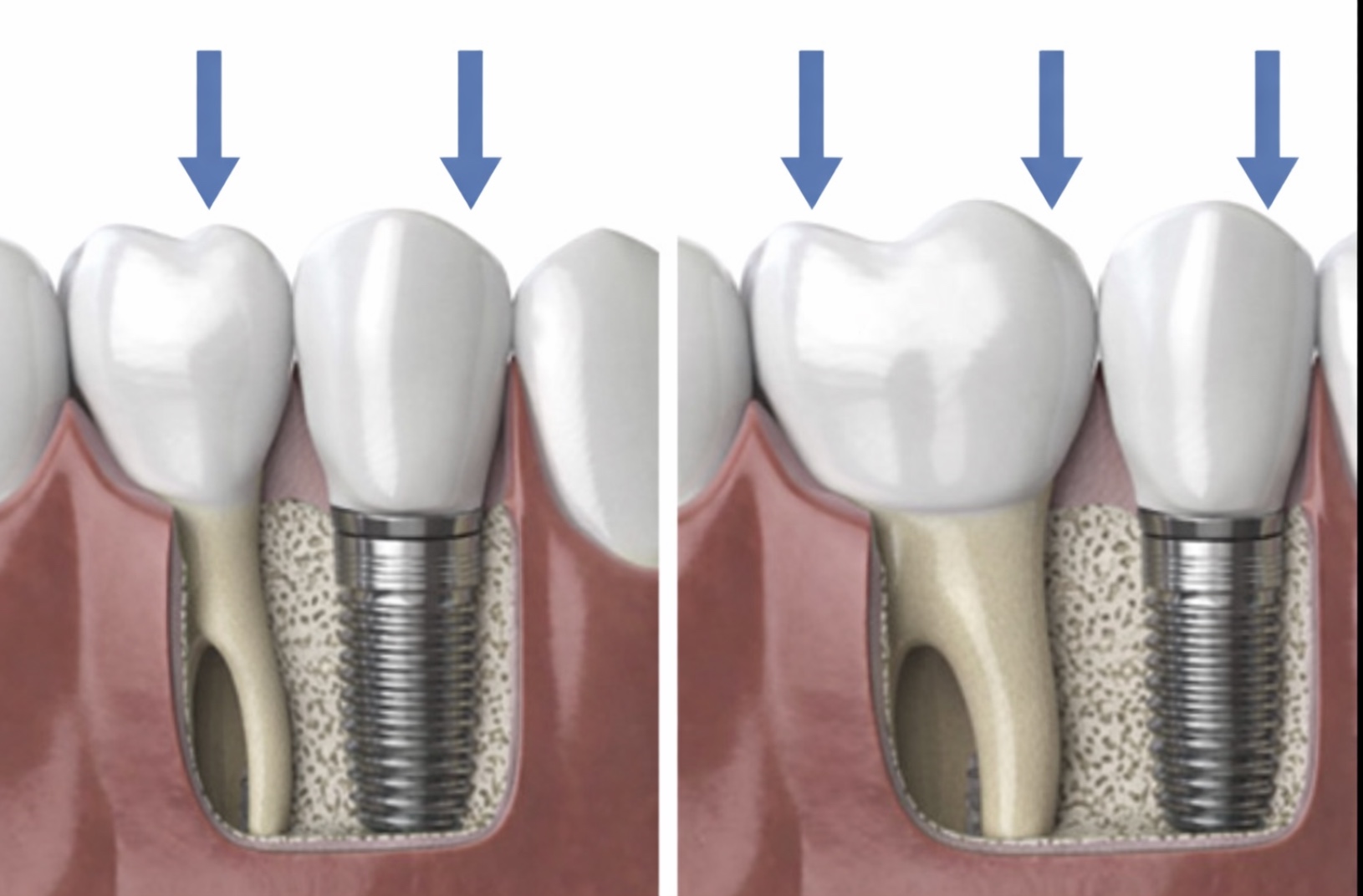
Your natural teeth aren't actually attached directly to your jawbone. I know that sounds strange, because they certainly feel like they're attached! But every healthy natural tooth is surrounded by a specialized tissue called the periodontal ligament. Think of it as a tiny suspension system. This ligament is made up of connective tissue fibers that attach the tooth to the surrounding bone. It allows a very small amount of movement when you bite, helps distribute the forces generated during chewing, and contains specialized nerve endings that help your brain recognize how much pressure you're putting on your teeth.
Those nerves are part of the reason you can bite into a piece of food and automatically adjust how hard you're chewing. Your teeth are constantly giving your brain information about what's happening in your mouth. Dental implants don't have that ligament. When an implant integrates, the bone attaches directly to the implant surface. That means there's no periodontal ligament between the implant and the bone to provide the same cushioning and sensory feedback. [1]
Now, that doesn't mean people with implants have absolutely no sensation when they bite. They can still detect pressure through other nerves and surrounding tissues. Researchers actually tested this in a study involving ten patients who had both natural teeth and implant-supported crowns. The patients could tell the difference between pressure applied to a natural tooth and pressure applied to an implant. The sensation from the implant was generally weaker, particularly at lower forces. [2]. So the sensory system still works, but it works differently. And the difference becomes particularly important when someone clenches or grinds their teeth.
Bone Is Alive, and It Responds to Force
I want to explain something about bone because it helps make the rest of this article easier to understand. Your bones are constantly rebuilding themselves. We have cells called osteoblasts that build bone and other cells called osteoclasts that break bone down. That process is happening throughout your life. One of the things that influences bone remodeling is mechanical force. When bone experiences appropriate amounts of force, it can respond by becoming stronger in the areas where it needs additional support. That's one of the reasons weight-bearing exercise is so important for maintaining healthy bones.
But there's a limit to how much force bone can handle. When the force becomes excessive, particularly when it's repeated over and over again, microscopic damage can develop faster than the bone can repair it. A 2006 review by Isidor examined how mechanical forces affect bone surrounding dental implants. The research described how appropriate loading can encourage bone formation, while excessive loading can produce microscopic damage and bone loss. [3]. And an earlier experiment involving monkeys produced some pretty dramatic results.
In that 1997 study, researchers placed titanium implants and deliberately subjected some of them to excessive sideways biting forces. Six of the eight overloaded implants became loose, and two were lost completely. The remaining overloaded implants showed different degrees of damage to the surrounding bone or loss of their connection to it. [4]. Now, I don't want anyone confusing an experiment deliberately designed to overload implants with what happens to every patient. But the experiment SHOWED that excessive mechanical forces can damage the relationship between an implant and the surrounding bone. An implant can experience mechanical problems long before the implant itself becomes loose. The crown may fracture. The screw holding an abutment in place may loosen. A restoration may repeatedly come off. Or a component may eventually break from the forces acting on it.
A systematic review published in 2012 examined 15 clinical studies involving implant complications after the restorations had been placed into function. The researchers identified excessive biting forces as an important factor in problems involving broken porcelain, fractured restoration components, loose or broken screws, and implant failure. [5]. Those are real problems that can happen even when the implant initially integrates beautifully.
Your Bite Can Generate More Force Than You Realize
Most of us don't think much about how hard we bite. We chew our food, swallow, and go about our day without giving it another thought. But some people generate enormous amounts of force through their teeth, particularly when they're clenching or grinding during sleep. Researchers actually measured nighttime biting forces in a group of ten people who experienced sleep bruxism, which is the medical term for grinding or clenching during sleep. They recorded 499 grinding events over 30 nights. The average measured force was approximately 22.5 kilograms of force. That's roughly equivalent to 50 pounds of force. And the highest recorded nighttime force in one participant reached approximately 81 kilograms of force.
That's almost 180 pounds of force!
Here's where Mom Math comes in. Imagine the weight of an average adult person being concentrated into a relatively small area of your bite. Now imagine that force happening while you're asleep, when you're not consciously deciding how hard to bite. And imagine those forces being repeated night after night, potentially for YEARS. That's a LOT for a dental restoration to handle.
In fact, some of the nighttime forces measured in this study exceeded the maximum biting forces the participants could voluntarily generate while they were awake. [6]. This is particularly important when we're talking about implants because they don't have the same ligament-based cushioning system as natural teeth. And the research on implant failure reflects that.
Bruxism More Than Doubles the Odds of Implant Failure
A 2024 systematic review examined 27 studies comparing dental implants in people with probable bruxism against implants in people who didn't have bruxism. The researchers looked at 2,105 implants in people who clenched or ground their teeth and 10,264 implants in people who didn't. They found that the odds of implant failure were approximately 2.2 times higher in the bruxism group. [7]
Think about that for a minute. We're talking about a difference large enough that dentists should absolutely be asking about clenching and grinding BEFORE they place implants.
Another study followed 98 patients with bruxism and compared their implant outcomes with a matched group of patients who didn't have bruxism. The researchers found approximately 2.7 times greater odds of implant failure in the bruxism group. Those patients also experienced more mechanical problems with their implant restorations. [8]. And that brings me to one of the biggest questions I ask when I see someone with severe clenching.
WHY are they clenching? Because there's a difference between recognizing that someone clenches and figuring out what's causing it. And you know me well enough to know I'm a root cause kind of girl. And that's where the airway enters this conversation.
The Airway Connection: What Happens When You Can't Breathe Properly During Sleep?
Over the past 10 years, I've become increasingly interested in the relationship between breathing, jaw development, sleep, and the forces generated by the muscles around our mouths. When someone has obstructive sleep apnea, their upper airway repeatedly becomes narrowed or blocked during sleep. The body continues trying to breathe, but airflow becomes reduced or temporarily stops. Eventually, the nervous system responds, often producing a brief awakening that helps restore breathing. These events can happen over and over again throughout the night. And some researchers have discovered that jaw-muscle activity and tooth grinding can occur around these breathing interruptions and sleep arousals. That's important because it suggests that some clenching and grinding may be related to what's happening with the person's breathing during sleep.
A large study published in 2023 examined 914 adults who had obstructive sleep apnea. The researchers found that approximately half of them also had sleep bruxism. They also observed that approximately 86% of the rhythmic jaw-muscle activity they recorded occurred around sleep arousals. [9]. Another study examined the timing of breathing interruptions and grinding events in patients who had both conditions. Most breathing interruptions weren't followed by grinding. However, when the researchers did find a connection between the two events, grinding was much more likely to happen AFTER a breathing interruption than before it. [10]. That raises the possibility that certain grinding episodes may be part of the body's response to disturbed breathing.
But here's where we need to look closely at what the science has actually SHOWN. Not every study has found the same relationship. A 2024 review combining 14 studies didn't find a clear overall increase in sleep bruxism among people with sleep apnea compared with those without it. The researchers also noted problems with how the studies were designed and how bruxism was measured. [11]. So what does that tell us? It tells us that we can't automatically assume every person who clenches has a breathing problem. But it also tells us that simply counting how many people have both conditions may miss something important.
What happens during the individual breathing events? That's a different question from asking whether everyone with sleep apnea grinds their teeth. And for a patient who has severe nighttime clenching, repeated dental fractures, and symptoms suggesting sleep-disordered breathing, that's a question worth investigating.
What the Research Shows About Sleep Apnea and Implant Complications
In 2017, researchers examined records from a sleep-disorder clinic to look at complications involving implant-supported dental restorations. Of the 67 patients who had implant restorations, 49 had obstructive sleep apnea. Sixteen patients experienced complications with their restorations. And of those 16 patients, 13 had sleep apnea. The researchers identified 30 complications involving 22 restorations, including broken porcelain, loose screws, fractured screws or implants, and restorations coming loose. They also found that the patients with fracture-related complications tended to have more severe sleep apnea. [12]
Because these patients came from a sleep-disorder clinic, sleep apnea was already common in the group. Thirteen out of sixteen sounds dramatic, but we also need to remember that 49 of the 67 patients had sleep apnea. What the study shows is that sleep apnea was present in many of the patients experiencing implant restoration problems, and the severity of sleep apnea was greater among patients with certain types of fractures.
For a dentist treating someone who repeatedly breaks implant restorations, that's a pretty good reason to investigate the person's breathing. And it raises another question. How many implant studies are looking at the patient's airway BEFORE the implant is placed? When researchers study implant failure, they frequently examine things like smoking, diabetes, gum disease, bone quality, implant design, and biting forces. It's important to look at that stuff.
But if we don't routinely measure airway function, sleep quality, and breathing problems, how are we supposed to know how much those factors contribute to implant complications? In my clinical experience, airway problems are one of the FIRST things I want to investigate when I encounter someone with excessive clenching and repeated dental failures. I'm convinced we're overlooking a huge part of the problem. We don't yet have the published research to say that inadequate airway function is the number one cause of all dental implant failures. The studies I've reviewed simply haven't answered that question.
It's a BIG gap in our understanding. THAT being said, I can tell you observationally that my own clinical experience sees the pattern. Because treating the broken dental work without investigating the forces that broke it may leave the original problem exactly where it was.
Sometimes the Problem Is Where the Implant Was Placed
Now let's talk about something completely different that can create serious mechanical problems. Implant positioning. People often assume that if an implant is surrounded by good bone and looks properly integrated on an X-ray, the surgeon must have placed it correctly. Unfortunately, that's not always true. An implant can be surrounded by beautiful bone and still be positioned poorly for the tooth that it's supposed to support. The restoration has to be designed around where the implant was placed.
And if the implant is too far forward, too far backward, angled incorrectly, or positioned too close to another implant, the dentist restoring it may end up dealing with some very difficult mechanical problems. A dentist who doesn't place the implant may inherit a poorly placed implant that they can't restore properly for maximum success. I've dealt with that myself with some of my own patients.
A review by Gross examined how implant position, number, angle, distribution, and the quality of supporting bone affect the forces transmitted through implant restorations. [13]. These details matter because chewing forces don't magically travel straight down the implant simply because that's how we'd prefer them to behave. And that brings us to something called a cantilever.
What Is a Cantilever, and Why Does It Matter?
A cantilever happens when part of a restoration extends beyond the support underneath it. Think about a diving board. The board is attached at one end, and the farther you walk toward the unsupported end, the more leverage you create. Now imagine putting that same diving board into someone's mouth. Obviously, we're talking about a much smaller scale, but the mechanical principle is the same. When the biting surface of a crown is positioned away from the center of the implant supporting it, the force of chewing can create a bending or tipping effect. And the farther that force is from the implant's supporting axis, the greater the bending force can become.
Here's some simple Mom Math. If the same biting force is applied two millimeters away from the center of support instead of one millimeter away, the bending effect doubles. The patient isn't necessarily biting any harder. The difference is WHERE that force is being applied. It's the simplest way I can explain physics. That's why implant position matters so much. And it's also why simply changing the crown doesn't always solve the problem.
In one of my patients, the implants intended to replace his lower first permanent molars had been placed too far back, toward the lower second molars. That left the crowns extending forward from the implants supporting them. He repeatedly had crowns come loose. Eventually, even after switching to screw-retained restorations, the screws loosened, and the abutment screws ultimately fractured. The implants had been placed by another dentist. By the time I became involved, I was dealing with the consequences of their positions. That experience illustrates a problem I've seen more than once: the restoration is expected to compensate for an implant that's in the wrong place. And sometimes there simply isn't a good way to compensate.
A 2021 study looked at implant-supported restorations involving two implants in the back of the mouth. Researchers compared 23 restorations that experienced screw loosening with 32 that didn't. They found that the height of the restoration and the length of the cantilever were important factors in screw stress and loosening. Their computer modeling also showed that increasing those dimensions increased the forces acting on the screws. [14]. That's exactly why we need to plan the final tooth BEFORE determining where the implant belongs. The implant needs to support the restoration properly. And the restoration needs to fit the patient's bite.
Placing Implants Too Close Together Creates Another Problem
Sometimes implant positioning creates biological problems, too. When two implants are placed too close together, the bone between them may have difficulty maintaining its normal height. I've had a few of those patients. One of them was the same patient I mentioned above with the lower molars implants that were placed too far back. His upper right premolar implants were placed too close together. A second patient had zirconia implants placed in a dental tourism situation that were too close together on both of his upper bicuspid areas. Both sides ended up failing.
A study published in 2000 examined 36 patients with adjacent implants. The researchers compared the amount of bone loss between implants that were more than three millimeters apart with implants that were three millimeters apart or closer. The implants spaced more than three millimeters apart showed an average of 0.45 millimeters of bone loss between them. The implants spaced three millimeters apart or closer showed an average of 1.04 millimeters of bone loss. [15]. That's more than DOUBLE the amount of bone loss in the closer group. In both of my patients I mentioned above, their implants were MAYBE 1mm apart. Yikes. No wonder their implants failed.
The study was relatively small, and implant design and other factors can affect the results. But it demonstrates why the space between implants deserves attention during treatment planning. It's not just about squeezing everything into the available bone. We need to consider the health of the bone BETWEEN the implants, the space needed for the restorations, and whether the patient will be able to keep the area clean. When implants are placed too close together, restoring them properly can become much more difficult or even impossible.
The Shape of the Crown Matters, Too
Even when an implant is positioned reasonably well, the shape of the restoration can influence how forces travel through it. A crown that's too wide can create leverage. Steep chewing surfaces can increase sideways forces. And a restoration that hits too early or too hard when the patient closes their mouth can put unnecessary stress on the implant. A 2016 review examined ways to reduce excessive loading on dental implants. The researchers discussed the importance of reducing cantilevers, managing steep cusp angles, narrowing chewing surfaces when appropriate, distributing contacts carefully, and paying attention to grinding habits. [16]. These mechanical issues require careful planning.
Sometimes dentists focus on making the restoration stronger when the real problem is the force being applied to it. If a crown keeps breaking, we can make another crown. If an abutment screw keeps loosening, we can tighten it or replace it. But if the implant is poorly positioned or the patient is generating excessive forces, those repairs may only buy us time. And eventually, something else may break.
Titanium Implants Can Break, Too
I want to address this because there's a tendency to assume that ceramic implants are more vulnerable to fracture simply because they're ceramic. The early ones fractured because the implant manufacturers tried to make them the same as they made titanium implants. Titanium and zirconia are different materials. They don't behave the same. But the manufacturers failed to understand that at first and they kept trying to make the zirconia behave like titanium. Yes, zirconia implants can fracture under excessive forces. We need to understand their mechanical properties and plan accordingly. But titanium implants aren't indestructible either.
I treated a woman many years ago who had fractured FIVE titanium implants because of the forces she generated through severe clenching. She also managed to break a metal Hader bar in several places. And I've treated other patients who experienced broken implant screws and repeated restoration failures with titanium implants. Remember the patient I mentioned above who had a couple of different issues because of how his implants were placed? He's one of them. The material alone doesn't protect an implant from bad mechanics.
A 2022 study examined 16 clinically fractured zirconia implants from two manufacturers, including CeraRoot. Researchers carefully examined the fracture surfaces and found that bending overload appeared to be the primary cause of fracture in all 16 implants. [17]. They also found that implant design, surface defects, patient-related factors, and treatment planning could influence where fractures began. That tells us something important about implant treatment.
We need to plan for the forces the implant will experience, particularly sideways and bending forces. One-piece zirconia implants, which are my preference, eliminate the separate implant-abutment connection found in many two-piece systems. That's one of the reasons I like them. But a one-piece implant still needs to be positioned correctly. It still needs adequate supporting bone, a properly designed restoration, and appropriate management of the patient's biting forces. And because we can't simply change the angle of a separate abutment afterward, the original implant position becomes even more important. That's why I want the final restoration planned before the implant is placed. Thankfully, a good CBCT system has implant planning software. The key is to use a dentist who actually USES the software. Many people freehand the placement of implants. I think it's never a good idea to freehand implant placement. I can understand there are situations where it's virtually impossible to not freehand it (some people's mouths are literally that tiny). But it's a choice I would reserve only for the worst situations.
Not All Implant Failures Happen for the Same Reason
We've talked about implants breaking because of excessive biting forces, but what about the implants that never properly integrate into bone? Or the ones that integrate beautifully and then start losing bone around them years later? Those are different problems, and we need to understand what's actually happening before deciding why an implant failed.
In 2012, researchers examined 13 fractured one-piece zirconia implants. Twelve of those implants were only 3.25 millimeters wide, and the remaining implant, which was 4 millimeters wide, belonged to a patient with severe bruxism. When the researchers examined the broken implants under a microscope, they found that excessive bending forces had caused the fractures. They also discovered that scratches and small defects created during surface treatment made certain areas more likely to crack under pressure. [24]
Another study published in 2019 examined 15 fractured zirconia implants, including early Swiss Dental Solutions implants. The researchers even had the crowns still attached to the broken implants, which allowed them to study how the biting forces had been distributed. They used the wear patterns on those crowns to work backward and estimate where the damaging forces were concentrated. Their findings showed how biting forces applied away from the implant's center could create excessive bending stresses and contribute to fracture. [25]. It shows that even when an implant material is strong, its design and the position of the crown can make a HUGE difference in how well it handles the forces of chewing.
But those studies examined implants that BROKE. What about the implants that failed without breaking? A 2026 study followed 307 one-piece zirconia implants placed in 196 patients. Of those 307 implants, 42 failed. And here's the interesting part. Twenty-seven of those 42 failures happened BEFORE the implants were put into regular biting function. [26]
That means those early failures couldn't have been caused by years of chewing on the finished crowns. The researchers found that patients who needed bone grafting at the same time as implant placement had more failures. However, they couldn't determine exactly why every implant failed. Now, think about what that means when we're evaluating implant success. We have to consider the patient's bone quality, healing, inflammation, infection, implant positioning, and the forces acting on the implant. And we also need to consider the material itself.
This is particularly important with titanium. We already know that titanium particles can trigger inflammatory responses. Researchers have actually SHOWN that titanium ions and particles can activate immune cells and interfere with the processes involved in maintaining healthy bone. And some patients experience reactions to titanium implants that go beyond the ordinary mechanical problems we've been discussing. A 2026 review examined nine published clinical studies involving 21 patients evaluated for titanium hypersensitivity. Of those patients, 17 ultimately needed their implants removed. [27]
Those were selected patients with suspected or identified reactions, so the numbers don't tell us how often titanium reactions occur in the general population. But they DO show that material-related reactions can become serious enough to require implant removal. And that's one of the reasons I'm such a fan of individualized material compatibility testing. I exclusively recommend zirconia implants, but even I don't assume zirconia is appropriate for everybody. We're not cookie cutters, and the fact that an implant material works beautifully for one person doesn't guarantee that someone else's body will respond the same way.
An implant might fracture because of excessive mechanical forces. Another might fail because of problems with healing or supporting bone. And another might experience inflammatory complications involving the material itself. Sometimes several things are happening at once. That's why figuring out WHY an implant failed matters just as much as figuring out how to replace it. Because if we don't address the problem that caused the failure, we may end up putting the patient right back into the same situation all over again.
Here's Another Problem: Implants Don't Move Like Natural Teeth
Natural teeth can be moved orthodontically. Implants can't. When an orthodontist applies controlled forces to a tooth, the periodontal ligament and surrounding bone respond. Bone is removed in some areas and rebuilt in others, allowing the tooth to gradually change position. But an integrated dental implant doesn't have a periodontal ligament. Once it's firmly integrated into bone, it becomes a fixed point.
Researchers have described this difference for decades. A 1999 paper by Roberts explained how integrated implants remain fixed while natural teeth can move through normal orthodontic bone remodeling. [18]. And that creates an enormous treatment-planning issue.
What happens if a patient needs orthodontic treatment AFTER implants have already been placed? That's actually a failure to plan properly. Or maybe the dentist did explain to the patient that implants needed to be placed AFTER orthodontics, but the patient was not in a place where they could hear that properly. It happens. It's why I always try to talk to my patients about that if I can. The natural teeth may be able to move, but the implants won't move along with them. I call it the rate-limiting factor.
It can limit how the orthodontist adjusts the bite, changes tooth positions, or coordinates the arches. And if the patient needs their jaws expanded or their bite changed, implants that were placed too early may create additional obstacles. This is one of the reasons I want patients to understand the importance of planning their treatment in the correct order.
Why Airway and Orthodontic Treatment May Need to Come FIRST
Let's imagine a patient who has crowded teeth, narrow dental arches, clenching, and a missing tooth. The patient wants an implant. Fair enough. But what happens if we place the implant before investigating whether their jaws are adequately developed or whether they need orthodontic treatment? We may have just placed something permanent into a dental arch that needs to change. And that can make future treatment a LOT more complicated.
Here's where I think dentistry sometimes asks the wrong question. Researchers have published studies examining whether extracting premolars during orthodontic treatment makes the airway smaller. A 2025 systematic review looked at 11 studies involving 891 patients and found little overall difference in measured airway size between patients treated with premolar extractions and those treated without extractions. [19]
Okay.
So the researchers didn't find that the airway got significantly smaller. But here's what they didn't bother to look at. WAS THE AIRWAY ADEQUATE IN THE FIRST PLACE? Because if a patient had a narrow upper jaw, dental crowding, and breathing problems before treatment, showing that their airway didn't get smaller doesn't tell us whether the underlying problem was addressed. And it doesn't tell us what might've happened if the patient had received appropriate expansion instead. That's a completely different research question.
But when we DO have a patient with a narrow jaw and breathing difficulties, I want those problems investigated before we make decisions that permanently affect the patient's dental arches. And here's why: A 2025 systematic review examined 41 studies evaluating maxillary expansion and breathing in growing patients. The researchers found that expansion generally increased space in the nasal cavity and upper throat. Some studies also demonstrated improved nasal airflow and reduced resistance to breathing. Improvements in sleep apnea measurements were seen in certain groups, although the results weren't the same across every study. [20]
So we have research showing that appropriate expansion can change airway anatomy and sometimes improve breathing. And we have other research showing that simply extracting teeth may leave measured airway dimensions largely unchanged. But those findings aren't answering the same question. One asks whether extraction treatment changed the airway. The other asks what happens when we expand a narrow upper jaw. What patients really need to know is which treatment, if any, addresses the problems THEY have. And when implant placement is part of the plan, we need to have that conversation BEFORE we make the implant a permanent fixture in the arch.
What About Patients Who Already Have Implants?
Sometimes patients come to me with implants that were placed years earlier. Maybe their bites have changed. Maybe they've developed clenching. Maybe they're having problems with their airway that nobody investigated when the implants were originally placed. And maybe their implants are doing beautifully. The important thing is to evaluate the situation we actually have. An existing implant doesn't automatically prevent orthodontic treatment or airway care. But it may change the options available.
We need to understand where the implants are, how the remaining teeth could move, whether the existing restorations can be modified, and what treatment would be needed to accomplish the patient's goals. Sometimes treatment can be planned around existing implants. Other times, the presence of an implant creates compromises. And occasionally, an implant may need to be removed or replaced if its position interferes with an important treatment goal. Those decisions need to be made individually, with the patient understanding the available choices.
Why an X-Ray Can Look Perfect While Problems Are Developing
Here's another situation that can be frustrating for patients. They have pain around an implant, or something doesn't feel right, but they're told the X-ray looks fine. And sometimes it DOES look fine. But an X-ray is a picture of anatomy at a particular moment in time. It doesn't tell us how much force the patient generates when they're asleep. It doesn't tell us how often they clench, which direction those forces travel, or how those forces change when they move their jaws from side to side. And it doesn't measure the microscopic fatigue accumulating in an implant or restoration over months and years.
A 2023 review of implant loading found strong evidence connecting excessive biting forces with mechanical complications such as screw loosening and fractures. The research was less clear about whether force alone directly causes the inflammatory bone disease known as peri-implantitis, although excessive loading may worsen problems when inflammation is already present. [21]. And that makes sense when we remember that mechanical and biological problems can happen together. An implant may be experiencing excessive force AND inflammation. Or it may have mechanical problems without obvious bone loss. That's why simply looking at the X-ray doesn't tell us everything we need to know.
What CBCT Can and Can't Show
A CBCT scan gives us a three-dimensional view of the jaws. That can be incredibly useful when we're evaluating implant position, surrounding bone, nearby nerves, and other important structures. But CBCT has limitations, too. A 2011 review explained how image artifacts can create distortions and misleading patterns that interfere with interpreting dental scans. [22]. And those artifacts generally occur around implants. They are incredibly annoying to have because they sometimes block out adjacent issues as well.
Interestingly, a 2024 study comparing titanium and zirconia implants found that zirconia produced more CBCT image artifacts under the conditions tested. The researchers also showed that adjusting the scan settings and using artifact-reduction software could help improve image quality. [23]. That's important for me because I have a lot of patients with zirconia implants. I can tell you from personal experience with the CBCT on zirconia implants that they shine so bright it's like looking at the sun sometimes. I can't see the structures around them occasionally.
We need to understand the limitations of our imaging equipment regardless of which material we're using. And a CBCT still isn't a substitute for investigating how the implant functions. If a patient has repeated crown fractures, screw loosening, discomfort, altered sensation, or other symptoms, we need to investigate what's actually happening. A scan that looks good doesn't mean the patient is imagining the problem. And if symptoms suggest a nerve injury or another problem that isn't visible on routine imaging, further evaluation may be needed.
Sometimes the Problem Is the Entire System
Account required
Sign in to see more
Create an account or sign in to unlock the full list.