Resource Libraries
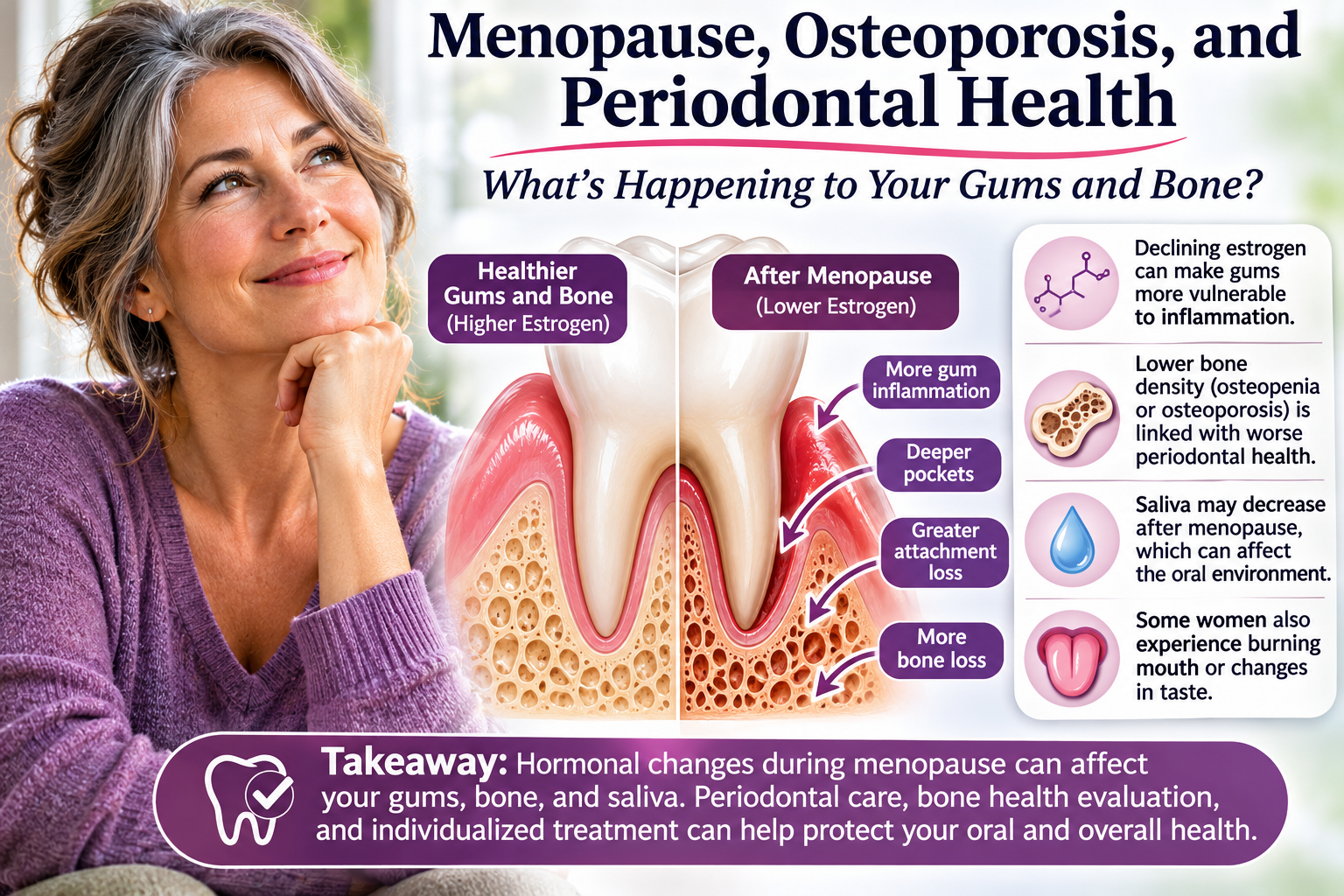
Menopause, Osteoporosis, and Periodontal Health: What's Happening to Our Gums and Bone?
Why do some women develop bleeding gums, dry mouth, and bone loss during menopause? Explore what the research shows about estrogen, osteoporosis, and periodontal health.
Part 8 of the 10-Part Periodontal Disease Series
This is Part 8 of my 10-part series exploring periodontal disease and its connection to the rest of our health. I've also written a much larger HERE for anyone who wants to dig into all the research in one place. Each article in this series covers a different subject and can stand on its own. You don't need to read the previous articles to understand this one, although you're certainly welcome to explore the entire series!
One quick note about the references: I'm keeping the same reference numbers used in my periodontal disease master article so you can find the original studies in either place. That's why the numbers may skip around. New research added specifically for this series is labeled [A1], [A2], and so on, with the complete references at the end of each article.
When your mouth starts changing and nobody can tell you WHY
Imagine a woman who's been taking care of her teeth the same way for thirty years. She brushes, cleans between her teeth, and sees her dentist regularly. But somewhere in her forties or fifties, things start changing. Her mouth feels dry when she wakes up. Her gums bleed more easily. Maybe she notices that her teeth look longer, or certain foods suddenly make her mouth burn. She mentions it to her dentist or physician. And somebody says, "Well, you're getting older." Thank you, Captain Obvious. Now can we please figure out what's actually happening?
As a post menopausal woman myself, I get particularly frustrated when women have legitimate health concerns dismissed as normal aging. I've experienced medical gaslighting myself, and I know how discouraging it can be when someone acts as though identifying your age explains everything. BUT, women in general ARE dismissed when it comes to their medical concerns. It's insane that half of the population is brushed off. So our job is to fully advocate for ourselves, even if we have to keep looking for the right doctors. Some of them are getting better.
Menopause involves serious changes in hormones, immune function, bone metabolism, sleep, and other processes throughout the body. And those changes can affect our mouths. Researchers have been studying the relationships between menopause, periodontal disease, osteoporosis, and saliva for years. Some of the newer findings are especially useful because they show what's happening in the actual tissues. So let's look at what changes, why those changes matter, and what we can do about them.
What happens to estrogen during menopause?
Menopause is officially reached after a woman has gone 12 consecutive months without a menstrual period, provided there isn't another medical reason for those periods to have stopped. But hormonal changes usually begin before that. The 5-10 years leading up to menopause are called perimenopause.
During perimenopause, estrogen and progesterone levels can fluctuate a lot. Periods may become irregular. Sleep may change. Hot flashes can begin. Some women experience changes in mood, energy, body composition, and other aspects of their health. After menopause, estrogen levels generally settle at much lower levels than during the reproductive years. And estrogen does a LOT more than regulate menstrual cycles.
It influences blood vessels, immune responses, connective tissue, saliva production, and the cells responsible for maintaining our bones. Our gums and jawbones are living tissues, so they're part of that process. That's why a woman can develop new oral problems during midlife even though her dental routine hasn't changed. And scientists have been measuring those changes.
What did the 2026 periodontal research find?
In March 2026, researchers published a systematic review examining periodontal health before and after menopause. They included nine studies comparing women who had gone through menopause with women who hadn't. The postmenopausal women weren't receiving hormone replacement therapy in the studies selected for the review. [A28]. And what did the researchers find?
Overall, the women who had gone through menopause had:
-
Greater loss of periodontal attachment. Clinical attachment loss tells us how much of the supporting tissue attaching the gums to the teeth has been lost.
-
Deeper periodontal pockets. A deeper periodontal pocket can provide a protected environment for bacteria associated with periodontal disease.
-
More signs of gum inflammation. And inflammation can contribute to the destruction of the tissues and bone surrounding the teeth.
The review found a pattern of worse periodontal health after menopause, although the studies differed in their methods and didn't establish exactly how much of the difference was caused by menopause itself. But the overall findings support something we've been discussing throughout this series. The same amount of plaque doesn't necessarily produce the same amount of periodontal damage in every person. The body's response matters. And when hormones change, that response can change, too.
Why does estrogen matter so much to our bones?
Our bones are living tissues. They're constantly being maintained, repaired, and rebuilt. We have cells called osteoclasts that remove older bone. And other cells called osteoblasts that build new bone. When everything is working properly, the activities of those cells remain balanced. But estrogen plays an important role in regulating that balance. As estrogen levels decline after menopause, the body may begin removing bone faster than it can replace it. Over time, that can lead to reduced bone density.
When bone density becomes significantly reduced, we call it osteoporosis. And because our teeth depend on the bone surrounding their roots for support, researchers have investigated whether osteoporosis may contribute to periodontal problems. Now, osteoporosis and periodontitis aren't the same condition. Osteoporosis involves changes in bone density and strength throughout the skeleton. Periodontitis involves inflammation and destruction of the tissues and bone supporting teeth. But those processes share some of the same biological machinery.
How inflammation can make bone loss worse
Remember our osteoclasts and osteoblasts? During periodontal disease, the immune system responds to bacteria living underneath the gums. That response involves chemical messages that can encourage osteoclasts to remove more bone. One of those messages is called RANKL. RANKL helps tell osteoclasts when to get to work. We also have a substance called osteoprotegerin, or OPG, that helps regulate that message. Think of OPG as part of the braking system.
When inflammation changes the balance between RANKL and OPG, the bone-removing cells can become more active. And when estrogen levels decline, the body's ability to maintain healthy bone balance may already be under additional strain. [24]. So we're dealing with two processes that can affect the same supporting structures. One involves declining estrogen and systemic bone loss. The other involves periodontal infection and inflammation.
That's why it's important to understand a woman's overall bone health when she develops periodontal disease during or after menopause. We need to look at the WHOLE person. And newer research supports doing exactly that.
What did researchers find when they examined 3,689 postmenopausal women?
A systematic review published in December 2025 examined the relationship between osteoporosis and periodontal disease in postmenopausal women. The researchers combined findings from 17 studies involving 3,689 participants. [A29]. Fourteen of the seventeen studies reported a relationship between low bone density or osteoporosis and periodontal disease. That's more than EIGHT out of every TEN studies!
The researchers also combined measurements of periodontal attachment loss. Women with osteoporosis generally had greater attachment loss than women without osteoporosis. The researchers reported a standardized difference of approximately 0.75 between the groups. Now, that number isn't 0.75 millimeters. It's a statistical measurement that lets researchers compare findings from studies that used different methods. It tells us that, overall, the amount of attachment loss was greater in the women with osteoporosis.
The researchers also found considerable differences between the individual studies. So we can't take the combined result and predict exactly how much attachment any particular woman will lose. But the pattern is important. Women with lower bone density were more likely to have worse periodontal findings. And another study gives us an easier number to understand.
The osteoporosis study that found 2.49 times the odds
In a study published in 2016, researchers compared periodontal health in 134 older women. Forty-eight had normal bone density, while 86 had osteoporosis. [A30]. The researchers measured periodontal attachment loss, gum recession, bone density, and other health factors. And they found that the women with osteoporosis had more sites with significant attachment loss and gum recession. After adjusting for several factors, women with osteoporosis had approximately 2.49 times the odds of severe periodontitis compared with women who had normal bone density. That's nearly TWO AND A HALF TIMES the odds!
Let's do some Mom Math. Imagine that 10 out of every 100 women with normal bone density have severe periodontitis. That means 10 have severe periodontal disease, while 90 don't. The odds are: 10 ÷ 90 = 0.1111
Now multiply by 2.49:
0.1111 × 2.49 = 0.2767
To turn those odds back into a percentage:
0.2767 ÷ 1.2767 = 0.2167
That's approximately 21.7%. So in our imaginary example, about 22 out of every 100 women with osteoporosis would have severe periodontitis, compared with 10 out of every 100 women with normal bone density. That's about 12 additional women per 100! Now, those are hypothetical numbers to explain the odds ratio, rather than the actual percentages in the study. But they help show how strongly osteoporosis and severe periodontal disease were associated in this group of women. And remember, the researchers were examining actual bone density and periodontal measurements. They weren't simply asking women whether they thought they had osteoporosis or gum disease.
What if you have osteopenia instead of osteoporosis?
Osteopenia means your bone density is lower than the expected range for healthy younger adults, but it hasn't reached the level used to diagnose osteoporosis. You can think of osteopenia as a warning that your bone health deserves attention. But here's something important. You can have osteopenia and STILL experience fractures because your bones aren't as strong as they should be.
A DEXA scan measures bone mineral density, but density is only one part of bone strength. The internal structure of bone matters, too. And someone who has experienced several fractures deserves a thorough evaluation, even when their DEXA results haven't reached the osteoporosis range. This matters in dentistry because the jawbones are part of the same skeleton. A DEXA scan measures bone density in places such as the hip and spine. Dental X-rays give us different information. They help us evaluate the height and shape of the bone surrounding tooth roots, including changes associated with periodontal disease. They're measuring different things.
For a woman with significant periodontal bone loss, a history of fractures, or other signs suggesting poor bone health, I want to know whether her overall skeletal health has been evaluated. And if she's already been diagnosed with osteopenia or osteoporosis, that deserves a place in our periodontal treatment planning. But there's another issue we need to discuss. And it's a BIG one. HUGE. And the medical community consistently fails to properly inform their patients about the risks of osteoporosis treatments.
Osteoporosis medications and the risk of jawbone death
Some of the medications commonly prescribed for osteoporosis work by suppressing the cells responsible for removing older bone. One group is called bisphosphonates. You may recognize names such as alendronate (Fosamax), risedronate (Actonel), or zoledronic acid (Reclast). Another medication is denosumab (Prolia), which works differently but also suppresses bone resorption.
Now, here's my concern. Our bones are LIVING tissues. They're constantly remodeling. Old or damaged bone needs to be removed so new bone can replace it. Our jawbones are particularly active because they're constantly responding to chewing forces, the presence of teeth, microorganisms, inflammation, and changes in the surrounding tissues. When medications interfere with bone remodeling, we need to understand what that means for long-term healing. Because there's a potentially devastating complication associated with these medications.
It's called medication-related osteonecrosis of the jaw, or MRONJ. Osteonecrosis literally means bone death. We're talking about jawbone that can become exposed, infected, painful, and unable to heal normally. Some patients develop persistent drainage, swelling, and destruction of surrounding tissues. In severe cases, treatment can require extensive surgical removal of dead bone. And some patients struggle with the condition for months or YEARS. This is something I take VERY seriously.
What causes MRONJ?
Researchers have identified several biological processes that appear to contribute to MRONJ. One involves suppression of normal bone remodeling. Bisphosphonates accumulate in bone and can remain there for many years, potentially more than a decade after treatment stops. Their effects on bone remodeling can persist long after the final dose. Denosumab works differently. It blocks a protein called RANKL, which helps activate osteoclasts, the cells responsible for removing bone.
Both medications reduce bone resorption, but normal bone remodeling is also part of the process our bodies use to repair microscopic damage and respond to injury. Researchers are investigating how suppressing that process affects the jawbone's ability to heal. Inflammation, infection, immune responses, and changes involving blood vessels may also contribute.
And that brings us directly back to periodontal disease. Because periodontal disease involves chronic infection and inflammation in the tissues surrounding teeth. When a patient already has periodontal disease, adding a medication that changes bone remodeling creates another concern about how well those tissues will heal.
How common is MRONJ? Let's look at the actual research.
You'll sometimes see MRONJ described as an extremely rare complication. It's not. And you'll see figures such as 0.02%, 0.03%, or 0.05%. Those numbers come from particular studies and treatment populations. They are painting the "rosier" picture. But they don't tell the WHOLE story. And I'm always going to insist that my readers have the more complete picture. Because researchers have also found substantially higher rates, particularly with longer treatment, certain medications, and dental extractions. So let's start with a large population study.
More than 58,000 patients: The risk increased with years of treatment
In 2025, researchers published a nationwide Finnish study involving 58,367 patients receiving antiresorptive medications. [A36]. They followed patients over several years and examined how often MRONJ developed. Among patients receiving low-dose denosumab, the estimated cumulative incidence increased as treatment continued.
Here's what they found:
-
After four years: 0.42% of the patients developed MRONJ.
-
After five years: 0.69% of the patients developed MRONJ.
-
After six years: 0.86% of the patients developed MRONJ.
-
After seven years: 1.03% of the patients developed MRONJ.
-
After eight years: 1.09% of the patients developed MRONJ.
Let's do some Mom Math. A cumulative incidence of 1.09% means approximately 11 out of every 1,000 patients. And remember, we're talking about LOW-dose denosumab, commonly used for osteoporosis. Not the intensive doses used for certain cancers.
The researchers also found that denosumab users had approximately FIVE TIMES the hazard of developing MRONJ compared with bisphosphonate users, after accounting for the factors included in their analysis. For low-dose bisphosphonates, the estimated cumulative incidence after eight years was 0.14%. That's lower, but it also shows why we need to distinguish between medications rather than lumping them all together.
And there's another important finding. The risk generally accumulated as treatment continued. So a woman who takes one of these medications for a year isn't necessarily facing the same risk as someone who's been taking it for eight years. How LONG someone takes these medications matters.
What happens when a patient needs a tooth extracted?
Now let's talk about something particularly important to those of us who practice dentistry. Because a patient's risk of developing MRONJ after a tooth extraction increases dramatically from the risk among everyone taking these medications who don't have a tooth pulled. But then I want you to think abut how many older women have to have teeth pulled (due to failing root canals, abscessed or cracked teeth, etc). It's a LOT.
In 2023, researchers published a prospective study involving 427 osteoporosis patients taking denosumab who needed dental extractions. [A37]. Together, those patients underwent 1,081 extractions. And 10 patients developed osteonecrosis of the jaw. That's 2.3%.
Let's do some Mom Math. 2.3% means approximately 23 out of every 1,000 patients. Or about one out of every 43 patients. The researchers also examined 299 patients who weren't taking denosumab. None of those patients developed osteonecrosis in the comparison group.
Now, here's ANOTHER study. In 2024, researchers examined 78 osteoporosis patients taking antiresorptive medications who underwent tooth extractions. [A38]. And four of those 78 patients developed MRONJ. That's approximately 5.1%! Let's translate that. Five percent means approximately one out of every 20 patients. Now we're talking about a much more concerning number. This was a relatively small group of patients who already needed extractions, so we can't apply that percentage to every woman taking osteoporosis medication.
But these studies show why I don't want patients making decisions based exclusively on the smallest reported MRONJ figures. Because if someone eventually needs an infected tooth removed, we're dealing with a different clinical situation. And sometimes the tooth NEEDS to come out. We can't simply leave a serious infection untreated because the patient has been taking a medication associated with impaired jawbone healing.
What about patients receiving these medications for cancer?
This is where the numbers become even more concerning. Patients receiving intensive antiresorptive treatment for cancers involving bone are often exposed to higher doses and more frequent treatment than people taking these medications for osteoporosis. And researchers have documented dramatically higher rates of MRONJ in some of these populations.
In 2021, researchers published a study involving 398 cancer patients receiving high-dose bone-modifying medications. [A34]. They found that the estimated cumulative incidence of MRONJ increased with time:
-
After one year: 4.5% of the patients developed MRONJ.
-
After two years: 12.9% of the patients developed MRONJ.
-
After three years: 17.7% of the patients developed MRONJ.
-
After four years: 21.6% of the patients developed MRONJ.
TWENTY-ONE POINT SIX PERCENT. Let's do some Mom Math. Imagine 1,000 comparable patients receiving these treatments and followed for four years. Applying that study's cumulative estimate, approximately 216 out of every 1,000 patients would develop MRONJ. That's more than ONE IN FIVE.
The study actually recorded MRONJ in 42 of its 398 patients during observation. The 21.6% figure was a time-adjusted cumulative estimate, accounting for how long patients remained under follow-up. But the findings are still deeply concerning. And researchers found that significant bone loss around teeth was associated with MRONJ. That's especially relevant to the periodontal disease we're discussing in this article.
And there's another study. In 2024, researchers published findings involving 179 men with metastatic prostate cancer who received bone-modifying medications. [A35]. They reported estimated cumulative MRONJ incidence of:
-
18% after two years of the patients developed MRONJ.
-
27% after five years of the patients developed MRONJ.
-
61% after ten years of the patients developed MRONJ
SIXTY-ONE PERCENT. That's an extremely high long-term estimate from a specific group of patients, with fewer people contributing data at the later follow-up points. It isn't the risk faced by every cancer patient. But it shows how serious the problem can become with prolonged treatment in certain populations.
The researchers also found that many of the patients who developed MRONJ had more advanced stages of the condition. We're talking about patients experiencing significant disease involving their jawbones. And I don't believe these numbers should be buried in the fine print when patients are making treatment decisions.
Why patients need a comprehensive dental exam BEFORE starting these medications
Now here's where all of this research becomes particularly important. Researchers have identified dental infection, periodontal disease, significant bone loss around teeth, and procedures involving the jawbone among the factors associated with MRONJ. Tooth extractions are particularly important.
But MRONJ can develop without a tooth extraction, too. Think about a woman who begins osteoporosis medication while she already has deep periodontal pockets or a chronically infected tooth. Maybe nobody identifies the problem before she begins treatment. Years later, that tooth becomes painful or the periodontal disease progresses. Now the tooth needs to come out. And her dental team has to consider the fact that she's been taking medications that affect bone remodeling.
That's why I believe a comprehensive dental exam should be part of the discussion BEFORE someone begins any medication associated with MRONJ.
We need to identify active periodontal disease, infected teeth, and other problems that may eventually require surgery.
We also need to explain why maintaining periodontal health matters during treatment.
Because if there's anything I've learned from decades of practicing dentistry, it's that preventing a problem is usually much easier than dealing with the consequences after it becomes serious. But the bigger issue is that the MOST that I have seen medical professionals do is tell their patients that they need to go to their dentist for dental clearance before starting the bisphosphonate treatment. They do NOT inform their patients about the risks of bisphosphonates. They leave it up to the dentists to inform them, and if the dentist doesn't know either, then that patient isn't getting informed.
My position on bisphosphonates
As a biological dentist, I do not recommend bisphosphonates. And I will not willingly "CLEAR" a patient to take them. Clearing them means I will accept responsibility if the patient gets MRONJ, and I'm unwilling to accept responsibility for the consequences of a medication I didn't prescribe. What I CAN do is fully inform my patients with a written document that tells them about the full risks, benefits, pros, cons and consequences, so that they can make an informed decision.
The possibility of medication-related jawbone necrosis is a risk I'm unwilling to dismiss, particularly when evaluating patients with periodontal disease or other existing dental problems. I recognize that these medications can reduce fractures in certain patient populations. Patients deserve to know that benefit when they're making decisions about their skeletal health.
But they also deserve to understand the possible consequences for their jawbones, the potential difficulties surrounding future dental surgery, and the fact that some of these medications remain in bone for years. If a patient is already taking one of these medications, I don't want them abruptly stopping it based on something they've read online. Stopping or changing treatment requires an individualized discussion with the prescribing physician, especially because certain drugs, including denosumab, can cause rapid bone loss and vertebral fractures when discontinued without an appropriate plan.
What I DO want is informed consent. I want women to understand the health of their bones, the condition of their periodontal tissues, and the possible long-term implications of their treatment choices. Because the goal should be to protect the skeleton without overlooking the health and healing capacity of the jawbones.
Let's talk about Saliva!
Now let's talk about something that doesn't always get nearly enough attention. SALIVA! Most people think saliva is simply the stuff that keeps their mouths wet. But saliva does an enormous amount of work. It helps lubricate tissues, wash away debris, regulate acidity, and deliver substances involved in protecting the mouth. And the amount of saliva we produce can influence which microorganisms thrive in our oral environment.
When someone doesn't produce enough saliva, the conditions inside the mouth can change considerably. Some women notice that their mouths become much drier during perimenopause or after menopause. Others wake up feeling as though they've spent the night sleeping in the Sahara Desert. And sometimes the dryness becomes so uncomfortable that speaking, chewing, swallowing, and sleeping become difficult. Researchers have been measuring what happens to saliva during menopause. And one newer study is particularly useful.
Account required
Sign in to see more
Create an account or sign in to unlock the full list.