Resource Libraries
Gum Disease, Diabetes, and Kidney Health
Can treating gum disease improve blood sugar and kidney health? Explore research showing how periodontal inflammation affects diabetes and what happens when infected gums are treated.
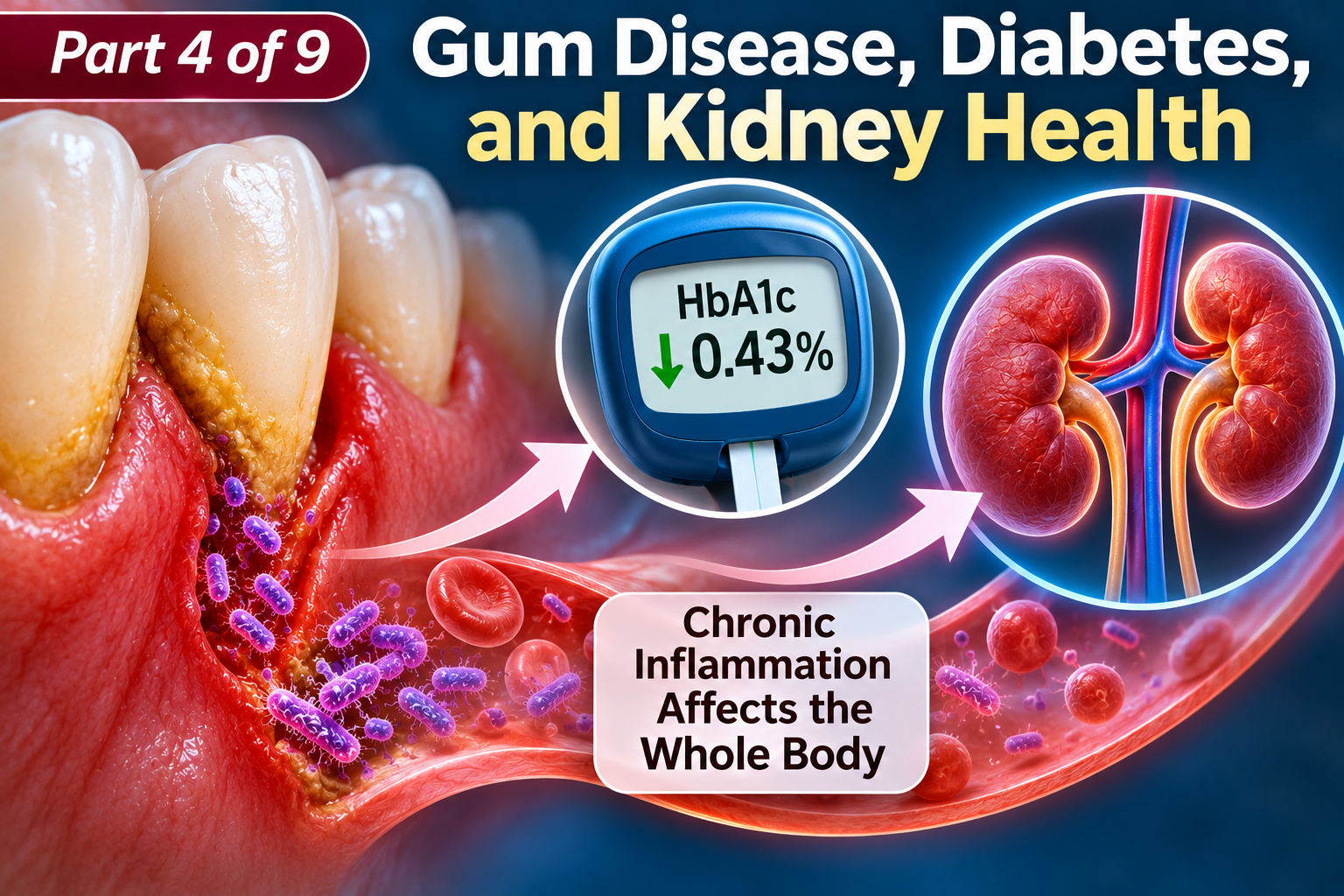
Part 4 of the Periodontal Disease Series
This is Part 4 of my 10-part series exploring periodontal disease and its connections to the rest of our health. I've also written a much larger master article HERE for anyone who wants to explore all the research in one place. Each article in this series covers a different subject and can stand on its own. You don't need to have read the previous three articles to understand this one.
One quick note about the research references: I'm keeping the same reference numbers used in my periodontal disease master article so you can find the original studies in either place. That's why the numbers may skip around. New studies added specifically for this series are labeled [A1], [A2], and so on, with their complete references included at the end.
What if treating your gums could improve your blood sugar?
Imagine someone who's been diagnosed with Type 2 diabetes. They're watching what they eat, taking their medications, monitoring their blood sugar, and trying to follow all the recommendations they've received from their physician. But their blood sugar is STILL higher than it should be. Meanwhile, they have periodontal disease. Their gums are inflamed, they have deep periodontal pockets, and they're dealing with an ongoing infection that may have been there for years.
Now imagine that they receive periodontal treatment and their blood sugar measurements actually improve. Without the dentist treating their diabetes! That's exactly the kind of result researchers have been studying for years. And we have clinical trials showing measurable improvements in blood sugar control following periodontal treatment. [39]. We're talking about a connection that works in BOTH directions. High blood sugar can make periodontal disease worse, and periodontal inflammation can make blood sugar harder to control. Understanding that relationship can change how we approach both conditions.
How diabetes changes what's happening underneath your gums
When someone has diabetes, their body has difficulty regulating the amount of glucose circulating in the blood. Glucose is a sugar that our cells use for energy. Normally, a hormone called insulin helps move glucose out of the bloodstream and into our cells. But in Type 2 diabetes, the cells become less responsive to insulin, and over time the body may also struggle to produce enough insulin to meet its needs. That allows blood sugar to remain higher than it should be.
And unfortunately, that excess sugar can influence much more than someone's blood glucose readings. It can affect immune function, inflammation, blood vessels, and the body's ability to repair damaged tissues. Our gums and the bone supporting our teeth are living tissues, so they're affected by those changes, too. Researchers have repeatedly found that diabetes and periodontal disease are connected in both directions. [38]. And one of the reasons involves something called advanced glycation end products. Yes, that's a mouthful. So let's make it understandable.
When sugar starts changing the body's proteins
Our bodies are filled with proteins. We need them to build tissues, repair damage, transport substances, and keep our cells functioning. But when too much sugar circulates in the bloodstream, some of that sugar attaches to proteins and other substances. Over time, those combinations can undergo chemical changes. The resulting compounds are called advanced glycation end products, or AGEs. They're important because they can change how tissues behave and contribute to inflammation. And our bodies have special receptors that recognize these altered compounds. When AGEs attach to those receptors, they can activate inflammatory signals.
Now imagine what's happening in someone who already has periodontal disease. They have bacteria living underneath their gums, an immune system responding to those bacteria, and inflammation that may already be damaging the supporting tissues. Then we add persistently high blood sugar and the additional inflammatory effects associated with AGEs. We're creating an environment where it can become even harder for the gums to heal.
In a 2013 study, researchers examined gum tissue from people with periodontal disease, including patients who also had diabetes. They found greater AGE-related staining in some of the tissues from people who had both conditions. [40]. Researchers were actually identifying these altered compounds inside the gum tissue! That helps explain why someone with poorly controlled diabetes may experience more serious periodontal problems and difficulty healing. But that's only one direction of the relationship.
How infected gums can make diabetes harder to manage
Now let's turn the situation around. Imagine someone whose diabetes has been reasonably well controlled. Then they develop significant periodontal inflammation. The immune system responds to the bacteria living in those periodontal pockets by releasing chemical messages that help coordinate inflammation. Some of those inflammatory signals can affect how the rest of the body responds to insulin. And when our cells become less responsive to insulin, blood sugar becomes harder to control.
So we have a cycle where elevated blood sugar can contribute to periodontal inflammation, while ongoing periodontal inflammation can interfere with blood sugar control. And around and around we go! This is one reason I've always been frustrated by the separation between medical and dental care. A physician may be working very hard to help someone regulate their diabetes, while an untreated periodontal infection continues contributing to their inflammatory burden. And the dentist may be trying to get that person's periodontal disease under control without knowing what their HbA1c has been doing. We need both sides of the story. And researchers have gone beyond studying the biological mechanisms. They've actually measured what happens to blood sugar after people receive periodontal treatment.
The major Cochrane review: What happened to HbA1c?
In 2022, researchers with the Cochrane Collaboration published a major review examining periodontal treatment in people with diabetes. Cochrane reviews bring together clinical trials investigating a particular question so researchers can look at the findings across multiple studies. This review included 35 randomized clinical trials involving 3,249 people. [39].
For the main comparison, the researchers analyzed 30 trials involving 2,443 participants. They wanted to know whether treating periodontal disease affected blood sugar control. And they used a blood test called HbA1c. If you have diabetes, you're probably very familiar with that test. But if you don't, let me explain what it measures.
What does HbA1c actually tell us?
Our red blood cells contain a protein called hemoglobin. Hemoglobin helps transport oxygen throughout the body. As blood circulates, some glucose attaches to that hemoglobin. The more glucose someone has circulating in their blood over time, the more tends to attach. An HbA1c test measures the percentage of hemoglobin that has glucose attached to it. Because red blood cells typically live for around three to four months, the test gives us a picture of someone's average blood sugar over approximately the previous two to three months. It's an important tool for monitoring diabetes.
And in the Cochrane review, the researchers found that people receiving periodontal treatment had an average 0.43 percentage-point greater reduction in HbA1c after three to four months than people receiving comparison care. [39]. Now, 0.43 might not sound like much. But remember, we're measuring a percentage of hemoglobin, and the difference can be clinically meaningful.
Let's do some Mom Math - because you know me well enough to know I don't love math, so every time I'm going through science that involves even a little bit of math, I want to make sure I understand it. Let's start with what a NORMAL HbA1c looks like. Normal is under 5.7. Pre-diabetic is 5.7-5.9. Diabetes numbers start at 6.0.
Now, Imagine someone whose HbA1c is 8.0%. If their HbA1c decreases by 0.43 percentage points, their new measurement would be: 8.00% − 0.43 percentage points = 7.57%. That's the average ADDITIONAL improvement researchers found in the periodontal-treatment group! And remember that these people were being treated for their GUM DISEASE! The researchers weren't changing everyone's diabetes medications as part of the periodontal intervention. They were comparing periodontal treatment with the care received by the other study participants. And they measured an improvement in a test used to monitor diabetes. But what happened after the first few months?
Did those improvements last?
The Cochrane researchers also examined blood sugar results six months after periodontal treatment. Combining findings from 12 trials, they reported an average additional HbA1c improvement of approximately 0.30 percentage points. [39]. So the differences weren't limited to the first few weeks following treatment. Researchers were still seeing measurable changes several months later. And newer research has continued examining this connection.
In 2025, another review combined 11 clinical studies involving people with diabetes and periodontal disease. The researchers found that periodontal treatment was associated with average HbA1c improvements of approximately 0.64 percentage points at three months and 0.33 percentage points at six months compared with the control groups. [A11]. The results were somewhat different from the earlier Cochrane review because the researchers included different combinations of studies and used different methods to analyze the results. But the overall findings pointed in the same direction.
Treating periodontal disease was associated with better blood sugar control. And researchers also measured reductions in C-reactive protein, or CRP. CRP is a protein produced by the liver that physicians use as one way to measure inflammation happening somewhere in the body. So we have studies showing improvements in both blood sugar and systemic inflammation following periodontal treatment. That's pretty significant when we consider how common BOTH diabetes and periodontal disease are.
What if someone has diabetes? Can their gums still heal?
There's another question I hear in clinical practice. If someone has diabetes, especially if they've been dealing with it for years, can they still respond well to periodontal treatment? The answer is YES. And a newer review gives us some useful information. In research published online in December 2025 and appearing in a 2026 journal issue, investigators examined 30 unique clinical studies comparing periodontal treatment outcomes in people with and without diabetes. [A12]. They wanted to find out whether diabetes changed how much patients improved after nonsurgical periodontal treatment.
The researchers examined changes in periodontal pocket depths, attachment levels, bleeding, and other measures of gum health. And they found no significant overall difference in those treatment improvements between patients with diabetes and those without diabetes. That's worth understanding! People with diabetes can have a greater risk of developing periodontal disease, particularly when their blood sugar is poorly controlled. But that doesn't mean they can't respond well when the disease is treated.
The researchers found that periodontal treatment improved the clinical measurements in both groups, without a meaningful overall difference between them. For someone who's been told that their diabetes makes their periodontal problems especially difficult to manage, that's encouraging information. We still need to understand the individual's blood sugar control, medications, immune response, and other health concerns. But the diagnosis of diabetes doesn't automatically mean their gums can't improve.
What about people who have prediabetes?
Now let's talk about something else. What happens BEFORE someone is diagnosed with diabetes? Millions of people have prediabetes, which means their blood sugar is higher than the normal range but hasn't reached the level used to diagnose diabetes. And many of those people don't know it. Blood sugar can become harder for the body to regulate long before someone develops obvious symptoms. During that time, changes in insulin response and inflammation can influence what's happening in the tissues throughout the body. Including the gums.
So when someone has periodontal disease that keeps returning despite appropriate care, blood sugar deserves attention. Especially if the patient has other risk factors or symptoms that suggest a metabolic problem. I want to know whether they've had their HbA1c checked recently. And if they haven't, I may recommend that they discuss blood sugar testing with their physician. Because when we're trying to figure out why someone's periodontal disease developed, or why it isn't responding as well as expected, we need to know what's happening with the WHOLE person.
What happens when someone can't CHEW healthy food?
There's another connection between oral health and diabetes that I don't think gets nearly enough attention. What happens when someone has lost so many teeth, or has so much periodontal destruction, that they can no longer chew comfortably? Imagine a person who has loose molars, missing back teeth, painful gums, or dentures that move every time they try to eat. Now imagine telling that person they need to eat more vegetables, nuts, fiber-rich foods, and healthy sources of protein to help control their blood sugar. Well, that's going to be a pretty frustrating conversation!
Some of those foods require a considerable amount of chewing. And when chewing becomes painful or difficult, people often change their diets. They may begin avoiding fresh vegetables, crunchy foods, nuts, and certain meats. Instead, they may choose foods that are softer and easier to eat. Unfortunately, many convenient soft foods are also highly processed and contain large amounts of refined carbohydrates. So now we're dealing with someone who's trying to improve their diabetes while struggling to eat the very foods that could support their health. That's why protecting the teeth and supporting bone matters for much more than someone's smile. And if teeth have already been lost, restoring comfortable chewing function deserves serious attention. Nutrition matters. And being able to CHEW nutritious food matters, too!
What do the kidneys have to do with all of this?
We've talked about blood sugar, inflammation, and the health of the tissues supporting our teeth. Now let's look at another part of the body that can be affected by diabetes and chronic inflammation. Our kidneys. Most people know that their kidneys filter waste from the blood. But they do a whole lot more than that! They help maintain the right balance of fluids and minerals, influence blood pressure, and regulate several processes that keep our bodies functioning. And they depend on enormous numbers of tiny blood vessels to do their jobs.
When someone has diabetes or high blood pressure, those tiny blood vessels can gradually become damaged. And chronic inflammation may contribute to the problems that develop. Chronic kidney disease, often shortened to CKD, means the kidneys have experienced lasting changes that reduce their ability to function properly. Researchers have been investigating the relationship between periodontal disease and kidney disease for years. And the findings are worth paying attention to.
How strongly are periodontal disease and kidney disease connected?
In 2025, researchers published a review examining the relationship between chronic kidney disease and ongoing oral infections. They combined seven studies involving 13,139 people. [A13]. The researchers examined two different types of oral infection: periodontal disease and infections around the roots of dead teeth. Those are different conditions, so it's important to look at them separately. For periodontal disease specifically, they found that people with chronic kidney disease had approximately 4.3 times the odds of having periodontitis compared with people without kidney disease.
FOUR POINT THREE TIMES the odds!
That's a pretty significant association. And because we've already talked about odds ratios in this series, let's do some Mom Math. Imagine 100 people without kidney disease, and 10 of them have periodontitis. That means 10 have the disease and 90 don't. If the odds of periodontitis were 4.3 times higher in a comparable group with kidney disease, approximately 32 out of 100 would have periodontitis. These are hypothetical numbers to help explain what an odds ratio means, rather than the actual percentages from the studies. But the example shows why researchers are investigating this connection.
The studies used different methods and involved different groups of patients, so the researchers also reported considerable variation between the results. Still, finding a relationship across more than 13,000 people gives us another reason to pay attention to periodontal health when someone has kidney disease. And researchers have started asking a different question. What happens to kidney function when we actually TREAT the periodontal disease?
The kidney trial that deserves attention
A study published online in December 2025, and appearing in the March 2026 issue of the Journal of Clinical Periodontology, examined exactly that. Researchers enrolled 53 people who had both chronic kidney disease and periodontitis. They divided the participants into two groups. One group of 27 people received periodontal treatment. The other 26 served as the comparison group. Then the researchers followed the patients for six months. They measured kidney function, systemic inflammation, and blood sugar control in patients who also had diabetes. [42]. And they found several important changes. Let's look at them one at a time.
First, kidney filtration improved
Our kidneys contain millions of tiny filtering structures that help remove waste and excess fluid from the blood. Physicians use a blood-test-based calculation called eGFR to estimate how well those kidneys are filtering. The letters stand for estimated glomerular filtration rate. Basically, it's a way to estimate how well the kidneys are doing their filtering job.
In general, a higher eGFR suggests better filtration, although the interpretation depends on the person's age, medical history, and other findings. The researchers calculated eGFR using two different methods. And after six months, the periodontal-treatment group had kidney filtration measurements approximately 10.3 to 11.2 points better than the comparison group, depending on which calculation was used. [42]. Let's put that in perspective.
Imagine someone has an eGFR of 35. An improvement of approximately 11 points would bring that measurement to about 46. That's a meaningful difference in a measurement used to monitor chronic kidney disease. And remember, the researchers were treating periodontal disease! The patients weren't receiving a new kidney treatment as the intervention being studied. They were receiving care for infected and inflamed tissues around their teeth.
Second, systemic inflammation dropped
The researchers also measured a blood marker called high-sensitivity C-reactive protein, or hsCRP. We've already discussed CRP as a way of measuring inflammation. The high-sensitivity version can detect smaller differences in the amount circulating in the blood. And after six months, the periodontal-treatment group had 84% lower hsCRP levels than the comparison group. [42]
EIGHTY-FOUR PERCENT!
Back to the Mom Math we go. Imagine one group's average inflammation marker measured 10 units. If another group's measurement were 84% lower, that would bring it down to 1.6 units. That's a BIG difference! The numbers in that example are hypothetical, but the 84% difference was reported in the actual study. And when we're dealing with people who already have chronic kidney disease, changes in systemic inflammation deserve attention.
Account required
Sign in to see more
Create an account or sign in to unlock the full list.