Resource Libraries
Changing the Oral Environment: Helping a Healthier Microbiome Thrive
Can changing what we eat, how we breathe, and which bacteria thrive improve gum health? Explore the research on nutrition, probiotics, inflammation, and the oral microbiome.
Part 9 of the 10-Part Periodontal Disease Series
This is Part 9 of my 10-part series exploring periodontal disease and its connections to the rest of our health. I've also written a much larger HERE for anyone who wants to explore the research in one place. Each article in this series covers a different aspect of periodontal health and can stand on its own.
One quick note about the references: I'm preserving the original numbers from my periodontal disease master article, so the numbering may skip around. Studies added specifically for this series use an [A] designation.
What if we're trying to grow the wrong things in our mouths?
Imagine you've planted a beautiful garden filled with flowers, vegetables, and herbs. But weeds keep taking over. So you pull them. And pull them. And pull them AGAIN. Eventually, you start wondering why you're spending so much time pulling weeds when they just keep coming back. Well, maybe the problem isn't simply the weeds. Maybe the conditions in your garden are helping them flourish. What if the soil isn't healthy? What if the plants you WANT aren't getting the nutrients they need? You can keep pulling weeds until you're blue in the face, but if you never change the conditions that allow them to thrive, you're going to spend an awful lot of time doing the same thing.
Our mouths work in a surprisingly similar way.
We have hundreds of species of bacteria living in our mouths, and many are normal members of a healthy oral microbiome. They form complicated communities, compete for nutrients, and interact with our immune systems. [17] [19]. Problems develop when that community changes in ways that encourage inflammation and disease. And if we want healthier gums, we need to understand what's creating those conditions. Because there's SO MUCH MORE to periodontal health than simply removing tartar.
Some periodontal bacteria actually BENEFIT from inflammation!
In 2014, researcher George Hajishengallis published a review describing something particularly interesting about the bacteria associated with periodontal disease. [73]. Some of those microorganisms actually FLOURISH when our gums become inflamed. Now that's a problem!
Inflamed tissues release proteins and blood-related compounds that certain periodontal bacteria use as nutrients. Those bacteria encourage additional inflammation, which provides them with even MORE nutrients. See the problem? We're creating an environment that feeds the very organisms contributing to the disease. This is why controlling inflammation matters. We're trying to break a cycle that helps disease-associated bacteria survive. And research shows that one way we can influence inflammation is through something we do every single day. EAT.
Can changing your DIET actually improve gum inflammation?
In 2019, German researchers published a randomized clinical trial involving 30 people with gingivitis. [76]. One group continued eating normally. The other followed a diet emphasizing vegetables, fiber, omega-3 fatty acids, vitamins, and antioxidants while reducing processed carbohydrates. After four weeks, the dietary group's average gingival inflammation score dropped from 1.04 to 0.61. That's a reduction of approximately 41%!
And here's the part I REALLY want you to notice. Their plaque measurements didn't significantly change! The participants weren't necessarily accumulating less plaque. Their gum tissues were responding differently. The study was small, but it showed something important: what we eat can influence how our bodies respond to the bacteria already living inside our mouths. And a newer study found something similar.
What happened when researchers reduced ultra-processed foods?
A randomized trial published online in 2025 and appearing in a 2026 journal issue involved 66 young adults with gingivitis. [A40]. One group received guidance to reduce ultra-processed foods. The other didn't receive that dietary guidance. During the first eight weeks, BEFORE professional plaque removal, the dietary group reduced its average daily intake of ultra-processed foods from approximately 913 calories to 447 calories. That's 466 fewer calories per day from ultra-processed foods.
And their average full-mouth bleeding score decreased from 18.9% to 14.6%. Meanwhile, the comparison group showed essentially no improvement. And after both groups received professional plaque removal, gingivitis had resolved in 24 percentage points more participants in the dietary-intervention group at 16 weeks. These researchers weren't testing another medication. They were investigating what happened when people changed their FOOD. And the gums responded.
What about omega-3 fatty acids?
Omega-3 fatty acids are involved in processes that help regulate inflammation and support its resolution. In 2022, researchers published a review of clinical trials investigating omega-3 supplementation alongside periodontal treatment. [77]. Compared with periodontal treatment alone, adding omega-3s produced an average:
-
0.39 mm additional reduction in pocket depth
-
0.41 mm additional improvement in clinical attachment measurements
Now, we're talking about MILLIMETERS, but those measurements matter when we're trying to preserve the tissues supporting teeth. The trials used different protocols, so their results weren't identical. And because these studies used supplements, we can't assume that eating one particular food will produce exactly the same results. But the findings reinforce something I've believed for years. Nutrition matters to the tissues we're trying to heal.
I'm a huge believer in REAL FOOD. That doesn't mean I'm opposed to supplements when they're necessary, but I prefer getting nutrition through food whenever possible. And I have a very personal reason for that. When I was at my sickest with cancer, I was taking 75 supplement pills a day.
SEVENTY-FIVE.
I promise, by the time I finished swallowing all those pills, I was practically full and didn't even WANT to eat! These days, I prefer to make food the foundation and use supplements sparingly and thoughtfully when needed. Because food is supposed to NOURISH us, not become an afterthought. And that brings us to something else researchers have been investigating.
Can we encourage HEALTHIER bacteria to grow?
What if we could help microorganisms associated with healthy gums become more established inside the mouth? That's the idea behind oral probiotics. Probiotics are living microorganisms selected because they may provide a health benefit. But the particular species and strains matter. One bacterium isn't interchangeable with another just because somebody puts the word probiotic on the label.
In 2024, researchers published a review examining 33 articles involving 1,290 periodontal patients. [79]. They investigated what happened when probiotics were added to professional periodontal treatment. Several probiotic approaches improved pocket depth, attachment, and bleeding measurements, with certain Lactobacillus-based preparations performing particularly well.
Then, in 2026, researchers published a randomized trial involving 80 adults with stage II or III periodontitis. [A41]. All participants received nonsurgical periodontal treatment. They were then assigned to probiotic or placebo lozenges for 12 weeks. The probiotic lozenges contained two specific strains:
-
Lacticaseibacillus rhamnosus PB01
-
Latilactobacillus curvatus EB10
They also contained xylitol. Of the original participants, 61 completed the trial. The researchers collected bacterial samples from saliva and underneath the gums, then compared the groups. And they found some interesting differences. The probiotic group showed greater associations with bacteria often found in healthier oral communities, including Streptococcus sanguinis, Neisseria elongata, and Neisseria oralis. The comparison group had greater associations with several disease-associated organisms, including Fusobacterium nucleatum, Treponema socranskii, and Dialister pneumosintes.
The probiotic group also experienced greater reductions in bleeding and in the number of pockets measuring 5 mm or deeper. These were measurable clinical AND microbial changes. Now THAT'S interesting! But of course this leads me to another question. Can we support these healthier bacterial communities through REAL FOOD?
Can we get beneficial bacteria from fermented foods?
Researchers have found bacteria belonging to the broader species L. rhamnosus and L. curvatus in traditionally fermented foods. But the species isn't the same thing as the specific strain. An ordinary jar of sauerkraut hasn't been shown to contain the exact PB01 or EB10 strains used in the periodontal study. Still, traditionally fermented foods can contain living microorganisms, and researchers have begun investigating their effects on periodontal health.
In 2024, researchers in Turkey conducted a randomized trial involving 36 patients with periodontitis. [A43]. All received professional periodontal treatment. One group also received probiotic supplements, another consumed kefir, and the third received no additional product. The patients used their assigned products for 14 days and were followed for three months. Periodontal measurements improved across the groups, and the kefir group achieved outcomes similar to those of the probiotic group. The researchers also found reductions in Tannerella forsythia, a bacterium associated with periodontal disease.
The study didn't establish that kefir was better than periodontal treatment alone. But it gave researchers a starting point for investigating an actual FOOD rather than another supplement. And I want to see more studies like that!
My favorite traditionally fermented foods
I regularly encourage patients to explore yogurt with living cultures, kefir, kombucha, kvass, kimchi, sauerkraut, and old-fashioned lacto-fermented pickles. I particularly like explaining the difference between a traditionally fermented pickle and one preserved in vinegar. Lacto-fermentation uses microorganisms to transform the food. A vinegar pickle may taste similar, but it doesn't necessarily contain the same living bacterial communities. And not every fermented food still contains living microorganisms by the time we eat it. Some products are pasteurized or heated after fermentation. So when shopping specifically for living cultures, pay attention to how the food was prepared and processed. [A42]
I also recommend consuming acidic fermented beverages with meals rather than sipping them continuously throughout the day. Kombucha and some other fermented drinks can be acidic, and repeatedly exposing teeth to acid isn't a great idea. But there's something about food and the oral microbiome that I find even MORE interesting. What if we could feed the beneficial bacteria that are ALREADY living inside our mouths?
Can nitrate-rich vegetables help healthier oral bacteria flourish?
YES! Certain vegetables naturally contain nitrate, which some oral bacteria can convert into nitrite. That nitrite participates in pathways involved in producing nitric oxide, a molecule that helps regulate blood vessel function. But nitrate also influences the bacteria living inside our mouths. And we have clinical trials showing that.
What happened when researchers gave periodontal patients lettuce juice?
In 2016, researchers conducted a randomized trial involving 44 periodontal maintenance patients with gingivitis. [A44]. Both groups received professional periodontal care. Then one group drank nitrate-rich lettuce juice containing approximately 200 mg of nitrate per day. The other received a comparable beverage without nitrate. After 14 days, the average gingival inflammation score was: 0.3 in the nitrate group versus 0.5 in the comparison group. That's a 40% lower average inflammation score in the nitrate group!
And once again, plaque measurements didn't significantly change. We're changing something about the environment and measuring a difference in how the gums respond. But the researchers went further. In 2021, they published an analysis involving 37 periodontal maintenance patients who received nitrate-rich or nitrate-depleted lettuce juice. [A45]. They examined the bacterial communities underneath the gums after two weeks. And in the nitrate group, two bacterial genera increased significantly: Neisseria and Rothia. These include bacteria capable of reducing nitrate.
Remember our probiotic study? The probiotic-treated patients had greater associations with Neisseria elongata and Neisseria oralis. Now we have two different interventions influencing some of the same broader bacterial groups. One introduced selected probiotic strains. The other used FOOD to influence the bacteria already living inside the mouth. THAT is the kind of research I want to see more of!
What about eating vegetables instead of taking nitrate supplements?
Researchers investigated that question, too. In 2024, they studied 70 adults with high blood pressure who received nitrate through leafy green vegetables, nitrate supplements, or a placebo. [A46]. After five weeks, both nitrate groups showed changes in their oral bacterial communities, including increased Neisseria. But the leafy-vegetable group showed additional microbial changes, improved saliva-buffering capacity, and reduced salivary lactate.
These researchers weren't measuring periodontal pocket healing. They were examining bacterial communities and saliva. But their findings suggest that eating vegetables may influence the oral environment in ways that aren't identical to taking an isolated nitrate supplement. And that brings me to a simple nutritional rule I've been sharing with patients for years—with one new addition inspired by this research.
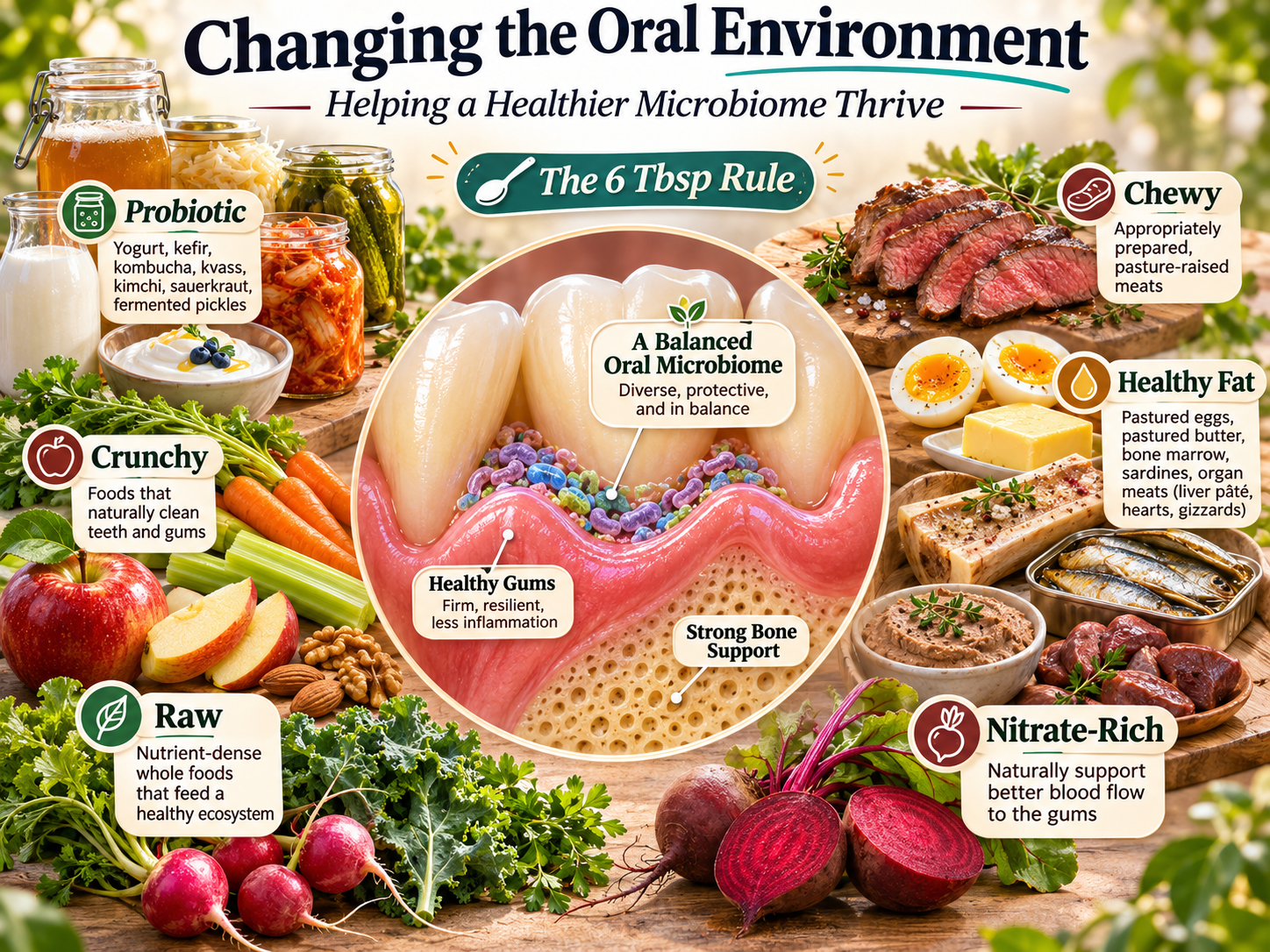
My six-tablespoon rule: Six ways to support a healthier mouth
With EVERY SINGLE MEAL - yes - breakfast included, I encourage patients to include at least one tablespoon each of something CRUNCHY, something CHEWY, something RAW, something PROBIOTIC, something containing a GOOD FAT, and something NITRATE-RICH.
But before you start imagining six little bowls lined up beside your dinner plate, let me explain. If you are a fan of Korean food at all, that's pretty much what BANCHAN is - those little dishes that come as sides with Korean BBQ usually fit all of the categories in some way. MEANING ONE FOOD CAN COUNT TOWARD MORE THAN ONE CATEGORY!
- A raw beet can be crunchy, chewy, raw, AND nitrate-rich.
- A lacto-fermented pickle can be crunchy, chewy, and probiotic.
- And a fresh arugula salad with avocado and olive oil covers several categories all by itself.
The goal is to include all six nutritional elements, not necessarily eat six different foods.
1. Something CRUNCHY: Feed the beneficial bacteria
I particularly like crunchy vegetables because many provide fiber and plant compounds that support beneficial microorganisms. Some fibers function as prebiotics, meaning they can be used by microorganisms in ways that benefit our health.
My favorite crunchy foods include:
-
Raw carrots
-
Celery sticks
-
Radishes
-
Jicama
-
Raw broccoli florets
-
Raw cauliflower
-
Red or green cabbage
-
Sugar snap peas
-
Snow peas
-
Raw bell peppers (well, to be honest, I really don't like Bell Peppers, but lots of people like them, so they made the list)
-
Cucumbers
-
Fresh apples
-
Asian pears
-
Raw beets
-
Water chestnuts
-
Lacto-fermented crunchy pickles
-
Raw sauerkraut with live cultures
And look at the crossover possibilities! Raw carrots, celery, radishes, and apples also count toward RAW and CHEWY. Raw beets add NITRATE-RICH, while a traditional lacto-fermented pickle may cover PROBIOTIC as well.
2. Something CHEWY: Give those jaw muscles something to DO!
Our jaws were designed to WORK! Chewing exercises the muscles that move our jaws, stimulates saliva, and places normal functional loads on the teeth and supporting structures. And I'm especially interested in how chewing function contributes to oral motor development and interacts with jaw development and airway health in children.
Foods that encourage actual chewing include:
- Pasture-raised organ meats of any kind (liver, gizzard, tripe, kidney, heart, thymus, stomach, whatever the offal meat is)
- Pastured meat jerkies of any kind.
- Naturally dried meat or jerky without excessive sugar
- Pasture-raised meat of any kind - beef, lamb, pork, chicken, turkey, goat, or whatever other meat has been raised appropriately for it's own dietary needs.
- Raw carrots
- Celery
- Jicama
- Apples
- Asian pears
- Raw cabbage
- Sugar snap peas
- Almonds
- Walnuts
- Pecans
- Hazelnuts
- Pumpkin seeds
And yes, hearts and gizzards absolutely belong on that list! They're traditional, nutrient-dense foods that many people have forgotten about. Of course, food texture needs to match the person's chewing and swallowing abilities. If someone has loose teeth, jaw pain, or a swallowing problem, we adapt the choices. For example, you can cook tough organ meats longer if needed to make them more tender. It's not as good for the jaws, but it just is what it is in terms of doing what you need to do to get the nutrition, because it comes first.
3. Something RAW: Add fresh nutrients and variety
I love incorporating raw foods because they're an easy way to add fresh vegetables, fruits, herbs, fiber, and plant compounds to a meal. Some of my favorites include:
-
Raw carrots
-
Celery
-
Cucumbers
-
Radishes
-
Jicama
-
Raw beets
-
Red cabbage
-
Green cabbage
-
Broccoli
-
Cauliflower
-
Arugula
-
Spinach
-
Romaine lettuce
-
Butter lettuce
-
Fresh parsley
-
Fresh cilantro
-
Fresh basil
-
Tomatoes
-
Avocados
-
Apples
-
Berries
-
Citrus fruit
-
Fresh pears
-
Sugar snap peas
Some of these foods cover several categories. Raw beets count toward CRUNCHY, CHEWY, RAW, and NITRATE-RICH. Celery can do the same. Avocado provides RAW and GOOD FAT. And a salad containing arugula, spinach, avocado, and crunchy vegetables can cover an impressive number of categories before you've even added the main course!
4. Something PROBIOTIC: Introduce living microorganisms
This is where my traditionally fermented foods come in. I'm especially interested in foods containing living microbial communities rather than depending entirely on probiotic supplements. Foods I recommend exploring include:
-
Plain yogurt containing live cultures
-
Traditionally cultured Greek yogurt
-
Milk kefir made with live kefir cultures
-
Water kefir
-
Coconut kefir with live cultures
-
Kombucha
-
Traditionally fermented beet kvass
-
Other traditionally fermented vegetable kvass
-
Kimchi
-
Raw, unpasteurized sauerkraut
-
Traditionally lacto-fermented cucumber pickles
-
Lacto-fermented carrots
-
Lacto-fermented beets
-
Lacto-fermented radishes
-
Lacto-fermented cauliflower
-
Lacto-fermented cabbage
-
Fermented garlic
-
Fermented onions
-
Fermented green beans
-
Live-culture fermented vegetable medleys
The preparation matters. Some commercial products are pasteurized after fermentation, while some pickles are simply preserved in vinegar and don't contain living cultures. And here's where the crossover becomes fun. Lacto-fermented carrots may cover CRUNCHY, CHEWY, and PROBIOTIC. Lacto-fermented beets can cover those categories while also providing NITRATE-RICH vegetables, although their nitrate content can change during fermentation. And crunchy kimchi or sauerkraut can satisfy more than one category.
5. Something containing a GOOD FAT: Nourish the tissues
I've long appreciated the nutritional work of Weston A. Price and Francis Pottenger, particularly their emphasis on traditional, nutrient-dense diets. I'm a big believer in REAL FOOD, including traditional animal fats, organ meats, and foods from animals raised on the diets their bodies were designed to eat.
I'm also a big believer in YUMMY AND VARIETY. You don't have to be bored with your food. Experiment! Be adventurous! You may never know what you are missing if you don't try something new! For example, I was really scared of blood products (like blood sausage, black pudding, blood cakes) for the longest time. But if you tend to run anemic, blood sausages and blood puddings are actually really good. ESPECIALLY FOR MENSTRUATING WOMEN. So my family became adventurous and one day tried the british black pudding, which is a blood sausage. My goodness, it was DELICIOUS. And extremely nutritious for our family of girls who tend to run anemic. Since then, we have blood sausages at least once or twice a month because I have two girls of childbearing age.
Some of my favorites include:
-
Butter from pasture-raised cows
-
Ghee made from pasture-raised butter
-
Whole pasture-raised eggs and egg yolks
-
Pasture-raised beef, lamb, and their natural fats
-
Pasture-raised pork and pork fat
-
Pasture-raised chicken and duck, including the skin
-
Beef tallow from pasture-raised cattle
-
Lard from pasture-raised pigs
-
Bone marrow (this is a family favorite. We buy meaty soup bones as one of our less expensive cuts of meat, and we stew them in all kinds of ways)
-
Sardines (another food we were afraid to try, and when we finally did, it became a family favorite. Now the three of us share a tin every day at dinner to get us the right kind of fats in our diet)
-
Wild-caught salmon, herring, and mackerel
-
Liver pâté made with butter or another traditional fat
-
Chicken, duck, and beef liver
-
Pasture-raised hearts and gizzards
-
Avocados
-
Olives and extra-virgin olive oil
-
Walnuts, pecans, almonds, and macadamia nuts
-
Pumpkin seeds
Some organ meats, such as hearts and gizzards, are relatively lean, so I consider them part of a nutrient-dense traditional diet rather than automatically counting them toward the fat portion of this rule. And liver is extraordinarily rich in vitamin A, so this is one of those foods where a little can go a long way.
But there's a reason I keep emphasizing PASTURE-RAISED animal foods. And it's not simply because I like the idea of happy cows wandering around eating grass! I mean obviously animal welfare is important to me, but I'm never going to be vegan.
What happens when we feed cattle GRAIN instead of GRASS?
Cows are RUMINANTS. Their digestive systems are adapted primarily to eating forage, including grass and other plants. But in conventional beef production, cattle are often moved onto high-grain finishing diets to encourage faster weight gain and greater fat deposition. And what the animals eat changes the composition of their tissues.
We have research showing exactly that. In 2024, researchers compared meat from 18 pasture-finished cattle and 18 grain-finished cattle. [A47]. And the differences were significant. The pasture-finished beef contained:
-
4.1 times as much total omega-3 fatty acid
-
3.5 times as much EPA
-
2.6 times as much DPA
-
3.1 times as much alpha-tocopherol, a form of vitamin E
But here's the part that REALLY caught my attention. The researchers measured the ratio of omega-6 to omega-3 fatty acids in the meat.
Pasture-finished beef: 1.58 to 1
Grain-finished beef: 10.85 to 1
Let's do some Mom Math. Take the grain-finished ratio and divide it by the pasture-finished ratio.
10.85 ÷ 1.58 = 6.87
That's nearly a SEVENFOLD difference in the omega-6-to-omega-3 ratio! And we're talking about the actual fatty-acid composition of the meat, not an opinion about which farming method sounds healthier. The researchers measured these differences in the laboratory. Now, a ratio by itself doesn't tell us the total amount of each fatty acid. But in this study, pasture-finished beef also contained considerably more omega-3.
And there's another important question. Do those nutritional differences actually show up in the HUMAN BODY when we eat the meat. Researchers investigated that, too!
What happened when PEOPLE ate grass-fed meat?
In a randomized clinical trial published in 2011, researchers studied 20 healthy adults. [A48]. For four weeks, the participants ate three weekly portions of beef and lamb. One group received meat from animals raised on grass-based diets. The other received meat from concentrate-fed animals. And when researchers examined their blood, they found that people eating the grass-fed meat had higher concentrations of long-chain omega-3 fatty acids in their plasma and platelets.
Think about what that means. The animal's diet influenced the fatty acids in its meat. And when people ate that meat, researchers could measure the difference in their BLOOD! The study didn't measure long-term outcomes such as cardiovascular disease or fatty liver, so those aren't conclusions we can draw from it. But it established something very important.
The nutritional composition of our animal foods is influenced by what those animals were fed. And those differences don't necessarily disappear when the meat reaches our dinner plates. That's why I care about how animals are raised. I'm interested in the nutritional quality of the food, not simply how much protein it contains. And it's why I prefer pasture-finished beef, butter from pasture-raised cows, pasture-raised eggs, and other traditionally raised animal foods.
And don't forget sardines and ORGAN MEATS!
I think we've forgotten how nutritious some traditional foods can be.
- Sardines are a wonderful example because they're naturally rich in EPA and DHA, two important long-chain omega-3 fatty acids.
- And organ meats provide nutrients that are often much more concentrated than those found in ordinary muscle meat.
- Liver provides substantial amounts of vitamin A, B12, iron, and copper.
- Heart supplies protein, B vitamins, and other nutrients involved in normal cellular function.
- Gizzards are another traditional, protein-rich food that can provide the chewing muscles with some work to do.
- And pâté is a practical way to incorporate liver into meals without asking somebody to sit down to a giant plate of liver and onions.
- A tablespoon of good liver pâté made with pasture-raised butter can fit beautifully into this nutritional approach!
- Cod liver oil is also a good source of fat, but to be honest, I don't love it flavorwise. That being said, if you like it, knock yourself out.
Why I'm particular about seed oils
And while we're talking about fats, I want to mention something else. I'm not a fan of building our diets around industrially processed seed oils. You may recognize soybean, corn, cottonseed, sunflower, safflower, and canola oils.
I call canola oil the great CON-ola!
One concern supported by research involves oils repeatedly exposed to high-temperature cooking. As oils are heated and reused, their fats can oxidize and break down, producing substances such as reactive aldehydes. Researchers have measured increasing oil degradation during repeated frying, particularly at higher temperatures. [A49] [A50]. That matters when we're considering the oils used to prepare commercially fried and ultra-processed foods.
I also pay attention to the balance of dietary fatty acids. Many conventional diets contain substantial amounts of omega-6 from processed foods while providing relatively little long-chain omega-3. Now, omega-6 fatty acids themselves are essential nutrients, and controlled human trials haven't consistently shown that ordinary linoleic-acid intake increases inflammatory markers. [A51]. That's different from examining chemically degraded oils repeatedly heated for frying.
I prefer building meals around whole, nutrient-dense foods and carefully chosen fats rather than relying heavily on ultra-processed foods and repeatedly heated cooking oils. Because the quality of our food begins long before it reaches our plates. And when we're discussing ways to nourish our bodies and support a healthier oral environment, I believe that's worth paying attention to.
Account required
Sign in to see more
Create an account or sign in to unlock the full list.