Resource Libraries
Why Gum Disease Is So Easy to Miss
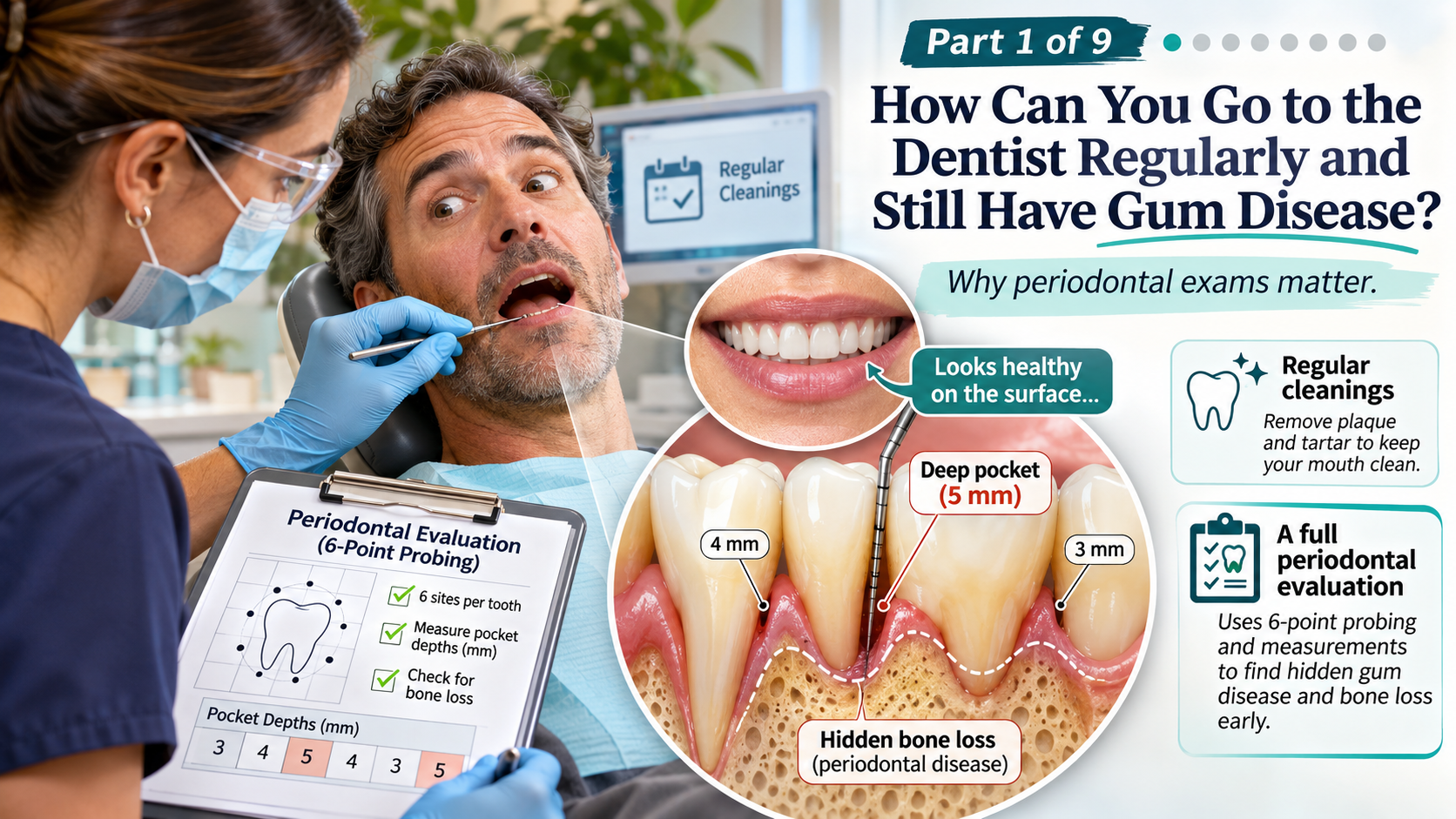
Can you visit the dentist every six months and STILL have serious gum disease without knowing it? In Part 1 of this 9-part series, we explore why periodontal disease is so often missed, what a comprehensive gum examination should include, and how early detection can help prevent devastating bone loss and tooth loss.
Part 1 of the Periodontal Disease Series
This is part 1 of a 10 -part series I’ve written on periodontal disease. It’s such a big topic that I have a master article HERE if you wish to read it, but I’ve tried to break it up into readable, easier-to-digest chunks for the person who needs to learn at a more manageable pace. The master articles are for the dentists and healthcare practitioners who want the mini-book, “90 pages printed” kind of articles. The rest of our consumers really aren’t looking for a series of booklets. So we will do our deep dives into the subject gently. Each of these smaller articles will still do the deep dives. In fact, they can stand on their own, and I may even include new references, because why not keep all of this reading interesting?
One quick note about the research references: I'm keeping the same reference numbers used in my periodontal disease master article so you can easily find the original studies in either place. That's why the numbers in these smaller articles may skip around. And because I'm adding some additional research specifically for this series, those new studies will be labeled [A1], [A2], and so on, with their complete references included at the end of the article.
How can you go to the dentist regularly and still have gum disease?
Imagine someone who's been faithfully visiting the dentist every six months for twenty years. They show up for their appointments, get their teeth cleaned, have the occasional X-ray, and leave with a new toothbrush and a reminder to floss. Everything seems fine. Then they switch dentists. Or they move somewhere else. Or the practice they were in was bought by another dentist. Or the dentist they have always seen hires a new hygienist. Whatever the situation, one day, they are told they have significant periodontal disease. They've lost bone around several teeth, some pockets are unusually deep, and they may need more extensive treatment.
WAIT! WHAT?
How did that happen? They've been going to the dentist for YEARS! I've been practicing dentistry for more than thirty years, and situations like this are one reason I get so frustrated when periodontal disease is treated as though it's simply a problem with someone's brushing and flossing habits. Of course cleaning matters. It matters a LOT. But periodontal disease involves bacteria, our immune systems, inflammation, connective tissue, and the bone supporting our teeth. Blood sugar, hormones, medications, genetics, and other health conditions can influence how those tissues respond. And a person can lose an enormous amount of supporting bone without experiencing significant pain.
So when someone tells me they've been seeing their dentist regularly but had no idea they were developing periodontal disease, I have some very specific questions.
- Were their periodontal tissues actually being measured and monitored?
- Do they ever recall being measured?
- Has their hygienist ever discussed periodontal disease with them?
- Have their gums been bleeding for years, or is this new?
- Have they noticed any changes in their health?
- Have they seen their dentist every 3-6 months regularly?
- Do they remember ever having had a "deep cleaning"?
- Have they ever been told that periodontal disease is treatable but not curable?
Because a cleaning and a periodontal examination aren't the same thing.
What should happen during a periodontal examination?
If you've ever heard your hygienist calling out numbers while someone enters them into a computer, you've probably heard periodontal measurements being recorded. Those numbers describe the depth of the space between your teeth and gums. We use a small instrument called a periodontal probe. It's marked in millimeters, allowing us to measure the space around each tooth. And we don't just measure one spot. A complete periodontal exam typically includes SIX measurements around every tooth. If you have 28 teeth because your four wisdom teeth are missing, that's 168 measurements!
Why so many? Because the supporting tissues around a tooth can be healthy in one area and severely damaged in another. One side of a molar might have a healthy, shallow measurement while another side has a deep pocket filled with bacterial deposits. If we only measure one or two convenient locations, we can miss an awful lot of information. Generally, we like to see pocket measurements of 1–3 mm. When we start seeing measurements of 4 mm, we need to investigate what's happening. Pockets measuring 5–6 mm raise greater concerns, and measurements of 7 mm or more can indicate significant periodontal destruction.
But pocket depth is only ONE part of the exam. [5]. We also need to know how much supporting attachment remains, whether the gums are bleeding, whether there's recession, whether X-rays show bone loss, and whether teeth have become loose. For molars, we also examine the spaces where the roots divide. These areas can become especially difficult to clean when periodontal disease has destroyed the bone surrounding them. And the measurements need to be documented so we can compare them with future exams.
What happens when dental offices aren't recording those measurements?
Believe it or not, this problem has actually been studied. It's such a common issue that it has become one of the biggest reasons people sue dental offices - "failure to diagnose" is a real and valid complaint. In 1989, researchers examined periodontal probing practices in 134 dental offices in Florida. They found that only 62% of those offices reported performing and recording complete periodontal probing examinations for new patients. That means 38% weren't documenting complete periodontal probing examinations when patients first came into the practice! And the numbers were even worse for established patients returning for regular appointments. Only 57% of practices reported performing and recording complete probing examinations for those patients. [3]. Which means that fewer than half of the dental offices were recording those numbers after the first set of probings.
Another study examined 2,488 patient records from 36 dental offices in North Carolina. Researchers found that only 16.3% of the records contained a documented periodontal diagnosis. And only 20.5% contained documentation of probing depths or tartar during the previous five years. [4]
FIVE YEARS!
Now, these are older studies, and I would love to see newer national research examining how consistently complete periodontal charting is being performed today. But these findings demonstrate that incomplete periodontal examinations and documentation have been recognized problems for DECADES. And this isn't simply my personal preference. The American Academy of Periodontology recommends that adults receive a comprehensive periodontal evaluation at least ONCE EVERY YEAR. That includes evaluating the gums, measuring periodontal pockets, checking the supporting tissues and bone, and documenting what we find. [A4]
We're talking about SIX measurements around every tooth, along with the other information that tells us whether the supporting structures are healthy. And for patients who already have periodontal disease, we may need to evaluate those tissues much more frequently. So if you've been seeing your dentist every six months for years, but nobody has performed and documented a comprehensive periodontal examination in the last several years, that's something worth asking about!
But failure to probe regularly is especially frustrating because periodontal disease can quietly destroy the structures holding our teeth in place. We wouldn't monitor someone's blood pressure by looking at them and deciding they seem healthy. We actually measure their blood pressure. We wouldn't tell someone with diabetes that their blood sugar looks fine because they're smiling and seem energetic. We measure that, too. So why would we evaluate the bone supporting someone's teeth by glancing at their gums and deciding everything looks pretty good?
And there's another problem. Even when people HAVE periodontal disease, they often don't know it. In a 2014 American study involving 972 women, researchers compared what the women believed about their periodontal health with what their actual dental examinations showed. They discovered that 43.8% of the women with SEVERE periodontal disease didn't report having been diagnosed with gum disease! [A1].
That's almost HALF of the women with severe disease!
And a much larger study published in 2026 examined 158,990 adults aged 75 and older in Japan. Researchers compared what people reported about their gums and teeth with what their dental examinations actually revealed. Among people whose gums bled when examined, 76% hadn't reported experiencing bleeding gums. And among those whose teeth had significant mobility, 57% hadn't reported that their teeth were loose! [A2]. We're talking about people who had measurable problems that they weren't even recognizing.
So it's actually quite common for people to say their gums don't hurt, they haven't noticed any bleeding, and their teeth feel perfectly fine. But we STILL need to measure what's happening underneath those gums. And there's research showing why measuring ALL the sites matters, too. In a 2010 study, researchers compared complete periodontal examinations with older methods that examined only selected teeth and locations. They found that the limited examination methods could underestimate how common periodontal disease was by 50% or MORE! [A3]
Imagine having a disease that can quietly destroy the bone supporting your teeth, not recognizing the symptoms, and then having an exam that misses large portions of your mouth! This is why I encourage people to ask whether they're receiving a comprehensive periodontal exam. We have the ability to measure what's happening, document changes, and identify problems before someone ends up with teeth that are moving around in their sockets.
Why healthy-looking gums can be misleading
Our society spends an enormous amount of money on products designed to make teeth whiter. Apparently, we've decided that a mouth full of sparkling-white teeth is the picture of perfect dental health. But tooth color tells us very little about what's happening underneath the gums. Someone can have beautiful white teeth and still be losing the bone supporting them. And sometimes the gums themselves don't look particularly unhealthy, either.
Periodontal disease can develop gradually, especially when the inflammation is occurring deep underneath the gumline. A person might have very little discomfort, occasional bleeding, or small changes they haven't recognized as symptoms. Maybe a space begins appearing between two teeth. Maybe food starts getting trapped somewhere it never used to collect. Maybe one tooth looks slightly longer than the others. Or maybe their teeth start shifting and their bite feels different. Those changes deserve attention because they can tell us something about what's happening to the tissues supporting the teeth.
I've seen patients with periodontal destruction so advanced that a tooth appeared to be floating on the X-ray because almost all the surrounding bone was gone! NO JOKE!! And sometimes those patients weren't experiencing pain EVEN THEN! That's one of the reasons I consider periodontal disease such a insidious and serious health problem. Pain is a terrible screening tool for a disease that can destroy supporting bone without making someone particularly uncomfortable.
Why the numbers can be confusing
Imagine two patients whose periodontal exams both reveal a five-millimeter pocket. Same number. Same measurement. But their actual conditions might be completely different. The first patient has swollen, inflamed gums. The swelling makes the pocket measure deeper, although the attachment and supporting bone may still be relatively healthy. The second patient has lost several millimeters of attachment and supporting bone. Both have a five-millimeter measurement, but the amount of permanent damage is very different.
That's why we also measure something called clinical attachment level, which tells us how much supporting attachment has been lost relative to a fixed point on the tooth. [5]. We need to look at where the gumline sits, how much attachment remains, what the X-rays show, and whether the tissue is inflamed. It's also important to distinguish between a pocket that's been stable for years and one that's getting deeper every time we examine it. A single measurement gives us information about what's happening TODAY. Comparing measurements over time tells us whether the disease is improving, remaining stable, or getting worse. And THAT is why accurate periodontal charting matters so much.
Why teeth sometimes look longer after periodontal treatment
When gums are inflamed, they can become swollen and puffy. Once the inflammation improves, that swelling begins to disappear. The gums may shrink back toward their healthier position, and suddenly the teeth appear longer. Some patients become upset because they think the dentist or hygienist caused their gums to recede. But what they're often seeing is the actual gumline after the inflammation and swelling have resolved. The supporting tissue may have already been damaged by periodontal disease. The swelling was simply hiding some of those changes. And periodontal treatment doesn't automatically rebuild all the supporting structures that were lost.
Gingivitis, which is inflammation of the gums without the attachment and bone destruction associated with periodontitis, can be reversed.
Periodontitis involves destruction of the supporting tissues. We can often stop that destruction from progressing, and certain regenerative treatments can rebuild some of the lost support in selected situations. But simply getting the inflammation under control doesn't magically return every tooth to the support it had before the disease developed. [6]
Patients deserve to understand those differences before treatment. Nobody should have to discover that their teeth look longer while staring into the bathroom mirror and wondering what on earth happened at their dental appointment!
Why a little bleeding deserves attention
Another common misunderstanding is that bleeding gums are normal. People may notice blood when brushing or flossing and assume they've simply brushed too hard. Sometimes tissue can be injured by overly aggressive cleaning. But persistent bleeding, especially when it occurs in several places, deserves investigation. When we gently measure periodontal pockets, bleeding can tell us that the tissue is inflamed. We record where bleeding occurs and compare those findings over time. And we look at the whole picture.
A patient who's bleeding at one isolated spot after accidentally injuring their gum is in a different situation from someone whose gums bleed at dozens of locations during every examination. Smoking and certain medical conditions can also affect how gum tissues respond, so we need to understand the person's health history. But one of the most useful things about documenting bleeding is that we can measure whether it improves after treatment. If someone has bleeding at many locations during their initial examination, and those areas stop bleeding after appropriate care, that's valuable information. We're seeing a change in the health of the tissues.
What if your teeth have already started moving?
Loose teeth scare people, and I get it. People have literal nightmares about their teeth falling out! But a tooth that moves isn't automatically a tooth that needs to be extracted. Teeth are held in their sockets by a living system of tiny fibers called the periodontal ligament. That ligament allows a small amount of natural movement and helps distribute the forces produced when we chew.
When the supporting bone and ligament are damaged, a tooth may begin moving more than it should. But mobility can have several causes.
- Orthodontic treatment deliberately moves teeth, for example. And teeth may feel temporarily looser during orthodontics while the supporting tissues are changing.
- Excessive biting forces, inflammation, and injury can also influence how securely a tooth feels
So before recommending an extraction, we need to understand WHY that tooth is moving.
- How much supporting bone remains?
- Is the inflammation active?
- Is the bite putting excessive pressure on the tooth?
- Can we stabilize the situation?
We aren't cookie cutters. Some teeth improve considerably when inflammation is controlled and contributing forces are addressed. Others have lost so much support that their long-term prognosis is poor. The important part is making that decision based on a proper examination rather than deciding that any tooth with mobility needs to come out.
How widespread is periodontal disease?
The numbers are much bigger than many people realize. A global study estimated that approximately 1.07 BILLION people had severe periodontitis in 2021. [8]. And a 2023 review examining 55 studies found periodontal disease in approximately 61.6% of the people represented in the studies using the more reliable diagnostic methods. [9]
That's more than SIX out of every TEN people!
When the researchers looked at adults aged 65 and older, the estimated prevalence climbed to 79.3%. Nearly EIGHT out of every TEN older adults in those studies! And remember, we're talking about periodontitis, where the structures supporting the teeth have already been damaged. In the United States, researchers analyzed complete periodontal examinations from 10,683 adults aged 30–79 and found that 42.2% had periodontitis, including 7.8% with severe disease. [10]. The percentage increased to 59.8% among adults aged 65 and older. [12]
We're talking about an enormous public health problem involving people who may feel perfectly healthy and have no idea they're losing supporting bone. That alone should be enough to make comprehensive periodontal examinations a routine part of protecting our health.
What should happen after a diagnosis?
Account required
Sign in to see more
Create an account or sign in to unlock the full list.