Resource Libraries
The Oral Microbiome, Biofilms, and Why Gums Lose Bone
Your mouth is home to hundreds of different microorganisms, and some can actually help create the conditions that destroy the bone supporting your teeth! In Part 2 of our periodontal disease series, we explore the oral microbiome, organized bacterial biofilms, protozoa that damage living gum cells, and the surprising ways our own immune systems contribute to periodontal destruction.
Part 2 of the Periodontal Disease Series
This is Part 2 of my 10 -part series exploring periodontal disease and the science behind what's happening underneath our gums. I've also written a much larger master article that you can find HERE for anyone who wants to explore the research in greater depth. Each article in this series covers a different part of periodontal health, so you can read them individually or follow the entire series. And while these articles are shorter than the master, we're still going to dig into the research. There's an awful lot more happening inside our mouths than most people realize!
One quick note about the research references: I'm keeping the same reference numbers used in my periodontal disease master article so you can easily find the original studies in either place. That's why the numbers in these smaller articles may skip around. Any new studies added specifically for this series will be labeled [A1], [A2], and so on, with their complete references included at the end.
You've got an entire community living inside your mouth!
Have you ever stopped to think about how many living organisms are sharing your mouth with you? I'm not talking about an occasional bacterium that wandered in while you were eating lunch. I'm talking about literally hundreds of different kinds of microorganisms living on your teeth, tongue, gums, and other oral tissues.
And that's NORMAL!
We have bacteria, fungi, viruses, and tiny single-celled organisms called protozoa living in our mouths. Many of them coexist peacefully with us, and some help maintain the environment that keeps other microorganisms from becoming a problem. [17]. We've spent decades being bombarded with advertising about antibacterial this and antimicrobial that. Apparently, we're supposed to be trying to sterilize everything we touch. But we aren't meant to be sterile beings. We actually NEED many of the microorganisms that live in our mouths! The challenge is maintaining an environment where the microorganisms associated with health can flourish without allowing the ones associated with disease to take over. And when that balance changes, the consequences can be pretty serious.
What happens when the weeds take over?
Imagine you've planted a beautiful garden. You've got rich soil, healthy plants, and all sorts of beneficial microorganisms working underneath the surface. Everything is thriving. But then the conditions in your garden begin changing. Maybe the soil becomes too acidic. Maybe the drainage changes, or the plants stop getting the nutrients they need. Certain plants begin struggling. Meanwhile, weeds that LOVE those new conditions start multiplying. Eventually, the weeds begin crowding out the plants you actually wanted to grow. Your garden hasn't necessarily been invaded by something completely new. The conditions have simply changed enough to favor different organisms.
Something similar happens inside our mouths. Scientists call this dysbiosis, which means the community of microorganisms has become unbalanced. [13]. The conditions inside the mouth influence which microorganisms thrive. Those microorganisms influence the conditions around them. And our immune systems respond to all of it. So we can end up with an environment where the organisms associated with periodontal disease have an advantage over the organisms associated with health. And once that happens, getting the balance back under control can be challenging.
Not every part of your mouth is the same
Think about the different places microorganisms can live.
- The surface of your tongue is covered with tiny structures that create places for microorganisms to settle.
- The smooth surface of a front tooth is a completely different environment.
- The grooves on a molar offer another set of conditions.
- And a deep periodontal pocket underneath the gumline is different from ALL of those.
There's less oxygen in some of these environments. Saliva reaches them differently. The available nutrients change. And the tissues surrounding them may be inflamed. Even different sides of the SAME tooth can have completely different microbial communities. That's important because we can collect a saliva sample and identify bacteria associated with periodontal disease, but that doesn't necessarily tell us what's living deep inside one particular periodontal pocket. We have to understand where the microorganisms are living and what they're doing. And researchers have discovered that some of these organisms are very good at working together.
The discovery that changed how we understood periodontal bacteria
In 1998, researcher Sigmund Socransky and his colleagues published a study that became one of the foundations of modern periodontal microbiology. They collected 13,261 bacterial plaque samples from 185 people and investigated 40 different bacterial groups. [14]. That's an awful lot of samples! And what they discovered helped explain why some bacterial communities are associated with healthier periodontal tissues while others are strongly associated with disease.
Certain bacteria tended to appear together.
They weren't simply scattered randomly throughout the mouth. Some groups were commonly found in healthier environments, while others appeared much more frequently in deeper periodontal pockets associated with inflammation and bleeding. The researchers organized these bacteria into groups that became known as the colored bacterial complexes.
If you've ever seen a periodontal bacterial chart covered in yellow, green, purple, orange, and red, this research is where those colors came from. I've wondered whether someone simply grabbed a handful of colored highlighters when they started organizing their research. I haven't found any evidence that's how it happened, but it certainly made the results easier to teach! So what did the colors mean?
The yellow, green, and purple complexes
The YELLOW complex included several Streptococcus species, including bacteria that commonly settle on tooth surfaces during the early development of dental plaque. Many of these bacteria are normally found in healthy mouths.
The GREEN complex included organisms such as Capnocytophaga and Eikenella corrodens. These bacteria were associated with earlier bacterial communities and weren't as strongly connected with periodontal destruction as the red-complex organisms.
The PURPLE complex included organisms such as Veillonella parvula and Actinomyces odontolyticus. These communities help establish the microbial populations living on our teeth.
When those communities develop, different bacteria begin interacting with one another. Some produce substances that neighboring organisms can use as food. Others help create the conditions that allow additional microorganisms to settle into the community.
Which brings us to the next two groups.
The orange complex
The ORANGE complex included bacteria such as Fusobacterium nucleatum, Prevotella intermedia, and Campylobacter rectus. These organisms were more strongly associated with periodontal disease. And Fusobacterium nucleatum is particularly important because it can help other bacteria attach to one another. It's sometimes called a bridge organism because it can connect different groups of bacteria as larger microbial communities develop.
Imagine you're building an apartment complex. You start with the foundation and the first few apartments. Then you add more buildings, connect them with walkways, and create the infrastructure that allows more people to move in. Some bacteria play similar roles in developing microbial communities. They help create the structure that allows additional organisms to establish themselves. And then we reach the group that really caught researchers' attention.
The red complex
The RED complex contained three bacteria that were especially strongly associated with deeper periodontal pockets and bleeding gums:
-
Porphyromonas gingivalis
-
Tannerella forsythia
-
Treponema denticola
These bacteria have become some of the most extensively studied microorganisms in periodontal research. One particularly important finding was that red-complex bacteria were rarely found without members of the orange complex already being present. [14]. That suggested that the relationships between bacterial groups were important. Certain communities could help establish conditions where other, more destructive organisms could flourish.
And as scientists developed better DNA-based methods for identifying microorganisms, they discovered that the oral microbiome was even more complicated than those original bacterial complexes suggested. [15]
How one bacterium can influence an entire community
Porphyromonas gingivalis, usually shortened to P. gingivalis, is one of the members of Socransky's red complex. Researchers have discovered that this organism can interfere with the way our immune systems respond to bacteria. And in 2011, scientists published an experiment that showed something what happened when P. gingivalis was introduced into the mouths of mice. Even when this bacterium represented a very small percentage of the overall bacterial community, it was capable of changing how the surrounding microorganisms and immune system interacted. The researchers found that it could encourage an unhealthy microbial community and promote inflammatory bone loss.
But there was another finding. When the broader community of ordinary bacteria wasn't present, P. gingivalis couldn't produce the same destructive effects. The organism depended on its interactions with the other bacteria! [18]. That helped researchers develop what we call the keystone pathogen concept. A keystone organism can have an influence on a much larger biological community even when relatively few of those organisms are present.
Think about a garden where one aggressive weed changes the conditions enough that other weeds begin flourishing. The original weed doesn't have to make up most of the garden to create a problem. And in the mouth, P. gingivalis can influence the immune system and surrounding microbial community in ways that favor periodontal disease. Now, those particular experiments were performed in mice. But they gave researchers a way to investigate something we've observed clinically for years. Two patients can have similar amounts of plaque and VERY different amounts of periodontal destruction. The makeup of the microbial community matters. And so does the person's immune response.
What happens BEFORE a periodontal pocket starts getting worse?
Researchers can now investigate something even more useful than which microorganisms are living underneath our gums. They can study what those microorganisms are actually DOING! In 2025, scientists published a study in which they followed 15 people for an entire year. They compared periodontal sites that remained stable with sites where disease continued progressing. Instead of simply measuring which organisms were present, they examined gene activity involving both the microorganisms and the patients' own cells. And at approximately six months, they identified a major change in how those systems were behaving. We're talking about differences in the activity of 1,722 human genes and 111,705 microbial genes! [A5]. Now, that doesn't mean 111,705 different bacteria suddenly appeared. The researchers were measuring which genes were more or less active.
Think about two factories that have exactly the same equipment. One factory might have only a few machines running, while the other has nearly every machine operating at full speed. If we simply counted the equipment, those factories might look similar. But their actual activity would be VERY different.
Something similar can happen with microorganisms. Two periodontal pockets may contain many of the same bacteria, but the activity of those communities can differ dramatically. The researchers discovered differences in immune activity between stable and progressing sites. They also identified changes involving how microorganisms used nutrients and interacted with their environment.
One particularly important finding involved genes associated with the immune system's ability to recognize and respond to threats. Those genes were more active in stable periodontal sites before the six-month transition than in sites where the disease continued progressing. That gives us another piece of the puzzle.
The presence of microorganisms is important, but their activity AND the body's response help determine what happens to the supporting tissues. And because the researchers followed those sites over time, they could examine changes occurring as the disease progressed rather than relying on one examination. That's the kind of research that helps us understand why one periodontal pocket can remain relatively stable while another pocket in the SAME mouth continues losing bone.
What exactly is a biofilm?
Most people have heard the word plaque. But dental plaque is actually an organized community of microorganisms called a biofilm. And understanding how a biofilm works helps explain why periodontal disease can be so difficult to manage. When you clean your teeth, salivary proteins begin forming a thin layer over the tooth surfaces almost immediately. Certain bacteria attach to that layer. Then other bacteria attach to the bacteria that are already there. Over time, these microorganisms produce substances that help hold the community together. The bacteria begin sharing nutrients, competing for resources, and creating different environments within the same structure. [19]
Remember that apartment complex? Some bacteria live near the outer surfaces, where they're more directly exposed to saliva and oxygen. Others live deep inside the structure, where the environment is very different. The protective material surrounding the community can also affect how easily antimicrobial substances reach the microorganisms living inside it. That's one reason a mouthwash that kills free-floating bacteria in a laboratory doesn't necessarily behave the same way against a mature biofilm attached to a tooth.
We need to physically DISRUPT the biofilm.
And when that biofilm extends deep into a periodontal pocket, we have a problem. A toothbrush can't reliably reach all the way to the bottom of a six- or seven-millimeter periodontal pocket. So someone can brush faithfully, clean between their teeth, and still have an established microbial community living in a place their home-care tools can't adequately reach. That's a structural problem, not a failure of personal character. And researchers are learning that physically disrupting those communities can change which microorganisms flourish afterward.
What happens to the oral microbiome AFTER periodontal treatment?
In 2026, researchers published a study involving 39 people with moderate to severe periodontal disease. They collected bacterial plaque samples before treatment and again approximately three to four months afterward. But instead of looking for only a few familiar periodontal bacteria, they used a technology called shotgun metagenomic sequencing. That's a fancy name for a method that allows researchers to examine enormous amounts of microbial DNA.
Across 78 samples, the researchers identified approximately 3.18 MILLION different microbial genes and 12,353 microbial species-level classifications! [A6]. Those numbers represent what was detected across the collected samples, not the number of living bacterial species inside one person's mouth. The technology allowed the researchers to look much more deeply at how the bacterial communities changed following treatment. And the results were encouraging.
After professional periodontal treatment, several microorganisms associated with periodontal disease decreased, including Porphyromonas gingivalis. Meanwhile, bacteria more commonly associated with healthier oral environments, including certain Actinomyces species and Streptococcus cristatus, increased. The researchers also measured clinical improvements. Bleeding during periodontal probing decreased from approximately 45% of examined sites to 29%. Average pocket depth at the sampled sites improved from 5.70 mm to 4.45 mm. That's an average improvement of 1.25 mm in those sampled pockets! And because we're measuring tissues in millimeters, that's a meaningful change. [A6]
But there was another finding I want to highlight. Microbial gene and species richness actually INCREASED following treatment. That means the researchers detected a greater variety of microbial genetic information after the periodontal environment improved. Now, greater diversity isn't automatically healthier in every part of the human body. Different environments have different biological requirements. But in this particular study, the increase occurred alongside clinical improvements and a shift away from several organisms strongly associated with periodontal disease.
We're seeing how treatment can change the organization of the microbial community, allowing different organisms to become more prominent. And THAT is why I'm so interested in helping healthier bacterial populations flourish rather than approaching the mouth as something that needs to be sterilized.
The bacteria that LOVE inflammation
Here's where periodontal disease becomes particularly nasty. You might assume that inflammation makes life difficult for bacteria. After all, inflammation is part of our immune system's response to infection. But certain periodontal bacteria have found ways to take advantage of it. As the gums become inflamed, additional fluid and proteins enter the periodontal pocket. The surrounding tissues may begin breaking down, releasing even more material. And some of the bacteria associated with periodontal disease can actually use those materials as nutrients.
Researchers call these organisms inflammophilic, which means they flourish in inflammatory conditions. [73]. So we end up with a vicious cycle. The bacteria encourage inflammation. The inflammation changes the environment and provides additional nutrients. Those conditions help certain bacteria multiply, and the growing bacterial community encourages still more inflammation.
Remember our garden? Now imagine that the weeds themselves are changing the soil in ways that help MORE weeds grow. That's part of what makes periodontal disease so difficult to manage. And it's also why biological periodontal treatment needs to address the conditions surrounding those microorganisms.
But before we get to the other things we can do to encourage a healthier environment, there's another group of microorganisms I want you to meet. Because bacteria aren't the only tiny creatures living underneath our gums.
Meet the protozoa!
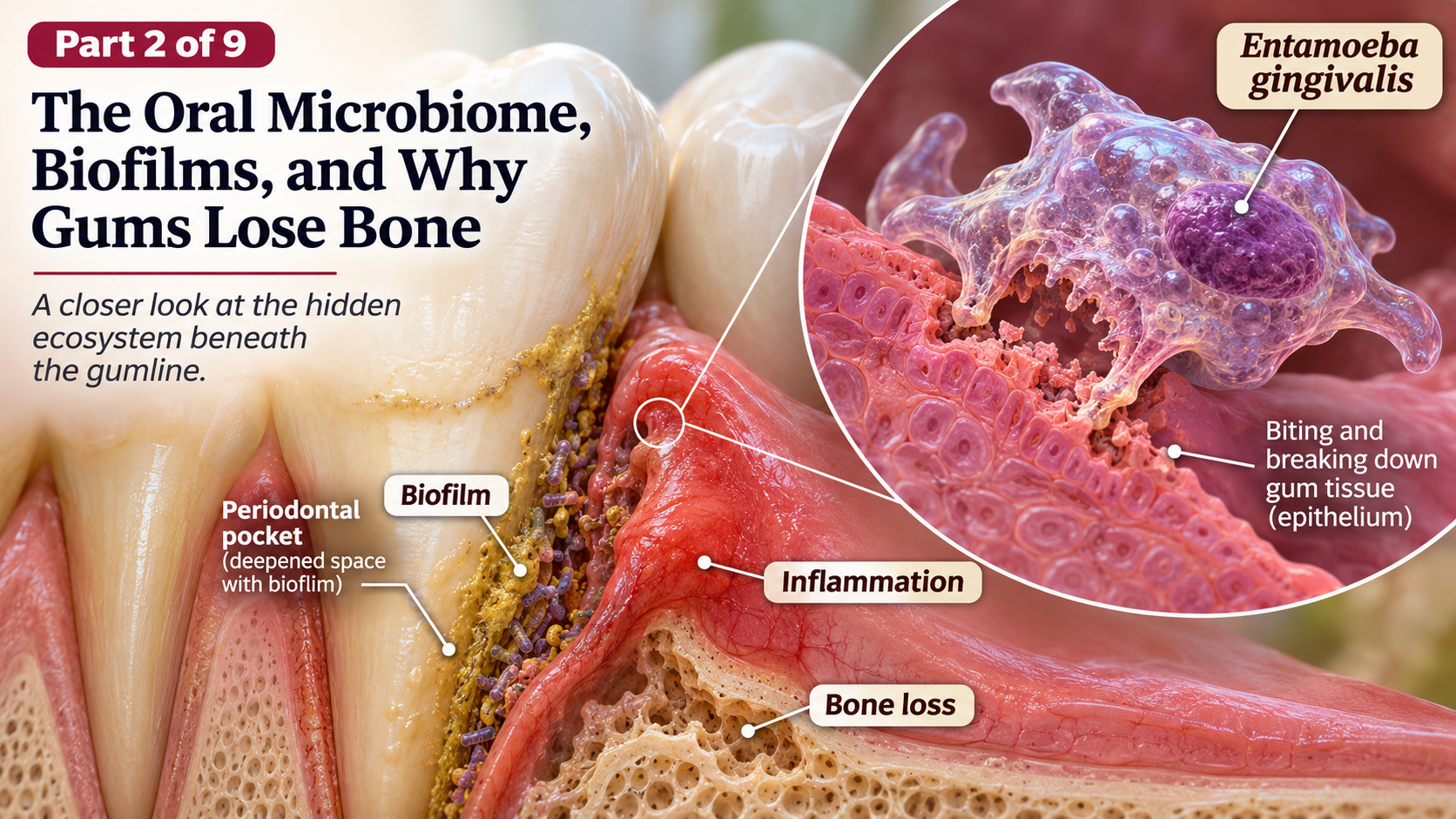
Protozoa are microscopic, single-celled organisms. And yes, we have protozoa living in our mouths, too. Two that have received particular attention in periodontal research are Entamoeba gingivalis and Trichomonas tenax. Researchers have identified both organisms in human mouths, including periodontal pockets. For years, these organisms were primarily identified using microscopes. But modern DNA-based methods have made it easier to detect them and study their relationships with periodontal disease. [21]. And researchers have discovered something about Entamoeba gingivalis that's particularly disturbing. It can actually take bites out of living human gum cells! I'm not making that up.
A microorganism that eats pieces of living cells
In a 2021 study, researchers exposed human gum cells to Entamoeba gingivalis and watched what happened. They used sophisticated imaging methods to examine how the organism interacted with the cells. And they observed it removing pieces of living cells. Scientists call this process trogocytosis.
Imagine a microscopic organism attaching itself to one of your living gum cells and taking little bites out of it. That's what the researchers observed. [22]. But the physical damage wasn't the only finding. The gum cells also responded by dramatically increasing the activity of genes involved in inflammation. Two of those genes were called TNF and IL8. You don't need to memorize those names. They're involved in producing chemical messages that help regulate inflammation. And researchers measured some VERY large changes.
Activity involving TNF increased approximately 430-fold. Activity involving IL8 increased approximately 359-fold. [22]
Account required
Sign in to see more
Create an account or sign in to unlock the full list.