Resource Libraries
Menopause and Gum Disease: When the Body Loses Its Buffer
Why gum disease accelerates in menopause, how poor sleep, airway strain and estrogen loss strip the body's reserve, and why women deserve biology, not blame.
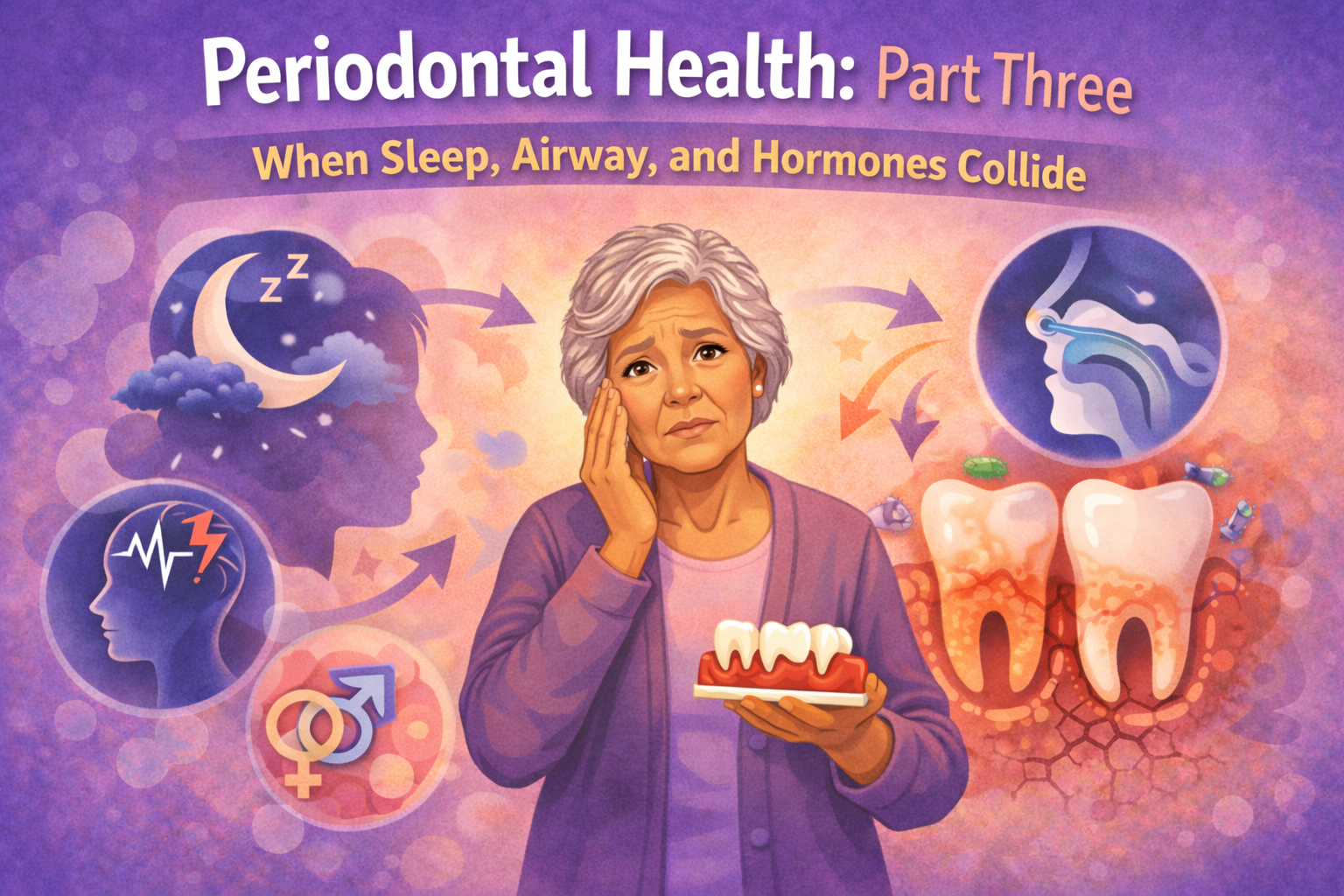
Part 3 of 3 in the Hormones and Periodontal Health Series
Hormones & Periodontal Health: When the System Loses Its Buffer
If Part One was about realizing that hormones change the rules, and Part Two was about recognizing how often those rules keep changing, Part Three is about what happens when the system runs out of margin for error. Because at some point — usually midlife — it’s no longer just hormones.
It’s hormones
plus poor sleep
plus airway vulnerability
plus nervous system strain
plus mechanical overload
And suddenly the body that used to “handle things just fine” is filing formal complaints.
Including the gums. And for bodies that never had much margin to begin with, midlife can push them straight into crisis mode.
We Talk About Airway. We Don’t Talk Enough About Sleep.
And that distinction matters more than most people realize.
In dentistry — especially biological dentistry — we do talk about airway. We talk about jaw development, tongue posture, mouth breathing, narrow arches, sleep apnea diagnoses, and structural risk factors. That part of the conversation is finally getting the attention it deserves.
What we talk about far less is sleep itself — not as a diagnosis, but as a physiologic state that directly regulates inflammation, immune signaling, bone remodeling, and tissue repair.
Airway is the structure.
Sleep is the physiology.
Periodontal tissues respond to physiology. You can have a structurally “acceptable” airway and still experience
fragmented sleep,
repeated arousals,
subtle oxygen desaturations,
chronic sympathetic activation.
And when that happens, the body does not heal or regulate inflammation the way we expect — even when oral hygiene is excellent. This is where periodontal stability quietly starts to erode.
You cannot regulate inflammation if you do not sleep well. You cannot heal tissue if your oxygen drops all night. And no, “I’m tired but functional” is not a clinical endpoint. Sleep is not passive rest. Sleep is when the body:
downshifts inflammatory signaling
regulates immune activity
repairs connective tissue
remodels bone
When sleep is fragmented — especially by repeated airway collapse — inflammation becomes the default setting. And yes. This shows up in the mouth. Every. Single. Day. These studies show that poor sleep and intermittent hypoxia shift the immune system toward a pro-inflammatory state and impair tissue repair — exactly the conditions under which periodontal stability becomes harder to maintain.
1. Sleep disruption and systemic inflammation
Irwin MR, Olmstead R, Carroll JE. PMID: 26140821
https://pubmed.ncbi.nlm.nih.gov/26140821
This analysis of 72 studies with over 50,000 adults found that poor sleep quality and long sleep duration (but not short sleep) are linked to higher levels of inflammatory markers like C-reactive protein and interleukin-6 in the blood, showing that sleep problems cause body-wide inflammation.
2. Intermittent hypoxia and inflammatory activation
Ryan S, Taylor CT, McNicholas WT. PMID: 16246965
https://pubmed.ncbi.nlm.nih.gov/16246965
This study showed that repeated cycles of low oxygen (like in sleep apnea) selectively activate inflammatory pathways in cells and patients, increasing tumor necrosis factor-alpha levels and white blood cells, while adaptive protective responses remain inactive, explaining how sleep apnea causes cardiovascular disease.
3. Sleep deprivation and impaired wound healing
Smith TJ, Wilson MA, Karl JP, et al. PMID: 28912361
https://pubmed.ncbi.nlm.nih.gov/28912361
This study created experimental wounds in healthy adults and found that 72 hours of sleep restriction (only 2 hours per night) delayed skin barrier recovery by nearly one full day and reduced local immune responses at wound sites, proving that lack of sleep slows healing.
Menopause and the Rise of Sleep-Disordered Breathing
(No, It’s Not Just Weight)
One of the most underrecognized shifts during menopause is a sharp increase in obstructive sleep apnea (OSA) risk — even in women who never had airway issues earlier in life. This is not simply about weight gain. (If it were, half of our athletic, size-4 patients wouldn’t be gasping at night). Declining estrogen and progesterone affect:
upper airway muscle tone
ventilatory control
arousal thresholds
airway collapsibility during sleep
Progesterone, in particular, acts as a respiratory stimulant. When it drops, breathing stability drops with it. RUDE. Many women:
don’t snore
aren’t “sleepy”
are told they’re anxious, stressed, or just aging gracefully
Meanwhile, their airway is collapsing dozens of times a night. Conventional Dentistry rarely screens for this. Biological dentists are more airway aware, but not everyone is. But we absolutely see the consequences.
What’s increasingly clear is that addressing sleep-disordered breathing — whether through medical management, dental appliances, or combined care — often improves inflammatory regulation system-wide. When oxygen stabilizes and sleep becomes restorative again, tissues heal differently. That includes periodontal tissues.
These findings explain why many peri- and post-menopausal women develop sleep-disordered breathing even without classic risk factors — and why symptoms are often missed.
1. Increased obstructive sleep apnea prevalence after menopause
Young T, Finn L, Austin D, Peterson A PMID: 12615621
https://pubmed.ncbi.nlm.nih.gov/12615621
This Wisconsin Sleep Cohort Study found that postmenopausal women had 2.6 times higher odds of having sleep apnea (5+ breathing pauses per hour) and 3.5 times higher odds of moderate sleep apnea (15+ pauses per hour) compared to premenopausal women, even after accounting for age, weight, and smoking, proving menopause independently increases sleep apnea risk.
2. Effects of sex hormones on ventilatory control
Gargaglioni LH, Marques DA, Patrone LGA. PMID: 31445081
https://pubmed.ncbi.nlm.nih.gov/31445081
This comprehensive review explains how sex hormones (especially estrogen and progesterone) affect breathing control by influencing the brain's breathing centers, oxygen and carbon dioxide sensors, and respiratory muscles. It describes how these hormones cause different breathing patterns between males and females and change throughout the menstrual cycle and with aging.
3. Role of progesterone as a respiratory stimulant
Boukari R, Laouafa S, Ribon-Demars A, Bairam A, Joseph V. PMID: 28189710
https://pubmed.ncbi.nlm.nih.gov/28189710
This review explains how progesterone acts as a respiratory stimulant that reduces sleep apnea frequency by activating special receptors in the brain and body. It also describes how estradiol protects against oxidative stress and high blood pressure caused by sleep apnea, suggesting these hormones could be therapeutic tools against sleep apnea.
Why Poor Sleep Wrecks Periodontal Stability
(And Why Your Scaling Didn’t “Fail”)
Sleep-disordered breathing drives:
chronic sympathetic nervous system activation
elevated cortisol
impaired immune regulation
persistent low-grade inflammation
Which means:
gingival inflammation escalates faster
healing slows
the host response to plaque gets dramatic
periodontal treatment becomes… unpredictable
Same plaque. Same hygiene. Different biology. No one did anything “wrong.” The system just lost its buffer.
This is also the moment where better questions matter. If a patient has unexplained periodontal instability, clenching, dry mouth, or repeated inflammatory flares — especially during perimenopause or menopause — sleep quality deserves to be part of the conversation, even when classic sleep apnea symptoms aren’t obvious. That’s not diagnosing sleep disorders. That’s recognizing physiology.
Multiple studies now demonstrate that sleep-disordered breathing is associated with increased periodontal inflammation and worse clinical outcomes — even after controlling for hygiene.
1. Association between obstructive sleep apnea and periodontitis
Zhang Z, Ge S, Zhai G, et al. PMID: 35862412
https://pubmed.ncbi.nlm.nih.gov/35862412
This meta-analysis of nine studies with over 43,000 people found that obstructive sleep apnea patients had 1.56 times higher risk of developing gum disease compared to people without sleep apnea, showing a strong statistical link between the two conditions even though the study cannot prove direct causation.
2. Obstructive sleep apnea, systemic inflammation, and immune dysregulation
Dong N, Yue H. PMID: 41194928
https://pubmed.ncbi.nlm.nih.gov/41194928
This 2025 review explains how obstructive sleep apnea causes widespread immune system problems through intermittent low oxygen and disrupted sleep. It activates inflammatory pathways (HIF-1α, NF-κB, and NLRP3 inflammasome) that trigger chronic inflammation and immune cell dysfunction, contributing to heart disease, metabolic disorders, brain problems, and cancer progression.
3. Inflammasome activation as a key mechanism linking OSA to inflammation
Díaz-García E, García-Tovar S, Alfaro E, et al. PMID: 35363597
https://pubmed.ncbi.nlm.nih.gov/35363597
This study found that severe sleep apnea patients have overactive NLRP3 inflammasomes in their immune cells, which directly correlates with oxygen drops during sleep. This activation triggers inflammatory chemicals (IL-1β and IL-18) and tissue factor release, linking intermittent low oxygen to body-wide inflammation and increased blood clotting risk.
The Nervous System Piece
As estrogen declines, nervous system regulation changes too.
We see:
reduced vagal tone
lower stress resilience
a tilt toward sympathetic dominance
Add poor sleep, and the body lives in a near-constant state of high alert. Clinically, this often shows up as:
clenching and bruxism
jaw tension and headaches
muscle guarding
accelerated periodontal breakdown under load
This is not Type-A personality. It's NOT STRESS. This is biology saying, “I am not okay, but I will grind my teeth about it.”
These findings support the observation that clenching and bruxism often emerge alongside hormonal shifts and sleep disruption — not simply stress or personality traits.
1. Estrogen and autonomic regulation
Littlejohn EL, Fedorchak S, Boychuk CR. PMID: 32493037
Account required
Sign in to see more
Create an account or sign in to unlock the full list.