Resource Libraries
Why Do Teenagers' Gums Bleed? Puberty and Gum Inflammation
Why teenagers' gums bleed despite good brushing, how estrogen and testosterone in puberty change the gum's response to plaque: same plaque, different biology.
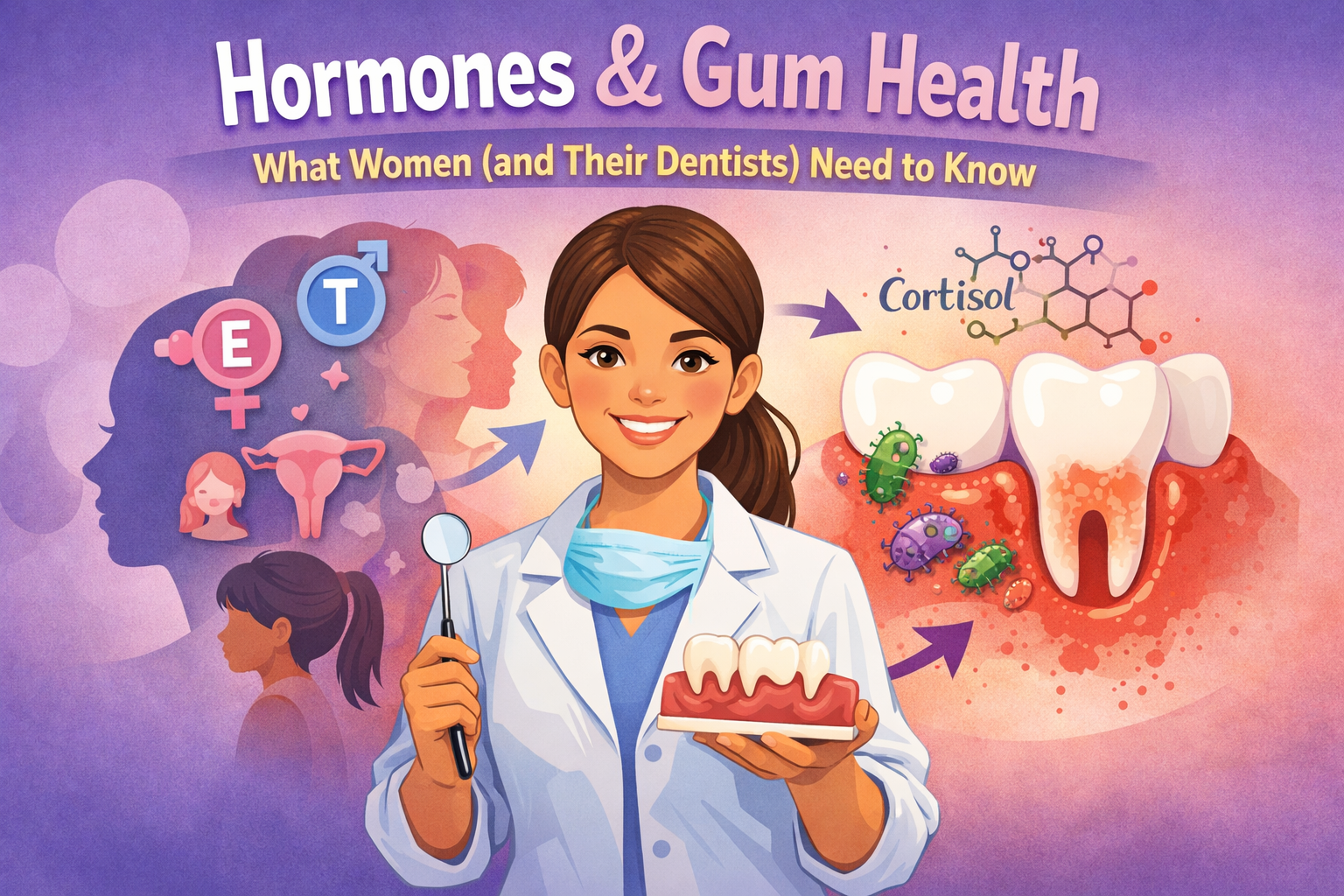
Part 1 of 3 in the Hormones and Periodontal Health Series
Hormones & Periodontal Health: Puberty and the Inflammatory Threshold
Let’s Start With the Elephant in the Operatory
Most medical and dental research has historically been male-dominated. That’s not an opinion — it’s a documented fact. Men were the default study subjects, the default physiology, the default “normal.” Which worked out fine…
Unless you happen to be a woman.
Women’s bodies are not static. They are cyclical, adaptive, and hormonally dynamic. Puberty, monthly cycles, pregnancy, postpartum, perimenopause, menopause — these are not side notes. They are major biologic events that influence inflammation, immune response, connective tissue, bone, saliva, pain perception, and healing. And yet, for decades, dentistry largely said:
“Plaque causes gum disease. Floss better.”
So when women showed up bleeding, inflamed, sore, or suddenly unstable — despite doing everything right — the conclusion wasn’t “our model is incomplete.”
It was: “You must not be cleaning well enough.” That narrative ends here.
A Quick Reality Check About Dentistry - And WHY I'm Choosing to Write About it in This Article (This Matters)
Dentistry used to be about 90% male at the dentist level. That is no longer true.
Today:
Roughly 40% of dentists are women, and younger dentists are approaching parity
Dental hygienists are ~95% female
Dental assistants are ~93–94% female
Translation?
Most periodontal care, preventive care, patient education, and hands-on treatment is delivered by women — often to women — inside systems still shaped by male-normed research.
Add to that the fact that women:
Go to the dentist more often
Show up earlier for preventive care
Ask more questions
Seek more education
And usually manage healthcare for their families
Women are not a niche audience in dentistry. We make up the vast majority of the dental workforce in hygiene and assisting roles, and an increasingly large portion of dentists. Women are also a majority patient population, and the primary consumers of oral-systemic health information.
CDC QuickStats — Adults ≥25 Years
This CDC QuickStats summary reports that in 2018, 69.4% of women aged 25+ had seen a dentist in the past year compared with 61.2% of men. https://blogs.cdc.gov/nchs/2020/02/21/4796/
Su S, Lipsky MS, Licari FW, Hung M
PMID: 35545161
https://pubmed.ncbi.nlm.nih.gov/35545161
This study compared oral health habits between men and women in the United States. Men had worse gum health, flossed less, visited the dentist less often, and had more cavities than women, showing that gender-specific dental health programs might help reduce these differences.
No other dental-oriented platform has in ANY way taken that reality into account. Literally anywhere. There are organizations like the AAWD, and our female dentist social media groups, for which I personally am eternally grateful, because we get connection on those groups that we simply can't get on the coed groups. I said what I said. But nowhere has dentistry in general acknowledged that women deserve more attention, both in the workforce due to exposure, or as consumers and patients. While our platform is a consumer education platform, we have a LOT of dental professionals in our group. FEMALE dental professionals. So we are determined to educate both professionals and consumers alike.
So yes — this platform is VERY intentionally women-focused. Not because men don’t matter. But because women have been systematically under-spoken-to-or-about. That’s not bias. It’s course correction.
Here are some of the sources for the claims made above:
“The Future of Dentistry Is Young Women” (2025) — Reports that in 2001 only ~16 % of dentists were female and by 2024 nearly 38 % were female. It also notes that among younger dentists (under 35), women are about 50 % of the workforce.
https://decisionsindentistry.com/2025/09/the-future-of-dentistry-is-young-women/
American Dental Association Health Policy Institute Data — Female dentists rose from ~24 % in 2010 to ~34.5 % in 2020; projected to approach parity by 2040. https://adanews.ada.org/ada-news/2021/march/women-make-up-growing-percentage-of-dental-workforce
Dental assistant demographics and statistics in the US -- https://www.zippia.com/dental-hygienist-jobs/demographics
Dental hygienist demographics and statistics in the US. -- https://www.zippia.com/dental-hygienist-jobs/demographics/
So What’s the Big Idea, Really?
Here it is — and it’s simpler than dentistry has made it: Periodontal disease is not just about bacteria. It’s about how your body responds to bacteria. Everyone has bacteria in their mouth.
People with perfectly healthy gums. People with gingivitis. People with advanced periodontal disease. The difference ISN'T who has bacteria. The difference is how loudly the body reacts to them. That reaction shows up as:
Inflammation
Bleeding
Swelling
Bone loss
Delayed healing
“Why won’t this calm down?” frustration
And that reaction is heavily influenced by hormones.
Why This Matters (Because This Is Where Patients Get Blamed)
If periodontal disease were only about bacteria, dentistry would be easy:
Remove plaque
Remove tartar
Problem solved
But that’s not what happens in real life. We all see patients who:
Brush well
Floss reasonably
Show up consistently
Do “all the right things”
…and still have inflamed, bleeding, unstable gums. Historically, dentistry didn’t say:
“Let’s look at your inflammatory threshold.” We said: “You must not be cleaning well enough.”
Which is convenient. And there is SO much more to it than that. I wrote about it in THIS resource article:
https://www.orabiologics.com/resource-library/why-75%25-of-people-have-some-form-of-gum-disease
But even in that article, I didn't really cover the whole hormonal relationship that is involved in the system too. Which is why I'm writing this article. The topic is just so... BIG!
The Host Response: The Part We Didn’t Talk About Enough
Your immune system decides:
How much inflammation is appropriate
How much bleeding occurs
How aggressively bone is resorbed
How quickly tissues heal
That decision is called the host response. And the host response is not fixed. It changes with:
Hormones
Stress
Sleep
Blood sugar
Life stage
So the same plaque load can look very different:
In a 13-year-old going through puberty
In someone in their luteal phase
In pregnancy
In perimenopause
In menopause
Same mouth. Different biology.
Where Hormones Come In (Without Making This Woo)
Hormones are chemical messengers. They don’t just affect reproduction — they affect:
Blood flow
Immune signaling
Collagen turnover
Bone remodeling
Pain perception
Healing speed
Your gums have receptors for estrogen, progesterone, and cortisol. Which means your periodontal tissues are listening to your hormones whether we acknowledge it or not. So when hormones fluctuate:
The gums may bleed more easily
Inflammation may escalate faster
Bone may become more vulnerable
Healing may slow down
Not because something is “wrong” — but because the rules have shifted. Yay us, right?!?!? Our rules shift from day to day, week to week, year to year and decade to decade depending on our phase of the moon or life! How frustrating can THAT be?
A Critical Clarification (This Part Matters)
Hormones do not cause periodontal disease by themselves. You still need bacteria. You still need plaque biofilm. You still need an inflammatory trigger. But hormones absolutely change:
How intense the response is
How quickly damage occurs
How well the tissues recover
Think of bacteria as the match. Hormones determine whether the ground is damp…. or bone dry.
Why This Changes Everything About How We Talk to Patients
Once you understand this, a lot of confusing clinical patterns suddenly make sense:
“Why did this get worse so fast?”
“Why does it flare at certain times?”
“Why did my gums change after pregnancy?”
“Why did everything fall apart in my 40s?”
And instead of blame, the conversation becomes: “Your tissues are responding differently right now. Let’s adjust accordingly.” That’s not lowering standards. That’s practicing biology-based dentistry. And THIS is why I'm including female dental professionals in this article and conversation. Because WE are the ones who are going to experience this in our bodies, and are therefore MUCH more likely to think about these things when our patients are telling us about what is going on in their mouth, or when we SEE this happening to them. We can ask the questions that the men are REALLY uncomfortable asking. There are advantages to being female...
Puberty: When Gums Suddenly Lose Their Chill
Let’s start with something most parents, teens, and even dental professionals have noticed — but rarely had explained well: “My kid brushes. They floss… sometimes. Why are their gums suddenly bleeding like this?” Short answer: puberty changes the rules. And no, this is not just about teenagers being teenagers. Don't get me wrong - MOUTH BREATHING REALLY DOESN'T HELP. And I discuss airway IN DEPTH in all of these articles here, so I'm not going to repeat myself in this article about that topic:
Airway for Children:
Your Child’s Best Face:
Let's Talk About Childrens' Airway Issues - Part 1 of My Unintentional Series https://www.orabiologics.com/resource-library/signs-your-child-may-have-an-airway-issue
Toddler Cavities are AIRWAY RED FLAGS, not parenting failures - Part 2 of Teresa Scott’s unintentional series: https://www.orabiologics.com/resource-library/questions-to-ask-before-starting-early-orthodontic-treatment
Generational Nutritional Injury - Part 3 of Teresa Scott’s unintentional series - https://www.orabiologics.com/resource-library/dr.-felix-liao-on-airway-health%3A-special-webinar-for-our-community
Tongue, Cheek and Lip Ties:
Account required
Sign in to see more
Create an account or sign in to unlock the full list.