Journal
Zirconia Implants and Full Arch Reconstruction: The Metal Free Approach
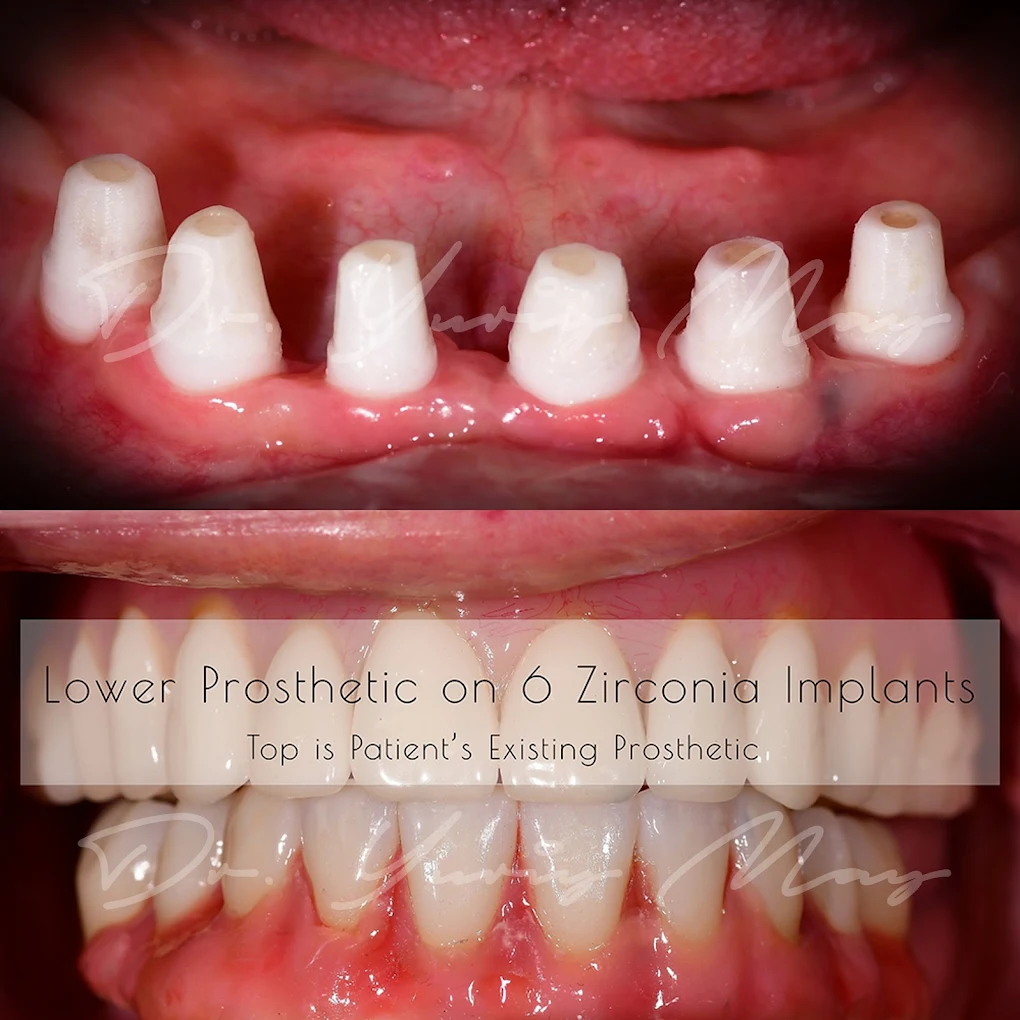
Rebuilding an entire arch involves resorbed bone, old infection and an esthetic result you live with permanently. Here is how metal free full arch and All-on-X reconstruction works, what happens before the implants, and the questions to ask first.
Replacing a single missing tooth is a well understood procedure. Rebuilding an entire arch, or an entire mouth, is a different order of problem. It involves bone that has often already receded, infection that may have been present for years, an airway that has adapted around the changes, and an esthetic result the patient has to live with in every photograph for the rest of their life.
This article explains how metal free full arch reconstruction works and what makes a case complex. It features Dr. Yuriy May of Natural Dentistry Center in Farmington, Connecticut, a practice patients travel across the country and internationally to reach.
What is a zirconia dental implant?
A zirconia dental implant is a tooth root replacement made from zirconium dioxide, a high strength ceramic, used in place of titanium alloy. It integrates with bone to support a crown, bridge or full arch restoration, without introducing metal into the jaw.
Patients pursue metal free implants for reasons that are usually specific rather than general. Some have documented metal sensitivity. Some are managing autoimmune conditions and want to reduce the number of immune variables in play. Some want to avoid the possibility of galvanic activity between dissimilar metals in the mouth. And some simply prefer the esthetics, since zirconia is white and does not cast the grey shadow at the gumline that titanium can produce as tissue recedes.
What full arch and All-on-X reconstruction involves
Full arch reconstruction replaces all the teeth in an upper or lower jaw. The All-on-X approach anchors a full arch of teeth onto a small number of strategically positioned implants rather than one implant per tooth, using the areas of the jaw where bone quality is best.
Done in ceramic, this is demanding work. It requires precise implant positioning, because a fixed full arch has no tolerance for a poorly angled implant. It requires managing bone that may have resorbed after years of failing teeth. And it requires an esthetic outcome delivered in a material with less adjustability than metal, which means the planning has to be right before surgery starts, not corrected afterward.
The biologic steps that come before the implants
In complex cases, the implant is often the last thing to happen. What comes first determines whether it succeeds.
Atraumatic biological extraction
Teeth are removed with the surrounding bone preserved rather than levered against, and the socket is fully debrided. Leaving remnants of the periodontal ligament behind is a recognized contributor to sites that do not heal properly.
Cavitation surgery
A cavitation is an area of compromised, poorly healed bone, most often found at old extraction sites where the socket did not heal completely. Because these areas are frequently invisible on conventional flat x-rays, 3D imaging is what makes them findable. Where present, the compromised bone is cleaned surgically before reconstruction is built over the area.
Regenerative therapy
Platelet rich fibrin made from the patient's own blood, ozone and laser assisted technique are used to reduce bacterial load and support bone and tissue regeneration ahead of, and alongside, implant placement.
Why diagnostics carry so much weight here
Full arch work concentrates risk. A single missing tooth restored imperfectly is a contained problem. An entire arch built on flawed planning is not. This is why practices doing high volumes of this work lean heavily on 3D CBCT imaging, digital surgical planning and biologic compatibility considerations before a single implant is placed. The planning phase in a complex ceramic case is often longer than the surgery.
Practice highlight: Natural Dentistry Center, Farmington, Connecticut
Natural Dentistry Center is a biological dental and ceramic implant practice in Connecticut, known for metal free zirconia implant dentistry and biological oral surgery. Dr. May lectures internationally, and the practice reports treating patients from 35 states and 15 countries.
Dr. Yuriy May, DMD, AFAAID, IBDM, AIAOMT, CIABDM, leads the practice clinically. Under his direction it has become a destination for patients seeking zirconia implants, full mouth reconstruction and biologically driven alternatives to conventional care. The practice is particularly known for complex full arch and All-on-X ceramic implant cases, biological extraction protocols, cavitation surgery and regenerative bone and tissue therapy using PRF, ozone and laser assisted technique.
Its commitment to metal free biocompatible materials is described as strict, with every case approached through a biological lens that prioritizes infection control, airway health, immune balance and long term stability while holding to demanding esthetic standards. Diagnostics include 3D CBCT imaging, digital surgical planning and biologic compatibility assessment.
Beyond surgery, Natural Dentistry Center offers an integrative model incorporating airway focused dentistry, functional orthodontics, myofunctional considerations and holistic support. Patients travel from across the United States and internationally for cases that require both surgical mastery and refined cosmetic execution.
Natural Dentistry Center is a vetted OraBiologics practice. Visit the full directory listing to see the doctors, the services it was verified for, and to request an appointment. Free membership opens the listing, and it is free to create an account.
Questions to ask before committing to full arch treatment
- How many full arch ceramic cases have you completed, and may I see documented results?
- What does the 3D scan show about my bone volume, and does it require grafting first?
- Have you assessed me for cavitations at previous extraction sites?
- What is the full sequence and timeline, from extraction through final restoration?
- What happens if an implant does not integrate, and what is covered?
- Is my airway being assessed as part of the reconstruction plan?
Frequently asked questions
What is All-on-X?
An approach that supports a full arch of replacement teeth on a small number of strategically placed implants, positioned in the areas of the jaw with the best available bone, rather than placing one implant per missing tooth.
What is a cavitation?
An area of compromised, incompletely healed bone, most commonly found at old extraction sites. Because it is often not visible on conventional flat x-rays, 3D imaging is generally required to identify it.
Can zirconia implants support a full arch restoration?
Yes, and practices specializing in metal free reconstruction perform full arch ceramic cases routinely. Suitability depends on your bone volume, bite forces and overall health, which is what the planning phase determines.
How long does full mouth reconstruction take?
It varies widely with case complexity, whether grafting or cavitation surgery is needed, and healing response. Ask for a written sequence with estimated timings at each stage rather than a single overall figure.
Why do patients travel for this kind of care?
Complex metal free reconstruction is a specialized skill set, and the number of practices doing it at volume is limited. Patients often prioritize documented experience over proximity for work of this scale.
Finding a provider
For treatment at this level, verified experience matters more than any other single factor. Every practice in the OraBiologics directory has been vetted against biologic protocol standards, and free membership opens the full network, the resource library and the live Ask The Experts sessions.
If you are holding a full mouth treatment plan and want an independent clinical read before you commit, an Oral Wellness Review is built for decisions of this size.
Membership
Go deeper with member-only resources
Access webinars, coaching, and curated wellness guidance backed by our vetting standards.