Resource Libraries
Tongue, Lip and Cheek Tie Symptoms in Babies and Adults: A Whole-Body Look
Tongue, lip and cheek tie symptoms in babies and adults, from feeding issues to neck tension and mouth breathing, and how fascia ties it to the whole body.
One of the questions I get asked ALL the time involves tongue ties, lip ties, and cheek ties. Parents want to know whether their baby's feeding problems might be related to a tongue tie, whether their child's narrow palate or mouth breathing could be connected to restricted tongue movement, or whether the tension they've experienced in their own jaw and neck for years might have something to do with the way their tongue functions. And these are REALLY good questions, because the tongue does a whole lot more than help us talk and taste our food.
Your tongue is involved in feeding, chewing, swallowing, speech, oral development, and the coordination of the muscles that help maintain your airway. It's connected to the jaw, the hyoid bone, the muscles of the neck, and the fascial network that extends throughout your body. That's a pretty impressive job description for something most people don't think about unless they accidentally bite it! I've spent years studying the relationship between oral function, facial development, airway health, and the rest of the body. And one of the things I've become increasingly fascinated with is how much compensation our bodies can develop when something isn't functioning the way it should.
We're amazingly adaptable creatures. When one movement becomes difficult, we find another way to accomplish the same task. Sometimes that works beautifully. Other times, the compensation creates additional challenges that can become part of our everyday experience without our ever realizing WHY they're happening. A restricted tongue is one of the things I want to investigate when those patterns show up. And there's some fascinating science explaining why.
What Exactly Is a Tongue Tie?
Underneath your tongue is a fold of tissue called the lingual frenulum. Everyone has one, although its appearance, thickness, location, and flexibility vary considerably. A tongue tie, medically called ankyloglossia, occurs when the tissue restricts normal tongue mobility. Some ties are obvious. The attachment may extend almost to the tongue tip, creating a heart-shaped appearance when the person tries to lift or extend the tongue. Others are much less visible. The tongue might look relatively normal until we ask the person to elevate it toward the palate, extend it without moving the jaw, or perform certain movements that reveal the restriction.
For years, the frenulum was commonly described as a little cord or string connecting the tongue to the floor of the mouth. In 2019, Nikki Mills and colleagues published an anatomical study that gave us a much better understanding of what we're actually looking at. They dissected nine adult cadavers and demonstrated that the lingual frenulum is formed by a dynamic fold in the fascia of the floor of the mouth. [1]
The fascia creates a sheet of connective tissue extending across the floor of the mouth, supporting structures including muscles, salivary glands, blood vessels, and nearby nerves. When the tongue elevates, that tissue moves with it, creating the fold we recognize as the frenulum. Another study published in 2020 examined thirteen cadaver specimens under the microscope and confirmed that this fascial layer varies in thickness, collagen composition, and mobility between individuals. [2]. So we're dealing with something much more complicated than a little string of extra skin. And understanding that anatomy helps explain why two people whose frenula look remarkably similar may have completely different levels of tongue mobility.
Not Every Tongue Tie Looks the Same
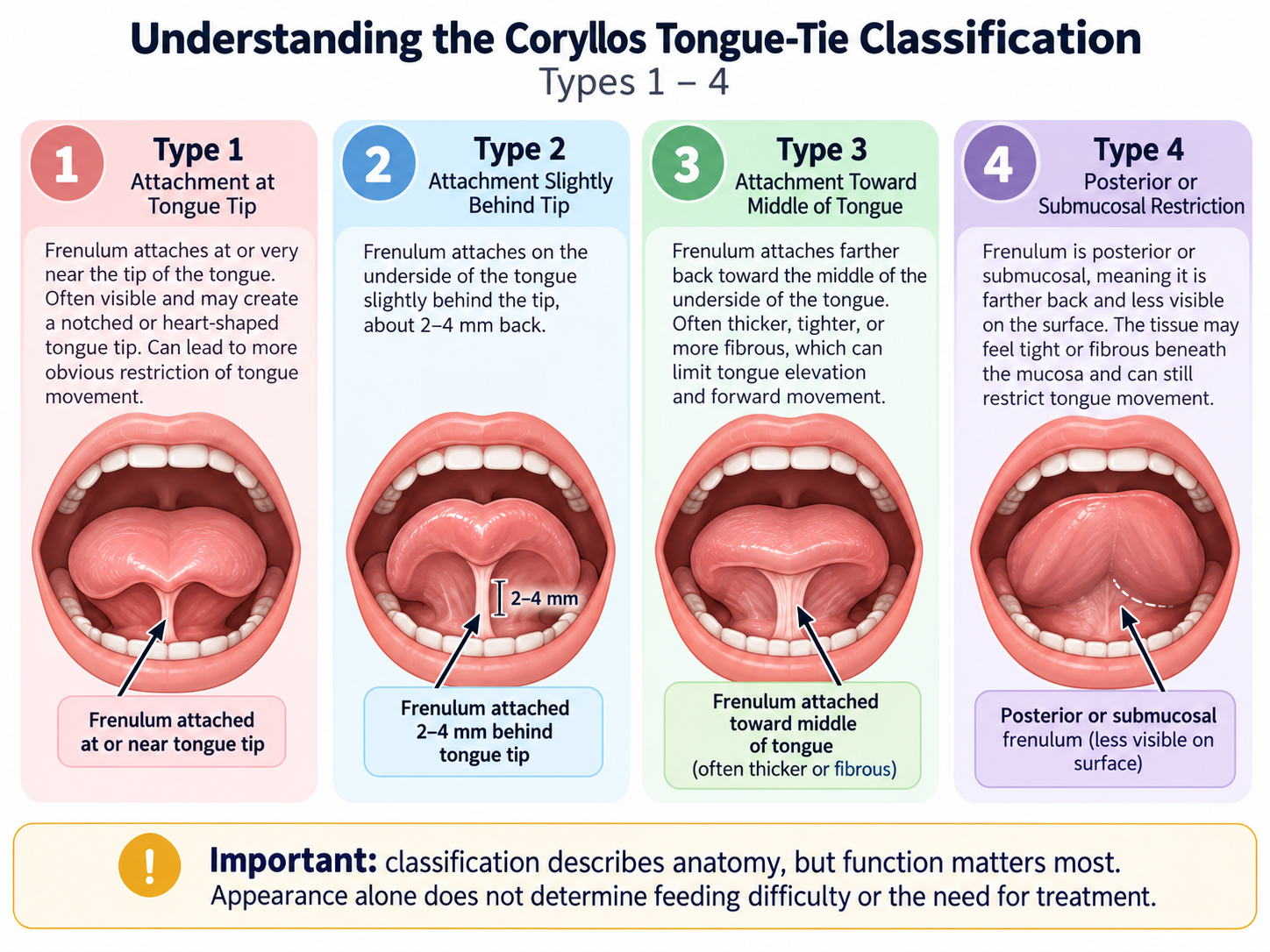
Dr. Larry Kotlow helped bring considerable attention to the importance of identifying tongue and lip restrictions, especially in infants experiencing feeding difficulties. Another commonly used classification system, developed by Coryllos, describes four types of tongue ties based on the location and appearance of the attachment.
- Type 1 involves tissue attached at or very close to the tongue tip. The tongue may appear notched or heart-shaped when elevated.
- Type 2 involves an attachment slightly farther behind the tip, generally around two to four millimeters back.
- Type 3 describes tissue attached farther toward the middle of the underside of the tongue. These attachments may be thicker or more fibrous.
- Type 4 describes a more posterior restriction that's often less obvious during a casual examination.
These categories help us describe what we're seeing, but I don't believe we should stop with the appearance. I want to know what that tongue can actually DO.
- Can the patient elevate it toward the palate without lifting the floor of the mouth?
- Can they move it independently of the jaw?
- Can they create and maintain suction against the palate?
- What happens when they swallow?
- Are they compensating with their neck, chin, or surrounding muscles?
A 2017 study involving 1,052 subjects evaluated tongue mobility measurements and proposed a more functional approach to grading ankyloglossia. The researchers examined relationships between tongue movement, frenulum length, and commonly used classification systems. [3] That's the direction I believe evaluations need to go. Pictures are helpful, and y'all know I LOVE clinical photographs. But pictures are even more useful when they show what the tissue is doing during movement.
What About Lip Ties and Cheek Ties?
The upper lip is connected to the gum tissue by the maxillary labial frenulum, and the cheeks have their own attachments called buccal frenula. These are normal anatomical structures, just like the lingual frenulum. But their size, attachment, flexibility, and relationship to surrounding tissues can vary from person to person.
With an upper lip restriction, I want to look at how the lip moves, whether the attachment creates tension on the surrounding tissues, and whether the patient is having difficulty with something the lip needs to accomplish. In infants, that may involve evaluating whether the lip can move comfortably during feeding and whether it contributes to an effective seal. In older children, we may be examining tissue tension, gingival attachments, oral hygiene, and the relationship between the frenulum and the developing dentition.
Cheek attachments deserve a similarly thoughtful evaluation. I want to know whether the tissue is interfering with movement or creating an identifiable functional or periodontal problem. A 2023 systematic review examined the available research on tongue-tie, lip-tie, and cheek-tie releases in relation to breastfeeding. The researchers found evidence supporting improvement after tongue-tie procedures in appropriately selected infants, while also identifying important gaps in the research involving lip and cheek releases. [4]
I think that's an excellent reason to keep researching these structures and evaluating them individually. The question isn't simply whether someone has a visible attachment. Everybody does. The question is whether that attachment is creating a meaningful restriction and whether addressing it is likely to improve the problem we're trying to solve.
Babies, Breastfeeding, and the Importance of Tongue Mobility
If you've ever watched a baby breastfeed successfully, you're witnessing a remarkable amount of coordination. The tongue, lips, jaw, cheeks, and swallowing muscles all have to work together while the baby maintains a seal, generates the appropriate suction, transfers milk, swallows, and continues breathing. That's a LOT of activity for someone who's only been on the planet for a few days!
When tongue movement is restricted, feeding can become difficult. Babies may struggle to maintain a latch, repeatedly slip off the breast, spend unusually long periods feeding, or become exhausted before they've transferred enough milk. The breastfeeding parent may experience significant nipple pain, trauma, or frustration because feeding simply isn't working the way it should. And when feeding is difficult, the entire family can end up exhausted.
The good news is that we have substantial research investigating what happens when functionally restrictive tongue ties are released. A 2024 systematic review and meta-analysis examined 21 studies evaluating breastfeeding outcomes following frenotomy. Researchers found statistically significant improvements in breastfeeding self-efficacy, maternal nipple pain, and latch quality. [5]. Breastfeeding self-efficacy measures how confident a mother feels about her ability to breastfeed successfully.
- The researchers found a moderate improvement within five to ten days after treatment and a larger improvement at one month.
- Nipple pain also decreased significantly, with improvements reported during the first couple of weeks and at one month.
- And measurements of breastfeeding quality improved within approximately five to seven days.
That's meaningful information for a family struggling through painful or ineffective feeding. Of course, the feeding evaluation still matters. A baby can struggle with feeding for several reasons, and I believe a qualified lactation consultant should be part of the conversation whenever possible. But when restricted tongue mobility is contributing to the problem, I want parents to understand that treatment may make a very real difference.
What About Reflux, Gas, and Colic?
This is another area that deserves much more attention. Parents sometimes describe babies who seem to swallow a lot of air while feeding, become uncomfortable afterward, spit up repeatedly, or struggle with symptoms that look like reflux. When a baby can't maintain an effective seal during feeding, it's reasonable to investigate whether the mechanics of feeding are contributing to aerophagia, which is the medical term for swallowing air.
Researchers have investigated whether improving tongue function through frenotomy also improves these symptoms. The 2024 meta-analysis found statistically significant improvement in parent-reported infant reflux symptoms one week after frenotomy, with additional improvement documented at one month. [5]. A separate systematic review published in 2025 examined seven studies evaluating reflux symptoms following tongue-tie release. Parent-reported symptom scores generally decreased after treatment. [6]
Now, reflux symptoms and objectively measured gastroesophageal reflux aren't exactly the same thing, and those studies primarily relied on symptom questionnaires rather than direct measurements of reflux episodes. But the reported improvements are worth investigating, particularly when feeding dysfunction and reflux-like symptoms occur together. I don't think we should automatically assume every baby who spits up has a tongue tie. But I absolutely believe oral function belongs in the evaluation when feeding problems, excessive air swallowing, and gastrointestinal discomfort appear together. We need to look at how the baby is actually feeding, not simply treat each symptom as though it's unrelated to everything else.
Your Tongue Is Connected to Your Toes. YES, Really.
Now we're getting into one of my favorite subjects. FASCIA! Fascia is connective tissue that surrounds muscles, nerves, blood vessels, organs, and other structures throughout the body. It forms an interconnected three-dimensional network extending from our heads all the way to our feet. And yes, the tongue participates in that larger anatomical system.
The tongue attaches through its muscles and connective tissues to structures including the mandible and hyoid bone. The hyoid is connected to multiple muscles involved in swallowing, breathing, jaw movement, and cervical function. Those structures participate in larger muscular and connective tissue relationships throughout the neck and trunk. The idea of myofascial chains describes how muscles and their surrounding connective tissues form anatomical continuities between different body regions. And you know me well enough to know I found research examining those relationships.
In 2016, Wilke and colleagues published a systematic review of 62 anatomical studies investigating proposed myofascial chains. They found strong evidence supporting several of these connections, including the superficial back line and the front and back functional lines. [7]. Another systematic review published that same year examined whether mechanical forces could transfer between structures along myofascial chains. The researchers identified evidence supporting force transmission through some of these anatomical relationships. [8]
This is important because fascia doesn't function as a collection of completely isolated pieces. Movement in one region can influence tension and mechanical behavior in connected tissues. Now, the specific amount of force transferred from the tongue to a distant structure isn't something these studies measured. But the anatomical continuity itself gives us a much more interesting way to understand why local restrictions and compensatory movement patterns deserve a whole-body evaluation. And researchers have started examining what those relationships may mean clinically.
Could a Tongue Tie Affect Your Neck, Posture, and Muscle Tension?
This is where the research gets REALLY interesting. Think about what happens when you try to perform a movement but something physically restricts you. Your body will often recruit other muscles to help accomplish the task. If the tongue can't elevate independently, someone may compensate by moving the jaw, tightening the floor-of-mouth muscles, or engaging muscles in the neck. Over time, those compensations can become part of the person's habitual movement patterns.
In 2019, Dr. Soroush Zaghi and colleagues published a study examining 348 patients who underwent lingual frenuloplasty combined with orofacial myofunctional therapy. [9]. These patients ranged from young children to adults in their seventies. The researchers reported improvement in several symptoms following treatment, including:
-
Mouth breathing: 78.4%
-
Snoring: 72.9%
-
Clenching: 91.0%
-
Myofascial tension: 77.5%
Overall, 87% reported improved quality of life, and 91% were satisfied with their treatment. These percentages describe improvement among the patients reporting the corresponding symptoms, rather than the entire group experiencing every one of those problems. That's a pretty impressive collection of findings. The treatment combined surgical release with myofunctional therapy, which is particularly interesting because it addresses both the tissue restriction and the muscular patterns that may have developed around it. And the postural research has continued.
In 2025, Micarelli and colleagues published a study comparing 96 adults with ankyloglossia to 98 adults without it. [10]. The researchers evaluated postural stability, neck mobility, cervical proprioception, jaw function, and dizziness-related symptoms. Proprioception is your nervous system's ability to recognize where your body is positioned and how it's moving without having to look. They found that adults with tongue ties demonstrated significantly different postural stability measurements, reduced cervical mobility, and greater errors in cervical position-sensing tests. They also identified relationships between tongue measurements and several of the neck and postural findings. That's fascinating!
For me, research like this reinforces why its important to examine tongue function when patients present with persistent jaw and neck tension or unusual compensatory patterns. It also gives us specific, measurable outcomes to investigate as the research develops. We're talking about actual postural testing, cervical range-of-motion measurements, and proprioceptive assessments, rather than simply asking someone whether they feel more relaxed. And I think that represents an exciting direction for biological dentistry and interdisciplinary care.
What Does Tongue Mobility Have to Do With Breathing?
If you've followed my work, you already know that I'm a little obsessed with airway health. And there's a very good reason for that. Breathing affects virtually every system in the body, and the structures of the mouth and jaws play important roles in maintaining an open upper airway. The tongue is a large muscular structure that occupies a substantial amount of space within the oral cavity. Its position and muscle activity influence the surrounding anatomy, particularly during sleep, when normal changes in muscle tone can make the airway more vulnerable to narrowing.
When evaluating a patient with restricted tongue mobility, I want to understand how that restriction interacts with tongue posture, oral function, jaw development, and breathing. And the research has identified some meaningful relationships. A 2024 systematic review and meta-analysis investigated the association between ankyloglossia and obstructive sleep apnea in children. [11]
In 2024, researchers published a systematic review and meta-analysis examining the relationship between tongue ties and obstructive sleep apnea in children. And what they found was pretty remarkable! Children with a short lingual frenulum had approximately THREE TIMES the odds of having obstructive sleep apnea compared with children without that restriction. But here's what REALLY caught my attention. Children with a high-arched palate had approximately TWELVE TIMES the odds of having obstructive sleep apnea compared with children without that anatomical finding! [11]
TWELVE TIMES!
Think about what that means when we're examining children with restricted tongue mobility, narrow dental arches, mouth breathing, and other signs of inadequate craniofacial development. These aren't just cosmetic concerns about whether the teeth are straight. We're looking at anatomical and functional relationships that may have profound implications for how well a child breathes, especially during sleep. And THIS is why I'm so passionate about airway-centered dentistry. I want us to recognize these patterns while children are still growing, when we have opportunities to evaluate and address developmental and functional problems rather than discovering them decades later.
And remember the Zaghi study? Patients also reported substantial improvements in mouth breathing and snoring following functional frenuloplasty and myofunctional therapy. [9]. I think this is exactly why tongue-tie evaluations need to be part of a broader conversation about airway health. When I see restricted tongue mobility in a child who also has a narrow palate, crowded teeth, mouth breathing, snoring, or restless sleep, I want to investigate how those findings may be related. I don't want to wait until the child develops more obvious problems before asking questions about their breathing. And if there's reason to suspect sleep-disordered breathing, that kiddo needs a sleep study. ASAP. Because sleep apnea deprives the brain of oxygen. A growing brain deprived of oxygen isn't a good thing. Waiting just makes it worse.
Tongue Posture and Facial Development
One of the things I wish more parents understood is that facial growth isn't determined by genetics alone. The environment in which a child grows matters, including breathing patterns, chewing demands, muscle function, oral habits, and the forces acting on the developing jaws. The tongue interacts with the palate during swallowing and other oral activities, and its position is one of several functional influences worth considering during growth. When a tongue can't elevate normally, we need to ask whether that limitation is influencing how the child uses the muscles of the mouth.
- Does the child rest with the mouth open? Is nasal breathing comfortable?
- Can the tongue establish contact with the palate? Is swallowing coordinated, or are other muscles being recruited to compensate?
- And how does all of that fit into the child's developing craniofacial anatomy?
The relationship between high-arched palates and pediatric sleep apnea identified in the 2024 meta-analysis makes these developmental questions particularly relevant. [11]. I don't believe orthodontic evaluations should focus exclusively on whether the teeth are straight. I want to understand WHY the jaws developed the way they did and whether there are functional issues that need attention. That's one of the reasons I believe airway-centered dentistry and orofacial myofunctional evaluation belong in the larger conversation about childhood development.
What About Speech and Swallowing?
The tongue has to perform remarkably precise movements during speech. Try saying words containing the sounds T, D, L, N, or R, and pay attention to what your tongue is doing. Different sounds require specific positioning and coordination, and certain restrictions can make those movements more challenging. But speech is also a learned motor function, so anatomical mobility and the ability to produce speech sounds don't always correspond perfectly.
A 2022 systematic review examined sixteen studies investigating tongue ties and speech articulation. Several before-and-after studies reported improvement following surgical treatment, while other studies produced less consistent findings. [12]. That tells me we need to evaluate the individual patient rather than assume every speech difficulty has the same cause. If a child has an articulation problem and restricted tongue movement, I want a qualified speech-language pathologist involved in determining whether the restriction is contributing to the difficulty.
Swallowing is another important function. A normal swallow requires coordination between the tongue, jaw, throat muscles, and other structures. If a person can't move the tongue effectively, compensations may develop during swallowing or food management. I believe these are good reasons to evaluate tongue mobility as part of a complete oral functional examination rather than treating the frenulum as an isolated anatomical curiosity.
What About Adults Who Have Had a Tongue Tie Their Entire Lives?
I think adults are sometimes overlooked in this conversation. We tend to associate tongue ties with babies struggling to breastfeed, but a tongue restriction doesn't automatically disappear when someone grows up. Adults may have spent decades adapting the way they swallow, chew, speak, or position their tongues without ever realizing that their movement was restricted. And because compensations can become so familiar, people may not even recognize them as compensations. They may simply believe that's how their bodies work.
This is one reason I find the adult research from Zaghi and Micarelli so interesting. We're seeing investigators evaluate functional complaints, myofascial tension, jaw activity, cervical mobility, and postural measurements in people well beyond infancy. [9,10]. That opens the door to a much broader clinical conversation.
If an adult has a restricted tongue, I want to evaluate whether it's affecting a function they actually use and whether improving that mobility could make a meaningful difference. And when a release is appropriate, I want to think about the muscular patterns that developed during all those years of compensation. Changing the anatomy is one part of the process. Learning to use the new mobility may be another.
Why I Believe Myofunctional Therapy Matters
Imagine you've spent your entire life walking with a restricted ankle. Then someone corrects the physical restriction. Your ankle may suddenly have more movement available, but that doesn't mean your brain and muscles automatically know how to use that movement efficiently. You've spent years developing habits around the limitation.
The same general principle can apply to oral function. When tongue movement has been restricted, the person may have learned to accomplish certain tasks using their jaw, lips, neck, or other muscles. Orofacial myofunctional therapy is designed to evaluate and improve specific oral muscle functions, including tongue coordination, swallowing patterns, lip competence, and other aspects of oral movement. And I think that becomes especially important when we're discussing older children and adults who may have developed longstanding compensations.
The Zaghi study combined surgical release with myofunctional therapy and reported improvements across several functional complaints. [9]. I find that approach particularly interesting because it addresses the anatomical restriction while also working with the muscular patterns that developed around it. Of course, the therapy needs to be appropriate for the patient's age and actual functional needs. A newborn, a seven-year-old, and a forty-year-old adult aren't going to need the same exercises or rehabilitation plan. And I want practitioners making those decisions based on the person in front of them, not simply handing everyone the same instructions.
How Do We Decide Whether a Tie Needs to Be Released?
This is where I think the quality of the examination becomes incredibly important. I don't want to diagnose a surgical problem simply because I can see a frenulum. I want to understand whether the tissue is actually restricting a function and what the patient is experiencing because of it. For an infant, that means assessing feeding, latch, milk transfer, comfort, and growth. For a child, we may need to evaluate tongue mobility, swallowing, speech, oral posture, jaw development, and breathing. For an adult, we may also be investigating longstanding functional limitations, compensatory muscle activity, and specific complaints involving the mouth, jaw, or neck.
And whenever possible, I want to work collaboratively with the other professionals involved in the patient's care. That may include lactation consultants, speech-language pathologists, myofunctional therapists, pediatricians, orthodontists, sleep physicians, and other specialists. Sometimes therapy alone may be appropriate. Sometimes the anatomical restriction is substantial enough that a release becomes an important part of the treatment plan. And sometimes there's no meaningful functional problem to correct. The important thing is that we know WHY we're recommending treatment.
What Happens During a Tongue-Tie Release?
There are several different terms used to describe procedures involving restrictive frenula.
- A frenotomy generally refers to cutting or releasing the restrictive tissue.
- A frenectomy involves removing frenulum tissue.
- A frenuloplasty involves surgically modifying the tissues, sometimes using sutures or other techniques to improve mobility while managing the surgical wound.
Depending on the patient's anatomy, age, and functional needs, different procedures may be appropriate. Scissors, scalpels, and surgical lasers can all be used for oral soft-tissue procedures. My personal choice in practice is the my laser - we use a Fotona Lightwalker which is an Erbium Yag laser but there are other lasers on the market that are also very effective. Lasers in general are better than scalpels and scissors for releasing frenulums and controlling the bleeding and postoperative inflammation.
What matters most to me is that the provider understands the anatomy, knows how to protect nearby structures, and has the training and experience necessary to perform the procedure safely. Remember that the floor of the mouth contains important blood vessels, salivary ducts, muscles, and nerves. The Mills anatomical studies make that very clear. [1,2]. So although some releases can be performed relatively quickly, they're still surgical procedures involving living tissue. And patients deserve thoughtful diagnosis, appropriate pain management, informed consent, and good follow-up care.
The Bigger Picture
After decades of practicing dentistry, I've become increasingly convinced that one of the biggest things we've overlooked is FUNCTION. We spend enormous amounts of time evaluating teeth, diagnosing cavities, placing restorations, straightening smiles, and replacing missing structures. And all of those things are important. But the mouth is also part of a living muscular, neurological, respiratory, and fascial system.
The tongue plays a role in feeding, swallowing, speech, muscle coordination, and airway function. Its anatomical connections extend into the surrounding structures of the head and neck and participate in the larger connective tissue network of the body. We now have research describing the fascial anatomy of the lingual frenulum, documenting myofascial chains, identifying relationships between tongue restrictions and pediatric sleep apnea, and measuring differences in cervical mobility and postural stability among adults with ankyloglossia. We also have clinical research reporting improvements in breastfeeding, nipple pain, reflux-like symptoms, mouth breathing, snoring, clenching, and myofascial tension following appropriately selected treatment. That's a lot of information worth understanding.
Account required
Sign in to see more
Create an account or sign in to unlock the full list.