Resource Libraries
What Does Your Tongue Say About Your Health?
What tongue color, coating and texture can and cannot tell you, and how Traditional Chinese Medicine and Ayurveda read the tongue as a clue, not a diagnosis.
Short answer: Your tongue’s color, coating, moisture and shape can offer clues about hydration, oral hygiene and overall health, but it cannot diagnose a condition on its own. Treat changes as a reason to look closer with your dentist or doctor.
Tongue Health: What It Can (and Cannot) Tell Us
The tongue is one of the few parts of the body where we can directly observe color, texture, moisture, shape, and coating without any imaging or lab work. For thousands of years, multiple medical traditions have used the tongue as a clue to internal health, not as a diagnosis, but as a visible reflection of what may be happening beneath the surface.
Two systems most commonly referenced today are Traditional Chinese Medicine (TCM) and Ayurveda. While they are often grouped together, they approach tongue assessment in very different ways.
A Brief Historical Context: TCM vs. Ayurveda
I want to make it clear that I am NOT an expert on either TCM or Ayurveda. I'm simply a lifelong learner who tries to keep an open mind about approaches to health that don't necessarily match modern western medicine approaches. Both systems are ancient, more than 2,000 years old, but they evolved with different goals and structures.
Ayurveda is likely the older system by several centuries. It is deeply individualized and rooted in constitutional balance (Vata, Pitta, Kapha), lifestyle, digestion, and spiritual integration.
Traditional Chinese Medicine (TCM) became highly systematized, particularly with state support in China during the 20th century. It emphasizes pattern recognition across organ systems, energy flow (Qi), and functional balance. Both traditions prioritize prevention, diet, lifestyle, and the mind–body connection, but they use the tongue differently.
Traditional Chinese Medicine (TCM): Tongue as a Diagnostic Tool
How TCM Uses the Tongue
In TCM, tongue inspection is one of the four core diagnostic methods, along with listening/smelling, asking questions, and pulse assessment.
Practitioners observe:
Tongue color
Tongue shape
Tongue coating
Tongue moisture
Cracks, scalloping, spots, or deviations
These features are interpreted as reflections of:
Qi (functional energy)
Blood
Yin and Yang balance
Internal organ systems (called zang-fu)
Tongue Region Mapping in TCM
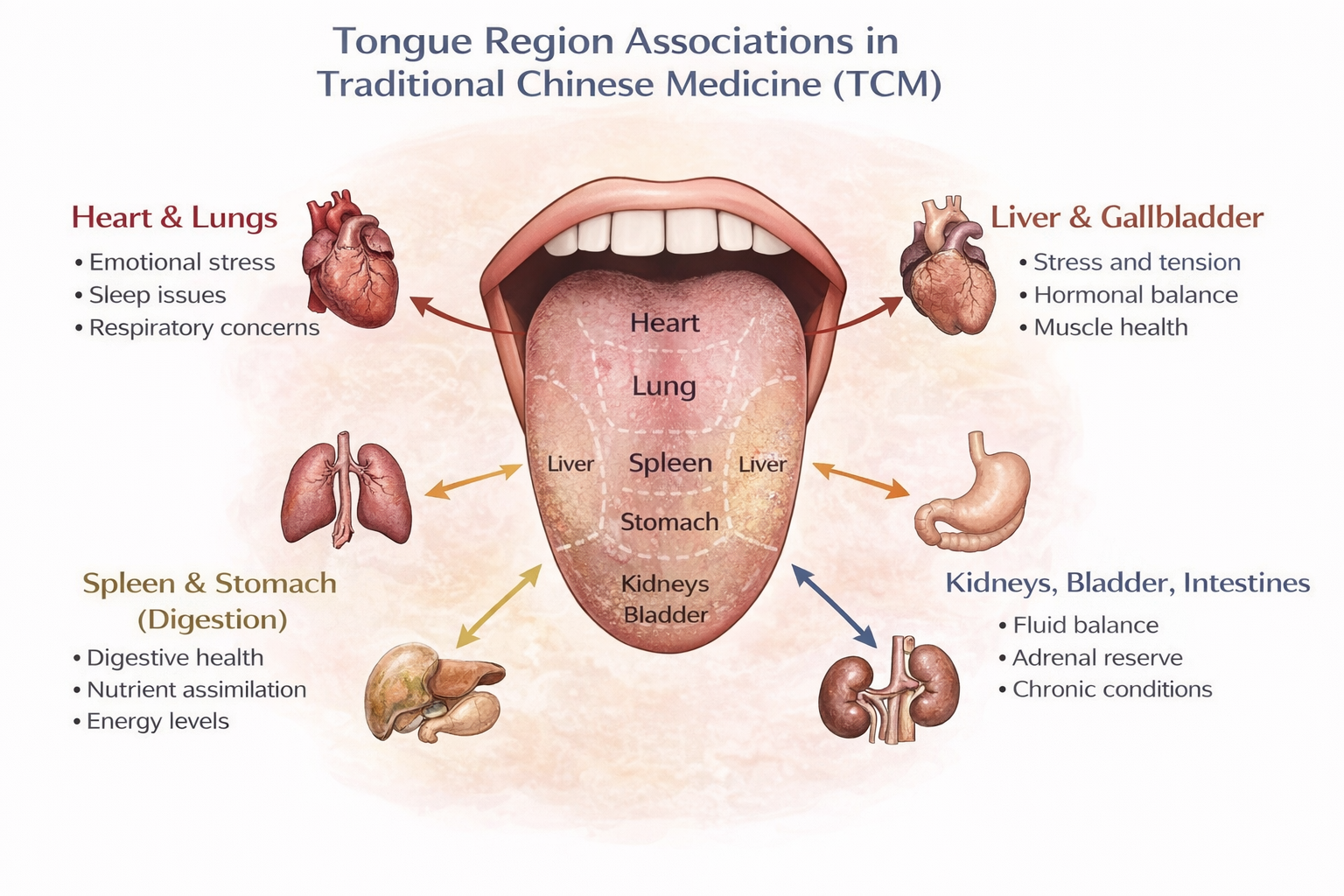
TCM includes a regional map of the tongue, where different areas are associated with different organ systems. This is not anatomy in the Western sense, it is a functional correlation model, similar to reflexology.
Common associations include:
Tip of the tongue → Heart & Lungs (emotional stress, sleep, respiration)
Sides of the tongue → Liver & Gallbladder (stress, tension, hormonal balance, muscle health)
Center of the tongue → Spleen & Stomach (digestion, nutrient assimilation, energy)
Back/base of the tongue → Kidneys, Bladder, Intestines (fluid balance, adrenal reserve, chronic depletion)
Changes in color, coating, or texture localized to these regions are interpreted as possible functional imbalances, not diseases.
Strengths and Limitations of TCM Tongue Diagnosis
Strengths
Long historical use
Integrates digestion, stress, sleep, and emotional health
Looks at patterns rather than isolated symptoms
Limitations
Highly practitioner-dependent
Low consistency between different practitioners
Mostly correlational evidence, not causation
Diet, medications, hydration, smoking, and oral hygiene can strongly influence appearance
Because of these limitations, modern research is exploring digital imaging and artificial intelligence systems to reduce subjectivity and improve consistency, with promising but still early results.
Ayurveda: Tongue as a Hygiene and Detox Practice
How Ayurveda Uses the Tongue
Ayurveda places far less emphasis on visual tongue diagnosis and far more emphasis on tongue cleaning as part of daily hygiene (dinacharya).
The primary goal is removal of Ama, a concept referring to metabolic waste or toxins, to support:
Digestion
Breath freshness
Oral health
Overall vitality
Tongue scraping is traditionally done once daily, before eating or drinking.
What Ayurveda Observes (More Broadly)
Ayurveda may note:
Thick coating
White or yellow discoloration
General tongue heaviness
But it does not use a detailed organ-mapping system like TCM. Interpretation is typically broader and tied to:
Digestive strength (Agni)
Dosha imbalance (Vata, Pitta, Kapha)
Safety Considerations
Gentle tongue cleaning appears to:
Reduce tongue coating
Improve breath
Support oral hygiene
Account required
Sign in to see more
Create an account or sign in to unlock the full list.