Resource Libraries
Can a Tooth Be Saved Without a Root Canal?
How vital pulp therapy differs from a root canal, when a living pulp can be saved with materials like MTA or Biodentine, and how to know when it is too late.
Part 1 of 10 in the Root Canal Question Series
The Root Canal Question — Vital Pulp Therapy, Preserving Living Teeth, and Understanding When It's Already Too Late.
Before You Kill the Tooth: What Does a Living Dental Pulp Actually Do, and Can We Save It?
If you've spent approximately twelve minutes around me, you probably already know that I'm not a fan of root canals.
I don't believe removing tissue from inside a tooth, filling the remaining space with artificial materials, and leaving that tooth in someone's mouth represents the biological ideal. Conventional root-canal treatment can relieve pain, reduce infection, and allow a tooth to continue functioning. I'm not disputing those accomplishments. I'm asking whether we're preserving the actual living biology of the tooth or simply preserving its structure.
And those are two VERY different things.
Now, there are circumstances where retaining a root-canaled tooth may be necessary. A child whose jaws are still growing, for example, may need to retain a strategically important tooth crucial to skeletal growth and esthetics. An adult may need to keep a molar while while we complete orthodontic treatment, certain types of palatal expansion, or other treatment intended to support jaw development and airway function. Depending on the treatment mechanics, removing that tooth could compromise the entire plan.
Sometimes we have to accept a biological compromise because the available alternatives create an even bigger problem. But a necessary compromise isn't the same thing as a biologically desirable treatment. Which brings me to something I think biological dentistry should be discussing considerably more often: vital pulp therapy, or VPT.
What if we could treat the diseased portion of a tooth's pulp while preserving the healthy, living portion? What if that tooth could retain its blood supply, immune activity, and at least some of its neurological and reparative functions? And what if we could keep that tooth alive for YEARS? There's actually some fascinating science answering those questions. But before we get to the exciting part, I need to make something absolutely clear.
FIRST, the tooth has to have living pulp. We can't preserve something that's already dead.
I want to put this near the beginning because I know there will be people reading this article who have already been told they need a root canal. Others may have several root-canaled teeth and are desperately searching for a way to make those teeth healthy and living again. And I don't want to give anyone false hope.
Vital pulp therapy can't restore the original pulp in a tooth whose entire pulp has already died or has been removed through conventional root-canal treatment.
Please read that again.
The word vital is right there in the name. Vital means ALIVE. This only works if a tooth is still fully alive. Conventional VPT works by preserving pulp tissue that is still alive and has the biological capacity to survive.
It doesn't regenerate a new pulp organ where the original one has completely died. It doesn't rebuild the original blood vessels, nerves, immune cells, and organized cellular structures inside an already root-canaled tooth. And it doesn't bring a completely necrotic pulp back to life.
We're preserving living biology, not resurrecting dead tissue. I'm a dentist, not Dr. Frankenstein. . I'm going to be clear here because many of my parents of young children choose to do an extraction on the baby teeth of their littles rather than do pulpotomies, because we have seen pulpotomies fail enough times that it's a subject we discuss. Now, I'm not sure WHY the pulpotomies fail - it's not usually US doing them but rather another dentist who has done them and then the patients comes to me after they fail. Perhaps that is why the family switches dentists. I simply don't know. At the end of the day, most of my parents choose to do extraction for a baby tooth rather than chance having to come back and extract the tooth later on. That's definitely a consideration for a baby tooth. Adult teeth replace baby teeth. So it's a do over. But on a permanent tooth, there is no do over. So it's still a valid discussion to have.
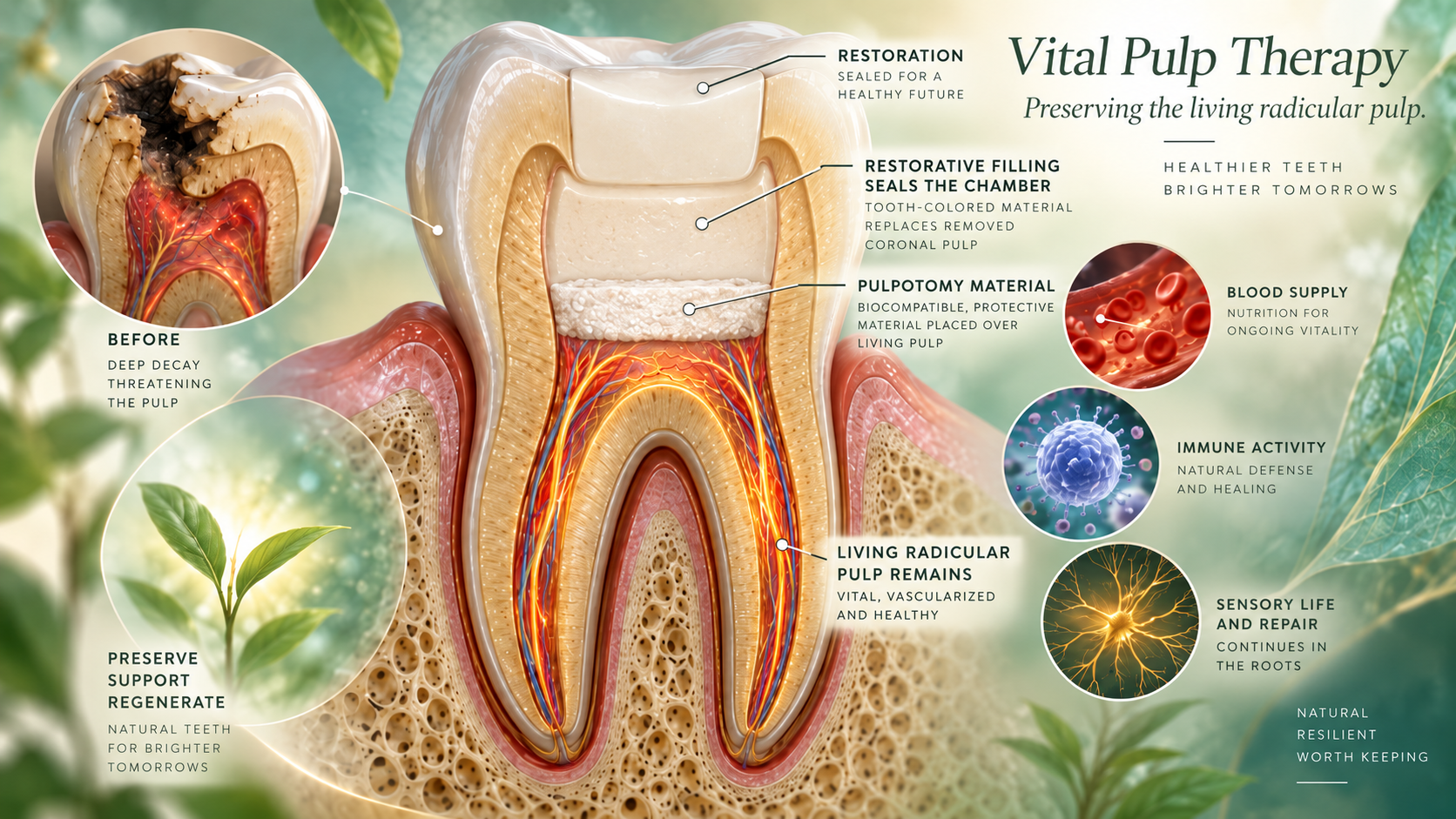
Now, there's an important distinction between a tooth whose ENTIRE pulp is necrotic and a tooth in which only PART of the pulp has become severely inflamed or necrotic. The pulp occupies both the chamber inside the crown and the canals extending through the roots. Sometimes the tissue in the coronal pulp is badly damaged, while tissue deeper inside the roots remains alive.
In appropriately selected cases, a dentist may be able to remove the damaged coronal tissue and preserve the living radicular pulp through a pulpotomy. That's still genuine vital pulp therapy because living tissue remains to be preserved.
But if the entire pulp system is necrotic, ordinary VPT is no longer an option.[1,2]
And here's another complication: a tooth doesn't necessarily have to be completely dead just because it hurts terribly, has been diagnosed with irreversible pulpitis, or doesn't respond to a cold test.
Likewise, a tooth that doesn't hurt at all may have a completely necrotic pulp and a chronic infection. Pain isn't a reliable measurement of whether the pulp is alive. The absence of pain certainly doesn't prove that it is.
This is why diagnosis matters so much. We need the patient's history, symptoms, clinical findings, appropriate testing and imaging, and sometimes direct evaluation of the pulp during treatment.
The first question isn't whether VPT has a 90% success rate. The first question is whether this particular tooth still contains living pulp tissue that can realistically be preserved.
If the answer is yes, then we can investigate whether VPT is appropriate. If the answer is no, then we need to discuss other treatment options. Regenerative endodontics is a separate, developing field that attempts to encourage new tissue formation in selected nonvital teeth. It isn't the same procedure as preserving the original pulp through VPT, and it hasn't become a routine, predictable way to recreate a fully functional adult dental pulp.
We'll explore that science in another article. For now, I want you to understand this distinction before we go any further, because there's no point getting excited about a treatment that simply isn't appropriate for your tooth.
A tooth is a living organ. The pulp isn't packing material.
The pulp is usually thought of as the nerve inside the tooth. They imagine that when a dentist performs a root canal, we're simply removing the part that makes the tooth hurt. That's an enormous oversimplification. A healthy dental pulp contains blood vessels, sensory nerves, immune cells, connective tissue, fibroblasts, odontoblasts, and other cells involved in maintaining and repairing the tooth.
There's an entire biological operation happening in there.[3]
Odontoblasts, for example, are generally described as the cells that form dentin, the mineralized tissue beneath the enamel. But these cells do considerably more than manufacture tooth structure.
Researchers have demonstrated that human odontoblast-like cells recognize bacterial components and release chemical signals that recruit immune cells. When exposed to bacterial lipoteichoic acid, they respond through microbial-recognition pathways and release chemokines that attract immature dendritic cells.[4]. In other words, cells that build dentin also help organize the tooth's defense against infection.
And then there's the nervous system.
Researchers have demonstrated communication between odontoblasts and sensory neurons involving calcium signaling and ATP release. In experimental models, stimulating odontoblasts produces measurable responses in neighboring cells and sensory neurons, and interrupting specific signaling pathways interferes with that communication.[5]
Other studies have found that sensory nerves participate in pulp repair through signaling molecules such as CGRP and Sonic hedgehog. Experimental disruption of sensory innervation can impair stem-cell recruitment and organized tissue repair.[6,7]
Now, these are laboratory and animal experiments, so we shouldn't pretend that every mechanism has been completely demonstrated in living human teeth. But they establish something important.
The pulpal nerves do more than tell your brain that your ice cream is cold. They participate in a communication network involving immune activity, cellular responses, and tissue repair. That's the biology we're trying to preserve.
Tooth taxidermy. Yes, I'm still calling it that.
I've referred to conventional root-canal treatment as tooth taxidermy for years because I think the analogy helps people understand what we're actually accomplishing. With conventional treatment, the pulp tissue and infected or necrotic contents are removed from the canals. The canal spaces are cleaned, disinfected as thoroughly as possible, and filled with artificial materials.
The tooth can continue to function. The periodontal ligament, surrounding bone, and gum tissues remain alive. Those surrounding tissues are important, and retaining them has genuine biological value. But the original internal pulp is gone.
The internal blood vessels aren't restored. The original pulpal immune network isn't recreated. The nerves and cellular relationships inside the pulp aren't rebuilt by placing a root filling.[1,3]. And once we understand what that living pulp actually DOES, I think the question becomes obvious.
Why would we remove the entire organ if we could safely preserve the healthy portion?
Sometimes there's nothing viable left to preserve. Sometimes the infection or destruction is too extensive. And sometimes the tooth itself is structurally beyond repair. But when genuinely healthy or recoverable pulp remains, I want us to consider whether we can save it before accepting its permanent removal. That's where vital pulp therapy comes in.
Vital pulp therapy: Can we treat the disease without removing the entire living organ?
VPT is actually a group of procedures intended to preserve living pulp tissue. Which procedure is appropriate depends on the extent of decay or injury, the condition of the pulp, and whether healthy tissue can be maintained after treatment. Here's how the different approaches compare.
- Indirect pulp treatment involves carefully managing deep decay without intentionally exposing the pulp. The objective is to maintain the entire living pulp while controlling the disease and sealing the tooth.
- Direct pulp capping involves placing a suitable material directly over a small pulp exposure when the tissue is considered capable of healing. The goal is to protect and preserve the remaining pulp.
- Partial pulpotomy removes a limited portion of the coronal pulp, including tissue believed to be inflamed or contaminated, while retaining the deeper living pulp.
- Full coronal pulpotomy removes the pulp inside the crown while preserving living pulp inside the roots.
These procedures don't preserve identical amounts of tissue, and that's important. I would rather preserve more healthy living pulp than less, assuming doing so doesn't compromise disease control. But we also don't want to leave severely damaged tissue behind simply because we've decided that less tissue removal must always be better. The goal is to preserve as much healthy, functional biology as reasonably possible.[1,2]
And here's why that approach actually makes biological sense. Ricucci and colleagues examined 264 extracted human teeth using histological and histobacteriological methods. They also analyzed outcomes from 757 clinical VPT cases.[8]. Their findings showed that pulpal inflammation associated with decay can be localized. Tissue immediately beneath a carious exposure may be severely inflamed or contaminated while deeper tissue remains comparatively healthy. That means a pulp can contain both diseased and potentially preservable tissue.
Now, that doesn't mean we can look at an X-ray and confidently identify the exact boundary between healthy and diseased pulp. We can't. Nor does it mean a pulpotomy is appropriate for every painful tooth. But the histological findings explain why selectively removing diseased tissue can sometimes preserve the living pulp beneath it. And that is fundamentally different from removing the entire pulp system.
How do we know whether the remaining pulp is STILL alive?
This is where I think we need to be careful about how dental studies describe success. A clinical study may report that 95% of treated teeth were successful. That sounds wonderful, but what exactly did the researchers measure?
- Did they demonstrate continued blood flow?
- Did they measure responses to cold or electrical stimulation?
- Did they look for symptoms, swelling, sinus tracts, or radiographic lesions?
- Did they examine continued root development?
- Or did they simply determine whether the tooth was still in the mouth?
Those are different outcomes. A tooth can remain in someone's mouth without having a living pulp. Cold and electric pulp tests primarily evaluate sensibility, which means neural responsiveness. They aren't direct measurements of blood circulation inside the pulp.[9]. That's particularly important after a pulpotomy because some of the original nerve-containing tissue has been removed.
A tooth may respond differently to cold while still containing living pulp. Conversely, the absence of symptoms doesn't establish that the remaining tissue is alive and healthy. More direct methods of assessing blood flow, such as laser Doppler flowmetry and dental pulse oximetry, exist. But they're technically challenging and aren't routinely available for every dental office or clinical study.[9]
So when researchers report pulpotomy success, we need to know whether they're measuring clinical health, tooth retention, sensibility, continued development, or actual pulpal vascularity. I want successful VPT to mean that we've preserved living biology, not merely that the tooth has avoided extraction. And I want our research to move toward better methods of demonstrating that.
So how much TIME can vital pulp therapy actually buy us?
This was the question that sent me down another research rabbit hole. Because if VPT can preserve living pulp, I want to know how long that biological benefit might last. Two years? Five years? Ten years?
And here's what's fascinating: the literature shows that appropriately selected teeth can remain clinically successful after VPT for years, and some have been followed for a decade or longer.
But there isn't one universal expiration date. The outcome depends on the diagnosis, remaining tissue, technique, treatment approach, restorative seal, materials, and other patient-specific factors. So let's look at what the research actually found.
Two years: Encouraging results across several procedures
A 2025 systematic review and meta-analysis evaluated VPT outcomes in permanent teeth.[10]. For teeth diagnosed with normal pulp or reversible pulpitis, reported success at 24 months ranged from approximately 91% to 97% across indirect pulp treatment, direct pulp capping, partial pulpotomy, and full pulpotomy. Those results are encouraging.
The investigators also found that partial pulpotomy and full pulpotomy could succeed in mature permanent teeth, not only in young teeth with incomplete root development. But remember, these findings come from particular study populations and clinical success criteria. They aren't proof that every surviving tooth retains perfectly normal pulp histology or function.
And the results certainly don't apply to teeth whose entire pulp was already necrotic before treatment. That's a point I can't emphasize enough.
Three years: Tooth survival and pulp vitality aren't the same thing
Eggmann and colleagues studied partial pulpotomies in permanent teeth with carious pulp exposures.[11]. Of 111 identified cases, 64 met the study's eligibility criteria. Patient ages ranged from 18 to 85 years, with a mean observation period of approximately 3.1 years.
The investigators reported:
-
89.1% success in maintaining pulp vitality
-
98.4% tooth survival
Now, THAT difference catches my attention. Because it demonstrates exactly why I don't want us talking about tooth survival as though it's synonymous with preserving living tissue. More teeth remained physically present than met the study's criteria for successful preservation of pulp vitality. And even the vitality outcome was based on clinical assessment rather than continuous direct measurement of blood flow.
Still, this is encouraging evidence that partial pulpotomy can preserve pulp vitality over several years in appropriately selected adult teeth. Notice I said ADULT teeth. This isn't something that only works because an eight-year-old has an immature tooth with tremendous healing potential. Is it perfect? NOPE. Is it better than fully dead, taxidermied teeth? I think so.
Five years: Partial and full pulpotomy in mature permanent molars
A 2025 follow-up of a randomized clinical trial compared partial and complete pulpotomy in mature permanent molars diagnosed with symptomatic irreversible pulpitis.[12]. The original trial included 93 participants, and 59 of the 88 participants eligible for five-year recall were available for evaluation.
The reported combined clinical and radiographic success rate was 83.05% at five years. There wasn't a statistically significant difference in overall success between partial and complete pulpotomy. However, teeth treated with partial pulpotomy demonstrated more reliable cold-test responses and less pulp canal obliteration than those receiving complete pulpotomy. That's interesting because preserving more of the original tissue may preserve more of its sensory responsiveness. It doesn't prove every remaining cell is functioning normally, but it's another reason to investigate the biological differences between the procedures.
The study also identified secondary caries as an important factor associated with failure. Which makes perfect sense. We can't preserve the pulp and then ignore the disease environment that endangered it in the first place. A good restoration and control of recurrent decay are essential parts of preserving that living tissue.
Five years in children: Continued development matters
A 2026 retrospective cohort examined 192 immature permanent teeth in 108 patients who underwent cervical pulpotomy.[13]. The mean patient age was approximately 8.9 years, and the mean follow-up period was 63 months, a little over five years. The reported overall success rate was 91.7%. These were selected vital immature permanent teeth, not teeth with completely necrotic pulp systems.
The study is important because living pulp in an immature permanent tooth does something we can't simply reproduce by filling the root canal with artificial material. It participates in continued root development. That process is called apexogenesis. If the root walls are thin and the apex is still open, maintaining living pulp may allow the root to continue developing and strengthening. And that is considerably more valuable than simply retaining a tooth-shaped object in a child's mouth.
Ten years and beyond: What do we know?
Kunert and colleagues published a retrospective analysis of 273 pulpotomies performed in permanent teeth.[14]. Patients ranged from 8 to 79 years old, and individual follow-up periods ranged from one to 29 years. That does NOT mean every tooth survived 29 years, nor does it mean the researchers directly verified vascular vitality throughout those decades. But it demonstrates that pulpotomy isn't automatically a short-term procedure.
Account required
Sign in to see more
Create an account or sign in to unlock the full list.