Resource Libraries
Gluten in Dental Products: Hidden Food Allergens to Avoid
Where gluten, soy and nut allergens hide in dental products such as polishing paste, fluoride varnish and gloves, why labeling is incomplete, and what to ask.
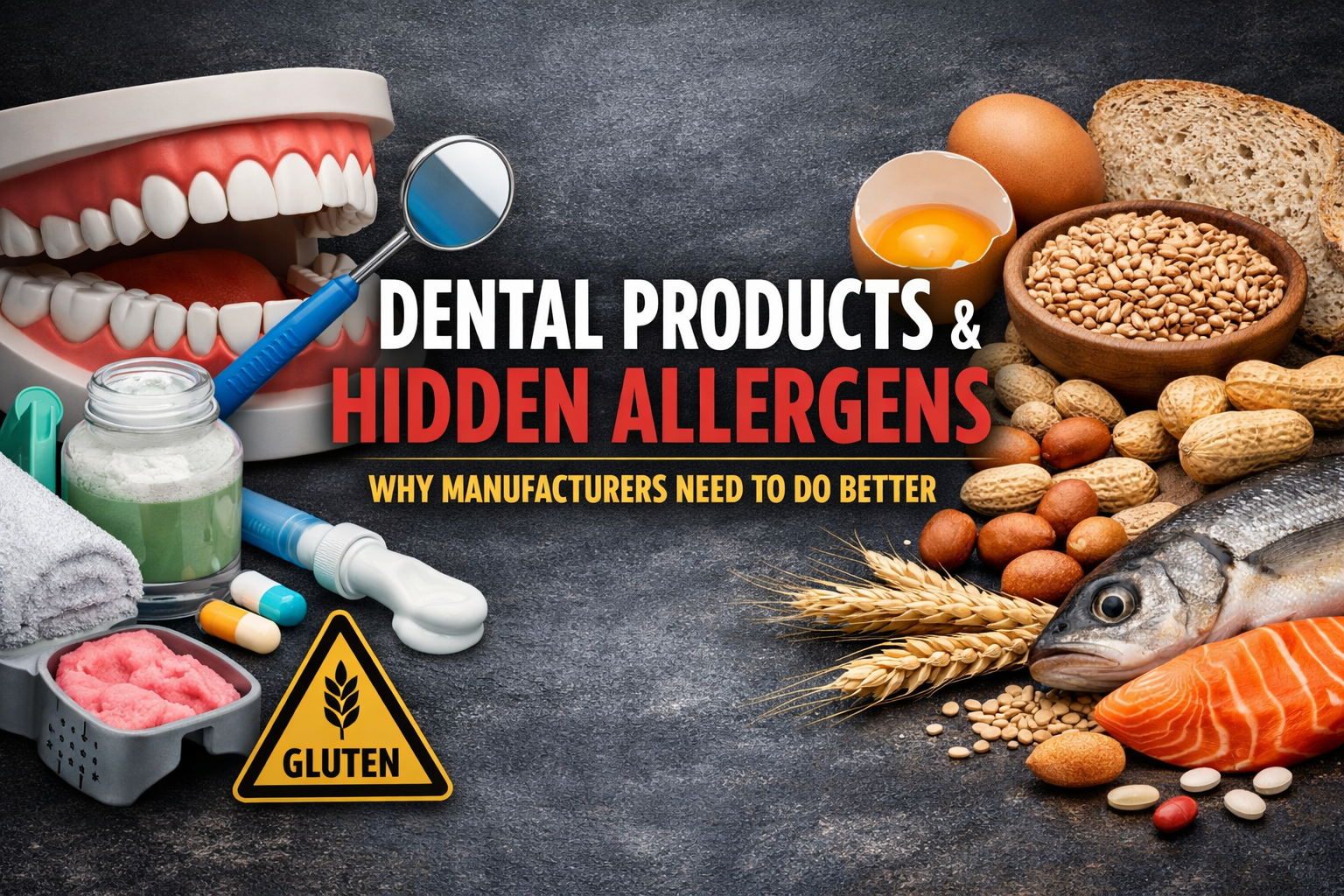
Food Allergens in Dental Products: An Avoidable Risk in Modern Dentistry
Products that go directly into the mouth should be free of major food allergens whenever reasonably possible. Honestly, that should not even be a controversial statement at this point. With food allergies rising as fast as they are, that should already be the standard by now.
And yet here we are. These are not products being handled with gloves in a warehouse somewhere. These are products being placed directly into the mouth, onto oral tissues, and often used repeatedly over time.
Dental offices are left trying to figure out whether the products we use every day contain milk protein, gluten contamination, soy, peanuts, tree nuts, egg, fish, shellfish, wheat, sesame, or whatever else is going to be the next thing added to the list. And half the time, the labeling is so incomplete you cannot even tell. Sesame became the ninth major food allergen under U.S. food law on January 1, 2023, which just makes the gap between food labeling and dental-product labeling even more ridiculous.
This is an avoidable problem.
Dental offices already have enough on their plates. We are already thinking about bond strength, durability, tissue tolerance, esthetics, resin chemistry, material compatibility, preservatives, flavors, latex, acrylates, and biocompatibility. Biological offices are juggling even more because we are intentionally trying to stock cleaner products and more compatible alternatives. We do not need manufacturers making this harder by throwing food allergens into intraoral products or being vague enough with disclosure that clinicians are left playing detective. We should be able to trust our dental materials suppliers. Really.
That is literally what the literature shows. The real issue is not just that some products contain allergens. The real issue is that clinicians should be able to trust that products going into the mouth are either free of major food allergens or very clearly labeled when they are not. That should not be too much to ask. Right now, that is not happening consistently. Coimbra and colleagues looked at 387 oral-care products and found food allergens most often in toothpaste, fluoride varnishes, and alginates, and they also pointed out that labeling was sometimes wrong or incomplete. Thankfully, vetted biological dentists usually avoid fluoride, so toothpaste and fluoride varnish are not likely to be sitting around our offices. But alginates? Those are impression materials. Those are everywhere. Including in biological offices. Like, we use them on a daily basis for diagnostic dental models.
And that matters because these are not weird fringe products nobody uses. These are everyday products. Toothpastes. Varnishes. Alginates. Retainers. Desensitizers. Remineralization products. The regular stuff. So if a clinician cannot quickly tell whether one of those products poses allergen risk, the burden falls on the wrong people: the office and the patient. That is not a reasonable chairside workflow. And to make this even more maddening, manufacturers will sometimes refuse to fully disclose ingredients because they consider the formulation proprietary. That is a manufacturing and disclosure failure. At minimum, manufacturers should be doing three things: avoiding major food allergens whenever reasonably possible, clearly disclosing when those allergens or milk-derived proteins are present, and being transparent about meaningful cross-contamination risk when known. None of that is unreasonable. It's basic product responsibility.
The gluten issue is a good example of the problem. Verma and colleagues tested 66 oral-hygiene and cosmetic products for gluten. Most were below 20 ppm, but 4 products were above that level, including 3 toothpastes. But honestly, the most important part was not even the percentage. It was the labeling problem. None of the products with detectable gluten listed wheat, barley, or rye as ingredients. So the product could test positive, and the label still would not help you. The authors did say this was not a broad market-wide problem, and that nuance matters. Fine. But “not common” is not the same thing as “not a problem,” especially if you are the patient who reacts.
And that same theme shows up in the celiac literature too. There is a published case report of a child with celiac disease whose symptoms and abnormal labs improved only after stopping use of an orthodontic retainer that was believed to be the source of continued gluten exposure. That does not mean every retainer is full of gluten and everybody needs to panic. It is a case report, not the Ten Commandments. But it is more than enough to prove the bigger point: oral and dental products absolutely can matter in highly sensitive people.
Then there is the acrylic monomer conversation. And this is where people can get confused fast. Acrylic monomer itself is not gluten. But acrylic-containing products can still be a problem for two different reasons: some may involve gluten exposure through additives or contamination, and some people react to the methacrylate chemistry itself. Those are not the same mechanism, and they should not be talked about like they are. Methacrylates and acrylates are important for a different reason. They are well-known sensitizers in dentistry and can trigger allergic contact reactions completely separate from gluten or celiac disease. Aalto-Korte and colleagues documented allergic reactions to acrylic monomers in dental personnel, especially 2-HEMA, TREGDMA, and bis-GMA. A systematic review also identified latex, acrylates, and formaldehyde as some of the more common dental-material allergens. So if a patient reacts to an acrylic-containing product, the question is not automatically, “Aha, was that gluten?” Sometimes the problem is the methacrylate itself.
And this is exactly why the word “sensitivity” can be so annoyingly unhelpful. Dentistry loves to throw ten different mechanisms into one giant junk drawer and call it sensitivity. But food-allergen exposure, gluten exposure in celiac disease, methacrylate allergy, flavor allergy, preservative allergy, rosin sensitivity, and plain old irritation are not the same thing. If the mechanism is different, the answer is different. You do not fix all of those with the same logic, so we need to stop talking about them like they are interchangeable.
Toothpaste is one of the biggest blind spots in this entire discussion. Sainio and Kanerva’s classic review found that the most common toothpaste allergens were flavors and preservatives, and the reactions they reported were not exactly subtle: stomatitis, cheilitis, glossitis, gingivitis, perioral dermatitis, and even immediate hypersensitivity. De Groot’s later review also described a whole pile of cases showing that toothpaste ingredients can trigger either allergic or irritant reactions. So when a patient says a toothpaste bothers them, that should not be brushed off like, “Oh, they probably just don’t like the flavor.” Sometimes the toothpaste is actually the problem.
Fluoride varnishes and alginates deserve more scrutiny too. Coimbra’s survey found food allergens fairly often in both categories. Which, I admit, made me a little happy. Yet another reason vetted biological offices are not exactly crying over fluoride varnishes. So Yay! Another win for our side! And then you have case reports that make it very clear that “routine” does not mean “harmless for everyone.” And this is not just a biological dentistry issue. Any dentist using products in the mouth should be able to know whether those products carry meaningful allergen risk without having to play detective. If it's anything like the restaurant industry, where most people who answer the phones or sell products have NO idea whether a restaurant or product is safe for celiacs, then we know the challenge we are up against. My daughter is seriously gluten sensitive. She doesn't have celiac - YET - but she has the gene. And her body can tell if she is exposed to gluten. I can't tell you the number of times we have encountered people on the phone at restaurants, or the waiters, who literally have no idea what gluten is. They assume it's rice. Or potatoes. Or they don't understand that pasta is made from wheat. Or that barley and rye have gluten as well. No joke. It's been a journey of learning for us. But it definitely brought this subject to the forefront for me, which is why I'm writing about it now. All of this to say - gluten and the other 8 top allergens have zero place in the dental world. Period. Dental offices should be a safe space. But we can't make it that way if the products we use don't ensure THEY are safe. Because we can't control THOSE ingredients. We should never have to learn the hard way about one of our products. A patient should never have to die because of something beyond our control. Can you imagine if a dental product is manufactured with peanuts and we have a patient come in with a peanut anaphylaxis and we only find out about it because the person has an anaphylactic reaction in the chair? What a horrible way to find out, right? That should NEVER be the burden of the dentist. The manufacturers should be held accountable for those things. Not the dentists.
Sharma and colleagues described allergic contact stomatitis from a colophony-containing dental product, and earlier work identified rosin in Duraphat with cases of hypersensitivity. Gangemi and colleagues reported a fatal anaphylactic shock after contact with an alginate impression material in a medically fragile patient. Now, none of that means varnishes and impression materials are broadly unsafe and everyone needs to lose their minds. It means routine use is not proof of clean formulation, and it is not proof that a product is universally well tolerated.
Milk protein is one of the clearest examples of an avoidable risk. CPP-ACP technology is derived from milk casein. That is well documented in the literature. Cross and colleagues reviewed the chemistry and clinical applications of casein phosphopeptides in oral health, and Azarpazhooh and Limeback’s systematic review focused specifically on casein derivatives in dentistry. GC’s own MI Paste Plus information states that Recaldent is derived from milk protein casein. So this is not some obscure biochemical footnote nobody could possibly be expected to know. This is a mainstream dental product containing a clinically meaningful milk-derived ingredient. If something used chairside contains milk protein, that should be very easy to identify before it ever gets near a milk-allergic patient.
The celiac literature also supports the bigger idea that dentists should care about this. Oral findings are part of the celiac picture. Those who have celiac disease struggle with increased risk of decay and poorer general oral health. So it's part of the celiac picture. Bulut and colleagues looked at nutrition and oral health in children with newly and previously diagnosed celiac disease, and other reviews have pointed out that oral manifestations can help identify or monitor disease. That does not mean every patient with celiac disease needs some elaborate custom dental protocol. It does mean dentistry is not outside this conversation, and we need to stop acting like it is.
Latex is not a food allergen, but it belongs in the bigger safety conversation because it proves the point that materials matter and dental offices are already expected to manage those risks. A 2024 systematic review and meta-analysis estimated latex allergy prevalence in dental professionals at about 10.37%, although the evidence quality was limited because the studies were all over the map. The broader dental-material allergy literature also keeps identifying latex as a repeat offender. That is exactly why piling poorly disclosed food-allergen risk on top of everything else feels so unreasonable. Offices are already juggling enough. Thankfully, authentic biological offices are usually latex free by default anyway, because ozone dissolves latex and we use ozone all over the place. So in that one area, biological dentistry actually tends to be ahead of the curve.
And then there is the regulatory absurdity. Packaged foods in the United States have to disclose the major allergens, including sesame as the ninth and newest offender. But dental products do not give clinicians the same clean, practical, standardized disclosure. We cannot be expected to know if the manufacturers won't disclose. And to make this even more maddening, sometimes manufacturers will not fully disclose ingredients because they consider the formulation proprietary. That may protect their recipe, but it does not help the clinician trying to protect the patient. So yes, a parent may get clearer allergen information from a snack bag than a dentist can get from a product going directly into the mouth. That is ridiculous. It should not take detective work, multiple phone calls, and a patient reaction to figure out whether a routine intraoral product contains something clinically meaningful.
The honest bottom line is this: manufacturers should be making intraoral products free from major food allergens whenever reasonably possible. Food allergies are becoming increasingly more common, not less. The problem is not just intentional allergen-containing ingredients. The problem is also contamination, additive choices, and incomplete disclosure that leave clinicians unable to reliably tell what is actually in the product. It is not acceptable to keep building products in ways that create avoidable risk and then leave clinicians stuck sorting it out chairside through incomplete labeling and extra inventory. The literature absolutely supports higher standards. Dentistry should not be expected to normalize “probably fine” when better formulation and better disclosure are both completely achievable. If a parent can get clearer allergen information from a granola bar than a dentist can get from something going directly into a child’s mouth, that is a systems failure. Full stop.
And because I know some of you are going to want the science, here you go:
Coimbra et al.
PMID: 37095111
https://pubmed.ncbi.nlm.nih.gov/37095111/
Researchers reviewed 387 oral-care products and found food allergens most often in toothpaste, fluoride varnishes, and alginates. They also said labeling was sometimes incomplete or inaccurate, which makes it harder for patients and dental offices to know whether a product is actually safe.
Account required
Sign in to see more
Create an account or sign in to unlock the full list.