Resource Libraries
Is There a Natural or Holistic Root Canal?
Whether a holistic root canal with ozone or laser exists, what regenerative endodontics does, why infection hides under a normal X-ray, and how long it lasts.
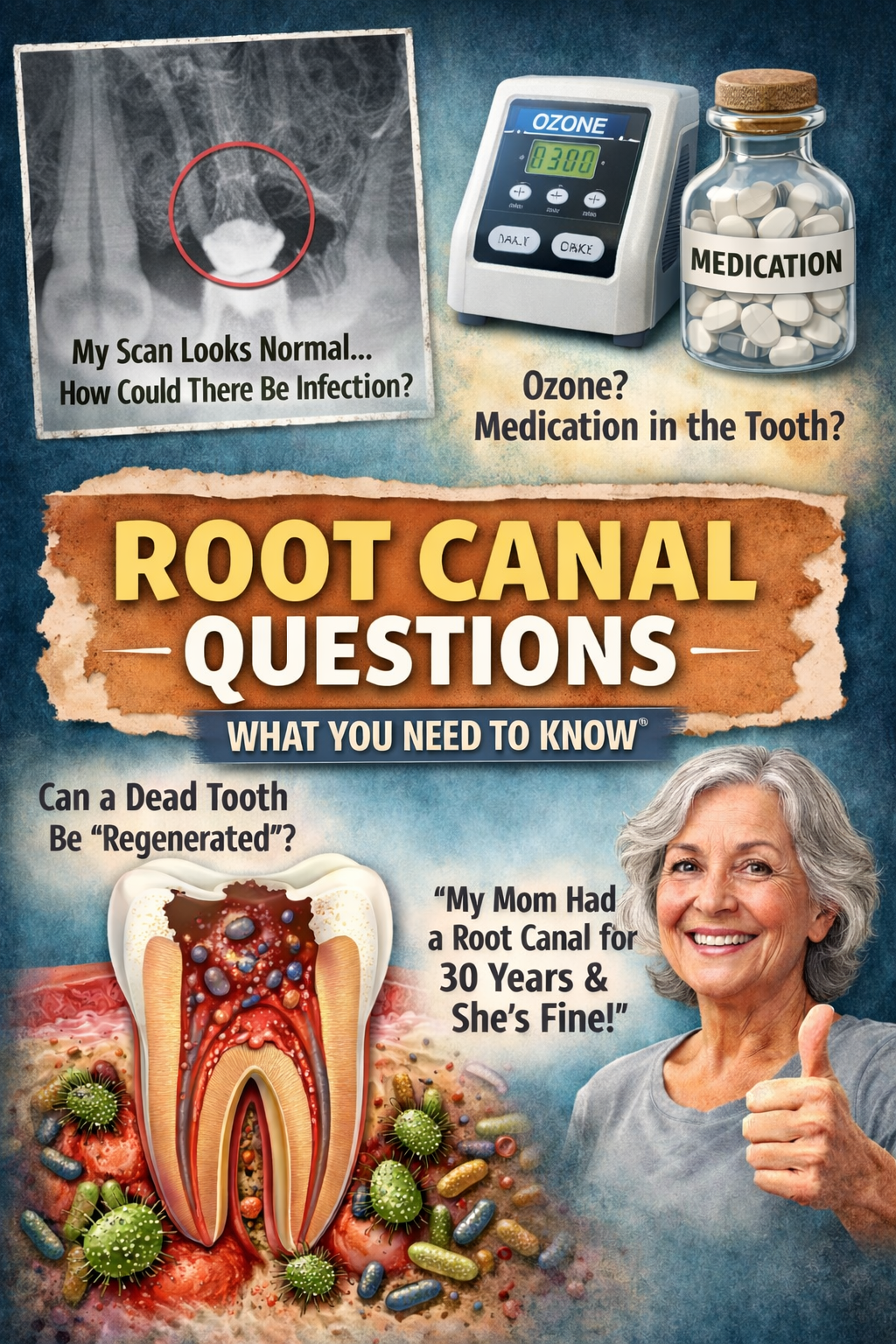
Part 2 of 2 in the Root Canal FAQ Series
FAQ's for Root Canals - Informed Consent, Biology, and Medical Freedom of Choice
If Part 1 of this series was about biology and materials, then Part 2 is about decision-making.
This is where most people actually live. Once someone understands that a root canal-treated tooth is dead, that bacteria cannot be fully eliminated, and that materials are not biologically inert, the questions change. They become more personal. More emotional. More nuanced.
People start asking things like:
-
Is it okay if I do this anyway?
-
What if my scan looks normal?
-
What about ozone or regeneration?
-
What if someone I love has had a root canal for decades and seems fine?
This article exists to answer those questions honestly—without fear-mongering, without minimizing concerns, and without telling anyone what they should do with their body. In this article, we will answer the following questions:
-
"What about if medication is left inside a tooth they are doing a root canal on for weeks?"
-
“What About Ozonated or ‘Holistic’ Root Canals?”
-
" What About Regenerative or Revascularization Root Canals?"
-
“If Cone Beam CT Scans Look Normal, How Could There Be Infection?”
-
“My Mom Has Had a Root Canal for 30 Years and She’s Fine”.
-
"Do All Root Canals Fail?"
-
“If I Try a Root Canal and It Doesn’t Work, Can I Extract Later?”
-
"What About Testing Extracted Root Canals for Bacteria?"
-
"What If I Do Nothing?"
I will add to this list over time if it becomes obvious something is a FAQ. As always, our position remains unchanged:
-
We are not fans of root canal therapy.
-
We are enormous fans of informed consent and medical freedom of choice.
Those two things are not in conflict.
“What About Root Canals Where Medication Is Left Inside for Weeks?”
Yes—this is a standard endodontic protocol in certain cases. In these situations, an endodontist may:
-
Clean the canals
-
Place an intracanal medicament (often calcium hydroxide or similar)
-
Temporarily seal the tooth
-
Leave the medication inside for several weeks
-
Then complete the root canal later
This approach can reduce symptoms and lower bacterial load temporarily. What it does not do is restore:
-
Blood flow
-
Immune function
-
Long-term biological viability
Medication does not change the fundamental issue: bacteria inevitably recolonize dentinal tubules over time because the body has no way to monitor, police, or clear that space once circulation is gone. This is not a criticism of the technique. It is a limitation of biology.
Why Root Canals Cannot Be Fully Sterilized
Dentinal tubules are microscopic channels that extend throughout the tooth. If laid end to end, they would measure miles within a single tooth. No current method—mechanical instrumentation, chemicals, ozone, or lasers—can sterilize these tubules completely.
This is not about outdated dentistry or poor technique. It is about anatomy.
Sterilization requires access and immune participation. A non-vital tooth has neither. If you want more science than we can shake a stick at, please read part one of this FAQ article. There are literally dozens of scientific links on it. Here is the link to that article:
PART 1: FAQ's for Root Canals - Informed Consent, Biology, and Medical Freedom of Choice: https://www.orabiologics.com/resource-library/root-canals%3A-informed-consent%2C-biology%2C-and-medical-freedom-of-choice
“What About Ozonated or ‘Holistic’ Root Canals?”
Let’s be very clear, because this is one of the most confusing and misused phrases in modern dentistry: There is no such thing as a biological or holistic root canal. None. Zero. By definition.
That statement is not meant to be provocative—it is meant to be precise.
Why the term “holistic root canal” is misleading
Root canal therapy, by definition, involves:
-
Removal of living pulp tissue
-
Permanent loss of blood supply
-
Permanent loss of immune surveillance
-
Permanent loss of lymphatic drainage
Once a tooth is rendered non-vital, it no longer meets the most basic criteria for biological integration. No matter how the canal is cleaned—whether with:
-
Conventional instruments
-
Lasers
-
Ozone
-
Advanced irrigation protocols
…the endpoint is still the same: a sealed, avascular structure inside living bone. Calling a root canal “holistic” because ozone or lasers are used confuses technique with biology. Those are not the same thing.
What ozone can do (and this matters)
Ozone is not fake. It is not imaginary. It does have real, measurable effects. Ozone can:
-
Reduce bacterial load
-
Temporarily lower inflammation
-
Improve short-term symptoms in some cases
That part is real, and pretending otherwise would be dishonest. If you want more of the science on ozone in dentistry, please see the abundant number of links in our resource articles on ozone in our library:
Ozone in Dentistry: https://www.orabiologics.com/resource-library/pubmed-research-on-dental-use-of-ozone
Ozone in Dentistry: Where It Helps, Where It Doesn’t, and Where Claims Go Too Far: https://www.orabiologics.com/resource-library/ozone-in-dentistry%3A-where-it-helps%2C-where-it-doesn%E2%80%99t%2C-and-where-claims-go-too-far
What ozone cannot do (this is the part that matters most)
Ozone does not:
-
Restore blood supply
-
Recreate immune surveillance
-
Re-establish lymphatic drainage
-
Prevent long-term recolonization of dentinal tubules
Ozone is a disinfectant, not a regenerative system. Once circulation is gone, there is no mechanism for:
-
Ongoing immune monitoring
-
Cellular repair
-
Toxin clearance
-
Biological adaptation over time
No amount of ozone changes that.
The core issue ozone does not solve
Dentinal tubules remain. Anatomical complexity remains. An avascular environment remains.
Bacteria and biofilms do not need permission to return. They simply need time.
So while ozone may:
-
Reduce symptoms
-
Delay progression
-
Improve short-term outcomes
…it does not change the endpoint. A dead tooth, no matter how good the root canal, is still DEAD. It cannot be resurrected. FULL STOP.
Why this distinction matters for informed consent
When patients hear phrases like:
-
“Holistic root canal”
-
“Biological root canal”
-
“Natural root canal”
they are often led to believe that:
-
The tooth has been biologically restored
-
The immune system has been re-engaged
-
The long-term risks have been eliminated
That is not accurate, and it undermines informed consent. A root canal done with ozone or lasers is still:
-
A root canal
-
In a non-vital tooth
-
In an avascular system
Clearing up a common misconception
You will often hear claims that ozone- or laser-assisted root canals are:
-
Less aggressive
-
Better tolerated
-
Longer-lasting
That is not supported by biology or consistent clinical evidence. While some patients may experience temporary symptom relief, that does not mean the procedure itself is gentler, safer, or more biologically compatible. Symptom relief is not the same thing as biological resolution.
What ozone actually changes—and what it does not
Ozone may reduce bacterial load at the time of treatment. That is its role. Lasers and ozone do a little bit better at cleaning out the canal. But at the end of the day, there is no evidence that shows that root canals done with laser and ozone will keep a tooth sterile or viable any longer. As with any root canal, the most anyone can get is to BUY TIME. What Ozone does not change:
-
The tooth is still rendered non-vital
-
Blood supply is still permanently lost
-
Immune surveillance is still absent
-
Lymphatic drainage is still absent
-
Dentinal tubules remain inaccessible to sterilization
-
Long-term recolonization remains inevitable
From the body’s perspective, the environment has not fundamentally changed.
Why “better tolerated” is a misleading phrase
If a patient feels better after an ozonated root canal, that usually reflects:
-
Temporary reduction in inflammatory signaling
-
Suppression of microbial activity
-
Short-term symptom control
It does not mean:
-
The tooth has been biologically restored
-
The immune system has regained access
-
Long-term inflammatory burden has been eliminated
A reduction in symptoms does not equal improved biological compatibility.
The core truth
Ozonated or laser-assisted root canals do not:
-
Make the procedure more biological
-
Make the tooth more compatible with the immune system
-
Change the long-term biological endpoint
They are still managing a non-vital, avascular system. Calling that “holistic” or “biological” misrepresents what is actually happening and creates false reassurance.
Our position
Ozone is a tool. It is marvelous for inflammation. But It is not regeneration. It is not immune restoration. It is not biology reclaiming control. A root canal performed with ozone is still a root canal. Pathogens will still eventually recolonize every nook and cranny of the tooth. And a root canal—by definition—cannot be biological.
We do not believe ozone root canals are “evil.” We do not believe they are always the wrong choice. What we do believe is this:
-
Technique does not override biology.
-
Terminology should not outpace evidence.
Ozonated root canals manage biology temporarily —but they still manage a fundamentally compromised system. Consumers deserve to understand that distinction clearly, so they can decide whether managing the problem aligns with their values, health priorities, and long-term goals. That is informed consent. That is medical freedom of choice. And that is why we refuse to call something biological when, by definition, it is not.
Regenerative or Revascularization Root Canals
(Including “Root Canal Genesis”)
This is where skepticism is not only appropriate—it’s necessary. Revascularization techniques:
-
Are limited to very specific cases (often immature teeth)
-
Do not recreate a normal pulp–dentin complex
-
Do not restore original immune architecture
-
Have no long-term evidence demonstrating durable biological success
First: the simple truth
If a tooth is dead, it is dead. There is no version of a root canal procedure that brings the tooth back to life. That means:
-
No original nerve comes back
-
No original blood supply comes back
-
No original immune system inside the tooth comes back
Anything else we say has to be measured against that reality.
What “regenerative” or “revascularization” root canals ACTUALLY mean
When you hear phrases like:
-
Regenerative root canal
-
Revascularization
-
Root Canal Genesis
people often picture something like this: “The inside of the tooth grows back and works like it used to.” That is not what happens. Here is what actually happens:
-
The inside of a dead tooth is cleaned out (just like a regular root canal).
-
Strong disinfectants and medications are used to kill as much bacteria as possible.
-
The dentist intentionally causes bleeding from the bone at the tip of the root.
-
Blood from the surrounding bone flows into the empty tooth space.
-
Cells from the bone and ligament around the tooth grow into that space.
That’s it. The tooth itself does not come back to life.
Where the confusing wording comes from
The scientific papers say things like: “These procedures do not require the tooth to be partially vital.” That sounds impressive, but what it really means is: “The tooth is already dead. We’re not bringing it back. We’re just putting other tissue into the empty space.”
So yes — these procedures are done on dead, infected teeth. That does not mean the tooth becomes alive again. The teeth are not Lazarus. They will never resurrect.
What kind of tissue actually grows inside the tooth?
This is the most important part, and it’s often glossed over. When scientists look at these teeth under a microscope, they do not see real tooth pulp. They see:
-
Bone-like tissue
-
Cementum-like tissue
-
Ligament-like tissue
-
Some blood vessels
This tissue comes from:
-
Bone stem cells
-
Ligament cells around the tooth
Not from tooth pulp cells. So the inside of the tooth ends up filled with: “Repair tissue” — not original tooth tissue. Think of it like this:
-
Original tooth pulp = a working computer
-
Regenerative root canal = stuffing wires and batteries into the empty case
Something fills the space, but it’s not the original system, and it doesn’t work the same way.
Why feeling sensation does NOT mean the tooth is alive
Some studies say: “Patients regained sensibility to pulp testing.” This is another place people get misled. What that really means:
-
Nerves from the surrounding ligament can sometimes transmit sensation
-
Blood vessels from nearby bone can grow into the space
It does not mean:
-
The tooth regained its immune system
-
The tooth regained normal defense against infection
Feeling sensation ≠ biological restoration.
Why this works better in kids (and poorly in adults)
These procedures were originally designed for children with immature teeth. Why?
-
Kids have wide-open root tips
-
Strong healing capacity
-
Lots of active stem cells
-
Ongoing growth
In adults:
-
Root tips are closed
-
Healing is slower
-
Infection is harder to control
-
Results are less predictable
That’s why studies show:
-
Success rates are all over the place (some claim 60–100%, but they only follow them short term. There is no long term follow up)
-
Traditional treatments sometimes work better long-term
-
Many “successful” cases only have short follow-up
The bottom line
Here’s the clean truth:
-
These procedures do not bring dead teeth back to life
-
They do not recreate a normal immune system inside the tooth
-
They do not regenerate true tooth pulp
-
They fill a dead space with other tissue from nearby bone
They may:
-
Reduce symptoms
-
Delay problems
-
Help in very specific situations
But they do not change the fundamental biology. A dead tooth is still dead.
Why this matters for informed consent
Calling these procedures “regenerative” or “biological” makes people think: “My tooth will be alive again.” That is not accurate, and it sets up false expectations. A more honest description would be: “A repair procedure that sometimes stabilizes a dead tooth by filling the space with non-tooth tissue.” That may still be a choice someone makes — and that’s fine. But people deserve to understand what it is and what it is not. Here's the science.
1. Kim SG, Malek M, Sigurdsson A, Lin LM, Kahler B.
PMID: 29777616
https://pubmed.ncbi.nlm.nih.gov/29777616/
Regenerative endodontics uses blood clots or platelet-rich plasma to help immature teeth continue developing. However, true regeneration of the pulp-dentin complex is not achieved. Histologic studies show repair tissue from periodontal and bone sources forms instead. Results for root development are variable and unpredictable.
-
Clinical Takeaway: This comprehensive review explicitly states that "true regeneration of the pulp/dentine complex is not achieved" and that histologic studies show "repair derived primarily from the periodontal and osseous tissues." The word "regeneration" in the procedure name does not match the biological reality.
2. Minic S, Vital S, Chaussain C, Boukpessi T, Mangione F.
PMID: 36142446
https://pubmed.ncbi.nlm.nih.gov/36142446/
This systematic review of 75 human and 49 animal studies found that tissue formed after regenerative procedures is fibrous, cementum-like, or bone-like tissue along dentin walls—not true pulp. While teeth showed root development and remained functional, the physiological structure and function of the dentin-pulp complex was not reproduced.
-
Clinical Takeaway: The largest systematic review on tissue characteristics confirms that what forms in the canal is repair tissue (fibrous connective tissue, cementum, bone), not regenerated pulp. The procedure achieves tooth viability but not restoration of original biological architecture.
3. Galler KM.
PMID: 26715631
https://pubmed.ncbi.nlm.nih.gov/26715631/
This review states that ideally, regenerative procedures would create immunocompetent tissue that reconstitutes original pulp structure and function. However, animal studies document repair rather than regeneration, opening discussion about whether biological outcomes match patient-based outcomes. The protocol remains unstandardized with many open questions.
-
Clinical Takeaway: The author explicitly distinguishes between "biological outcome" (what tissue actually forms) and "patient-based outcome" (symptom resolution, tooth retention). Animal histology consistently shows repair tissue, not regenerated pulp—a critical distinction obscured by optimistic terminology.
4. Lin LM, Ricucci D, Huang GT.
PMID: 24330275
https://pubmed.ncbi.nlm.nih.gov/24330275/
This review examines tissue types formed after revascularization in animal and human studies. The understanding of stem cells and microenvironment determines whether wound healing results in regeneration or repair. The challenges include achieving a sterile microenvironment and understanding that vital tissue generation does not equal pulp regeneration.
-
Clinical Takeaway: The distinction between regeneration (restoration of original tissue) and repair (replacement with different tissue) is fundamental. This review emphasizes that the microenvironment in necrotic, previously infected canals favors repair over regeneration—the biological conditions for true pulp regeneration are rarely present.
Account required
Sign in to see more
Create an account or sign in to unlock the full list.