Resource Libraries
The Mouth Is More Than Teeth: Why Your Airway Changes Everything
Signs of an inadequate airway in children and adults, from snoring and teeth grinding to fatigue and anxiety, and why oxygen delivery is foundational.
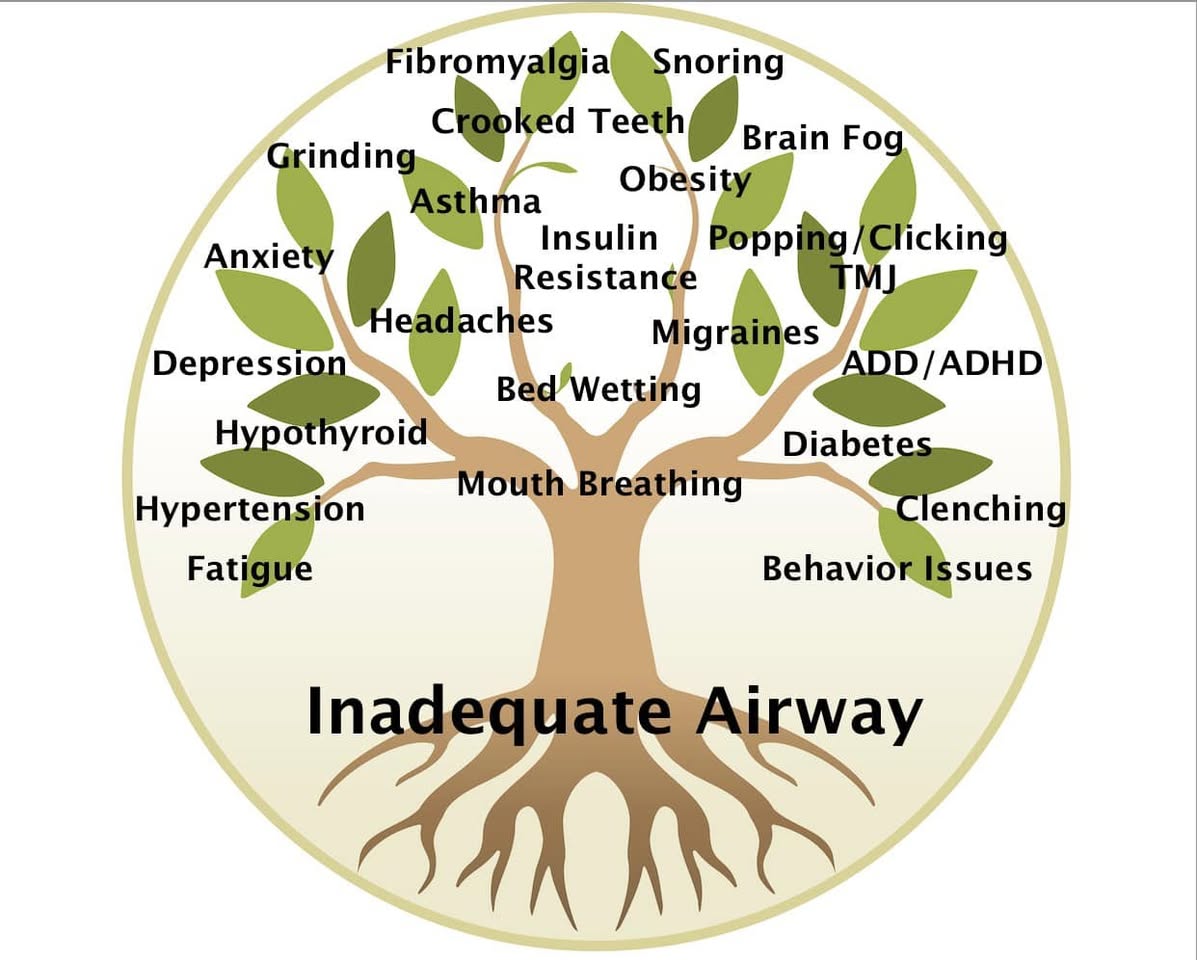
What Your Jaw, Tongue, and Breathing Have to Do With Your Health
I've been a dentist for more than 30 years, and one of the most important things I've learned is that a beautiful smile doesn't necessarily mean a healthy mouth. You can have perfectly straight teeth, gorgeous white enamel, and a smile that looks like it belongs in a toothpaste commercial, while the structures supporting those teeth are creating problems that affect your breathing, your sleep, and your overall health. And most people have absolutely NO idea!
For generations, dentistry has focused primarily on teeth. We repair cavities, straighten crooked teeth, replace missing teeth, and make smiles beautiful. Those are all important parts of our profession, but for the most part, we've been tooth mechanics. See a hole, fix or fill a hole. And while that's certainly an important job, we've been missing a HUGE piece of the puzzle.
What about the space those teeth occupy? What about the tongue, the jaws, the nasal passages, and the airway behind them? And if you've read much of my writing, you've probably heard me say that the roof of your mouth is also the floor of your nose. That's right! The upper jaw, called the maxilla, forms much of the hard palate and the floor of the nasal cavity. Its size and shape affect the space available for your teeth and tongue, while the position of your lower jaw helps determine where your tongue sits in relation to your throat.
So when those structures don't develop properly, we may be looking at a whole lot more than crowded teeth. Research has found connections between narrow upper jaws, certain facial growth patterns, and breathing problems during sleep in both children and adults.[1,2]. And THAT is why I believe evaluating the airway should be as much a part of dentistry as checking for cavities and gum disease.
Unfortunately, dentistry and medicine have spent far too much time operating in their own separate little worlds. And when it comes to the airway, those professional boundaries can become especially frustrating. Dentists are already examining the very structures that help determine how well someone breathes. We evaluate jaw development, tongue position, dental crowding, and facial growth. We're in a wonderful position to recognize problems early, particularly in children whose jaws are still developing. Yet we've made it unnecessarily complicated for dentists and physicians to work together on something that affects both of our professions.
And think about how many people spend years being treated for high blood pressure, fatigue, headaches, poor sleep, or blood sugar problems without anyone asking whether their breathing at night might be contributing to what they're experiencing. Sleep apnea has been linked to ALL of these problems to some degree or other, and sometimes identifying it changes the entire direction of someone's care.
I want dentistry and medicine working TOGETHER to recognize those connections, because I don't particularly care which profession gets credit for helping someone breathe better. I care that the patient gets the help they need! We can make someone's teeth look absolutely beautiful, but if we've overlooked a breathing problem, we've missed something seriously important.
The Six-Foot Tiger in the Three-Foot Cage
I want to share one of my favorite ways of explaining why jaw development matters. And I need to give credit where it's due, because this wonderful analogy comes from Dr. Felix Liao, a biological dentist and author of Six-Foot Tiger, Three-Foot Cage: Take Charge of Your Health by Taking Charge of Your Mouth. When I first heard Dr. Liao explain this, it made so much sense to me that I incorporated it into the way I evaluate and educate my own patients.
Imagine your tongue is a six-foot tiger, and your mouth is the cage that tiger lives in. When the cage is large enough, the tiger has plenty of room to move around and get comfortable. Everything fits where it's supposed to. But what happens when you try to stuff that same six-foot tiger into a three-foot cage? Where do you suppose the tiger's butt ends up?
IN THE BACK OF THE THROAT!
Now THAT is a mental picture you're probably not going to forget! And it's a wonderful way to explain something that's actually pretty complicated. Your tongue is a BIG muscle, and it needs somewhere to live. If your jaws are too narrow or too small to give it enough room, that tongue may end up sitting farther back toward your throat, right where you need space to breathe.
When you're awake, the muscles surrounding your airway help keep it open. But when you fall asleep, those muscles relax. If your airway is already too narrow, that relaxation can make it even harder for air to get through. Sometimes the airway partially closes. Sometimes it closes completely for a few seconds, and the brain has to interrupt sleep to get things moving again. And you don't even have to experience a dramatic drop in oxygen for this to become a problem. Your brain may repeatedly wake you just enough to restore your breathing, without you ever becoming conscious enough to remember it. So you can spend eight hours in bed and still wake up feeling like you haven't slept a wink!
Dr. Liao calls the broader pattern of problems involving inadequate oral structure and function Impaired Mouth Syndrome. It's a way of describing how the size and development of the mouth can affect things we don't usually think of as dental problems. What I love about his approach is that it gets us looking at the space available for the tongue, the development of the jaws, and the way everything works together instead of just concentrating on whether the teeth are straight.
Because the problem usually isn't the tiger. It's the cage.
What Happens When You Can't Breathe Properly While You Sleep?
Most people understand that we need oxygen to survive. That's pretty obvious! But what they may not realize is how much work the body does to keep us breathing while we're asleep. Normally, we cycle through different stages of sleep that allow our brains and bodies to rest, repair, and recover from everything we've put them through during the day. But imagine trying to get that restorative sleep when your airway keeps closing.
A person with obstructive sleep apnea may snore, gasp for air, or stop breathing for several seconds at a time. When that happens, the brain recognizes that something's wrong and works to get the airway open again. Sometimes that means waking the person just enough to start breathing normally, only for the whole thing to happen again a few minutes later. And again. And again. Some people experience these interruptions dozens of times every hour, all night long, without ever remembering a single one. I've known people who do this every single breath during sleep. ALL. OF. THEM.
All they know is that they're EXHAUSTED. And unfortunately, the consequences can go well beyond feeling tired. Repeated breathing interruptions and disrupted sleep have been linked to high blood pressure, cardiovascular problems, difficulty concentrating, headaches, mood changes, and problems with blood sugar regulation.
Now imagine what that kind of sleep disruption can do to a child whose brain and body are still developing. Children who aren't getting enough restorative sleep don't always look sleepy. Sometimes they're hyperactive, impulsive, irritable, anxious, or so emotionally overwhelmed that the smallest frustration turns into a complete meltdown. Other children really ARE exhausted and struggle just to stay awake at school.
Sometimes the Child Who Can't Sit Still Is the Child Who Can't Sleep
Think about the kiddo who never seems to settle down, struggles to concentrate in school, or has a hard time managing frustration. They may be hyper, argumentative, wiggly, easily overwhelmed, or so exhausted that they're falling asleep at their desk. Naturally, parents and teachers start wondering about ADHD, anxiety, sensory processing difficulties, or behavioral problems. And sometimes those are exactly the things we need to be looking into. But here's a question that really hardly ever gets asked.
How is that child breathing while they're asleep?
-
Do they snore?
-
Do they still wet the bed?
-
Do they sleep with their mouth open?
-
Do they toss and turn all night?
-
Do they wake up with dry, chapped lips?
-
Do they sleep with their head tipped backward, almost as though they're trying to stretch their throat open?
-
Do they sleep on their tummy with their little rear end sticking up in the air and their head tilted back, even though it looks like they're practically breathing into their pillow?
I want parents to pay attention to these things, because sometimes the positions children sleep in are their body's way of trying to make breathing easier. And we actually have some interesting research showing just how much a child's breathing can affect their sleep and behavior. In one study, researchers followed 464 children between the ages of five and nine who had obstructive sleep apnea. Some had surgery to remove their enlarged tonsils and adenoids, while the others were monitored without surgery. Seven months later, the researchers compared the two groups.
In the children who'd had surgery, 79% had sleep-study results that were back in the normal range. In the children who hadn't had surgery, that number was only 46%.[3]. That's a HUGE difference! And here's where it gets even more interesting. The children who'd had surgery also showed greater improvements in their sleep, behavior, and quality of life. Their parents were noticing changes in how they functioned during the day, not just how they slept at night.
Now, the researchers also gave the children tests that measured attention and something called executive function. That's the collection of skills our brains use to plan, organize, control impulses, and manage what we're doing. On those particular tests, the children who'd had surgery didn't improve significantly more than the children who hadn't.
But think about what the other findings tell us. Some of these children were behaving differently during the day after their breathing problems were treated! And that's particularly important when we're talking about children who are autistic, have ADHD, or struggle with sensory processing. Those children can have breathing and sleep problems, too. And when a child is already struggling to manage their emotions, concentrate, or deal with sensory overload, a lousy night's sleep certainly isn't going to make things easier!
I don't want parents assuming that every difficulty their child experiences is simply part of being autistic or having ADHD when there may ALSO be a breathing problem making their life harder. And I certainly don't want us to assume that a breathing problem explains away a child's neurodevelopmental differences. I want us to look at the WHOLE child.
Imagine spending years struggling through school, having meltdowns, getting into trouble for being disruptive, or being labeled as a difficult child, when part of what's making life so hard is that you're not getting the restorative sleep your brain and body desperately need. And imagine how much better life could become if somebody finally figured that out.
That's why I want us to look at how our children breathe, not just how they behave.
Bedwetting: The Connection That Breaks My Heart
Of all the things I've learned about airway problems in children, the connection to bedwetting is one that absolutely breaks my heart. For generations, children have been shamed, humiliated, beaten, and sometimes even killed because they wet their beds. And what makes me so angry is that these children were being punished for something that happened WHILE THEY WERE ASLEEP!
In Texas, six-year-old Arianna Battelle was murdered in 2020 after suffering repeated abuse that included being punished for wetting the bed and not eating quickly enough. Both her father and stepmother were eventually sentenced to life in prison.
She was SIX YEARS OLD.
I can't even begin to imagine what that little girl went through. And I can't help thinking about how many children are still being punished for something they have absolutely no control over. I'm going to say it PLAIN for the people who still think that bedwetting is a lack of self discipline, a lack of willpower, or a sign of defiance. It's NOT ANY OF THOSE.
Bedwetting is often connected to sleep disordered breathing.
When children have obstructive sleep apnea, their breathing gets interrupted over and over during the night. And researchers have found that some of these children stop wetting their beds when their breathing problems are treated. In 2021, researchers looked at data from 393 children who had obstructive sleep apnea. About one out of every three children was also wetting the bed.
Seven months later, the children who'd had their enlarged tonsils and adenoids removed had an 11-percentage-point drop in bedwetting. In the children who hadn't had surgery, bedwetting had barely changed.[4]. Some of these children had been struggling with bedwetting, and treating their breathing problems helped them stay dry at night!
Imagine what that could mean to a child who's embarrassed to go to a sleepover, afraid their friends will find out, or dreading another morning waking up in wet sheets. And imagine how much worse it is for a child who's actually being PUNISHED for it.
Now, there are other reasons children wet their beds. Constipation, emotional dysregulation, bladder development, and other health problems can all play a role. But if your child is wetting the bed AND snoring, breathing through their mouth, tossing and turning all night, or waking up exhausted, I want you to think about their airway, too.
Have their breathing and sleep evaluated. You may discover something that nobody thought to look for. I don't know why Arianna wet her bed, and I won't pretend that I do. But I DO know that she deserved to be loved, protected, and helped rather than punished. Every child does. No child should EVER be punished for wetting the bed.
Your Upper Jaw May Be Telling Us Something Important
Now let's talk about the maxilla, because I think this is one of the most important structures in airway-centered dentistry. The maxilla is your upper jaw. It supports your upper teeth, forms the hard palate, contributes to the structure of your nasal cavity, and plays an important role in facial development. When the upper jaw is narrow, the palate may be high and constricted, leaving less room for the teeth and tongue. And because the palate forms the floor of the nose, its development can also influence the dimensions of the nasal cavity.
This relationship is one reason I'm particularly interested in evaluating children while they're still growing. A review examining 40 publications on childhood sleep-disordered breathing identified several craniofacial patterns associated with these problems, including narrow upper jaws, high palates, and lower jaws positioned farther backward.[1]. A separate 2025 review of 32 studies found that adults with obstructive sleep apnea also tended to have narrower upper dental arches and differences in jaw position and the space behind the tongue compared with adults without apnea.[2]
Those findings don't mean everyone with crowded teeth has a breathing problem. They tell us that jaw development is one of the pieces worth examining. Here's another analogy I like to use. Think of the upper jaw as a shoe and the lower jaw as the foot that needs to fit comfortably into it. If the shoe is too narrow, the foot isn't going to fit properly. The toes will get crowded.
And when we're looking at the relationship between the jaws, we need to think about the available space rather than simply lining up the teeth and calling it a day. That's why crowding, particularly when it's accompanied by a narrow upper arch, deserves a closer look. Teeth don't grow in isolation from the bones, muscles, and breathing structures around them. And THAT brings us to orthodontics.
Straight Teeth Don't Guarantee a Healthy Airway
I have tremendous respect for the technical skill involved in orthodontics. Moving teeth into beautiful alignment while maintaining a functional bite takes a remarkable amount of knowledge and precision. But I want airway development and function to be part of that treatment planning, too. If a child has a narrow upper jaw, crowded teeth, chronic mouth breathing, and restless sleep, I want those concerns evaluated before we concentrate exclusively on straightening the teeth.
And I especially want a thoughtful discussion before deciding to remove healthy permanent teeth in the name of creating room. To be honest, I don't think there is any such thing. You don't make a cage larger by removing some of the bars and spacing the rest of the bars out more evenly. That may make the cage look less crowded in terms of the bars on the cage, but the cage didn't actually get any bigger. I'm particularly reluctant about bicuspid extractions when evaluating patients with inadequate jaw development or existing breathing concerns.
Here's something about orthodontic research that absolutely drives me CRAZY. In 2025, researchers published a review involving 891 orthodontic patients. They compared what happened to the airway when patients had bicuspids removed before orthodontic treatment versus when they didn't. Their conclusion? On average, removing the bicuspids didn't significantly change the measured size of the airway.[7]. Well, that's nice. Actually, it's not. It's BAD SCIENCE. They didn't ask the right question!!
WAS THE AIRWAY BIG ENOUGH TO BEGIN WITH?
That's the question I want answered! If a child comes to me with crowded teeth, a narrow upper jaw, and inadequate room for their tongue, I'm not particularly impressed by being told that we can straighten those teeth without making the airway any smaller. I want to know WHY those teeth are crowded in the first place. IT'S. NOT. NORMAL. TO. HAVE. CROWDING. IN. TEETH. It's common. But common isn't normal. NORMAL is supposed to be enough room for all of the teeth to fit without crowding.
- Is the jaw too narrow?
- Is there enough room for the tongue?
- Could we improve the development of the jaws instead of simply rearranging the teeth within the space that's already there?
- And perhaps most importantly, would addressing those structural problems help the child breathe and sleep better?
Those aren't the questions this particular research (or LOTS of other studies just like it) was designed to answer. The researchers were looking at changes in airway measurements, not comparing extraction treatment with a comprehensive approach designed to address inadequate jaw development and breathing.
And there's another problem with relying on airway measurements alone. An airway can look perfectly acceptable on a scan taken while someone is awake, yet repeatedly collapse when that person falls asleep. Because a CBCT of the airway is simply a snapshot in time. A sleep study is a snapshot OVER time. It's about how the airway actually FUNCTIONS, not just how big it looks in a picture.
This is why I'm so passionate about evaluating jaw development BEFORE we decide how to straighten someone's teeth. If the jaw is genuinely too narrow, shouldn't we at least investigate whether we can address that problem while the child is still growing? I'd much rather explore whether we can create the room those teeth and that tongue actually need than automatically remove healthy teeth to make everything fit into the space that's available.
My goal isn't simply to straighten teeth without making the airway worse. I want to know whether we have an opportunity to make the whole system work BETTER.
And that's a completely different way of looking at orthodontics. I think orthodontics should become a whole different specialty called dentofacial orthopedics. Because orthodontics should be about MINOR corrections. Dentofacial orthopedics is about making sure that cage gets large enough to make sure all of the bars fit comfortably.
When a child's upper jaw hasn't developed enough to give their teeth and tongue the room they need, I want to know what we can do to help that jaw GROW. Think about it. If the jaw is too narrow, why would we focus exclusively on moving the teeth around when we might have an opportunity to address the very thing that caused the crowding in the first place?
In 2025, researchers reviewed 12 clinical studies looking at rapid maxillary expansion, which is a way of widening the upper jaw. They found that expanding the upper jaw increased the space inside the nasal cavity and improved several measurements of breathing. Some of the studies even showed improvements in sleep apnea.[6]. Now THAT is exciting!
We're talking about changing the actual structures that help support breathing. And when we're working with children whose jaws are still growing, we have an incredible opportunity to influence how those structures develop. That's why I get so passionate about identifying these problems EARLY. I want to know whether we can give the tongue more room, improve the space available for breathing, and help those jaws develop in a way that supports the child's health for the rest of their life. And if we can accomplish that while creating enough room for beautifully straight teeth? Even BETTER!
Because I'm interested in a whole lot more than making teeth look pretty. I want the entire mouth to FUNCTION the way it's supposed to.
What About Grinding, Clenching, and TMJ Problems?
Here's another thing that makes me want to ask questions. When someone comes into my office with teeth that are worn down from grinding, I don't want to simply make them a night guard and send them on their merry way. I want to know WHY they're grinding.
- Are they stressed?
- Are they clenching during the day?
- Are they snoring at night?
- Do they wake up exhausted?
- Are they struggling to breathe comfortably while they're asleep?
Because sometimes the grinding may be connected to something much bigger than their teeth. In 2024, researchers reviewed 29 studies involving children and teenagers to see whether teeth grinding during sleep was connected to breathing problems. Most of those studies found a relationship between the two, although the researchers couldn't establish that the breathing problems were actually CAUSING the grinding.[5]
If a child is grinding their teeth, snoring, tossing and turning all night, and waking up exhausted, why would I look at the grinding as an isolated problem? I want to look at how that child BREATHES. The same goes for adults who have chronic jaw pain, tight muscles, headaches, and years of grinding or clenching. I'm interested in finding out whether something about their breathing or sleep might be contributing to what they're experiencing.
Now, there's absolutely a place for protecting teeth from damage. A night guard can be useful for that. But protecting the teeth doesn't explain what's causing the grinding. And that's the difference in how I approach these patients. I want to know what's happening with the tongue, the jaws, the muscles, and the airway. I want to know how they're sleeping and whether their breathing is being interrupted over and over throughout the night. Because if there's an underlying problem contributing to all of this, I want us to FIND it.
I don't want to spend the next 20 years protecting someone's teeth from a problem we never bothered to investigate.
Can Exercise-Related Breathing Problems Be Mistaken for Asthma?
Absolutely, and this is another area where understanding the airway can be important. Some people experience significant breathing difficulty during exercise and are told they have exercise-induced asthma. I don't actually believe this is a real thing. I think it's a sign of an inadequate airway. Don't get me wrong. Many people genuinely do have asthma. I'm not disputing that. I just think that asthma isn't induced by exercise exclusively. I think if it is, it's not really asthma, unless the person has had asthma attacks without exercising.
There's another condition called exercise-induced laryngeal obstruction, or EILO. The larynx is your voice box, and in people with EILO, part of that structure narrows during intense physical activity, interfering with airflow. The symptoms can resemble asthma, including shortness of breath and noisy breathing, but the underlying problem is different.
A 2021 review described how easily EILO can be confused with exercise-induced asthma, particularly in children and adolescents.[10]. One important clue is that EILO often causes difficulty breathing IN, sometimes accompanied by throat tightness or a high-pitched sound during inhalation. This condition isn't necessarily caused by having a narrow jaw, but it's a perfect example of why identifying exactly WHERE someone's breathing is being restricted matters. A patient may have asthma, an upper airway obstruction, or both. And the treatment needs to address the actual problem.
What Can We Do About an Inadequate Airway?
I'm a big believer that the earlier we recognize problems involving jaw development, nasal breathing, and oral function, the more options we may have. In children who are still growing, treatment may include orthopedic expansion when the upper jaw is genuinely narrow, management of nasal obstruction, or evaluation of enlarged tonsils and adenoids. I also pay close attention to tongue posture, swallowing patterns, oral habits, and muscle function.
For some patients, orofacial myofunctional therapy may be helpful. This involves exercises and training designed to improve tongue function and the activity of muscles involved in the mouth and throat. And there's research supporting its potential role. A 2024 systematic review examined seven randomized trials involving 310 patients.
Among adults, myofunctional therapy reduced the apnea-hypopnea index, or AHI, by an average of approximately 10 breathing disturbances per hour compared with control groups.[8]. AHI is simply the number of complete or partial breathing interruptions recorded per hour of sleep. An improvement of 10 events per hour can be meaningful, depending on how severe the problem was to begin with. The evidence was less encouraging in children, partly because children in the available trial had difficulty consistently completing the exercises.
That tells me we need to be realistic about what we're asking families to do and how we're measuring success. For patients with restricted tongue movement, a functional evaluation may also identify situations where a tongue-tie release deserves consideration. The procedure should be based on an actual functional problem and accompanied by appropriate therapy when indicated. It's not a magical cure for every breathing or sleep problem, and the mere presence of a visible tongue-tie doesn't tell us whether surgery will help.
Depending on the cause and severity of the problem, treatment may also involve nasal airway management, breathing retraining, oral appliances, or surgery. Sometimes we need more than one approach because more than one part of the airway is contributing to the problem. And sometimes we need several professionals working together. I love seeing dentists, orthodontists, ENTs, sleep specialists, and myofunctional therapists collaborate because each of us brings a different perspective to the patient.
Nobody has to be an expert in everything. We simply have to be willing to recognize what needs attention and help patients get to the right people.
What about Oral Appliances?
Now, let's talk about mandibular advancement devices, or MADs, because this is where I think we need to understand the difference between helping someone breathe and actually correcting the problem that's causing their airway to collapse. A MAD holds the lower jaw forward while someone sleeps. That pulls the tongue and surrounding soft tissues forward, creating more room for air to pass through the throat. And yes, research shows that these appliances can reduce the number of times someone stops breathing during sleep.[9]. But here's my problem with them.
What happens when you take the appliance OUT?
If someone has maxillary or mandibular hypoplasia, meaning their upper or lower jaw never developed to an adequate size, that appliance hasn't done anything to correct the underdeveloped bones! And there's research showing exactly that. Researchers followed 62 patients who'd worn mandibular advancement appliances for an average of 12.6 years. Some had been wearing them for as long as 21 years! They found significant changes in the positions of the teeth, but very little lasting change in the underlying jaw structure.[11]
So we're holding the lower jaw forward every night to keep the airway open, but we haven't actually corrected the structural problem that may be contributing to the obstruction. And these appliances come with their own problems. In one study, 24% of people using MADs developed jaw-joint or chewing muscle pain early in treatment, compared with 6% of people using CPAP. The pain often improved over time, but that's still a pretty significant difference.[12]
And then there are the changes to the bite. Another study followed 77 people who'd used these appliances for an average of 11 years. Their teeth gradually shifted, changing how their upper and lower teeth came together. And those changes continued the longer they wore the appliances.[13]. Now think about that. We're asking someone to hold their jaw in an unnatural forward position night after night, potentially for the rest of their life, while accepting the possibility of jaw pain and permanent changes to their bite. And the original skeletal problem is still there!
CPAP approaches the problem differently by using air pressure to keep the airway open, but it doesn't correct underdeveloped jaws, either. It's still just a band-aid. Both treatments can help people breathe while they're sleeping, and sometimes that help is absolutely necessary. Untreated sleep apnea can have serious consequences, and I certainly don't want someone going without effective treatment while we're investigating their options.
But if a person's airway problems are related to maxillary or mandibular hypoplasia, I want us to investigate whether we can actually address those structural problems.
- Is the upper jaw too narrow?
- Is the lower jaw underdeveloped or positioned too far backward?
- Is there adequate room for the tongue?
- And what options do we have for improving the underlying anatomy rather than relying exclusively on an appliance to compensate for it?
Because if the cage is too small, I want to know what we can do about the CAGE. I don't want to spend the next 20 years simply finding new ways to keep that poor tiger's butt out of the throat!
How Can You Recognize Possible Airway Problems at Home?
One of the things I want people to understand is that you don't need expensive equipment to begin noticing patterns that deserve attention. You just need to start paying attention to how you or your child breathe, sleep, and function throughout the day. I actually have a checklist that I've adapted from Dr. Felix Liao's Impaired Mouth Syndrome Score, with some additions of my own. It looks at clues in both the mouth and the rest of the body, because sometimes the things that seem completely unrelated turn out to be important pieces of the same puzzle.
Here are some things I encourage families to watch for.
While you're sleeping:
-
Snoring, gasping, choking, or pauses in breathing.
-
Grinding or clenching your teeth.
-
Tossing and turning or sleeping in unusual positions, especially with your head tilted backward.
-
Sleeping with your mouth open.
-
Waking up with a dry mouth, chapped lips, a sore jaw, or a headache.
-
Waking up multiple times during the night to use the bathroom.
-
Sleeping eight hours or more and STILL waking up exhausted.
Account required
Sign in to see more
Create an account or sign in to unlock the full list.