Resource Libraries
Signs of Airway Issues in Children and What to Ask a Dentist
Symptoms that point to sleep-disordered breathing in children, from snoring and bedwetting to crowded teeth, and the questions to ask an airway dentist first.
Part 1 of 4 in the Children's Airway Series
Let's Talk About Childrens' Airway Issues
Let’s Talk About Children’s Airway Issues (Part 1 of my unintentional series)
(How to tell whether your dentist truly understands airway-centered growth)
Parents ask me all the time How to know if a dentist actually understands airway and growth. It’s a GREAT question - because there aren't really guides out there to help parents! It’s an important question. Orthodontics is still widely believed to be about straight teeth. But if you’ve been in this group long enough, you already know that orthodontics should actually be something called DENTOFACIAL ORTHOPEDICS. Straight teeth do NOT equal a healthy airway. And a healthy airway is not optional, it is foundational to your child’s sleep, behavior, facial development, emotional regulation, immune strength, and long-term health.
Airway Is a MAJOR Issue, Not a Side Topic
Across the globe, airway disorders are rapidly shaping children’s health outcomes and adult disease patterns. And the numbers are not small. Here in the U.S. alone:
~38,000 cardiovascular deaths every year are linked to sleep apnea.
From 1999–2019, 17,053 people had sleep apnea listed as the underlying cause of death.
When including sleep apnea as any contributing cause, the number climbs to 231,418 deaths between 1999–2020.
Untreated severe sleep apnea increases all-cause mortality and makes people several times more likely to die from heart failure or fatal car accidents.
Sleep-apnea–related mortality has risen sharply over recent decades.
So airway is indeed a MAJOR issue, one of the most profound, least-recognized public health emergencies we're dealing with.
And this matters for your children because: Airway problems don’t magically appear in adulthood. They begin in childhood, or earlier. Which is why early recognition is everything.
Why I’m Writing This Now
I realized recently that although I’ve written extensively about mercury, fluoride, cavitations, infections, and biological dentistry… I hadn’t yet written a deep dive of my own on CHILDREN’S AIRWAY DEVELOPMENT on this platform. I’ve shared several other sources, and educational snippets in the comments, but this group thrives on depth, and there was no deep dive into the subject. Therefore... Eventually I decided it was time for ME to do the deep dive! I understand better than anyone that the members of our group and platform want to understand things clearly. You are NOT soundbyte people. You want to know what to look for. And you want to know how to find providers who ACTUALLY understand airway physiology, not just how to straighten teeth in a cosmetic arch form. So I'm going to write a series of resources about airway to help make things a bit clearer for you:
This post is meant to be a practical, parent-friendly guide to help you figure out whether a dentist truly understands airway-centered growth. Because ALL of us, including our children, deserve more than straight teeth. EVERY person deserves:
room to breathe
room to sleep deeply
room to grow properly
room for a tongue to function the way it’s supposed to
and a body that functions WELL into old age
As adults, correcting airway problems takes far more time, money, and effort. But for children? The window of opportunity is extraordinary. If we harness growth at the right time, we are not just “fixing teeth.” We are building the foundation for a healthy life. And we are preventing decades of suffering that are entirely preventable.
How to Tell If a Dentist Truly Understands Airway-Centered Dentistry
Here are the core questions, and what their answers should tell you. I’m going to give you not just the questions but also how to interpret the answers, because the interpretation is where parents often get stuck.
1. “How do you evaluate my child’s airway, breathing, and nasal function as part of the exam?”
WHAT YOU WANT TO HEAR:
Discussions about nasal breathing, tonsils/adenoids, facial growth pattern, posture, lip seal, tongue posture, sleep symptoms, snoring, and developmental screening.
RED FLAG:
If they only talk about cavities and crooked teeth, they’re not airway-centered, period. If they tell you that your 5 year old child needs to have teeth extracted for orthodontic purposes, get several different opinions!
2. “Do you screen for signs of sleep-disordered breathing?”
LOOK FOR:
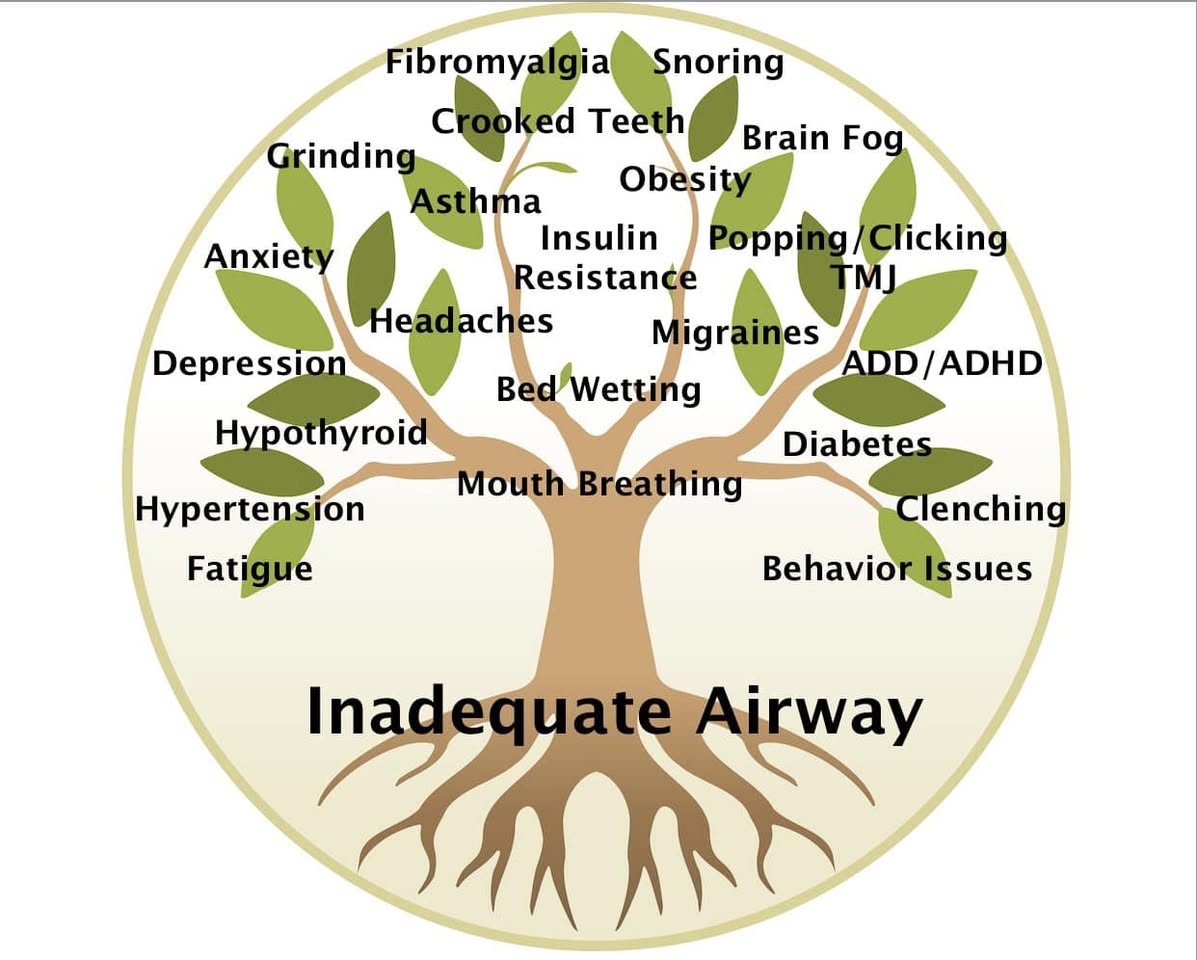
Questions about snoring, mouth breathing, restless sleep, sweating, bedwetting, night terrors, behavior issues, and daytime fatigue. Look for them to be using Home Sleep Testing in their office, or regularly referring to a pediatric sleep testing center.
RED FLAG:
“Sleep isn’t part of dentistry.” "It's normal for kids to toss and turn. They'll grow out of it". If they say this, you have your answer.
3. “How do you approach jaw and facial growth?”
LOOK FOR:
A philosophy centered on function first: tongue space, nasal breathing, proper chewing, and balanced growth not just straightening teeth.
RED FLAG:
“We’ll wait until all the adult teeth come in” (translation: we will miss the growth window and rely on braces alone).
4. “How do you assess tongue posture, lip seal, and habits?”
LOOK FOR:
They evaluate lip seal, tongue posture, swallow pattern, mouth breathing habits, and oral tone.
RED FLAG:
“This doesn’t really matter.” It matters more than most people realize.
5. “Can you identify and treat issues like tongue-tie or mouth breathing?”
LOOK FOR:
Comfort discussing restricted airway, tethered oral tissues, nasal obstruction, and collaboration with other professionals. Make sure they suture if they are releasing tongue ties on anyone who isn't an infant. Make sure that they know that ties released in infancy grow back and usually have to be re released. Make absolutely sure they work with a myofunctional therapist. Make absolutely sure they require myofunctional therapy before AND after the tie releases.
RED FLAG:
“We don’t treat or refer for tongue-ties,” or ""We think tongue and lip tie releases are really more for cosmetic reasons, not for function - it's a scam". No. It's not. Orthodontists don't really do frenulum releases, so you can't depend solely on that question for them. But an airway centered general dentist does. or “Kids outgrow mouth breathing.”
No. They don’t.
6. “Do you use expanders and functional therapies before considering extractions or braces?”
LOOK FOR:
Expanders, myofunctional therapy, nutritional factors, nasal hygiene, addressing the root causes, discussions of surgically facilitated orthodontics.
RED FLAG:
No experience with surgically facilitated orthodontics. You want someone who has lots of experience with surgically facilitated orthodontics if possible. Immediate extraction plans “to make room.” You already know my stance on this.
7. “How does nutrition factor into your recommendations?”
LOOK FOR:
Discussions about chewing, food texture, Weston Price/Pottenger principles (if they are biological - airway centered orthodontists are not necessarily holistic in any way), and the impact of soft diets on jaw growth. We are just happy to GET an orthodontist that is airway educated and passionate about it!
RED FLAG:
Nutrition never comes up.
8. “Do you coordinate care with ENTs, myofunctional therapists, chiropractors, PT/OT, or sleep physicians?”
LOOK FOR:
“Yes, we collaborate regularly.”
RED FLAG:
“We don’t need a team.”
Airway cases ALWAYS need a team.
9. "Do you do Surgically Facilitated Orthodontic Treatment?"
Account required
Sign in to see more
Create an account or sign in to unlock the full list.