Resource Libraries
Mercury Toxicity Symptoms: The Exhaustive List
The mercury toxicity symptom list, from fatigue, tremor and brain fog to thyroid and mood shifts, why it mimics so much, and why exposure history matters.
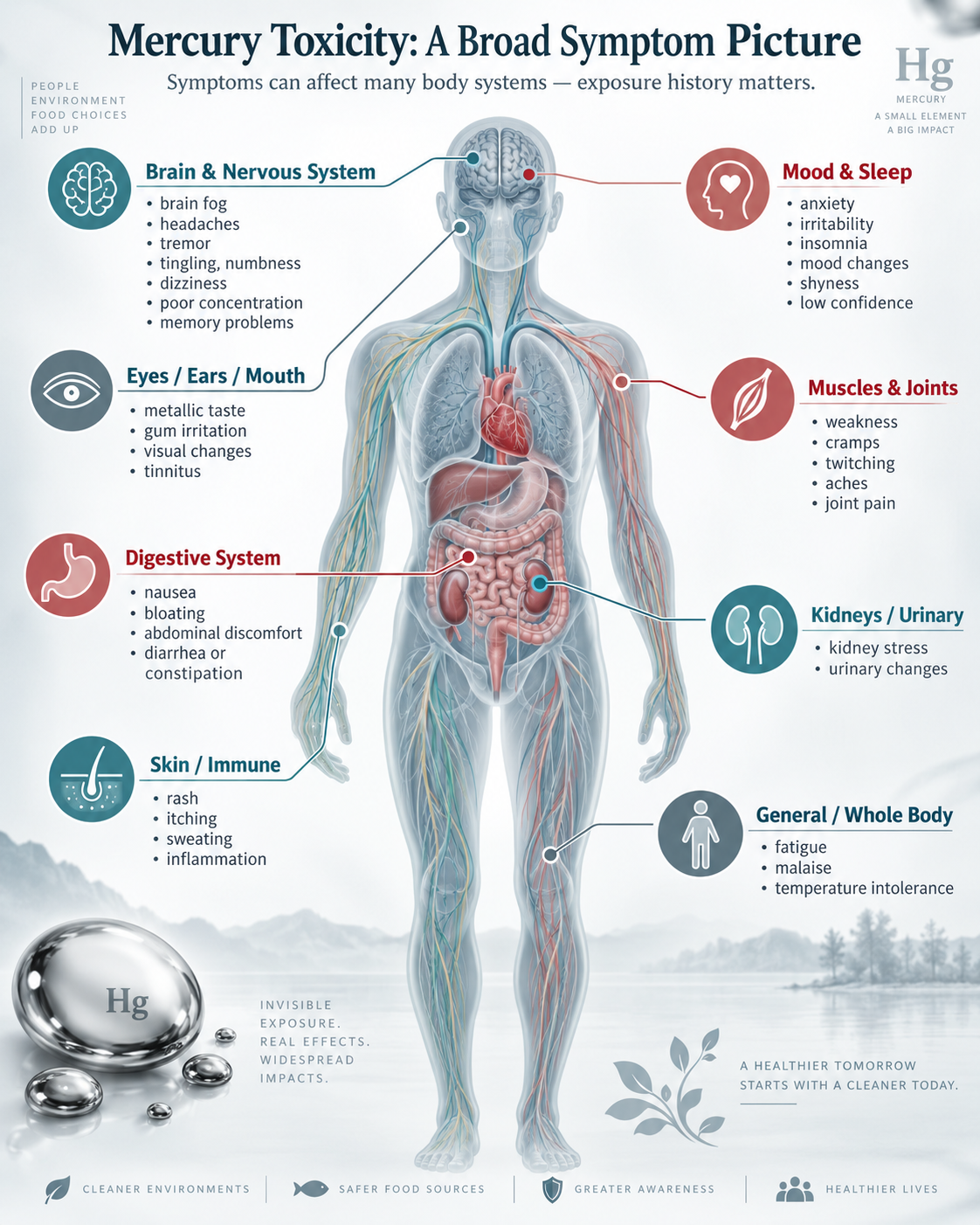
Mercury Toxicity Can Look Like a LOT of Other Things: The Exhaustive Symptom List—and Why Exposure History Matters
If any of the people reading don't know my story, I'm a stage 4 cancer survivor. I healed mostly holistically. I was given a year to live and a 1% chance of survival from grade 4, stage 4B endometrial cancer December 1, 2015. I did have focal radiation on the metastasis in my bone, but other than my hysterectomy and the radiation, all other care was holistic. I put myself into remission with IV vitamin C and nutrition by May 31, 2016 and am still here to count my blessings every single day.
At my sickest, I counted 63 different symptoms on the list that follows. Sixty-three. It sounds ridiculous that a person could have 63 symptoms of anything and NOT have been diagnosed with something definitive. But once you actually dig through the mercury toxicology literature, it becomes a LOT less ridiculous.
Mercury poisoning doesn’t have one neat little symptom that walks into the room wearing a name tag. It can affect the:
- brain,
- peripheral nerves,
- muscles,
- kidneys,
- mouth,
- GI tract,
- skin,
- cardiovascular system,
- respiratory system,
- reproductive system,
- autonomic nervous system
- cognition.
- Mood.
- Coordination.
- Sleep.
- Sensation.
And depending on the chemical form of mercury, the dose, how long the exposure lasted, the route of exposure, the age of the person, and their individual susceptibility, the symptom pattern can look completely different from one human being to another. [A1–A5]
That’s exactly why mercury toxicity gets missed. And it’s also exactly why a giant symptom list can be misused. So before we go ANY further, I want to say something that matters enormously:
Having symptoms on this list does NOT diagnose mercury toxicity.
Lordy, if those symptoms diagnosed mercury toxicity, half the planet would qualify by Wednesday. . The symptoms only become meaningful in context.
Exposure history matters. The pattern matters. The timing matters. The mercury species matters. And appropriate clinical testing matters. What I want to do here is something different. I want to show you just HOW broad the documented mercury symptom picture actually is.
A Quick Note About Where This Article Fits—and Those Weird Reference Numbers
This article is a companion article to my larger mercury project, Mercury Amalgam Is Not an Inert Filling: What the Science Actually Shows and Why the Removal Method Matters, and the 12-part series I created from it.
I originally wasn’t planning to write a separate article containing the complete mercury-toxicity symptom inventory. But once I started trying to fit the symptoms into the preparation article, it became VERY obvious that mercury has far too many documented clinical manifestations to cram into a couple of paragraphs without making a complete mess of the subject.
So here we are. . Because this article grew out of that larger project, I’m keeping the same reference-number system. References shown with regular numbers—such as [76], [81], or [85]—are references that already appear in the master mercury bibliography, using their original numbers. That means they’re going to skip around. I haven’t lost references 1 through 75, and I still know how to count. They simply support other parts of the larger mercury discussion.
References beginning with an A, such as [A1] or [A6], are additional sources I added specifically for THIS article because I wanted the symptom discussion to be much more comprehensive than the master article originally needed to be. At the bottom, I’ll give you the complete citation and direct link for every source used here, so you don’t have to go hunting through the full master bibliography unless you actually want to.
First, We Have to Separate the Different Kinds of Mercury
This matters because people constantly throw every mercury symptom ever reported into one giant pile. That isn’t good toxicology. For dental amalgam, the most relevant exposure is elemental mercury vapor. Elemental mercury vapor is absorbed efficiently through the lungs. It enters the bloodstream, crosses biological membranes, can cross the blood-brain barrier, and is then oxidized inside tissues into inorganic mercury. [A1,A2]. That’s the form I’m going to emphasize in this article because this article grew out of my dental-amalgam series.
Inorganic mercury salts behave differently. They’re generally more important with ingestion or certain products and can cause severe gastrointestinal and renal toxicity. [A1,A2]
Methylmercury is another completely different exposure pattern, primarily associated with contaminated fish and seafood. Its classic neurological findings include things like ataxia, constricted visual fields, sensory abnormalities, dysarthria, and hearing impairment. [A4]
So when you see an enormous list online that includes EVERYTHING from gingivitis to tunnel vision to bloody diarrhea without telling you which mercury form caused which symptom, be careful. Some symptoms overlap. Some don’t.
The Classic Mercury Triad Is Actually Pretty Small
Historically, severe chronic elemental-mercury poisoning was recognized by three major findings:
- tremor,
- erethism, and
- gingivitis. [A4]
Tremor is fairly self-explanatory. Gingivitis is inflammation of the gums. But erethism is a word most people have never heard unless they’ve spent entirely too much time reading mercury toxicology.
Mercurial erethism is the old toxicology term for the personality and behavioral changes seen with chronic mercury poisoning—things like irritability, emotional instability, anxiety, insomnia, memory problems, loss of self-confidence, and sometimes extreme shyness or social withdrawal. [A4].
This is where the phrase “mad as a hatter” comes from. Hat makers historically used mercury compounds during felt production and developed neurological and behavioral symptoms from chronic occupational exposure.
Except here’s the problem: Modern mercury toxicity does not always arrive looking like a nineteenth-century hatter shaking uncontrollably and behaving bizarrely. Lower or chronic exposure may show up much more subtly.
- Fatigue.
- Memory problems.
- Mood changes.
- Fine tremor.
- Poor concentration.
- Reduced dexterity.
- Sleep disturbance.
- Weakness.
- Tingling.
- Headaches.
- And a long list of symptoms that can easily be blamed on something else. [76,A4–A6]
Here Is the Exhaustive Documented Symptom Inventory
I’m grouping these by body system because otherwise this list becomes complete chaos. Some findings are classic and strongly established. Others have been reported in occupational studies, poisoning cases, or specific mercury syndromes and are less specific. Not every symptom has the same evidentiary weight, and not every person with mercury toxicity gets every symptom.
-
Neuropsychiatric, emotional, and behavioral: irritability; unusual irritability; easy loss of temper; emotional lability; emotional instability; mood swings; nervousness; anxiety; excessive anxiety; agitation; restlessness; hyperexcitability; excitability; excessive shyness; extreme shyness; timidity; diffidence; loss of self-confidence; social withdrawal; avoidance of people; desire to be alone; personality change; behavioral change; depression; depressed mood; apathy; loss of interest; increased sensitivity to criticism; fearfulness; fretfulness in children; hallucinations with substantial exposure; confusion; altered mental status; delirium in severe poisoning; severe psychiatric disturbance in advanced intoxication; and, historically, the full syndrome known as mercurial erethism. [A1,A2,A4]
-
Cognitive and intellectual: memory loss; short-term memory problems; impaired recall; forgetfulness; difficulty finding or retaining information; poor concentration; impaired attention; difficulty focusing; difficulty thinking clearly; cognitive slowing; impaired information-processing speed; impaired learning; poorer neuropsychological performance; impaired verbal memory; impaired visual memory; impaired visuospatial performance; poorer executive function; poorer cognitive flexibility; difficulty with mental arithmetic; impaired constructional ability; slower reaction time; psychomotor slowing; reduced work performance; decreased school performance in children; and measurable deficits on attention, memory, motor, and construction tasks even in some occupational populations without dramatic clinical poisoning. [A4,A6]
-
Sleep and energy: insomnia; difficulty falling asleep; difficulty staying asleep; frequent waking; disturbed sleep; poor-quality sleep; fatigue; unusual tiredness; chronic tiredness; lethargy; weakness; generalized weakness; decreased stamina; and excessive sleepiness or somnolence in some reported exposures. [76,A1,A2,A4]
-
Tremor and motor control: fine tremor; finger tremor; hand tremor; postural tremor; action tremor; intention tremor; resting tremor in heavier exposure; eyelid tremor; lip tremor; tongue tremor; tremulous speech; worsening handwriting; shaky handwriting; impaired hand steadiness; impaired fine-motor control; reduced manual dexterity; slower motor speed; impaired eye-hand coordination; impaired coordination; clumsiness; poor balance; postural instability; unsteady gait; abnormal gait; difficulty walking; ataxia; dysarthria or slurred speech; decreased precision of movement; abnormal reflexes; decreased or absent ankle reflexes; and persistent motor deficits in some previously heavily exposed workers. [78,84,85,A5]
-
Peripheral nerve and sensory: paresthesias; pins-and-needles sensations; tingling; numbness; altered sensation; distal sensory loss; tingling of the hands; tingling of the feet; tingling of the tongue; perioral tingling; altered touch perception; impaired vibration or sensory discrimination in some exposure studies; peripheral neuropathy; polyneuropathy; abnormal nerve conduction; burning sensations in the extremities; and sensory abnormalities that may persist after exposure ends in some individuals. [84,85,A1,A5]
-
Muscular and neuromuscular: muscle weakness; limb weakness; reduced grip or muscle strength; muscle twitching; fasciculations; muscle spasms; muscle cramps; severe leg cramps; muscle atrophy with substantial exposure; impaired neuromuscular control; hypotonia or low muscle tone, especially in children with acrodynia; reduced coordination; and abnormal reflexes. [A1,A2,A5]
-
Head, balance, and general neurologic: headache; recurrent headache; dizziness; light-headedness; vertigo-like complaints; balance difficulty; poor coordination; unsteady walking; tremor; weakness; neuromuscular changes; and, with severe poisoning, broader neurological impairment. [A1,A2]
-
Vision and eyes: blurred vision; visual disturbance; burning or irritated eyes; conjunctivitis; photophobia or sensitivity to light; altered visual performance; and, particularly with methylmercury rather than the usual elemental-mercury pattern associated with amalgam, constricted visual fields or “tunnel vision,” severe visual impairment, and blindness at high exposure. [A2,A4]
-
Hearing, taste, and smell: impaired hearing; sensorineural hearing loss; deafness with severe methylmercury poisoning; altered taste; decreased taste; loss of taste; metallic taste; bitter or abnormal taste; altered smell; reduced smell; and loss of smell in some mercury-toxicology reports. [A1,A4]
-
Oral and dental: gingivitis; swollen gums; red gums; tender or painful gums; bleeding gums; stomatitis; inflammation of the oral mucosa; ulceration of the mouth; mouth sores; oral burning; glossitis; excessive salivation; hypersalivation; ptyalism; sialorrhea; drooling; sore throat; difficulty swallowing or dysphagia; metallic taste; loose teeth in substantial historical poisoning; and severe oral or oropharyngeal injury with corrosive inorganic-mercury salts. [A1,A2,A4]
-
Gastrointestinal: nausea; vomiting; abdominal pain; gastric pain; abdominal cramping; diarrhea; loss of appetite; anorexia; weight loss; GI distress; enteritis; colitis; and general gastrointestinal disturbance. Severe ingestion of inorganic mercury salts can additionally cause intense burning pain, ulceration, bloody vomiting, bloody diarrhea, intestinal necrosis, tenesmus, and circulatory collapse. Those dramatic corrosive findings are NOT the clinical picture I’m talking about with ordinary amalgam vapor exposure. [A1,A2]
-
Renal and urinary: proteinuria; increased urinary protein; microalbuminuria; renal tubular dysfunction; increased urinary enzymes; hematuria; decreased urine output or oliguria; anuria with severe poisoning; edema related to nephrotic injury; nephrotic syndrome in some inorganic-mercury exposures; acute tubular injury; acute kidney injury; acute renal failure; and chronic renal injury following significant exposure. Some of these are laboratory or clinical findings rather than symptoms the patient will necessarily feel. [A1,A2]
-
Skin and dermatologic: red or erythematous rash; pruritic rash; itching; dermatitis; contact dermatitis; vesiculation after certain inorganic-mercury skin exposures; generalized rash; maculopapular or measles-like eruptions in poisoning cases; flushing; reddening of the hands and feet; swelling of hands and feet; painful hands and feet; peeling or desquamation of palms and soles; peeling around the nose; increased sweating; profuse perspiration; dermatographism in acrodynia; and hypertrichosis or excessive hair growth described in some acrodynia cases. [A1,A2,A8]
-
Acrodynia or “pink disease”: intensely pink or red hands and feet; painful or burning hands and feet; tenderness of the extremities; swelling of hands and feet; peeling of the hands and feet; skin peeling around the nose; severe leg cramps; weakness; hypotonia; irritability; personality change; fretfulness; insomnia; photophobia; excessive salivation; excessive sweating; fever; tachycardia; hypertension; paresthesias; rash; itching; and peripheral nerve dysfunction. Acrodynia is especially recognized in children but isn’t biologically restricted only to young children. [A1,A2,A8]
-
Cardiovascular and autonomic: hypertension; severe hypertension in some pediatric poisoning cases; tachycardia; elevated heart rate; autonomic instability; flushing; excessive sweating; excessive salivation; and, in severe acute poisoning, circulatory instability or shock. [A1,A2]
-
Respiratory—primarily acute or substantial elemental-mercury vapor exposure: dry cough; cough; shortness of breath; dyspnea; chest tightness; chest pain; airway irritation; bronchitis; bronchiolitis; chemical pneumonitis; interstitial pneumonitis; airway obstruction; decreased pulmonary function; pulmonary edema; respiratory distress; respiratory insufficiency; respiratory failure; and, following severe injury, residual fibrosis or restrictive lung disease. I would NOT take somebody with one old amalgam and a cough and tell them the filling caused lung injury. These findings belong mainly to acute or much heavier vapor exposure. [A2,A3]
-
General or constitutional: malaise; fatigue; weakness; unusual tiredness; lethargy; loss of appetite; anorexia; weight loss; fever; low-grade fever; metal-fume-fever-like illness after high acute vapor exposure; chills in some acute exposures; headache; and a general sense of being unwell. These are some of the least specific symptoms on the entire list, which is exactly why they’re so easy to dismiss OR overinterpret. [A1–A3]
-
Menstrual and reproductive symptoms/findings: dysmenorrhea or painful periods; abnormal menstruation; delayed menstrual cycles; longer menstrual periods; altered menstrual blood volume; hypomenorrhea or unusually light menstrual flow in some occupational studies; and other menstrual irregularities reported among women occupationally exposed to metallic mercury vapor. A study of 296 exposed women found significantly more dysmenorrhea than in 394 controls. [A7] Reproductive outcomes such as fertility changes, miscarriage, stillbirth, low birth weight, pregnancy-induced hypertension, or birth defects belong in a separate outcomes discussion because they are not symptoms and the evidence is more complicated.
-
Children and developmental manifestations: irritability; fretfulness; personality change; sleep disturbance; weakness; hypotonia; tremor; poor coordination; delayed developmental milestones; poorer attention; impaired learning; impaired manual dexterity; motor impairment; poorer leg coordination; language delay; altered cognitive performance; and, with substantial prenatal methylmercury exposure, severe neurodevelopmental impairment, seizures, sensory impairment, delayed walking, and deficits in hearing or vision. [A8,A9]
-
Symptoms and findings particularly associated with methylmercury rather than amalgam-type elemental vapor: paresthesias; perioral tingling; numbness; ataxia; severe coordination problems; dysarthria; abnormal gait; hearing loss or deafness; constriction of the visual fields; impaired vision; altered sensory discrimination; severe motor dysfunction; weakness; and developmental neurological injury after prenatal exposure. I’m including them because this is an exhaustive mercury-toxicity article, but I would NOT use them to imply that dental amalgam exposure and Minamata-type methylmercury poisoning are biologically interchangeable. They aren’t. [A4]
-
Severe acute elemental-mercury vapor poisoning: cough; dyspnea; chest pain; fever; weakness; headache; metallic taste; nausea; vomiting; diarrhea; abdominal pain; visual disturbance; tremor; neurological changes; tachycardia; hypertension; kidney injury; chemical pneumonitis; pulmonary edema; respiratory failure; and potentially death. [A2,A3]
-
Severe inorganic-mercury-salt poisoning: metallic taste; severe burning of the mouth, throat, stomach, or GI tract; blistering or ulceration of lips and tongue; oral and GI ulceration; severe abdominal pain; vomiting; hematemesis; bloody diarrhea; tenesmus; profound fluid loss; circulatory collapse; oliguria; anuria; acute tubular necrosis; acute renal failure; neurological toxicity; and potentially death. Again, this is a different exposure scenario from elemental vapor coming off dental amalgam. [A1,A2]
That is why the symptom list becomes enormous. Mercury is not a one-organ toxicant. A LOT of these symptoms also apply to about 7000 other conditions, so I can see why it can be easily missed if someone isn't familiar with mercury toxicity. It's why I recommend working with a practitioner who can properly evaluate you and has the experience to catch things that might have been missed by other practitioners.
Some Symptoms Are MUCH More Characteristic Than Others
If somebody comes to me with:
- fatigue,
- headaches,
- constipation,
- anxiety,
- and joint pain,
I cannot look at that combination and say: “This is definitely Mercury.” There are hundreds of reasons somebody can have those symptoms. But suppose somebody has a significant elemental-mercury exposure history AND they develop:
- a new tremor,
- increasing irritability,
- insomnia,
- short-term memory problems,
- difficulty concentrating,
- reduced hand coordination,
- paresthesias,
- gingivitis,
- and excessive salivation.
Now my eyebrows are going up. Because that cluster starts to resemble the documented elemental-mercury pattern considerably more closely. [A1,A4,A5]. The classic triad of tremor + erethism + gingivitis is much more mercury-shaped than fatigue alone. That still isn’t a diagnosis. But it absolutely deserves investigation.
One of the Weirdest Mercury Symptoms Is Extreme Shyness
I want to stop on this one because I think it is fascinating. Extreme shyness. That sounds like a personality trait. It’s in the mercury literature. Mercurial erethism historically included:
- extreme shyness,
- loss of self-confidence,
- emotional instability,
- irritability,
- excitability,
- nervousness,
- memory problems,
- and insomnia. [A4]
Imagine somebody slowly becoming more anxious, more withdrawn, less confident, more irritable, unable to sleep, and unable to remember things the way they used to. That could get diagnosed as:
- anxiety,
- depression,
- burnout,
- menopause,
- ADHD,
- trauma,
- stress,
- or just: “You’re going through a lot.”
And all of those things may genuinely belong in the differential diagnosis. But toxic exposure belongs there too when the history fits. That is why exposure history matters SO much.
Mercury Can Affect Performance Before Somebody Looks “Poisoned”
Another thing I think is important is that measurable neurobehavioral changes don’t require somebody to look catastrophically ill. A meta-analysis of occupational mercury studies looked at 686 exposed workers and 579 controls. Researchers found significant effects in:
- attention,
- memory,
- constructional ability,
- and motor performance,
at mean urinary mercury concentrations in the included studies ranging around 18–34 μg/g creatinine. [A6]. A later systematic review looked at more than 3,000 workers with chronic elemental-mercury-vapor exposure. The more consistent neurological findings included:
- tremor,
- impaired coordination,
- abnormal reflexes,
- reduced manual dexterity,
- and slower motor performance. [A5]
Those are not internet “detox symptoms.” They are measurable neurological findings.
And Some Effects Can Persist LONG After Exposure Stops
This one matters to me because people often assume: “Well, once the mercury is gone, everything should immediately return to normal.” Sometimes people improve dramatically. Sometimes recovery takes time. And some effects may persist.
Reference [84] evaluated 76 former mercury miners an average of 18 years after their occupational exposure had ended. Many of the original poisoning symptoms had improved. But neurological symptoms remained more common than in matched controls, and former miners still performed worse on:
- motor coordination,
- reaction time,
- and short-term memory. [84]
Reference [85] looked at former workers whose major mercury exposure had ended at least 30 years earlier. Historical exposure was still associated with some measures of peripheral nerve dysfunction and poorer hand-eye coordination. [85]. And a broader review of approximately 30 studies found that recovery varied enormously. Some psychomotor functions improved within months, while neuropsychological recovery could be slower or incomplete. [81]
So mercury toxicity isn’t necessarily: exposure stops → symptoms disappear next week. Biology is considerably messier than that.
Dental Professionals Give Us a Particularly Important Human Model
Dental personnel are relevant because their occupational exposure historically involved elemental mercury vapor—the same mercury form released by dental amalgam. A review of dental personnel found associations between occupational mercury exposure and nonspecific symptoms including:
- fatigue,
- weakness,
- memory complaints,
- mood changes,
- and neurological symptoms. [76]
And an enormous U.S. study involving 13,906 dentists found that greater urinary mercury was associated with more tremor. [78]. That doesn’t mean every tired dental assistant had mercury poisoning. It tells us elemental-mercury exposure in real dental workplaces has produced measurable exposure and neurological signals in humans. That is relevant.
Objective Findings Are Not the Same as Symptoms
There’s another category that gets left out of symptom lists because you may not FEEL it happening. Mercury exposure has also been associated in various studies with objective findings including:
- abnormal tremor testing,
- reduced manual dexterity,
- slower motor speed,
- impaired coordination,
- abnormal reflexes,
- nerve-conduction abnormalities,
- abnormal neuropsychological performance,
- abnormal EEG findings in some occupational studies,
- proteinuria,
- renal tubular biomarkers,
- microalbuminuria,
- altered urinary enzyme excretion,
- and impaired pulmonary function after high vapor exposure. [A1,A4–A6]
Those findings matter because sometimes the first evidence of toxicity is measurable before it becomes an obvious symptom.
Account required
Sign in to see more
Create an account or sign in to unlock the full list.