Resource Libraries
Mold Illness and Root Canal Teeth: Why You Stay Stuck
Why mold illness symptoms and mycotoxin labs plateau after remediation, how root canal teeth with no blood supply harbor fungi, and what to evaluate next.
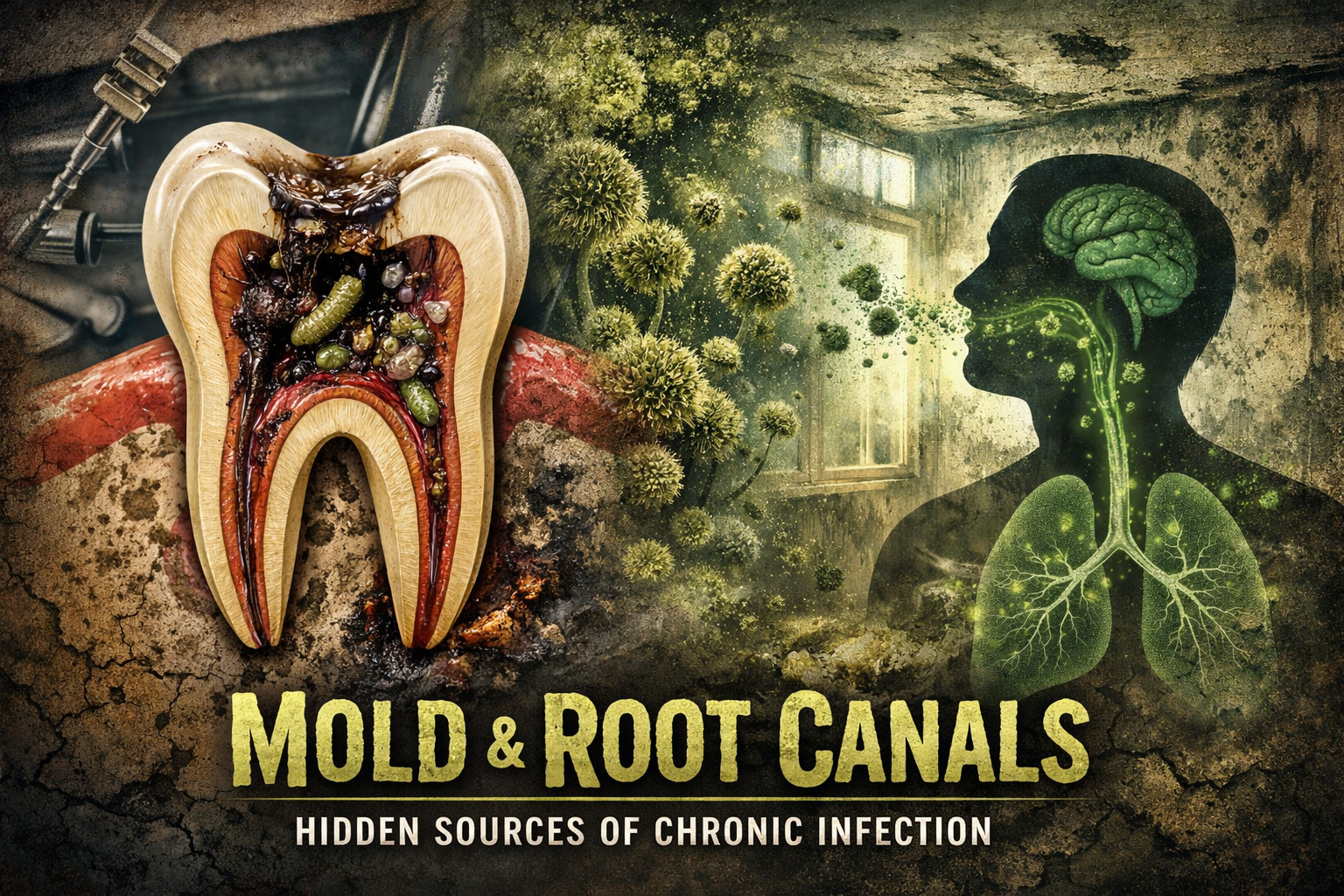
Toxic Mold and Teeth: Why Root Canal Teeth Matter When Mold and Mycotoxins Won’t Clear
There are certain patterns you see often enough in clinical practice that they stop feeling coincidental. One of them is this: People do everything right for mold illness, they leave the exposure, remediate their homes, work with skilled functional or environmental medicine practitioners, and yet they remain stuck. Labs plateau. Symptoms linger. Mycotoxins won’t clear. Eventually, the question comes up: What about the teeth? This article exists to answer that question clearly, directly, and with the science on the table.
A foundational concept
A root canal tooth is a non-vital structure. Once the pulp is removed:
-
There is no blood supply
-
No immune surveillance
-
No lymphatic drainage
-
No ability to clear toxins
-
No bioelectrical current
Blood is how the body detoxifies. Cells communicate through bioelectrical and biochemical signaling. No blood and no bioelectrical current means no signaling, no clearance, no healing.
So before we talk about mold, fungi, bacteria, or mycotoxins, we have to be honest about anatomy: A structure with no circulation cannot participate in detoxification or healing.
That single fact is the lens through which all of the research below must be viewed.
As is usual for me, I’m going to list the science, clearly and explicitly. The personal part of me that was interested in this topic is because I have spent over a year now battling mold toxicity personally. Now, I don't have any root canals. But as a stage 4 cancer survivor, I can tell you mold toxicity has been harder to beat than cancer was for me. I'm not saying that is or will be the case for everyone. I can only speak from my own personal experiences. But this is why this topic has a special interest for me. For those who need the studies on this, here they are… in spades.
Environmental pollutants affect oral health directly
The mouth is not “separate”. Before we ever get to root canals, sinuses, or dental materials, we need to clear up a persistent misconception: The mouth is not biologically isolated from environmental toxic exposure. It never has been. Mold conversations are often framed as respiratory-only problems, while dentistry is treated as a separate, mechanical system. The science does not support that divide.
1. Environmental pollutants, including mold, directly affect oral tissues
Zhu L, Tang M, Cai Y, Wang P.
PMID: 39835314
https://pubmed.ncbi.nlm.nih.gov/39835314/
This comprehensive review examines how environmental pollutants, including mold and heavy metals, affect oral health. The research shows these pollutants can contribute to tooth decay, gum disease, and oral cancer through mechanisms like inflammation and oxidative stress, highlighting the importance of pollution control for oral health.
-
Why this paper matters in a mold discussion: This review establishes something critical before we ever mention root canals:
Environmental toxins, including mold and heavy metals: are capable of:
-
inducing chronic inflammation in oral tissues
-
increasing oxidative stress locally
-
altering immune responses in the mouth
In other words, the oral cavity is not a passive bystander when environmental toxin exposure occurs. It is a target tissue. This matters for two reasons:
-
It normalizes the idea that mold and pollutants affect oral biology.
The question is not whether mold can influence oral health, the literature says it can. The question becomes how and where those effects persist. -
It provides context for why dental structures matter in systemic toxic load.
If environmental pollutants contribute to oral inflammation and disease, then oral structures that cannot clear toxins deserve closer scrutiny, especially in patients with persistent mold-related illness.
The key connection to root canal teeth
Zhu et al. do not claim that mold exposure causes root canal disease. That is not their focus, and it would be inappropriate to suggest otherwise. What this paper does do is establish a biologically sound premise: Environmental toxins influence oral tissues through inflammation and oxidative stress. When that premise is applied to a non-vital tooth with no blood supply, the implications become much harder to ignore. A living tissue exposed to toxins has at least some capacity for repair, immune response, and clearance. A dead structure does not. This is why, in patients with mold illness or persistent mycotoxins, dentistry cannot be evaluated in isolation from environmental medicine. The mouth is part of the same biological system, not a separate compartment.
2. Root canal bacteria are biologically active, not “sealed away”
Suprewicz Ł, Tokajuk G, Cieśluk M, et al.
PMID: 33114460
https://pubmed.ncbi.nlm.nih.gov/33114460/
This study examined bacteria found in root canals and their effects on gum cells and cancer cells. Researchers found that certain bacteria from infected root canals can cause cells to grow faster and change their physical properties, suggesting oral bacteria may contribute to disease development in the mouth and other body tissues.
-
Why this matters: This study is often misinterpreted, so let’s be precise. It does not claim that root canals cause cancer. What it demonstrates is something far more relevant clinically:
-
Bacteria commonly found in root canal systems produce biologically active byproducts
-
Those byproducts can alter cell behavior
-
These effects occur even when the bacteria are no longer alive
-
That last point is key. Mycotoxins behave in a similar way. They are not organisms; they are toxic metabolic byproducts. They do not require active infection to exert effects. When toxins, bacterial or fungal, are trapped inside a structure with no blood supply, the body cannot neutralize or remove them. It can only react.
3. Dental materials can create a fungal growth environment
Terashima K, Kagoya R, Tanaka M, Nishijima H, Kondo K.
PMID: 39463579
https://pubmed.ncbi.nlm.nih.gov/39463579/
This case report describes a patient who developed both fungal sinus infection and bacterial infection after root canal filling material accidentally entered the sinus cavity. The dental material (gutta-percha) created an environment where both Candida fungus and bacteria could grow, causing sinus problems requiring surgery to remove.
-
The clinical takeaway: This case highlights something dentistry does not like to talk about:
foreign materials change biology. When root canal materials enter the sinus:-
They act as a physical scaffold
-
They trap moisture
-
They support mixed bacterial–fungal biofilms
-
Systemic medications and detox protocols do not reliably reach these spaces. Surgical removal was required because the body had no other mechanism to resolve the infection.
4. Root canal treatment is a major risk factor for fungal sinus disease
Mensi M, Piccioni M, Marsili F, et al.
PMID: 17142068
https://pubmed.ncbi.nlm.nih.gov/17142068/
This study found that people who had root canal treatment on upper teeth were 14 times more likely to develop fungal balls in their sinuses compared to people without root canals. The fungal infection typically developed about 4 years after the dental procedure, suggesting root canal treatment is a major risk factor.
-
Why timing matters: Four years is a long time. Long enough that:
-
The dental procedure is forgotten
-
Symptoms appear unrelated
-
The source is never questioned
-
This delayed presentation explains why these connections are so often missed. The biology unfolds slowly, quietly, and without drama, until it doesn’t.
5. Zinc-containing dental materials can feed mold
Giardino L, Pontieri F, Savoldi E, Tallarigo F.
PMID: 16793483
https://pubmed.ncbi.nlm.nih.gov/16793483/
This case report describes a healthy 60-year-old man who developed Aspergillus fungal infection in his sinus after root canal filling material was accidentally pushed into the sinus. The zinc oxide in dental materials can act as food for Aspergillus fungus, helping it grow and cause infection.
Note: PMID 3465133 could not be verified in the available medical literature for this topic.
Nicolai P, Mensi M, Marsili F, et al.
PMID: 26019392
https://pmc.ncbi.nlm.nih.gov/articles/PMC4443559/
This study measured zinc and other metals in fungal balls from sinuses and compared them to dental filling materials. Researchers found similar metal concentrations in fungus balls and root canal materials, suggesting that dental materials accidentally pushed into sinuses during tooth treatment help fungus grow and cause infections.
-
Important nuance: Zinc is not inherently harmful. But zinc trapped in a protected, moist environment with limited immune access becomes a nutrient source for certain fungi. This is about biochemistry meeting anatomy.
6. Why root canal infections persist despite “proper” treatment
This is where decades of endodontic literature quietly dismantle the idea that root canals can be reliably sterilized.
García CC, Sempere FV, Diago MP, Bowen EM.
PMID: 18059244
https://pubmed.ncbi.nlm.nih.gov/18059244/
This review discusses infections that persist around tooth roots even after proper root canal treatment. These infections can appear as inflammatory tissue masses, cysts, or scar tissue. The article explains how bacteria inside root canals cause these problems and why some infections don't heal despite treatment.
Nair PN, Sjögren U, Krey G, Sundqvist G.
PMID: 8225641
https://pubmed.ncbi.nlm.nih.gov/8225641/
This study followed a tooth with a radicular cyst (fluid-filled sac at the tooth root) for 10 years after root canal treatment. Despite proper treatment, the cyst persisted because bacteria remained trapped inside the cyst cavity where root canal medications couldn't reach them, showing why some infections don't heal with standard treatment alone.
Nair PN, Sjögren U, Krey G, Kahnberg KE, Sundqvist G.
PMID: 2094761
https://pubmed.ncbi.nlm.nih.gov/2094761/
This long-term study examined teeth that didn't heal after root canal treatment and found bacteria and fungi living deep inside the tooth structure in tiny tubes (dentinal tubules). Using electron microscopy, researchers discovered these microorganisms were protected from treatment chemicals, explaining why some root canal infections persist despite proper treatment.
Yoo YJ, Kim AR, Perinpanayagam H, et al.
PMID: 32858856
https://pubmed.ncbi.nlm.nih.gov/32858856/
This review explains how Candida fungus infects root canals and resists treatment. The fungus sticks to tooth structure, forms protective biofilms, and hides inside tiny tubes in teeth where cleaning solutions can't reach. This makes fungal root canal infections very difficult to treat and often requires special medications or surgery.
-
Why this matters for mold illness: These studies show that microorganisms, including fungi, can survive inside root canal systems long after treatment, protected from medicaments and immune response.
Once again: no blood supply, no clearance.
Account required
Sign in to see more
Create an account or sign in to unlock the full list.