Resource Libraries
Alpha-Gal Syndrome and Dental Care: What You Must Avoid
How alpha-gal syndrome, the tick-borne red meat allergy, affects dental care, from bone grafts and collagen membranes to gelatin capsules, and what to ask.
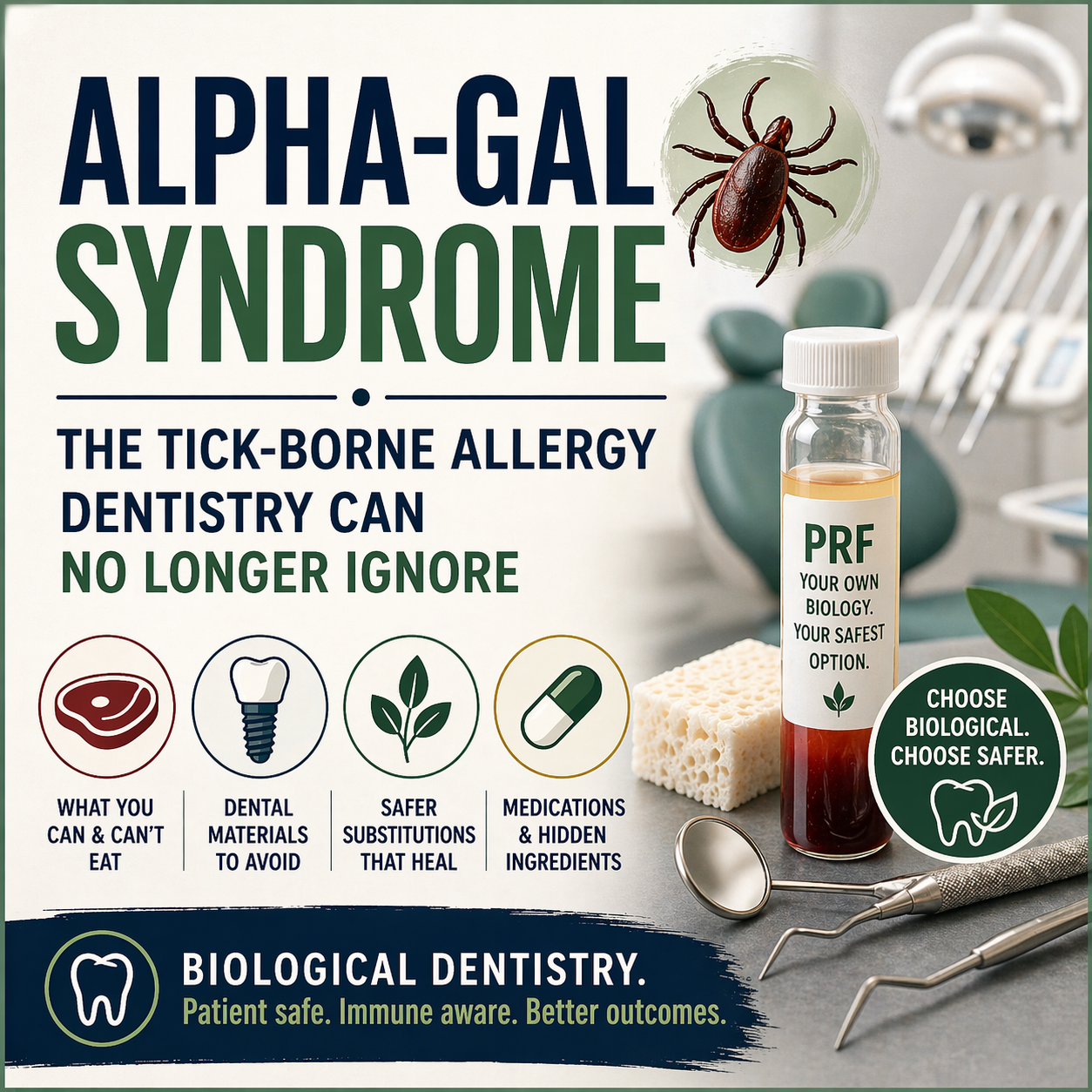
Alpha-Gal Syndrome: The Tick-Borne Allergy That Dentistry Can No Longer Ignore
Anyone who has heard of alpha-gal syndrome probably thinks of it as “the red meat allergy.” That is not wrong, exactly. It is just... incomplete. Alpha-gal syndrome, often abbreviated AGS, is an allergy to a sugar molecule called galactose-α-1,3-galactose, usually shortened to alpha-gal. This molecule is found in non-primate mammals, so it can be present in beef, pork, lamb, venison, goat, rabbit, and bison, as well as in gelatin, collagen, certain medications, and a surprising number of surgical and dental materials. So yes, a person with alpha-gal may react to a steak. But they may also react to a gelatin capsule, a collagen plug, a bovine bone graft, a porcine-derived membrane, or a mammalian-derived hemostatic agent placed into an extraction socket.
That is where dentistry enters the chat. And to be perfectly honest, dentistry is not ready for this conversation yet. Most dental offices screen for penicillin allergy. Many screen for latex allergy. Some screen for metal sensitivity. But alpha-gal? Not usually. And that is a problem, because the first dental-specific review on alpha-gal syndrome identified mammalian-derived hemostatic agents and collagen products as major areas of concern in dental care.
The uncomfortable truth is that many dental materials were designed around handling, hemostasis, bone regeneration, convenience, and clinical performance. They were not designed around the possibility that a patient’s immune system may recognize mammalian-derived materials as a threat.
Sterile does not mean immunologically invisible. So let's look at the issues with Alpha-Gal and how it can affect a person in life but particularly in a dental office.
What Alpha-Gal Syndrome Actually Is
Alpha-gal syndrome is an IgE-mediated hypersensitivity reaction. That means the immune system produces IgE antibodies against alpha-gal, and those antibodies can trigger allergic symptoms when the person is exposed again. The unusual part is that alpha-gal is not a protein. Most classic food allergies involve proteins. Alpha-gal is a carbohydrate, which is one reason this condition behaves differently from the allergies most people understand.
The condition is most commonly associated with tick bites, especially bites from the Lone Star tick in the United States. After a tick bite, some people develop IgE antibodies to alpha-gal. Once that immune pattern develops, exposure to mammalian-derived foods or products can trigger symptoms.
This isn't a dietary quirk. It's the immune system recognizing a mammalian molecule and responding to it. That is why the “red meat allergy” label is too small. It makes people think only about hamburgers and bacon. In reality, alpha-gal syndrome can involve food, medications, supplements, medical devices, surgical products, and dental materials.
Why Alpha-Gal Is So Often Missed
One of the reasons alpha-gal syndrome is so frequently missed is that it doesn't behave like the allergies most people are familiar with. If someone has a peanut allergy, a shellfish allergy, or a medication allergy, the reaction usually happens quickly. Regular food allergies are to proteins. The timing makes the connection obvious. Alpha-gal is different.
Alpha-gal reactions are clinically delayed IgE-mediated hypersensitivity reactions, meaning the symptoms may not happen until 3 to 6 hours after exposure. This is not the same as classic Type IV “delayed-type hypersensitivity,” which is a different immune pathway. Alpha-gal is still IgE-mediated, but symptoms are delayed because of how alpha-gal is absorbed and transported in the body, especially when it is associated with fats.
A person may eat a burger at 7 PM, feel perfectly fine through dinner, go to bed, and then wake up at 2 AM covered in hives, cramping, vomiting, swelling, or even experiencing anaphylaxis. That delay is a big part of the problem. Few patients naturally connect a reaction in the middle of the night with the food they ate hours earlier. Many physicians don't either, especially if they were not trained to recognize alpha-gal syndrome. So patients may be told they have “idiopathic urticaria,” “random anaphylaxis,” “GI sensitivity,” or—my personal least favorite catch-all diagnosis—“anxiety.” In all honesty, I tend to think of "anxiety" as a lazy diagnosis that doctors give when they don't feel like looking deeper. And listen, anxiety is real. But anxiety does not explain everything. Sometimes the body is reacting to something very specific, and we simply haven't asked the right question yet.
The other reason alpha-gal is confusing is that reactions are not always consistent. A patient may eat a small amount of lean meat and be fine, then later react severely to something fattier. That is because alpha-gal is often carried in fat-containing molecules, so fattier foods may produce a stronger or more delayed immune response. Alcohol, exercise, illness, inflammation, and total exposure load may also lower the threshold for a reaction. So now we have a condition that is delayed, inconsistent, dose-dependent, and influenced by cofactors. It can be confusing. Except it does make sense once you understand the mechanism. The problem is that most clinicians are not looking for it yet.
How Common Is Alpha-Gal Becoming?
Alpha-gal syndrome is no longer some rare little medical curiosity that only allergists need to think about. CDC-associated testing data from 2017 to 2022 included more than 295,000 people tested for alpha-gal IgE, of whom about 30.5% tested positive. Positive tests were concentrated in the southern, midwestern, and mid-Atlantic United States, which overlap with areas where tick exposure is common.
Another large study found a six-fold increase in positive alpha-gal IgE results over time. That does not necessarily mean everyone with a positive test has the same level of clinical reactivity, but it absolutely means exposure and sensitization are not rare.
For dental professionals, the practical takeaway is simple: if you practice in a region with significant tick exposure, you probably have alpha-gal patients in your practice, whether you know it or not.
And even if you are outside those regions, people travel. Ticks migrate. Climate patterns shift. Patients move. This is not going to stay neatly contained in a single geographic box just because it would be convenient for our medical history forms.
What People With Alpha-Gal Can and Cannot Eat
One of the most overwhelming parts of being diagnosed with alpha-gal syndrome is trying to figure out what is actually safe to eat. Patients are usually told at first that they have a “red meat allergy,” which sounds simple enough until they realize that the reaction is not limited to steak or bacon, and that the underlying issue is not the color of the meat at all. It is the animal’s biology.
Alpha-gal is found in all non-primate mammals, meaning the immune system is reacting to a sugar molecule present across an entire category of animals, not just a few commonly consumed ones.
Instead of memorizing a long, constantly changing list of foods, I think it helps to use a much more consistent rule: if the animal is a mammal, it contains alpha-gal and may trigger a reaction.
That becomes especially important when you step outside of typical Western diets. Around the world, people consume a much wider variety of animals, and many of those are still mammals, even if they are not commonly eaten in the United States. This is why a comprehensive list matters.
Patients and their families do not need to memorize every animal on earth, but they do need to understand the pattern.
Mammals to Avoid or Treat as High Risk
Cow: beef, veal
Pig: pork, bacon, ham
Sheep: lamb, mutton
Goat
Deer: venison
Elk
Moose
Bison / buffalo
Rabbit
Squirrel
Opossum
Horse
Donkey
Camel
Alpaca
Llama
Kangaroo
Wallaby
Other marsupials used as food
Whale
Dolphin
Seal
Sea lion
Other marine mammals
Kangaroo is a good example of where people get tripped up. Kangaroos are marsupials, but marsupials are still mammals. Opossums are also marsupials, and yes, people in parts of the United States do eat opossum. Marine mammals are another category that people do not always think about. A whale lives in water, but it is still a mammal. A dolphin is not a fish. It is a mammal. If it is a mammal, it belongs on the alpha-gal caution list.
Foods That Are Generally Considered Safe Because They Are Not Mammals
Chicken
Turkey
Duck
Goose
Quail
Pheasant
Ostrich
Emu
Fish, including salmon, tuna, cod, snapper, halibut, sardines, anchovies, and shark
Shellfish, including shrimp, crab, lobster, clams, mussels, oysters, and scallops
Eggs, including chicken, duck, and quail eggs
Plant-based foods, including vegetables, fruits, grains, legumes, nuts, and seeds
This part matters emotionally, not just medically. When someone is newly diagnosed, it can feel like everything has been taken away. But it has not. There are still many protein options available, and for some patients, foods like emu can feel surprisingly similar to a tender grass-fed beef steak in flavor, texture, and eating experience. That may sound like a small thing, but when someone is grieving the loss of familiar foods, it is not small at all. Now, dairy is where the conversation becomes more nuanced.
Foods That May or May Not Be Tolerated
Milk
Cheese
Butter
Cream
Whey protein, including whey protein isolate
Casein protein
Yogurt
Ice cream
Other mammal-derived dairy products
Dairy products come from mammals, so they can contain alpha-gal. However, not every alpha-gal patient reacts to dairy, and the degree of reactivity varies widely. Some individuals tolerate dairy without any issue, while others experience clear symptoms even with small amounts. The difference appears to relate to individual sensitivity, IgE levels, cofactors, and possibly fat content.
Whey protein isolate is a perfect example of why this can get confusing. People hear the word “isolate” and assume it must be purified enough to be safe. But whey still comes from cow’s milk. Processing may reduce some components, but it does not guarantee complete removal of alpha-gal epitopes or all clinically relevant mammalian residues. So whey protein isolate cannot be universally labeled safe. Some patients tolerate it. Some don't.
This is one of the most important points for both patients and clinicians to understand: alpha-gal is not the same for everyone. Some react only to mammalian meat. Others react to dairy, gelatin, capsules, medications, fumes from cooking mammalian meat, or medical materials. The safest approach is to use the food framework as a starting point, then individualize based on reaction history and guidance from an allergist.
Eating Out With Alpha-Gal
Eating at home with alpha-gal is one thing. Eating out is an entirely different situation. At home, patients can control ingredients, cookware, oils, seasoning blends, and preparation surfaces. They can safely prepare poultry, fish, shellfish, eggs, emu, or other non-mammalian foods without worrying that the chicken was grilled next to a hamburger or that butter was automatically added to the vegetables. Restaurants are different.
Most restaurants are not familiar with alpha-gal syndrome, and even when staff members are kind and well-intentioned, they may not understand the level of detail required to keep a sensitive patient safe. Cross-contamination can happen through shared grills, shared fryers, shared pans, cutting boards, sauces, cooking fats, butter, gelatin-containing desserts, dairy ingredients, broths, gravies, and “natural flavors.” Even something that looks safe on the menu may not be safe once you know how it was prepared.
For this reason, many alpha-gal patients—especially those with more severe reactions—find that the safest strategy when eating out is to choose vegan restaurants or vegan dishes whenever possible. Not because they are necessarily vegan at home, but because vegan meals dramatically reduce the risk of hidden mammalian ingredients and cross-contamination.
That matters for risk management. At home, a patient may do beautifully with fish, turkey, duck, eggs, or emu. In a restaurant, that same patient may choose vegan simply because the kitchen is less likely to accidentally expose them to mammalian meat, dairy, gelatin, butter, lard, broth, or shared cooking surfaces. When someone has experienced delayed anaphylaxis, that level of caution is not dramatic. It is reasonable.
Alpha-Gal, Lyme Disease, and Tick Exposure
Another important point is that alpha-gal syndrome can coexist with other tick-borne conditions. Lyme disease and alpha-gal syndrome are not the same condition. Lyme disease is an infection caused by bacteria, while alpha-gal syndrome is an immune sensitization that results in allergy. But both are associated with tick exposure, which means a patient may have a history of Lyme disease, alpha-gal syndrome, or both. That matters because patients with tick-borne histories are often medically complicated, and they are also frequently dismissed. If someone says, “I developed strange food reactions after tick exposure,” that should not be treated as noise. That is a clue.
From a dental perspective, this matters because these patients may already be medically sensitive, inflamed, reactive, or exhausted from trying to get someone to take their symptoms seriously. The dental team does not need to diagnose Lyme disease or manage the patient’s entire medical history. But we do need to recognize that tick-borne illnesses and tick-associated immune reactions can overlap in the same person.
Can Alpha-Gal Cause Anaphylaxis?
Alpha-gal syndrome is not a mild intolerance. In some patients, it can cause true anaphylaxis.
Symptoms may include hives, itching, swelling of the lips or tongue, throat tightness, vomiting, diarrhea, abdominal cramping, dizziness, low blood pressure, difficulty breathing, and full anaphylaxis.
The delayed timing is what makes it especially dangerous and easy to miss. A patient can be completely fine in the dental chair, go home, take a medication in a gelatin capsule, or have had a collagen plug placed during surgery, and then react hours later.
Unless the dental team understands alpha-gal, that reaction may never be connected back to the procedure. That is why material selection, medication review, and post-operative instructions matter. With alpha-gal, the fact that a patient looks fine when they leave the office does not mean the risk window has closed.
Alpha-Gal, Diabetes, Keto, and Special Diets
One real-world issue that deserves more attention is what happens when a patient has alpha-gal syndrome but also relies on a specific diet for medical reasons. For example, many people with diabetes, insulin resistance, or metabolic disease use a ketogenic or low-carbohydrate diet to help stabilize blood sugar. That can become complicated very quickly.
Traditional ketogenic diets often rely heavily on beef, pork, lamb, butter, cream, cheese, and other mammalian foods. For an alpha-gal patient, many of those foods may be unsafe or at least uncertain. So telling someone to “just avoid red meat” is not enough. We have to think about how they are going to maintain stable blood sugar, adequate protein, enough calories, and a diet they can actually live with.
The good news is that a low-carbohydrate or ketogenic-style diet is still possible for many alpha-gal patients. It just has to be rebuilt around non-mammalian foods. Poultry, fish, shellfish, eggs, and sometimes emu can provide protein. Fats can come from olive oil, avocado oil, coconut oil, MCT oil, avocados, nuts, seeds, and other plant-based sources. Some patients tolerate dairy, but others do not, so that has to be individualized.
The goal is metabolic stability without allergic reactions. Patients trying to manage both alpha-gal and diabetes should ideally work with a clinician or dietitian who understands food allergies and metabolic health. Otherwise, they may end up overly restricted, undernourished, afraid to eat, or swinging between blood sugar problems and allergic symptoms.
Nobody needs that circus.
Why This Matters in Dentistry
Everything we just discussed about food has a dental parallel. If a person’s immune system reacts to mammalian-derived alpha-gal in food, then we cannot casually assume they will be fine with mammalian-derived collagen, gelatin, grafting material, or hemostatic agents placed directly into a wound.
Account required
Sign in to see more
Create an account or sign in to unlock the full list.