Resource Libraries
Are Titanium Dental Implants Safe? What the Research Shows
Why titanium implants can trigger immune, inflammatory and systemic reactions, backed by 20 peer-reviewed dental and orthopedic papers, and why to test first.
Why Titanium Implants Are Not Biologically Compatible: What the Research Shows
Why titanium implants pose immune, inflammatory, and systemic risks — supported by 20 peer-reviewed dental and orthopedic studies —
And why biocompatibility testing is essential before placing any implant.
By Teresa M. Scott, DDS
Please join me in thanking Dr. Judson Wall of Utah, who generously allowed me to use his slides for this educational resource. He is an exceptional biological dentist and lecturer; the discussion below is my own writing. I’ve included 10 dental studies and 10 orthopedic studies that illustrate why titanium inside the body is not biologically compatible, despite the long-standing claims made in conventional dentistry and medicine.
For decades, titanium implants have been marketed as "highly biocompatible." Holistic medicine and biological dentistry respectfully disagree — and as you’ll see below, we have research to support those concerns.
Titanium implants corrode, release ions, trigger inflammatory responses, disrupt immune function, and can migrate systemically. These effects are documented across both dental and orthopedic literature.
Why Titanium Raises Concerns
The issues surrounding titanium generally fall into the following categories:
-
immune activation and hypersensitivity
-
corrosion and release of titanium particles
-
chronic inflammatory response
-
cytotoxicity
-
DNA damage or genotoxicity
-
reduced long-term stability
-
systemic distribution of metal ions
-
peri-implantitis and bone loss
-
potential carcinogenic associations
To make the research digestible, here are 20 peer-reviewed studies divided into dental and orthopedic fields.
I want you to know that finding these articles was HARD! The system keeps "losing" them. I have a screenshot of the Open Evidence search platform that I tried to use initially, because I have confirmed the links I had TWICE before. They weren't new links! But they were all "broken" when I tried again. So I have tried to put the PMID on each study as well as the link and the summary, because it's hard to find the science, only to have it disappear! I have to use both PubMed AND Open Evidence, as well as asking different questions to find the exact studies. If I didn't know better, it would seem that the pubmed evidence is essentially trying to bury itself. So when you see these studies, know that I searched, re-searched, in some cases went around the mulberry bush and back to find the articles I KNEW were there. If a link breaks, please let us know so that we can correct it. It's frustrating as I'm writing these articles to see the links I work so hard to find disappear. All of this to say - know that we work hard to find you the science. The work behind the scenes to find all of this information for you and put it into a digestible form is far more than you realize. We can only hope you find this information valuable for your education and to be able to make your medical decisions with fully informed consent.
Dental Studies
1. Immune Response and Titanium Allergy (PMID: 18705814). This study tested 1,500 dental implant patients for titanium allergies. Found that 0.6% had positive allergy tests, with higher rates in patients showing allergic symptoms or unexplained implant failures. True titanium allergies are rare but can occur. https://pubmed.ncbi.nlm.nih.gov/18705814/
2. Corrosion and Titanium Ion Release (PMC8488597) Titanium dental implants can break down and release tiny particles into surrounding gum tissue. These particles trigger immune system responses and inflammation. Sites with implant disease had more particles than healthy sites, though direct cause-and-effect isn't proven. https://pmc.ncbi.nlm.nih.gov/articles/PMC8488597/
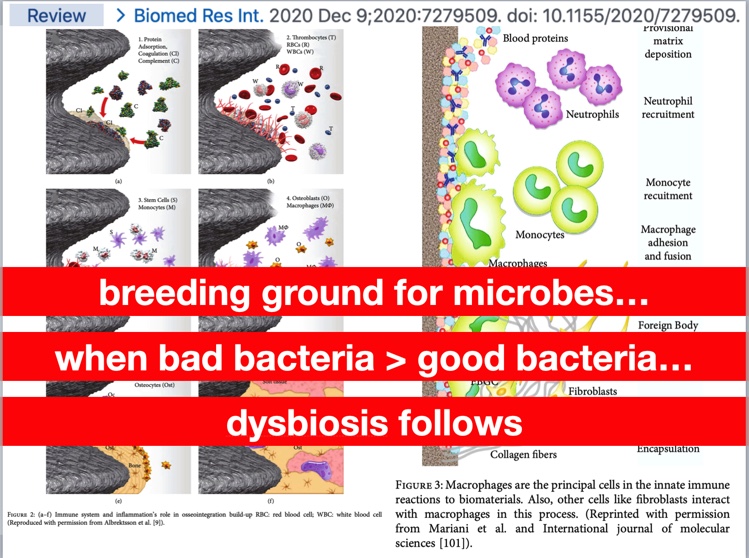
3. Peri-Implantitis: Role of Metal Nanoparticles (PMC11470642) Bressan et al. (2019) found titanium nanoparticles from dental implants decreased cell viability and increased oxidative stress in mesenchymal stem cells and fibroblasts. Tissue analysis showed high titanium levels, oxidative stress, neutrophil recruitment, collagen degradation, and imbalanced bone turnover around implants.
https://pubmed.ncbi.nlm.nih.gov/31242601/
4. Metal Ion Toxicity & Osteoblast Disruption (PMID: 25446332) - This was an interesting one, because it was about Fluoride exposure causing titanium dental implants to release titanium ions, which team up with bacteria to trigger inflammation and bone loss around the implant by making gum cells more sensitive to germs and activating bone-destroying cells called osteoclasts.
https://pubmed.ncbi.nlm.nih.gov/25446332/
5. Systemic Distribution of Titanium Particles . (PMID: 37996420) This review discusses how titanium particles released from dental implants accumulate in surrounding tissues, are found at higher levels in peri-implantitis sites, and may contribute to inflammation and bone loss. It examines particle distribution, potential mechanisms of disease progression, and current prevention/treatment strategies, while highlighting areas needing further research.
https://pubmed.ncbi.nlm.nih.gov/37996420/
6. Chronic Inflammation Around Titanium Implants. (PMID: 37520600). Peri-implantitis is gum inflammation around dental implants caused by bacteria. This infection might affect the whole body by releasing inflammatory chemicals into the bloodstream, potentially worsening diabetes, heart disease, and obesity. Scientists understand how regular gum disease affects overall health better than implant-related inflammation.
https://pmc.ncbi.nlm.nih.gov/articles/PMC10373087/
7. DNA Damage & Genotoxicity - (PMID: 36228836) Researchers reviewed 192 studies on titanium dioxide's ability to damage DNA. Only 34 studies were high-quality. Ten showed DNA damage, but all occurred alongside cell stress and inflammation. The scientists concluded titanium dioxide doesn't directly damage DNA—instead, it causes indirect damage through oxidative stress.
https://pubmed.ncbi.nlm.nih.gov/36228836/
8. Cytotoxicity Toward Gingival Fibroblasts - (PMID: 35438207) Titanium nanoparticles damaged the internal skeleton of gingival fibroblasts, reducing cell survival, movement, and growth. The particles triggered inflammation chemicals (cytokines) that signal bone destruction. When bacteria were present alongside titanium particles, the damage worsened significantly. Nanoparticles caused more harm than larger microparticles.
https://pubmed.ncbi.nlm.nih.gov/35438207/
9. Impaired Osteoblast Mineralization - (PMID: 38669870) TiO₂ nanoparticles reduced bone formation in mice by causing osteoblast death and blocking bone-building ability. The nanoparticles accumulated in bone cells, damaged their energy-producing mitochondria, and disrupted two key pathways (PI3K/AKT and Wnt/β-catenin) required for bone formation, resulting in weaker bones with reduced trabecular structure.
https://pubmed.ncbi.nlm.nih.gov/38669870/
Account required
Sign in to see more
Create an account or sign in to unlock the full list.