Resource Libraries
Is the Air in a Dental Office Safe? Mercury Vapor Explained
How mercury vapor from amalgam drilling lingers in dental office air, what OSHA calls a safe level, and why a vetted office protects you even without amalgam.
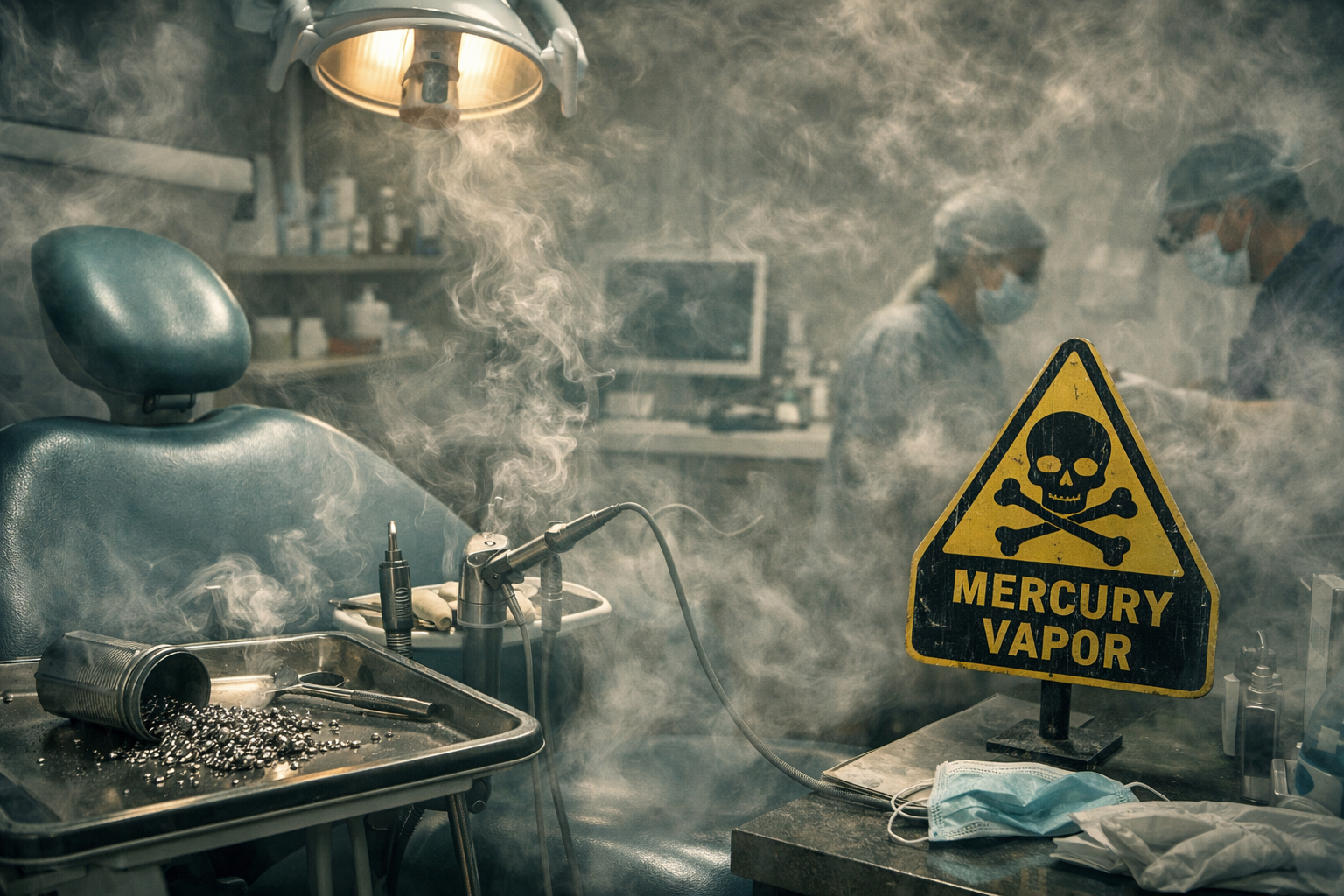
Why You Should Choose a Vetted Dental Office (Even If You Don't Need Amalgams Removed Yourself)
Before we get into the studies, I want you to know what “safe” mercury exposure means in the real world—because consumers deserve to understand the reference points. Spoiler: there is no truly “safe” level of mercury, especially for pregnancy and vulnerable biology, but regulatory agencies do publish exposure limits. Unfortunately, sometimes people publish things in different measuring units, so to prevent confusion, all air measurements in this article are expressed in the same unit: µg/m³.
What “safe” means on paper (all converted to µg/m³)
These are workplace / health guidance thresholds, not magic forcefields:
OSHA PEL (ceiling): 0.1 mg/m³ = 100 µg/m³ (legal workplace ceiling in many contexts)
NIOSH REL (10-hr TWA): 0.05 mg/m³ = 50 µg/m³ (recommended worker exposure limit)
ACGIH TLV (8-hr TWA): 0.025 mg/m³ = 25 µg/m³ (stricter guideline used widely in industry)
EPA RfC (chronic inhalation): 0.0003 mg/m³ = 0.3 µg/m³ (health-based reference concentration for the general public)
OSHA Permissible Exposure Limit (PEL): The ceiling limit of 0.1 mg/m³ (100 µg/m³) for mercury vapor is an official OSHA standard that has been in place since the agency adopted the ACGIH threshold limit values in 1972. This ceiling limit is referenced in multiple studies examining occupational mercury exposure.
NIOSH Recommended Exposure Limit (REL): The 10-hour time-weighted average of 0.05 mg/m³ (50 µg/m³) is the NIOSH recommended exposure limit for mercury vapor. This REL is consistently cited in occupational health assessments and represents a more protective standard than the OSHA PEL.
ACGIH Threshold Limit Value (TLV): The 8-hour time-weighted average of 0.025 mg/m³ (25 µg/m³) is the current ACGIH TLV for elemental mercury vapor. The ACGIH also established a biological exposure index (BEI) of 35 µg/g creatinine for urine mercury.[5] The TLV has been progressively reduced over time, with the ACGIH showing a more aggressive policy particularly for substances with carcinogenic potential.
EPA Reference Concentration (RfC): While the EPA has established a reference dose (RfD) of 0.1 µg/kg/day for methylmercury (not mercury vapor), the chronic inhalation reference concentration of[6-7] 0.0003 mg/m³ (0.3 µg/m³) for elemental mercury vapor has been proposed in the scientific literature. This proposed RfC was derived using uncertainty factors of 30-50 applied to a LOAEL of 3.5 µg/m³, resulting in values of 0.1 or 0.07 µg/m³ for ambient air exposure.
The occupational limits (OSHA, NIOSH, ACGIH) are well-established regulatory or recommended standards, while the EPA RfC for mercury vapor represents a proposed environmental standard from the peer-reviewed literature rather than an official EPA regulatory value.
So yes: depending on which “authority” you cite, “acceptable” ranges from 100 µg/m³ down to 0.3 µg/m³ — a difference of more than 300×. That alone should tell you why “but it’s under OSHA” is not the mic drop some people think it is.
“But I’m not getting an amalgam removed.”
I hear a version of this statement constantly, usually from people explaining why they’ll use a biological dentist only for amalgam removal or extractions: “But I’m not getting an amalgam removed or a tooth extracted.” I understand why people say that. It feels logical. Unfortunately, mercury does not care which patient is in the chair. Dentistry happens in AIR, not in isolation. And air is shared—by patients, staff, doctors, and anyone who walks through the door. That’s why choosing a vetted dental office matters even when no amalgam is being removed on you.
Mercury in dentistry is an environmental exposure — not a single procedure
Elemental mercury vapor is invisible, odorless, easily inhaled, absorbed through the lungs, and biologically active at low levels. Once mercury enters a dental environment—through amalgam placement, removal, polishing, drilling, vacuum systems, or historic spills—it can persist in indoor air, dust, cracks in flooring, and in suction/exhaust infrastructure. So the question isn’t just:
“Are my fillings being removed today?”
It’s also:
“What’s in the air of this building because of what this office does every day?”
What the research shows (all air values in µg/m³)
Across multiple countries and decades, studies have measured mercury vapor in dental environments that range from modestly above to extremely above safety limits. MANY values exceed ACGIH’s 25 µg/m³ guideline. Some approach or exceed OSHA’s 100 µg/m³ ceiling. And the highest reports are far above both. When an office doesn’t use robust safety protocols (engineering controls + procedural controls), mercury can end up where you’d expect in a dental practice: suction exhaust, near the floor, in dust, and in the breathing zone during high-aerosol tasks. And here’s the part consumers rarely consider: If an office claims to be “biological” but isn’t properly protecting its team from chronic exposure, you have to wonder where else they are cutting corners while using “biological” language. Safety should NEVER be about "optics".
This is DAILY exposure to mercury. Every hour of their workday. Let that sit. Would you allow your child to go into an office that has constant, chronically high levels of mercury in their air? If you were pregnant, would you want to step into an environment that had high mercury all day long? Would you want your pregnant wife to WORK in that kind of place? And yet, that is what is accepted every single time a person steps into a conventional office that places or removes amalgams without appropriate protection protocols. Please understand - dentists are NOT maliciously trying to poison anyone. We are taught in dental school that we are perfectly safe, DESPITE the research showing otherwise. And the vast majority of us believe what we are taught without questioning it. The schools are very good at teaching us that biological approaches to dentistry are complete garbage. That there is nothing to be concerned about. That those of us who believe that our profession is toxic are simply tilting at windmills (Don Quixote reference, for those who don't know). But the research shows otherwise. And Biological Dentistry is SCIENCE FORWARD. So we will continue teaching it, hoping we reach the right people and effect positive change for all.
Air measurements in dental environments
Stone ME, Cohen ME, Debban BA
PMID: 16678246
https://pubmed.ncbi.nlm.nih.gov/16678246
Measured mercury vapor from dental vacuum exhaust systems at three U.S. clinics. Exhaust air contained 36.9–72.2 µg/m³ (mean values: 36,895–72,211 ng/m³). Mercury accumulates in suction systems and is released into the environment outside the operatory.
Gioda A, Hanke G, Elias-Boneta A, Jiménez-Velez B
PMID: 18203562
https://pubmed.ncbi.nlm.nih.gov/18203562
Measured mercury vapor in a dental school in Puerto Rico. Simulation lab reached 1,100–3,300 µg/m³; clinic air 13.6–102.7 µg/m³. Some values exceeded OSHA limits (100 µg/m³), showing training environments can create very high exposures.
Al-Zubaidi ES, Rabee AM
PMID: 29043874
https://pubmed.ncbi.nlm.nih.gov/29043874
Measured clinic air mercury in four Baghdad dental clinics: 84.7–609.3 µg/m³. Most readings exceeded occupational standards and were linked to abnormal liver enzymes, cholesterol, and reduced glutathione in workers. One of the highest real-world clinical exposure reports.
Corte G, Monkman JL, Kleinberg I
PMID: 1155966
https://pubmed.ncbi.nlm.nih.gov/1155966
Studied 88 U.S. dental offices and found air mercury from 0.45–742 µg/m³. Levels spiked during floor sweeping and after spill cleanup, showing mercury settles in dust and floors and gets re-aerosolized by routine cleaning.
Ritchie KA, Burke FJ, Gilmour WH, et al.
PMID: 15611750
https://pubmed.ncbi.nlm.nih.gov/15611750
Surveyed 180 Scottish dental practices. 67.8% had at least one area above occupational standards; 25% had breathing-zone measurements above limits. Highest levels were often near floor level at skirting boards and chair bases, consistent with mercury settling.
Biomonitoring in dental personnel
Shirkhanloo H, Fallah Mehrjerdi MA, Hassani H
PMID: 25257992
https://pubmed.ncbi.nlm.nih.gov/25257992
Compared 50 dental workers to 50 controls. Workers had much higher mercury in blood (16.40 vs 2.50 µg/L) and urine (19.41 vs 2.15 µg/g creatinine). Demonstrates dental work environments lead to higher internal mercury burden.
Jamil N, Baqar M, Ilyas S, et al.
PMID: 27446955
https://pubmed.ncbi.nlm.nih.gov/27446955
In Lahore dental clinics, dentists and assistants had much higher blood mercury (29.8 µg/L and 22.8 µg/L) than controls (3.3 µg/L). Mercury increased with age and experience. Occupational exposure translates into measurable body burden.
Goodrich JM, Chou HN, Gruninger SE, Franzblau A, Basu N
PMID: 26329138
https://pubmed.ncbi.nlm.nih.gov/26329138
Studied 630 U.S. dental professionals at an ADA meeting. Mercury in urine (1.28 µg/L), blood (3.67 µg/L), and hair (0.60 µg/g) was higher than general U.S. population. Even in modern settings, dentistry is associated with higher mercury exposure.
Population exposure estimates (not clinic air, still relevant)
Geier DA, Geier MR
PMID: 35786065
https://pubmed.ncbi.nlm.nih.gov/35786065
Analyzed U.S. NHANES data (2015–2018) and urinary mercury to estimate mercury vapor exposure in adults with amalgams. Estimated 54.3% of adults exceeded California EPA safety limits and 10.4% exceeded U.S. EPA limits. Population-level modeling, not direct air testing.
Richardson GM, Wilson R, Allard D, et al.
PMID: 21782213
https://pubmed.ncbi.nlm.nih.gov/21782213
Estimated mercury exposure from dental amalgam across U.S. population (2001-2004 data). Estimated 67.2 million Americans exceed EPA reference levels. Calculated 0.2–0.4 µg/day per amalgam surface. Exposure modeling, not direct clinic air monitoring.
Environmental / wastewater
Hylander LD, Lindvall A, Gahnberg L
PMID: 16054673
https://pubmed.ncbi.nlm.nih.gov/16054673
Studied 12 Swedish dental clinics and found that even with amalgam separators (designed to remove 95% mercury), mercury still escapes into wastewater systems. Supports why dentistry is a major contributor to environmental mercury.
Review articles
Picard G, Prakash T, Labrèche F, Gravel S
PMID: 40934158
https://pubmed.ncbi.nlm.nih.gov/40934158
Scoping review of chemical exposures in dentistry (2000-2024). Identified scenarios where mercury exposure can exceed recommended limits, including very high student exposures (up to 3 mg/m³) in simulation settings. Useful overview placing individual studies in context.
Aaseth J, Hilt B, Bjørklund G
PMID: 29482185
https://pubmed.ncbi.nlm.nih.gov/29482185
Reviewed mercury exposure and health effects in dental personnel, including symptoms of chronic exposure (weakness, fatigue, anorexia, CNS symptoms). Notes Norway and Sweden have banned dental amalgam, reflecting ongoing occupational and environmental concerns.
Jirau-Colón H, González-Parrilla L, Martinez-Jiménez J, Adam W, Jiménez-Velez B
PMID: 30909378
https://pubmed.ncbi.nlm.nih.gov/30909378
Review discussing continuous mercury vapor release from amalgam and toxicology considerations. Highlights ongoing scientific debate and limitations of "safety" claims when exposure is continuous and vulnerable populations (pregnant women, children) exist.
Tzoutzas I, Karoussis I, Maltezou HC
PMID: 35746455
https://pubmed.ncbi.nlm.nih.gov/35746455
Review on air quality in dental care facilities, including aerosols and mitigation strategies (HEPA filters, UV-C, high-volume evacuation). Supports that air quality matters for both infection risk and chemical exposure risk in dentistry.
OSHA vs “no safe level” — both can be true
OSHA’s ceiling (100 µg/m³) is a workplace compliance threshold mainly aimed at preventing overt toxicity in adult workers. It’s not designed as a “safe for pregnancy / safe for kids / safe for chemically sensitive humans” line in the sand. IT SHOULD BE. Because if we protect the weakest members of our workforce, we protect everyone by default. Protection against toxins should NEVER be for "average" exposure. And when they made the threshold 100 µg/m³, they guaranteed that a LOT of people were going to get sick. And they did!
I can't tell you the number of people I have met who were mercury toxic in my career - visibly sick due to mercury. Not to mention the ones who have no idea that the chronic illnesses they are dealing with is mercury toxicity. At my sickest, I had 63 symptoms of mercury toxicity. And knowing this information you are reading now sure does make sense in hindsight.
EPA’s chronic inhalation reference concentration for elemental mercury in air is 0.3 µg/m³—orders of magnitude lower. That’s why our pregnancy toxicology content emphasizes the real-world clinical truth: There is no known safe level of mercury exposure during pregnancy.
So yes, an office can be “OSHA-compliant” and still be biologically inappropriate for vulnerable populations. That’s how toxicology works. And if it's not safe for children or pregnant women, why are we allowing ourselves to even walk in to these places?!?! I went to my 30th dental school reunion May 2025 in San Antonio, and we were all invited to go to the school there. I refused. I knew there were no special efforts to protect anyone from mercury, and I have spent the better part of the past 15 years trying to recover from the effects of my first 19 years in dentistry (the first 4 years of it DURING dental school). Nothing can make me go back into an environment that I know isn't safe willingly again.
What is the Minimata Convention?
The Minamata Convention on Mercury is a global public-health and environmental treaty adopted in 2013 (entered into force 2017) to protect humans and the environment from mercury exposure. It’s named after Minamata, Japan, where industrial mercury discharge caused catastrophic neurologic disease—one of the clearest real-world proofs that there is no safe level of mercury exposure.
What the Convention actually does (plain English)
1. Acknowledges mercury is dangerous.
Mercury is explicitly recognized as:
A potent neurotoxin
Harmful to fetuses, infants, and children
Capable of bioaccumulating and biomagnifying
A global pollutant (it travels far from its source)
This matters because it sets a precautionary framework: harm doesn’t require massive doses.
Account required
Sign in to see more
Create an account or sign in to unlock the full list.