Resource Libraries
Why Two (or TEN!) Good Dentists Can Disagree
Why two or ten dentists can look at the same mouth and recommend different treatments, how judgment and biology shape each plan, and how to choose calmly.
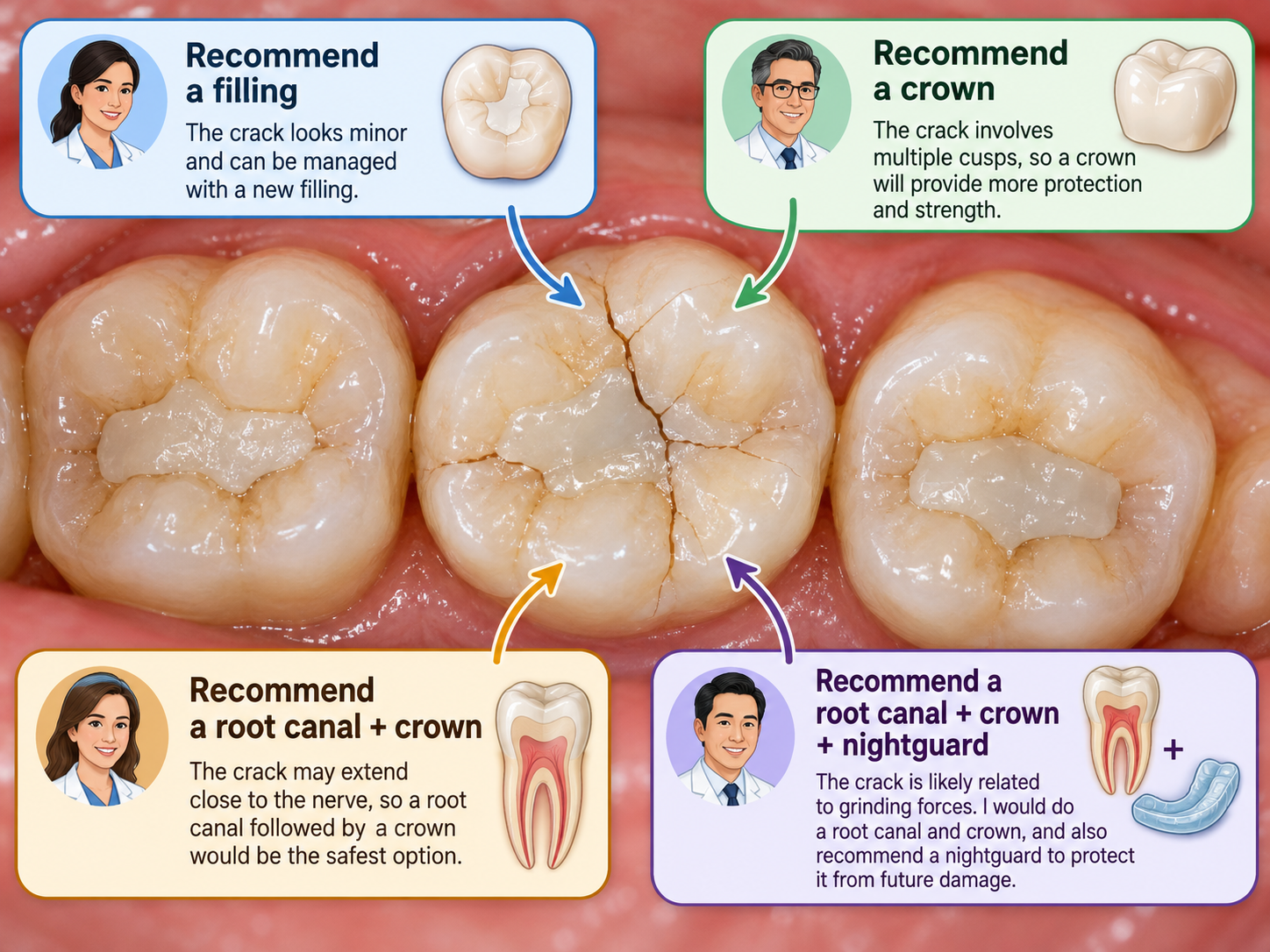
And Why That Doesn't Automatically Mean Either One Is Wrong
Have you ever gone to one dentist who told you that you needed a crown, then visited another who said a filling would be perfectly fine, and then went to a THIRD dentist who said the tooth didn't need anything done to it at all? And now you're wondering if ANYBODY knows what they're doing? I get it.
I've been practicing dentistry for over three decades now, and I've seen this happen more times than I can count. Patients come into my office with treatment plans from two or three different dentists, sometimes with recommendations that are so different you'd think we were looking at entirely different mouths. Naturally, they want to know who's right, who's wrong, and how they're supposed to make an intelligent decision when the people who went to school for this stuff can't seem to agree.
Sometimes the differences are relatively small. One dentist thinks a tooth has a small cavity and can be watched, while another believes it should be repaired while it's still really small. Other times we're talking about whether a tooth should be crowned, root canaled, extracted, or left alone. And sometimes those different opinions come with price tags that vary by thousands, or even tens of thousands, of dollars. I'd be confused too!
But I've learned over the years is that dentistry isn't nearly as black and white as most people think it is. There are plenty of situations where more than one treatment option is reasonable, and sometimes two perfectly competent dentists can look at the same problem and come to very different conclusions. Of course, sometimes one of them really IS wrong. We're going to talk about that too, because I don't believe in pretending every professional opinion is equally valid just because the person giving it has a dental degree.
And as usual, I brought the science!
So How Often Do Dentists Actually Disagree?
Quite a bit, apparently. In 2013, researchers from the National Dental Practice-Based Research Network studied how dentists decided when cavities needed treatment and whether existing restorations should be repaired or replaced. They found that agreement about when to restore cavities ranged from 40% to 68%, depending on the clinical situation. But when the question was whether an existing restoration should be repaired or completely replaced, agreement was only 36% to 43%. [1]. Those numbers feel pretty shocking when you think about it. These were licensed dentists looking at standardized clinical scenarios, and they frequently came to different conclusions.
That's not just an American phenomenon. A much larger study published in 2025 evaluated 3,680 dentists across 21 countries. Researchers presented scenarios involving early cavities that hadn't yet developed into actual holes and asked the dentists when they would recommend drilling and placing restorations. Only 22.7% of the responses involving patients at low risk for cavities, and 32.7% involving patients at high risk, matched the treatment thresholds established by the researchers using current guidelines. [2]
Now, those were hypothetical situations, and answering a survey isn't necessarily the same thing as evaluating a real patient sitting in your chair. But the study certainly demonstrates how differently dentists can approach the same problem, even when they're working with identical information. Interestingly, many of the differences involved recommending treatment EARLIER than the guidelines suggested. So we're not just talking about personal preferences here. Sometimes the disagreement involves whether the proposed treatment is actually supported by the available evidence.
Dentistry Is a Whole Lot More Complicated Than "See a Hole, Fill a Hole"
I've talked about this before, but I think it's worth discussing again because it explains so much about why dentists disagree. People sometimes think we're basically tooth mechanics. We find something broken, repair it, and send you home. There's a cavity, so we fill it. A tooth breaks, so we put a crown on it. A tooth is missing, so we replace it. Easy peasy, right? Except teeth are living biological structures, and every single one of them has a history.
Let's say you have a molar with a large filling that's been there for twenty years. You don't have any pain, you can chew perfectly well, and as far as you're concerned, the tooth is doing its job. One dentist looks at it and recommends replacing the filling. Another sees a crack and recommends a crown. A third dentist thinks the crack is superficial and recommends leaving everything alone for now. All three could potentially have reasonable arguments, depending on what they actually found during the examination. Some dentists prefer to be proactive. Others prefer to wait and see.
We have to consider how much healthy tooth structure remains, whether the crack is superficial or extends deeper, how the tooth fits together with the opposing teeth, whether there's evidence of excessive force, and what kind of long-term prognosis we're dealing with. And sometimes there are things happening inside the tooth that we simply can't see. Microscopic things that extend to the pulp and make a person's tooth a ticking time bomb, but go unnoticed until the drill touches the tooth - which then means the patient blames the dentist when their tooth starts hurting.
I can't tell you how many times I've removed an old filling and discovered a crack underneath that wasn't visible beforehand. Sometimes that discovery completely changes what I recommend. A dentist who hasn't removed the filling doesn't necessarily have the same information as someone who has. And sometimes it's just experience talking. Some dentists want to please their patients. The patient will come in asking for a second opinion, and the dentist hears the patient say "I wasn't expecting this diagnosis. My other dentist recommended this treatment. I don't want to do it. Do I have to?" And of course the dentist will answer "No, you don't have to do anything. We can watch this". And maybe you can. And maybe you really shouldn't. Everyone is different. We aren't cookie cutters. So before deciding that two recommendations are contradictory, we need to make sure the dentists are actually evaluating the same findings.
We All Look at Things Through Different Lenses
Every dental school is different. We learn the fundamentals as dental students, pass our boards, and receive licenses to practice. But what happens AFTER dental school can be wildly different. Some dentists become absolutely brilliant at restorative dentistry. They spend decades perfecting the art and science of rebuilding damaged teeth. Others become highly skilled in surgery, periodontal treatment, orthodontics, endodontics, or complex full-mouth reconstruction. Some develop a particular interest in airway health, facial development, and how breathing affects oral function. And then there are people like me, who went down the biological dentistry rabbit hole and never came back up.
I've spent a tremendous amount of time studying toxicology, biocompatibility, inflammation, oral-systemic relationships, and how dental treatment may affect the rest of the body. Those subjects influence how I evaluate patients and what kinds of questions I ask.
- A restorative dentist may look at a heavily damaged tooth and immediately start thinking about how to rebuild it so that it can withstand chewing forces.
- A periodontist may be particularly concerned about the amount of supporting bone and whether the periodontal tissues can maintain that tooth long-term.
- An airway-aware dentist might notice severe grinding and start wondering whether sleep-disordered breathing is contributing to the problem.
- And a biological dentist might be looking at all of those things while also considering the patient's systemic health, inflammatory conditions, and the biological implications of different treatment materials.
None of those perspectives automatically makes one dentist better than another. Ideally, we're all considering the same larger picture, even when we have particular areas of expertise. But our training and interests absolutely influence what catches our attention first. And of course, because you know I'm going to bring the science, there's actually research confirming that clinical decisions are affected by much more than the findings in someone's mouth.
A 2023 scoping review examined 64 studies looking at how dentists make decisions when the available information is incomplete or uncertain. The researchers identified six major influences, including clinical findings, professional experience, patient preferences, cognitive biases, technology, and clinical guidelines. [3]. So yes, the science confirms that our professional backgrounds and the way we process information can influence what we recommend. And it makes perfect sense that it SHOULD.
Thirty Years of Experience Can Teach You a LOT, but It Can Also Change How You See Risk
I didn't fully appreciate when I was a brand-new dentist just how much my experiences would influence my treatment decisions. When you've spent decades watching restorations succeed and fail, you develop a pretty good sense of what tends to work and what makes you nervous. For example, I've seen teeth with enormous fillings that somehow survived for decades. I've also seen teeth that looked perfectly reasonable fracture in ways that made me wonder what on earth happened. Teeth have a way of keeping dentists humble, and every one of those experiences becomes part of how we evaluate future patients.
Imagine two dentists looking at a tooth with a large filling and a suspicious crack.
- One has successfully maintained similar teeth for years without crowning them. That dentist might be comfortable replacing the filling and monitoring the situation.
- Another has seen several similar teeth split right down the middle, leaving extraction as the only reasonable option. That dentist might recommend a crown much sooner.
Neither dentist is necessarily trying to do something inappropriate. They're drawing on different experiences. But there's a catch. Our brains don't always give equal weight to every experience we've had. We tend to remember dramatic complications, unexpected failures, and situations that made us feel terrible for our patients. And sometimes those memories influence us more than they should.
That same 2023 review identified cognitive shortcuts and biases as important factors in dental decision-making. [3] I think experience is incredibly valuable, especially when you're treating complicated patients whose circumstances don't fit neatly into a textbook. But I also think we need to be willing to question our own assumptions.
I've changed my mind about plenty of things over the course of my career because I've learned something new, encountered better evidence, or realized that something I was taught in dental school wasn't quite as straightforward as I'd believed. That's actually how I became a biological dentist after 17 years of practicing conventional dentistry. I learned something new, realized it was better than the old things I knew, and became willing to let go of the old knowledge in favor of the newer, better information. I hope I continue doing that for as long as I'm alive. I'd be much more concerned about a dentist who stopped learning twenty years ago than one who's willing to admit that new evidence has changed their approach.
Sometimes We're Not Disagreeing About WHAT to Treat. We're Disagreeing About WHEN.
Let's talk about cavities for a minute, because this is one of the easiest examples to understand. Imagine you have a small area of decay between two teeth. One dentist tells you that you need a filling, and another tells you that the area can be monitored while you work on improving the conditions that allowed the decay to develop. So who's right?
Well, here are some questions that help us navigate the situation:
- How deep is the lesion?
- Has it actually developed into a hole?
- Is it actively progressing, or has it remained stable?
- What's your individual risk for developing cavities?
- Are you able to keep the area clean?
Those are all important questions. Modern research has demonstrated that certain carious lesions can be arrested or managed without immediately drilling into the tooth.
In 2018, the American Dental Association published evidence-based guidelines evaluating nonrestorative treatments for carious lesions. The expert panel developed eleven recommendations addressing different types of lesions and tooth surfaces. [4]. Now, some of the interventions supported by those guidelines involve fluoride, and as a biological dentist, I have my own concerns about routine fluoride exposure and prefer to consider other appropriate approaches when possible.
But I'm not going to pretend the research doesn't exist simply because I don't agree with every treatment philosophy represented in it. The larger point is that we have evidence supporting the management of selected lesions without immediately drilling away tooth structure. Of course, that doesn't mean we should ignore active decay and hope it magically disappears.
There are LOTS of situations where delaying treatment could allow a manageable problem to become a much bigger one. And there are situations where drilling into a tooth unnecessarily sacrifices healthy structure that can never be replaced. This is why I believe dentists need to explain the reasoning behind their recommendations instead of simply telling patients what they need. I personally believe pictures are worth 1000 words. So I take LOTS of them. Because dentistry is visual. We SEE the problems. And if we can see it, we can show it.
If one dentist says a cavity needs treatment now and another says it can wait, I want to know WHY each of them believes that. That's where the useful information is.
Even the Word "Conservative" Can Mean Completely Different Things
This is something I've noticed quite a bit in conversations between conventional and biological dentists. We can both describe ourselves as conservative practitioners while recommending treatments that are almost completely opposite. Let's take a severely compromised tooth as an example. One dentist wants to save the tooth at virtually any reasonable cost because preserving the natural dentition is the priority. Another dentist is concerned about the possibility of persistent infection, repeated procedures, or leaving a chronically compromised tooth in place. Both may believe they're recommending the more conservative approach. They're just trying to preserve different things. This becomes particularly relevant when we're discussing root canal treatment, extractions, and replacement options.
You already know that I place enormous value on preserving LIVING teeth. I want teeth to retain their blood supply, nerves, immune function, and natural biological activity whenever reasonably possible. I also have concerns about what happens when a tooth dies, particularly when persistent infection or unresolved inflammatory disease is involved. Those considerations absolutely influence the way I approach treatment.
Another dentist may place greater emphasis on retaining the natural root and avoiding extraction, and they may believe conventional root canal treatment provides the most appropriate balance of risks and benefits. We're both looking at the same tooth, but we may be approaching the decision with different priorities and different interpretations of the available evidence.
I think it's perfectly reasonable for dentists to have different clinical philosophies. Our education and experience inform our clinical philosophies. It's that simple and that complicated.
Our Tolerance for Risk Is Different, and So Is Yours
Another reason dentists disagree is that we don't all have the same comfort level with uncertainty. Some practitioners are more concerned about treating too aggressively. Others worry more about what might happen if they wait. And when you add the patient's own preferences to that equation, things can get considerably more complicated.
Imagine that you have a tooth with a questionable prognosis. One patient might tell me that they want to keep that tooth for as long as possible, even if it means accepting the possibility of additional treatment later. Another might say they've already spent thousands of dollars trying to save it, and they're tired of investing in something that might fail anyway. They are both valid and important to consider. Because it's YOUR BODY, YOUR CHOICE.
I've had patients who wanted to avoid surgery at almost any cost, and others who preferred a more definitive treatment because they didn't want to keep returning for repeated procedures. I've also had patients whose decisions were influenced by finances, medical issues, previous traumatic experiences, or simply how much dentistry they were emotionally prepared to handle. All of those things matter when we're discussing treatment options.
In fact, a systematic review published online in 2025 examined 233 studies from 49 countries investigating the factors that influence patients' dental treatment decisions. The researchers identified 101 different factors, with out-of-pocket expenses and dental fear among the most frequently reported. Communication and expected treatment durability also mattered. [5]. That's a pretty good reminder that people don't make healthcare decisions in a vacuum. I know for sure that healthcare workers in general forget that sometimes.
A treatment plan can be absolutely beautiful on paper and completely unrealistic for the person who has to live through it and pay for it. I can recommend what I believe offers the best biological and clinical outcome, but I also have to consider whether the patient can actually follow through with the plan.
- Sometimes we have to stage treatment.
- Sometimes we have to choose an interim solution.
- And sometimes we have to accept that a patient values something differently than we do.
AND IT'S OK WHEN THAT HAPPENS. The important thing is to give our patients all of the information they need to make the best decision they can with the time, money, effort, and any other resources they may have to devote to the situation. And to do it in a way that doesn't play the blame game and doesn't shame them. Life happens. The key is to help a person through their issue with empathy and compassion and a practical way to get through the situation.
As long as the proposed treatment is clinically appropriate and the patient understands the risks, benefits, pros, cons and consequences, those preferences deserve to be part of the conversation.
The Patient's Health Can Change the Recommendation, Too
The next thing I want to discuss is that we aren't treating isolated teeth. We're treating people whose systemic health, medications, inflammatory conditions, healing capacity, and medical histories may influence how they respond to dental treatment. A procedure that's relatively straightforward for one patient may require a very different approach for someone with compromised healing, significant periodontal disease, a bleeding disorder, or medications that affect surgical planning. And sometimes we're evaluating the same patient at different points in their life.
A treatment that seemed reasonable ten years ago may not be the treatment we'd recommend today because the patient's health circumstances have changed. This is another reason I don't particularly like the idea that there's always one perfect treatment plan. There may be a treatment that's most appropriate given the information we have today, but we also have to recognize that people and their circumstances change. And that means treatment planning sometimes has to change with them.
Sometimes the Dentists Aren't Working With the Same Information
This is probably one of the easiest reasons for disagreement to overlook. Let's say one dentist evaluated your tooth using a clinical examination and conventional radiographs. Another dentist had access to previous images, additional diagnostic testing, and perhaps a CBCT scan when the circumstances warranted one. Those dentists may not actually be working with the same information.
One may have recognized a fracture that wasn't apparent during the earlier examination. Another may have reviewed previous imaging and discovered that an area of concern has remained stable for years. Sometimes symptoms have changed between appointments, too. And sometimes the original diagnosis was simply incomplete.
I see this frequently when patients arrive with treatment recommendations but without their previous imaging or clinical records. I can certainly evaluate what I see today, but it helps tremendously to know what the dentist saw six months or two years ago. That's why I encourage patients seeking second opinions to obtain copies of their relevant records whenever possible.
And if you're going for a second opinion, I would encourage you to actually have a proper examination rather than expecting another dentist to evaluate a complicated treatment plan from a photograph or a quick look at an X-ray. A meaningful second opinion requires enough information to make a meaningful diagnosis.
Now, Sometimes One Dentist Really IS Wrong
Account required
Sign in to see more
Create an account or sign in to unlock the full list.