Resource Libraries
Why Dental Work Has to Be Done in the Right Order
Why infection, decay and gum disease must be treated before cosmetic work, how state dental boards judge substandard care, and why piecemeal dentistry fails.
Why “Doing Everything All At Once” or "Piecemeal" Often Fails
And How Dental Care Must Be Sequenced to Protect Teeth, Bone, and Outcomes
One of the most common sources of confusion, and frustration, for patients and clinicians alike is treatment sequencing. Patients often ask:
“Why can’t we just do the orthodontics now?”
“Why do I need periodontal treatment before airway?”
“Why can’t the implants be placed first so I can chew?”
These are fair questions. But dentistry is not a menu. It is a biologic system under load, and some problems must be addressed before others, or everything downstream is compromised.
This article explains why sequencing matters, what must come first, where flexibility exists, and where it does not.
Dentistry Is Hierarchical, Not Parallel
In biological dentistry, treatment is prioritized based on risk, reversibility, and biologic stability.
Think in engineering terms:
Some problems are fires.
They go first. If you don’t put the fires out, the entire structure burns.Some problems are structural weaknesses.
If ignored, the roof or floor collapses once load is applied.Some problems are optimization goals.
Necessary, but only after the structure is sound. It's nice to have walls, right?Last comes appearance.
You don’t hang curtains or buy furniture until the house is stable, the walls and flooring are in and stable, tiled and painted, the doors are framed and painted, etc.
Trying to address everything simultaneously is not efficient. In many cases, it is actively harmful.
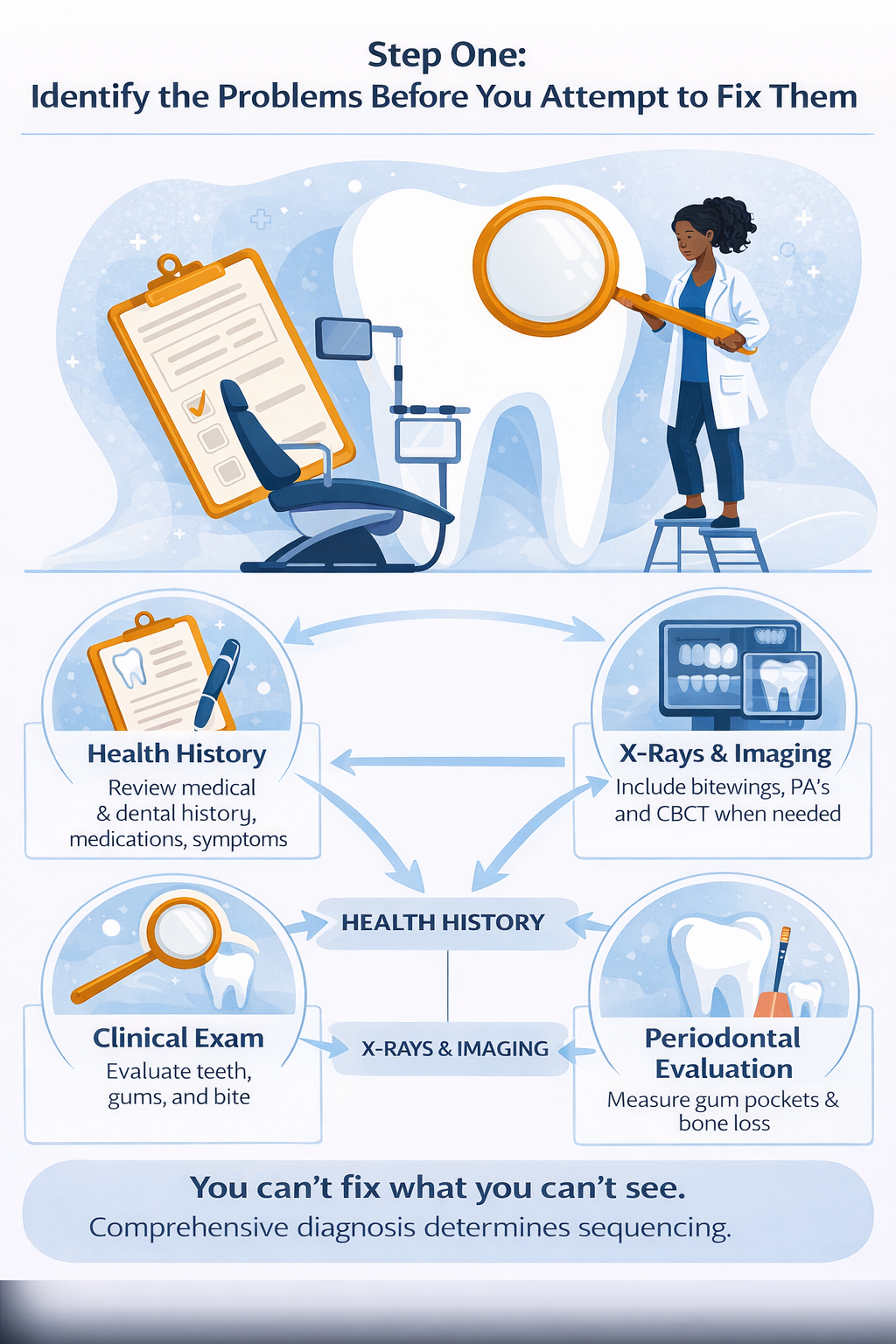
Step One: Identify the Problems Before You Attempt to Fix Them
Before sequencing treatment, before prioritizing disease, before talking about airway, orthodontics, implants, or cosmetics, there is one non-negotiable step: You must identify what is actually going on. You cannot fix what you cannot see. And in dentistry, seeing requires more than looking at teeth.
Comprehensive diagnosis includes:
clinical examination
appropriate radiographic imaging (bitewings, periapicals, CBCT when indicated)
periodontal charting
occlusal evaluation
airway screening
review of symptoms (pain, function, sleep, fatigue)
medical and dental history
evaluation of prior dental work and failures
often it requires diagnostic models and waxups and articulated casts
Skipping this step is not efficiency. It is guessing. I KNOW this is a LOT. I KNOW this is expensive. In my office, our new patient process is close to 4-5 hours long. So believe me, I GET it.
Why This Step Is Often Rushed, and Why That’s Dangerous
Patients often arrive with a solution in mind:
“I want veneers.”
“I want braces.”
“I want implants.”
“I just want to chew again.”
But a request is not a diagnosis. If active decay, infection, periodontal disease, structural instability, or force-related breakdown is present, and not identified first, every downstream treatment decision is compromised. This is where well-intentioned care turns into avoidable failure.
Identification Is Where Many People Have Already Been Failed
Many patients consult biological or integrative dentists because Step One was never completed elsewhere. Common examples:
undiagnosed posterior decay hidden under restorations
buccal or lingual bone loss not visible on 2D imaging
occlusal trauma dismissed as “stress”
airway compromise never screened
persistent pain with “normal” X-rays
failing root canals or implants labeled “fine” because they look intact
chronic pain that hasn't resolved and the conventional approach just keeps telling the patient "everything looks great!"
If the problem is not identified, it cannot be prioritized. If it cannot be prioritized, sequencing becomes guesswork.
Identification Determines What Is a Fire, and What Can Wait
Once problems are accurately identified, they can be categorized:
Active fires (infection, abscess, symptomatic cavitations)
Biologic instability (periodontal disease, large decay, force overload)
Structural risk (fractures, severe wear, occlusal collapse)
Optimization goals (airway, orthodontics)
Elective improvements (cosmetics)
Without Step One, everything looks equally urgent, or nothing does.
That’s how people end up doing veneers on unstable mouths, implants in high-force systems, or orthodontics in the presence of active disease.
Why This Matters Legally and Clinically
Failure to properly identify disease before treatment is one of the most common roots of malpractice claims: even when the procedure itself was technically well done. Because the question is not: “Was the veneer placed well?” It is: “Should it have been placed at all, given what else was going on?”
Diagnosis is the foundation that protects:
patients
outcomes
clinicians’ licenses
Step Two: Put Out the Fires
These issues must be addressed first because they represent active disease or immediate biologic risk:
acute or chronic infections
abscessed teeth
failing root canals with symptoms or pathology
non-restorable teeth requiring extraction
active, symptomatic cavitations or osteonecrosis concerns
Not all cavitations are urgent. Some are asymptomatic and stable and can be addressed later. Others are biologic fires.
Example:
A patient was referred by his functional medicine physician with a history of multiple prior tooth extractions that had healed poorly, resulting in areas of altered bone metabolism commonly referred to in biological dentistry as cavitations. Both energetic testing and clinical evaluation suggested reduced bone density and impaired function at several of these sites. Notably, the affected areas corresponded anatomically and meridian-wise with regions associated with the large and small intestine. The patient had experienced severe, longstanding intestinal dysfunction that had left him functionally disabled for years, despite extensive medical and functional care. Given the clinical findings, these cavitation sites were treated surgically in a staged manner, one side at a time, over two appointments. Within weeks of completing treatment, the patient reported meaningful improvement in his systemic symptoms.
No promises were made. No outcomes were guaranteed. But biologically active sources of stress were addressed, and the system responded.
Why fires come first:
infection destabilizes the immune system
worsens periodontal disease
interferes with healing
makes all downstream treatment less predictable
You cannot build on a burning foundation.
Step Three: Control Periodontal Disease and Large Decay
This phase cannot be rushed.
Periodontal disease:
often takes months to years to bring under sufficient control
requires repeated reassessment
fluctuates with stress, sleep, airway, and systemic inflammation
Large or deep decay must also be stabilized before advanced care.
A Non-Negotiable Legal Reality
It is malpractice to move teeth in the presence of active periodontal disease or untreated decay. This is not opinion. It is standard of care.
Orthodontists Are Legally Required to Stop Treatment if Decay Is Present
Orthodontists must pause or remove orthodontic appliances if active decay is discovered. Why?
Continuing orthodontics with decay:
accelerates tooth destruction
increases risk of pulpal injury
creates foreseeable harm
exposes the provider to malpractice
jeopardizes licensure
For this reason, orthodontists routinely:
pause treatment
remove brackets
refer patients back to general or periodontal dentists
This applies whether orthodontics is cosmetic, functional, or airway-driven.
The same principle applies to uncontrolled periodontal disease.
Step Four: Structural Stabilization When Teeth Are at Risk
Some patients cannot safely wait for final restorations. Examples include:
Account required
Sign in to see more
Create an account or sign in to unlock the full list.