Resource Libraries
Zirconia vs Titanium Implants: Why Ceramic Wins Long Term
Why zirconia implants, one-piece systems like CeraRoot and SDS, show better long-term success and fewer immune reactions than titanium, and why to test first.
Why I prefer one-piece ceramic implants, what research tells us about how the body responds to different materials, and why I believe implant treatment should be individualized.
When patients ask me why I use zirconia dental implants instead of titanium, my answer involves quite a bit more than the fact that zirconia is ceramic and titanium is metal. I've spent years studying how dental materials interact with the body, and one of the most important things I've learned is that we can't assume a material will be appropriate for every patient simply because it has a long history of use or a good success rate. We're not cookie cutters. I've probably said that on 75% of the articles I've written on this platform. Our bodies don't all respond to the same materials in the same way, and I believe that deserves consideration when we're planning to place something permanently into someone's jawbone.
In my practice, I exclusively recommend zirconia dental implants, particularly one-piece systems such as CeraRoot and SDS. I prefer them for several reasons, including their material properties, the way they're designed, their interaction with surrounding tissues, and the fact that they allow me to provide a metal-free alternative for patients who want one. But even though zirconia is my preferred implant material, I don't automatically assume it's appropriate for everyone. In fact, I disagree with colleagues who believe zirconia is universally biocompatible. Let me explain why.
What Does Biocompatibility Actually Mean?
When we describe something as biocompatible, we're talking about how well a material performs in a particular biological environment without producing an unacceptable immunological or bioelectrical response. It's a bit more complicated than simply asking whether an implant will mechanically stay in the bone.
A dental implant is placed directly into living tissue. It comes into contact with bone, immune cells, blood vessels, connective tissue, and eventually the millions of microorganisms that inhabit the mouth. All of these systems interact. An implant may integrate mechanically with the bone while the surrounding tissues experience inflammation. It may remain mechanically stable even when the gums around it are unhealthy. And an implant that performs beautifully in one patient may behave differently in another because the patients themselves are different.
That's why I look beyond whether the implant is still physically present. I want to know how the tissues are responding, whether the surrounding bone remains healthy, whether inflammation is developing, and whether we've considered the patient's individual health history before selecting the material.
Why Zirconia?
Zirconia is a ceramic material made primarily from zirconium dioxide. Although zirconium itself is a metal, zirconium dioxide is a chemically different material, and zirconia dental implants are classified as ceramic implants. The zirconia used in implant dentistry is specially formulated to provide the strength and stability required to withstand the forces generated during chewing.
It has several characteristics that make it attractive for biological dentistry.
- Zirconia allows us to place an implant without introducing a metallic implant body.
- Zirconia doesn't undergo the same electrochemical corrosion processes that can affect titanium in the oral environment.
- Research has identified differences in bacterial accumulation, soft-tissue responses, and immune-cell behavior around zirconia compared with titanium.
- And perhaps most importantly, we now have substantial clinical data demonstrating that zirconia implants can function successfully over extended periods.
None of that means that every zirconia implant will succeed or that the material can't produce complications. Implant success depends on far more than the material itself. But these are important reasons why I prefer to begin with zirconia.
What the Long-Term Research Shows
One of my favorite studies examined 1,828 CeraRoot ceramic implants placed in 771 patients. The researchers followed these implants for periods extending up to 15 years and reported an overall implant survival rate of 98.69%. [1]
This wasn't a study following a handful of implants for six months. It included nearly two thousand implants and evaluated their performance over a period that, for some patients, extended well beyond a decade. The results are particularly meaningful to me because CeraRoot is one of the two implant systems I recommend.
A separate systematic review published in 2023 examined 25 clinical studies involving 4,017 zirconia implants in 2,083 patients. The researchers calculated a cumulative implant survival rate of 95.1% at 10 years. They also found that one-piece zirconia implants had better survival results than two-piece zirconia implants in the studies they analyzed. [2]. And I don't like the 2 piece ones. I advocate for the one piece ones because I have seen better results overall in my own patients.
These findings tell us that zirconia is capable of excellent long-term performance. However, the CeraRoot study wasn't designed to compare zirconia directly with titanium, and the systematic review included different implant systems, surgical protocols, and patient populations. More recent direct comparisons have generally found similar survival and clinical outcomes between zirconia and titanium implants over the periods studied. [11]
That's worth understanding because my preference for zirconia isn't based on claiming that every study has demonstrated superior implant survival. It's based on considering the material's biological characteristics, the available clinical research, my experience treating patients, and my desire to avoid introducing metals when I have a suitable alternative.
The Immune System Doesn't Ignore an Implant
When we place an implant into bone, the immune system becomes involved in the healing process. That response is normal. Immune cells help coordinate inflammation, tissue repair, and bone remodeling. But the implant material can influence how those cells behave. A study published in 2025 compared immune responses to titanium and zirconia implants in mice. The researchers found that zirconia produced less infiltration by certain inflammatory immune cells, particularly neutrophils, and encouraged a different pattern of macrophage activity. [5]
Macrophages are immune cells involved in coordinating inflammation and tissue repair. They don't all behave identically, and their activity can shift depending on the signals they receive from their surrounding environment. In this experimental study, tissues around titanium implants showed greater activity associated with inflammatory macrophages, while zirconia encouraged responses associated with healing and regeneration.
It's fascinating because it provides a possible biological explanation for some of the differences we've observed between implant materials. We should understand that this was an animal experiment examining early healing. It doesn't establish that zirconia prevents chronic systemic disease in humans. But it does demonstrate something important: the material itself can influence the biological response. That's exactly the kind of question biological dentistry asks.
What Happens When Bacteria Enter the Picture?
We can't discuss dental implants without discussing bacteria. Our mouths contain complex microbial communities. Some microorganisms are associated with health, while others can contribute to inflammation and tissue destruction when conditions allow them to become problematic. Researchers have investigated whether bacteria and inflammatory responses differ around titanium and zirconia implants.
In a 2019 experiment, investigators followed 16 patients through a period of excellent oral hygiene, followed by two weeks without oral hygiene, and then a return to normal hygiene. The researchers measured inflammatory markers around natural teeth, titanium implants, and zirconia implants. They found higher levels of one inflammatory marker, interleukin-1 beta, around titanium implants than around zirconia implants during the experimental plaque accumulation. [3]
A companion study evaluated the clinical and microbiological changes. It found higher total bacterial counts around titanium implants, while zirconia showed lower counts under the study conditions. [4]. These weren't decades-long studies, but they provided human evidence that the material surrounding the implant can influence the local biological environment.
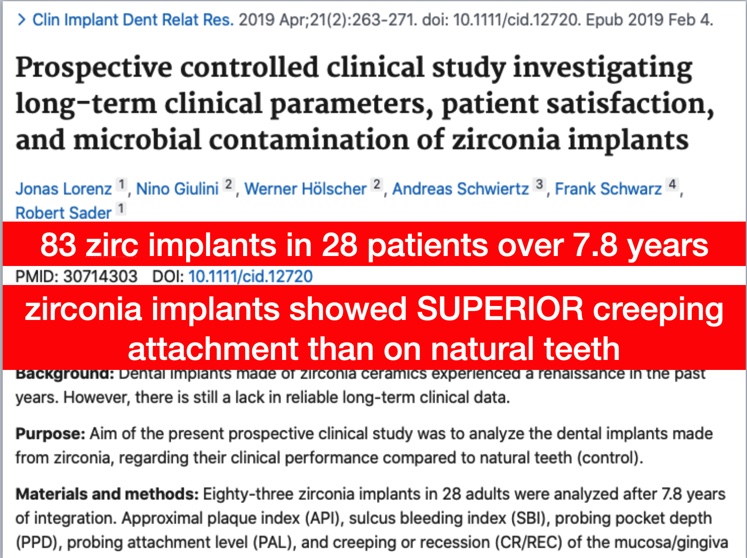
Another clinical study evaluated 83 zirconia implants in 28 patients after an average of 7.8 years. The researchers reported 100% implant survival in that group, although one implant had severe peri-implantitis. They also observed favorable results involving plaque accumulation and soft-tissue recession compared with natural teeth. [6]. That last detail matters. An implant surviving didn't mean every implant was free from disease. One of those implants had significant inflammation despite remaining in place. It's important to understand that distinction.
Why I Prefer One-Piece Zirconia Implants
Implant design matters, too. Traditional two-piece implant systems have an implant body placed into bone and a separate abutment that connects to the crown. The junction between those components creates an interface that can experience microscopic movement and, depending on the design and conditions, may allow bacterial leakage.
One-piece ceramic implants are different. With the one-piece systems I prefer, the implant body and abutment form a continuous structure. There's no separate implant-abutment connection, so we eliminate that particular junction and its associated microgap. A 2024 review examined the advantages and limitations of one-piece and two-piece ceramic implants, including their designs, clinical outcomes, restoration requirements, and potential complications. [7]
For me, reducing unnecessary component interfaces is an attractive feature of one-piece systems. But there's a practical reality that's important. One-piece implants require extremely thoughtful surgical positioning because we can't simply replace or reposition a separate abutment afterward. Crown placement must also be carefully managed, including preventing excess cement from remaining around the implant.
And although zirconia is strong, it's still possible for an implant to fracture when subjected to excessive mechanical forces. I want you to understand that I have seen titanium implants fracture due to excessive forces too. One of my patients 25 years ago before I was even biological managed to break 4 titanium implants. No joke. This was a lady who had also managed to fracture all of her teeth from the force of her clenching. This was before I understood anything about airway. Looking back, I am absolutely convinced that this poor lady had a very bad airway and it caused a great deal of health issues for her.
Researchers analyzing 16 fractured zirconia implants identified bending overload as a major factor contributing to the failures. [8]. That's one reason I believe implant planning must consider the patient's bite, airway, muscle activity, and any orthodontic treatment that may be needed. We'll explore that in much greater detail in the companion article about implants under load.
What I've Observed in My Own Practice
One of the things I've noticed clinically is how bone sometimes appears to develop or maintain remarkably favorable contours around zirconia implants. I've even seen what appears radiographically to be bone creeping upward along the implant after the restoration has been completed. I noticed that bone seems to LIKE zirconia. It creeps up onto the zirconia implants when they are well done, sometimes making my life interesting when I'm trying to restore because a margin that was previously adequately 3 mm away from the bone ends up closer to the bone because the bone has creeped up. I restore as usual, but I watch those cases closely for inflammation due to the potential for biologic width issues. So far, the tissues have done very well.
Of course, bone isn't making a conscious decision about which material it prefers. What we're observing is the behavior of living bone as it remodels in response to its environment. My observations don't establish that zirconia causes bone to grow upward, and an X-ray alone can't explain every biological process occurring at an implant surface. But those experiences are part of why I've become so interested in the interaction between implant materials and living tissue. And I believe the differences identified in immunological and clinical research deserve continued investigation.
Why I Still Believe in Individual Compatibility Testing
Now we get to something that I feel very strongly about. Conventional dentists believe that every implant is compatible with everyone. They don't even think about biocompatibility. Some biological dentists believe zirconia is compatible with virtually everyone. I disagree, but I also realize everything is about perspective.
I believe the purpose of individualized care is to recognize that each patient brings a different biological history into the treatment room. In my practice, we routinely use EAV, or Electroacupuncture According to Voll, as part of our material compatibility assessments. This is an electrodermal testing method that we use to help guide our clinical material selections.
When a patient has mast cell activation syndrome or mast cell activation disorder, and the materials we're evaluating aren't producing favorable EAV findings, we may also recommend testing through BioComp Laboratories. BioComp evaluates serum reactivity to components found in dental materials. It's a different type of assessment from EAV.
Most biological dental offices don't have access to the same EAV equipment I use. Among my vetted biological colleagues who offer compatibility testing, BioComp is a commonly used option. I want to be careful about what these findings mean. An unfavorable compatibility result doesn't automatically establish that a patient has a medically diagnosed allergy. Neither EAV nor serum reactivity testing has been established as a reliable way to predict whether a particular dental implant will cause systemic disease or fail years later.
I use compatibility assessments as part of my precautionary clinical decision-making, together with the patient's history, material composition, treatment needs, and other relevant information. I have personal experience that my patients tend to do better when we follow our compatibility testing results. We have fewer post op complications. That is only my personal experience. The reason I value individualized assessment is simple: I don't want to assume that one material is appropriate for every single person.
What About My Clinical Observations?
Over the years, my colleagues and I have observed that zirconia generally produces more favorable compatibility findings than titanium in the testing methods we've used. I've sometimes described the pattern I've noticed about my own patients as approximately 97% favorable for zirconia and approximately 97% unfavorable for titanium. The other 3% are don't test compatible with either material. Those figures are observational estimates developed through clinical experience and conversations with colleagues. They aren't the results of a formal, systematically counted study. I don't want anyone to mistake them for scientifically established population rates. They also don't mean that 97% of people have a diagnosed titanium allergy.
What those observations have done is reinforce my desire to consider material selection individually rather than automatically assuming compatibility. And while my colleagues may feel comfortable regarding zirconia as universally compatible, I'm not willing to make that assumption. We're dealing with individual human beings, each with their own medical history, environmental exposures, immune responses, and personal priorities. Why would I expect every body to respond identically? Did I mention we aren't cookie cutters? I mean it.
Why Titanium Raises Additional Questions for Me
One of my biggest concerns about titanium implants is what happens to the metal after it's been placed inside the human body. Titanium oxidizes. That oxidation produces a layer of titanium dioxide on its surface, which is frequently presented as evidence that titanium is resistant to corrosion. But that layer isn't indestructible, and the conditions inside the human mouth can interfere with its stability.
Account required
Sign in to see more
Create an account or sign in to unlock the full list.