Resource Libraries
Stainless Steel vs Zirconia Crowns for Baby Teeth
Why baby teeth need crowns, how stainless steel crowns with nickel compare with metal-free zirconia, and how airway, ties and biocompatibility shape outcomes.
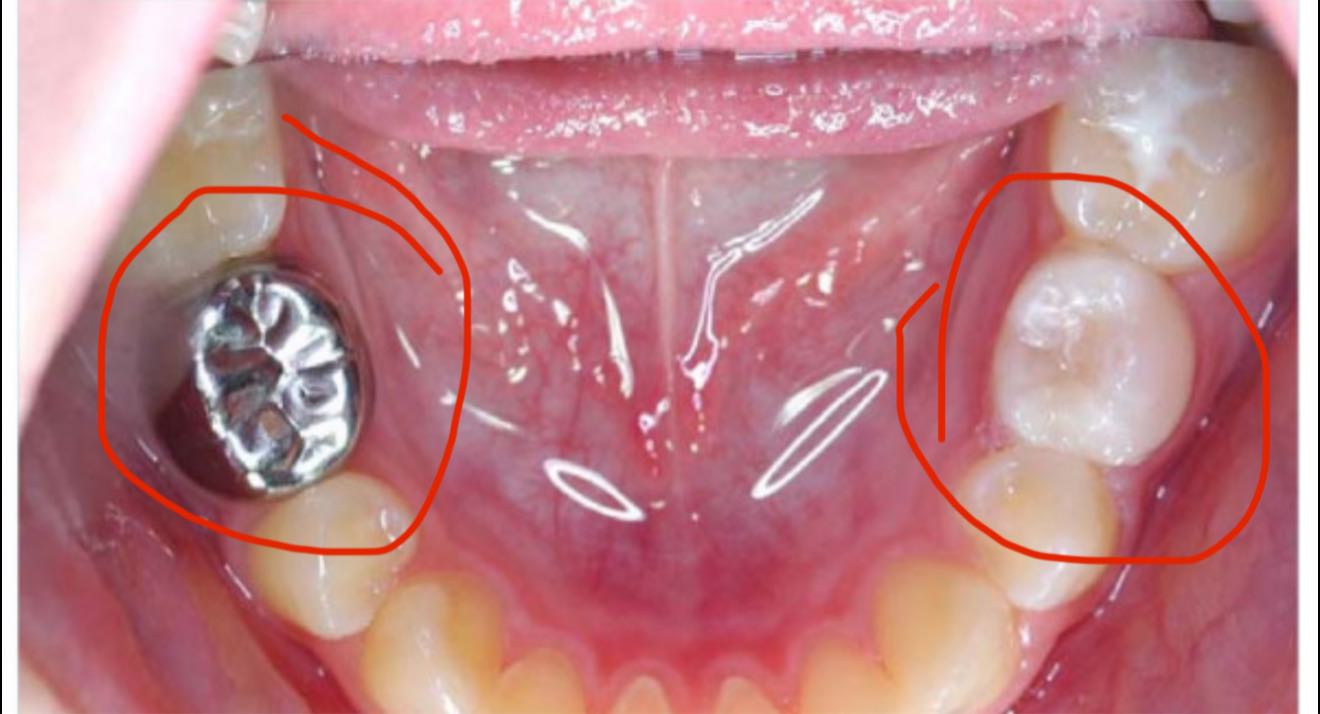
Understanding Children’s Dentistry Through a Biological Lens
I want to preface this by saying that I am not a pediatric dentist. I am a true family practitioner. I see babies all the way from birth on up, children, teens, special-needs children and special needs and normal adults, and senior citizens. The youngest child I’ve ever seen was two days old, and the oldest adult I’ve ever seen was 98 years old. So every thing that I discussed in this group is from the perspective of a family practitioner.
Some of the most common questions we get on our group are about children’s decay and children’s dentistry. People come on here desperate to try to reverse decay that is far beyond the enamel and far past the point where it can be reversed/re-mineralized. So many parents have been gaslighted by their dentists, who shake their fingers at the parent telling them that they are at fault because they did not give the child enough fluoride. I want to be clear that fluoride is not the answer.
Fluoride is a neurotoxin, and it has been shown in multiple pub med studies to lower the IQ in children. There are a couple of posts within this platform where I’ve discussed the science on fluoride neurotoxicity extensively. So it’s really important to not poison our children with fluoride. I’ve been a dentist for 30 years. I promise that the rate of decay in my patients did not rise or fall when I became a Biological Dentist and stopped using fluoride. In fact, it was identical. This tells me that using fluoride was not the solution to decay, nor was the lack of fluoride the cause of decay. What I have found in my Airway journey is that as we improved children’s airways, their rate of decay decreased dramatically.
That’s a wonderful finding, but it also means that the root cause of decay is definitely not a lack of fluoride. That being said, we need to deal with the decay that’s happening as a result of the root cause issue, which is the inadequate airway. 
One of the issues that comes up often is why a dentist would want to put a crown on a baby tooth instead of a filling. So that’s the first thing I’m going to address:
Why Bonding to Primary Teeth Is More Challenging:
1. Different Enamel Structure
• Baby teeth have thinner and less mineralized enamel than adult teeth.
• This makes it harder for bonding agents (the “glue” used to attach fillings to the tooth) to get a strong grip.
• Enamel on baby teeth is also smoother and more uniform, so it doesn’t etch (roughen) as well for bonding.
2. Larger Pulp Chambers
• The nerve (pulp) inside baby teeth takes up more space than in adult teeth.
• This means there’s less room for safe drilling and shaping, so dentists must be extra careful not to hit the nerve.
• That can limit how much bonding surface area is available and compromise how well the filling stays in.
3. More Moisture in the Mouth
• Young children have a hard time staying still and keeping their mouths dry.
• Moisture contamination during a filling makes it difficult for the materials to bond securely.
• Even a small amount of saliva can cause the bond to fail.
4. Tooth Flexibility
• Primary teeth are a bit softer and more flexible than adult teeth.
• This micro-movement can eventually weaken the bond between the tooth and the filling material.
5. Behavioral Challenges
• Kids may not tolerate long procedures or might move during treatment.
• This can lead to less precise bonding or insufficient curing (hardening) of the materials, reducing the strength of the seal.
From a Holistic Perspective:
This leads many holistic dentists to:
-
Use biocompatible materials only (e.g., BPA-free composites).
-
Prioritize non-invasive or minimally invasive treatments, like silver diamine fluoride (SDF) or silver nitrate, ozone therapy, or remineralization, when possible.
-
I will tell you that I’m not a fan of ozone therapy on young children’s teeth, because it is so hard to get them to not breathe it in. Ozone is a fantastic tool in disinfecting, preps, etc., but it must not be breathed into the lungs. Our lungs are meant to breathe a very specific combination of oxygen, carbon dioxide, and nitrogen. Anything other than that combination will cause irritation for the lungs. Since children having much harder time controlling their breath, breathing, ozone use on them is limited
-
Recommend crowns over fillings when bonding is too weak to protect the tooth long term, especially in large cavities, multiple surfaces, or after pulp therapy. So for example, if a tooth has decay on both of the between the teeth areas (the technical terms are mesial and distal), and on top of it if a child is a grinder, we are much more likely to recommend a crown. Most of us have been down this road with children for many years. We know what works and what doesn’t work. And we’re trying to help your children as efficiently and effectively as possible.
Bottom Line:
Fillings tend to fall out more easily in baby teeth because:
• The structure and chemistry of baby teeth don’t bond well to materials.
• Moisture, behavior, and biological differences make bonding harder.
• Children’s airways are inadequate and the tooth grinding causes fillings to get loose or fall out much easier than with adult teeth.
For this particular resource post, though, based on the sheer number of times people ask the same questions, I figured it was time to make a post specifically dedicated to pediatric crowns in particular. With that in mind, I’ve put together a comparison between stainless steel crowns and zirconia crowns, listing the risks, benefits, pros, cons, and consequences of each option.
Understanding when a crown is needed for a baby tooth (also called a primary tooth) helps you feel more confident in your child’s dental care decisions, especially from a holistic perspective.
Indications for Placing a Crown on a Baby Tooth:
Dentists generally recommend a crown, rather than a simple filling, when the tooth has too much damage or decay for a filling to stay secure and effective.
Here are the most common reasons a dentist might choose to place a crown:
1. Extensive Decay
• If the cavity covers multiple surfaces of the tooth or if the decay has weakened the tooth structure too much, a filling may not hold up well.
• Bonding does not generally work well on primary teeth.
• A crown provides full coverage and protection, helping to preserve the tooth until it naturally falls out.
2. After a Baby Root Canal (Pulpotomy or Pulpectomy)
• If the decay reaches the nerve (pulp) of the tooth, a dentist might perform a baby root canal and then place a crown to seal and protect the tooth.
• Crowns are standard after these procedures because the tooth becomes more fragile.
3. Worn baby teeth due to child grinding, an underlying airway inadequacy
• A crown can protect and restore a broken baby tooth, especially if it’s a molar that’s still needed for chewing and space-holding.
4. Developmental Defects
• Some children have weaker enamel due to enamel hypoplasia or other developmental issues. A crown helps protect these teeth from breaking or decaying.
5. Large Fillings That Are Likely to Fail
Account required
Sign in to see more
Create an account or sign in to unlock the full list.