Resource Libraries
Should I Get My Amalgam Fillings Removed?
Whether everyone with amalgam should have it removed, who benefits most, when removal can do more harm than good, and how to weigh your own exposure history.
Part 12 of 12 in the Mercury Series
Should Everyone With Amalgam Have It Removed?
Part 12 of the Mercury Amalgam Series
After eleven articles about mercury amalgam, this is probably the question everybody has been waiting for: If amalgam releases mercury, should everybody who has it get it removed?
My answer isn’t quite: “YES. Rip every filling out immediately.”
It’s also definitely not: “No. If the filling looks intact, just forget there’s mercury in it.”
Neither one of those answers respects the science we’ve spent this entire series discussing. The real answer is more complicated because there are actually TWO separate questions hiding inside this one.
The first is: Should we still be putting NEW mercury amalgam into people? For me, that answer is incredibly easy. NO.
The second question is: What should we do about amalgam that’s ALREADY in somebody’s mouth? That’s where timing, health, restoration condition, total mercury exposure, and the method of removal all matter.
A Quick Note About the Reference Numbers
Just like the rest of this series, the regular reference numbers—such as [20] or [94]—match the numbers in the complete master mercury article. So reference [94] here is exactly the same reference [94] there. The numbers are going to skip because we’re only using the studies that apply to THIS discussion. I haven’t forgotten how to count after twelve articles. At the bottom, I’ll give you the complete citation and direct link for every reference used here.
Let’s Separate the Two Questions
I think a LOT of confusion happens because these two completely different clinical questions get mashed together:
Should we keep placing mercury amalgam?
and
Should everybody who already has amalgam have all of it removed right now?
Those are not the same question. I don’t place new amalgam. I haven't placed an amalgam since I got out of dental school. I haven’t seen a scientific reason that would make me want to intentionally introduce another source of elemental-mercury exposure into somebody’s body when we have other restorative options available.
Dental amalgam is approximately 50% elemental mercury by weight. [1] It releases mercury vapor. Greater amalgam burden is generally associated with greater measurable inorganic mercury in blood or urine. [20,21] And people do not all absorb, distribute, retain, and eliminate mercury identically. [83]
So if I can restore a tooth without intentionally placing another mercury-containing restoration, I’m going to do that. That part really isn’t complicated for me.
But Existing Amalgam Is a Different Clinical Problem
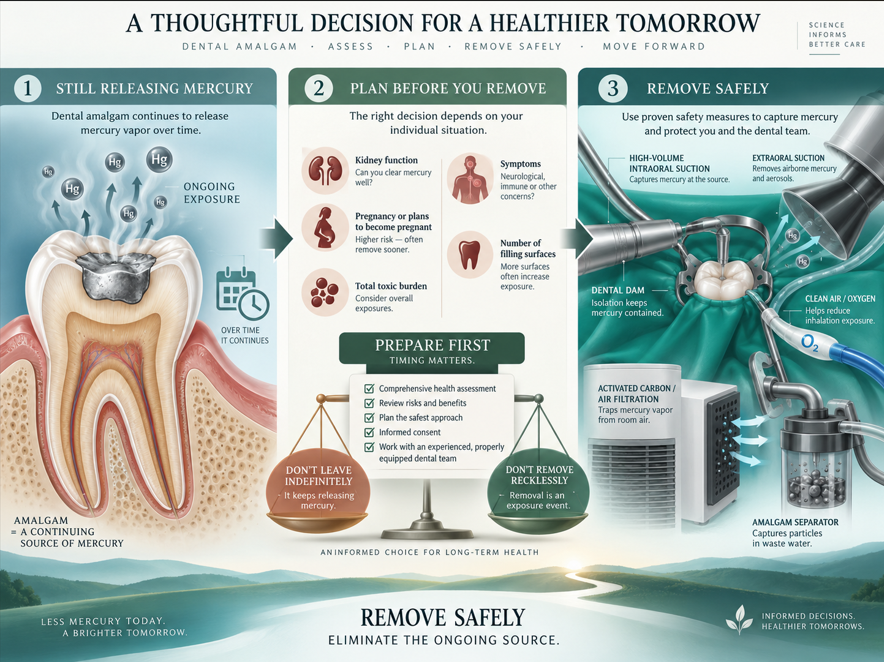
Once the amalgam is already in the tooth, the risk-benefit calculation changes. Why? Because removing it is itself a mercury exposure event. We spent all of Part 10 talking about this.
- High-speed removal generates respirable particulate. [91]
- Water and high-volume suction dramatically reduce mercury vapor during cutting. [92]
- Removed particles can continue releasing mercury vapor AFTER the filling has been drilled out. [93]
- Human studies have shown substantial temporary increases in mercury biomarkers after removal. [94,95]
- And the technique used during removal makes a measurable difference. [92,95,96]
So:
“I don’t want mercury in my mouth” does NOT automatically translate into: “I should have every filling drilled out tomorrow.” That would ignore half of the toxicology problem.
Existing Amalgam Is an Ongoing Exposure
This is where I want to be VERY clear about my position. If somebody already has amalgam in their mouth, I don’t think the answer is: “Well, it looks clinically intact, so just leave it there forever.” Clinically intact does NOT mean biologically inert. It simply means the restoration isn’t visibly fractured, leaking, or decayed. The mercury is still there.
And as we’ve already established throughout this series, amalgam continues releasing mercury vapor over time. That release can increase with chewing, brushing, heat, polishing, grinding, and other mechanical activity.
So for me, the long-term goal is still: Get the amalgam out. The real question is: WHEN and HOW do we do that in the safest way possible?
That’s very different from saying every person should panic and schedule all of their fillings for removal next Tuesday. Removal itself is an exposure event. So I don’t want to trade a chronic ongoing exposure for a poorly controlled acute exposure.
- I want the patient prepared.
- I want their health and elimination physiology considered.
- I want a physician involved first if they’re medically complicated or already symptomatic.
- I want the timing to make sense.
- And I want the amalgam removed using a comprehensive mercury-safe protocol.
For some patients, that may mean removing several restorations relatively soon. For others, it may mean stabilizing their health first and then removing the amalgams in stages.
Pregnancy, breastfeeding, significant medical instability, kidney dysfunction, severe constipation, nutritional depletion, or other major physiologic stressors may change the timing.
But those things change the timing. They don’t turn mercury amalgam into something I suddenly think should stay in the mouth permanently. That’s the distinction.
I don’t advocate indefinite retention of mercury amalgam. I advocate planned removal instead of panicked removal.
Because keeping the amalgam means continuing the exposure. Removing it means creating a temporary exposure event. So the goal is to prepare the patient, reduce the removal exposure as much as reasonably possible, and then eliminate the ongoing source.
I Also Care About What Happens to Those Fillings Every Day
We established earlier in this series that mercury release isn’t constant. It gets WORSE with certain things. Mechanical and thermal activity can change it.
- Chewing.
- Brushing.
- Grinding and clenching.
- Heat
- Polishing.
- Dental procedures.
So somebody with two tiny amalgams who barely touches them isn’t necessarily living with the same exposure pattern as somebody with twenty surfaces who is an aggressive bruxer.
Again: We aren’t cookie cutters.
The Patient’s Health Matters Just as Much as the Filling
This is the point I keep coming back to through this entire series. A population average is useful. It's NOT a guarantee of what happens inside one particular human being.
One person may have:
- two small amalgams,
- good kidney function,
- no major competing toxicant exposures,
- good nutritional status,
- no symptoms they’re concerned about,
- and no reason to rush.
Another person may have:
- fifteen or twenty amalgam surfaces,
- decades of exposure,
- occupational mercury exposure,
- kidney problems,
- significant constipation,
- nutritional depletion,
- other toxicant burdens,
- and several restorations that are already failing.
Those are not the same patient.
The better question is: “What is THIS person’s total exposure, susceptibility, current health, restorative need, and ability to tolerate the removal process?” That’s a much more useful question.
Genetics Matter, but They Don’t Give Us a Crystal Ball
Human research has found that genetic differences involving glutathione-related pathways can affect mercury retention and biomarker patterns. [83] That matters. But I don’t want somebody running a genetic panel, finding one SNP highlighted in red, and deciding: “Welp. I am apparently genetically incapable of handling mercury.” It's not that simple.
- Genetics are one piece.
- Kidney function is another.
- Nutrition is another.
- Exposure history matters.
- Bowel and biliary function matter.
- Other illnesses matter.
- Other toxicants matter.
- And there are probably susceptibility factors we haven’t even identified yet.
Which is precisely why I don’t believe: “The average person did fine” is enough information to guarantee what will happen to EVERY individual. You've heard or seen me say in other articles or webinars that my goal for society is always to protect the weakest members, because when we do that, we automatically protect EVERY member of society. I don't plan to averages. I plan to ensure ALL people are protected.
Symptomatic Patients Need an Even More Thoughtful Plan
If somebody already has symptoms that may be consistent with mercury toxicity, significant toxicant exposure, or a complicated medical history, I want their physician involved BEFORE elective removal. We covered this in Part 11.
My preference is for those patients to work with a functional-medicine physician who is genuinely experienced with heavy-metal toxicology, detoxification, and chelation.
Because removal itself creates another potentially significant exposure that can send a person toppling over the edge with their health. And it's simply unacceptable to do that if we can put systems in place that minimize and mitigate exposure.
So the person who is already struggling is exactly the person I DON’T want flying solo with a supplement list from Facebook and a dental appointment scheduled for next Thursday. Preparation belongs before the exposure.
Pregnancy Is a Perfect Example of Why Timing Matters
If somebody becomes pregnant and suddenly discovers that dental amalgam contains mercury, I do NOT want panic to drive the treatment plan. The FDA advises against removing intact amalgam solely for disease prevention during pregnancy or breastfeeding unless there’s a clinical reason to replace it. [1] And the thing is, the FDA doesn't advocate actively for SMART or PROTECT protocols during removal, and even THEY are saying "don't do it"! And that makes sense to me.
The filling didn’t become biologically inert because the patient became pregnant. But removal creates a significant mercury exposure too. So if an intact restoration doesn’t clinically need treatment, pregnancy generally isn’t the time I want to create an elective removal exposure.
Timing matters.
If the filling fractures, develops decay, or creates another genuine dental problem, that becomes a different conversation. But even then, we are doing what we can to minimize exposure. I wrote an article on orabiologics specific to pregnancy, and here is the link. https://orabiologics.com/resource-library/pregnancy-breastfeeding-and-mercury-removal-what-must-not-be-done
But: “I learned mercury is toxic, therefore all of my fillings must come out during pregnancy” is not a conclusion I support.
What If the Only Dentist Available Removes Amalgam Conventionally?
This matters more than people realize. If a patient has an intact amalgam and the only removal option available is:
- high-speed pulverization,
- ordinary suction,
- no sealed dental dam,
- no separate clean breathing source,
- no mercury-capable extraoral capture,
- no mercury-vapor filtration,
- and no proper respiratory protection for the team,
I don’t consider that an equivalent choice. The method of removal is PART of the risk-benefit decision. We have direct evidence that water, suction, dam isolation, and chunk-removal strategies reduce different components of mercury exposure. [92,95,96] So for an elective case, I would rather somebody take the time to find the right clinician than rush into a removal technique that creates avoidable exposure.
And No, I Don’t Want Twelve Fillings Ripped Out in a Panic
I'm not a proponent of fear-based dentistry. I don’t want someone to read this series, stare at their fillings in the mirror, and decide: “GOOD LORD. I NEED ALL OF THESE OUT TOMORROW.”
That's not the point of these articles. Mercury is toxic. Amalgam releases mercury. I don’t place it. And none of those statements requires me to terrify somebody who already has it.
For some patients, removing several restorations gradually and safely may make the most sense. For another patient, the best decision TODAY may be:
- monitor the intact restoration,
- improve overall health,
- correct meaningful deficiencies,
- work on elimination,
- find the right mercury-safe dentist,
- and make a plan.
That isn’t doing nothing. It's SMART planning... pun intended....
It's making a medical and dental decision instead of reacting out of fear.
Once the Source Is Gone, Mercury Biomarkers Generally Fall
There is one piece of this discussion that I do think gives people useful long-term context. When amalgam is removed, the ongoing mercury source is gone. A longitudinal Canadian study found that people with amalgam had approximately twice the urinary mercury of people who’d never had amalgam. After removal, urinary mercury fell to levels similar to the never-amalgam group. [104]
A Norwegian study also found significant reductions in serum inorganic mercury one year after complete amalgam removal. [105]
So removal can reduce ongoing inorganic-mercury exposure. That's real. But as we established in Parts 10 and 11, falling blood or urinary mercury doesn’t mean every tissue becomes mercury-free on exactly the same timetable.
Again: Removing the source and clearing every bit of retained mercury from the body are not the same biological event.
What Should Replace the Amalgam?
That’s an important question. It is also an entirely separate article. Because “Mercury-free” doesn't automatically mean biologically perfect.
Account required
Sign in to see more
Create an account or sign in to unlock the full list.