Resource Libraries
Safe Amalgam Removal Protocol: Why the Method Matters
Why removing amalgam is a mercury exposure event, how drilling without protection can spike blood mercury, and which SMART and PROTECT steps lower the dose.
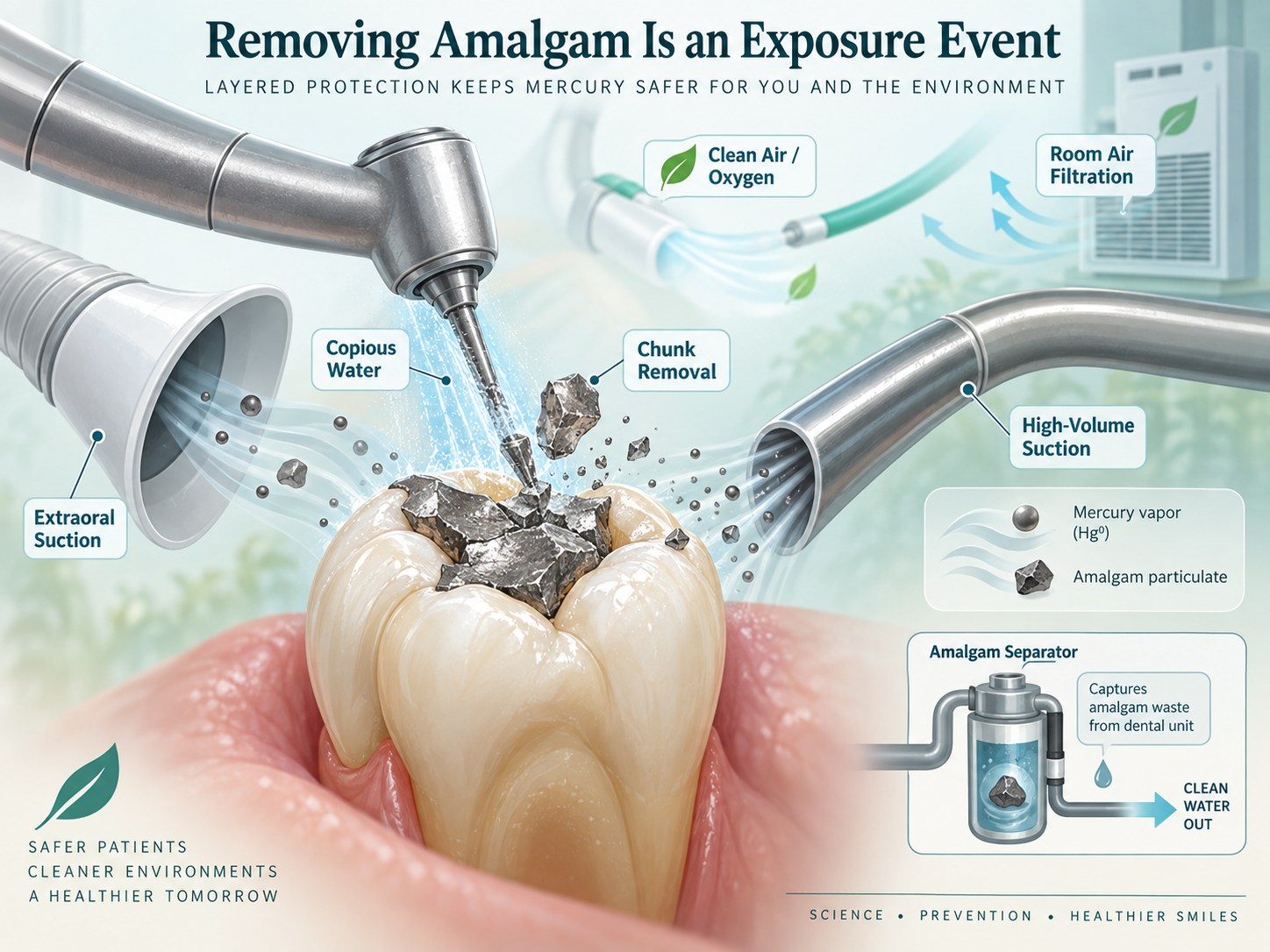
Part 10 of 12 in the Mercury Series
Removing Amalgam Is an Exposure Event: Why the Method Matters
Part 10 of the Mercury Amalgam Series
We’ve spent nine articles establishing that mercury does not stay permanently locked inside a hardened amalgam filling. So it should surprise absolutely no one that putting a high-speed dental bur through a restoration that is approximately 50% elemental mercury creates a very different exposure than simply leaving that filling sitting in the tooth.
Removing amalgam is an exposure event.
A handpiece cutting through amalgam creates:
heat, mercury vapor, aerosol, contaminated water, large fragments, and respirable mercury-containing particulate.
And once some of that mercury gets into the patient—or the dental team—it does not simply sit in the bloodstream waiting politely to leave through the kidneys.
Some is excreted. Some distributes through the body. Some may be retained in tissues much longer. That is why HOW amalgam is removed matters so much.
A Quick Note About the Reference Numbers
Just like the other articles in this series, references shown with regular numbers—such as [91] or [96]—use the exact same numbers as the complete master mercury article. So reference [91] here is reference [91] there. That means the numbers may skip. I haven’t lost the missing references, and yes, ten articles in, I still know how to count. They support other parts of the mercury story.
You’ll also see references beginning with an A, such as [A1]. Those are additional studies I added specifically while expanding this shorter article. At the end, I’ll give you the complete citation and direct link for every reference used here.
High-Speed Removal Produces Respirable Particulate
As far back as 1990, researchers were measuring particulate created during amalgam removal. [91]. High-speed drilling produced particles small enough to be fully respirable, meaning they were capable of traveling deep into the respiratory tract. Researchers then changed the technique. Water spray and high-volume evacuation significantly reduced the particulate reaching the patient. Adding a rubber dam reduced patient exposure even further.
But the simulated dentist was still exposed to respirable particulate. [91]. That is our first important lesson: Protecting the patient does not automatically protect the dentist or assistant standing directly over the procedure.
We need exposure controls for both.
Water and Suction Dramatically Change Mercury Vapor
A 2013 experiment measured mercury vapor during amalgam removal under different conditions. [92]. With: water spray + suction mercury vapor averaged approximately: 8 μg/m³. With suction but NO water? 141 μg/m³. With neither water nor suction? 214 μg/m³. [92]. That is not a small difference.
Water cools the amalgam while it is being cut, reducing heat-driven mercury volatilization. High-volume suction captures contamination close to the point where it is being generated. So when mercury-safe dentists insist on copious water and high-volume evacuation, that isn't protocol theater. We can actually measure the difference.
The Particles Keep Releasing Mercury After the Drilling Stops
A 2019 study collected amalgam particulate during actual patient removals and then measured the mercury vapor coming from those particles. [93]. They continued producing substantial mercury vapor for more than an hour after removal. Some larger samples remained above occupational ceiling values used for comparison for several hours.
And these procedures were already using extensive exposure controls. [93]. That means a tiny piece of amalgam sitting on:
- a gown,
- a glove,
- a face shield,
- an instrument,
- the floor,
- a suction component,
- or some other surface
can continue releasing mercury vapor after the tooth has been restored and the patient has left. The exposure-control problem therefore does not end when the bur stops spinning.
Human Biomarkers Show the Removal Exposure Too
One study followed ten people who had all of their amalgam restorations removed during one appointment. [94]. Before removal, their median fecal mercury concentration was: 2.7 μmol/kg. Two days later? 280 μmol/kg.
That's more than a 100-fold increase. Plasma mercury also increased temporarily. [94]. Then those measured concentrations began falling. Another study found that rubber-dam isolation reduced the patient’s immediate mercury response. Twenty-eight people had all amalgams removed using water cooling and high-volume evacuation; 18 also had rubber dam isolation. Only the group without the dam showed significant increases in both plasma and urinary mercury after removal. [95]. One year later, mercury levels were substantially below the patients’ original baselines.
So removal creates an acute exposure. Eliminating the restoration also eliminates an ongoing source. Both are true. But there is another part of this story that is extremely important: falling blood or urinary mercury doesn't necessarily mean every bit of absorbed mercury has left the body.
Excretion Is Not the Same Thing as Whole-Body Clearance
If mercury comes out in urine or feces, that mercury is OUT. Excellent. But that doesn't mean the entire absorbed dose followed it. Controlled human mercury-vapor research makes that very clear. Nine healthy volunteers without amalgam fillings inhaled a carefully measured dose of elemental mercury vapor. [A6]. The median amount retained after inhalation was approximately: 69%.
During the first three days, only about 1% of the absorbed dose appeared in urine. Even after 30 days, estimated urinary elimination varied enormously between individuals—from approximately 8% to 40% of the absorbed dose. [A6]. Same general exposure. Different bodies. Very different elimination.
Mercury that isn't being excreted doesn't simply remain floating indefinitely in blood. It distributes. Elemental mercury can cross biological membranes, including the blood-brain barrier. Once inside tissues, much of it is oxidized to inorganic mercury, a form that does not move across membranes as easily as elemental mercury did on the way in.
Human autopsy studies have measured mercury in the: brain, pituitary, thyroid, muscle, kidneys, and other tissues. [28]. And a systematic review of inorganic mercury retention concluded that mercury retained in the human brain may remain there for years to decades. [30]
So when somebody’s urinary mercury falls after removal, the scientifically accurate interpretation is: Less mercury is being excreted in the urine now. That's useful information. It's not proof that the whole body is mercury-free.
What People Call a “Poor Detoxer” Is Really Mercury Kinetics
People use the phrase poor detoxer a lot. I understand what they are trying to describe, because I am a poor detoxer. My genetics all by itself makes it so that I may only eliminate about 20% of what a normal detoxer can. It works in reverse for me too. I only absorb about 20% of the vital nutrients like the B vitamins that a normal person can. Yay me! But really what is going on with me is genetically poor kinetics. Meaning things simply don't have the ability to move the nutrients or eliminate the toxins that others do.
Some people clearly absorb, retain, distribute, and eliminate mercury differently from others. But there is not one magical “detox pathway” that is simply open or closed. Mercury handling involves:
- kidney function
- liver and biliary elimination,
- gastrointestinal excretion,
- glutathione chemistry,
- selenium biology,
- nutrition,
- genetics,
- and other physiologic factors.
Human genetic research has shown that variants affecting glutathione production can alter inorganic-mercury retention and elimination. [83]. So two people can experience similar exposures and produce very different biological curves afterward. This is also why the person with the lowest urinary mercury is not automatically the person with the lowest tissue burden.
Urine is an exit measurement. It measures what is being excreted through that route at that moment.
The Post-Removal Kinetics Continue for MONTHS
The longer removal studies make this especially clear. Twelve people were followed for as long as 115 days after all of their amalgams were removed. [A1]. Blood and plasma mercury increased during the first 48 hours. By 60 days, blood, plasma, and urinary mercury were approximately 60% of their original pre-removal values.
But the calculated median half-lives were approximately: 88 days in plasma and 46 days in urine. [A1]
Another study did not find a statistically significant reduction in urinary mercury excretion until approximately 100 days after removal. [A2]. A third followed people for as long as 14 months and calculated an average urinary mercury half-life of approximately 95 days. Urinary mercury initially increased after removal, then fell approximately fivefold over the following year. [A3]
Another study found plasma mercury increased approximately three- to fourfold immediately after removal, while urinary and red-cell mercury rose about 50%. The acute peaks approached pre-removal levels after about one month, and at 12 months plasma and urinary mercury were substantially below the original baseline. [A4]
So the acute exposure may occur over hours or days. The kinetics continue for weeks to months to even years and decades. And mercury retained in slowly exchanging tissues may persist far longer. That is the biological reason I care so much about minimizing the dose created during removal.
Mercury that never enters the body is mercury the patient never has to excrete, redistribute, retain, or eventually mobilize again.
This Is Why Chunk Removal Matters
A 2021 study compared different amalgam-removal conditions. [96]. The investigators found that:
- cutting restorations into larger fragments,
- using cooling water, and
- using intraoral suction
all reduced mercury remaining in the mouth and drainage system. That is exactly the logic behind: Chunk it. Don’t pulverize it. Every unnecessary second of drilling means more heat and more particulate. I want to make as few cuts as possible, section the restoration, and remove large pieces.
SMART and PROTECT Are Layered Exposure-Control Systems
SMART is the Safe Mercury Amalgam Removal Technique developed by the International Academy of Oral Medicine and Toxicology. [97]. PROTECT is the mercury-safe removal protocol developed by the International Academy of Biological Dentistry and Medicine. [98].
They aren't identical protocols. But they're built around the same basic principle: No single control blocks every mercury exposure pathway. That means we need layers.
The Dental Dam Has a Job—but It Does Not Protect the Airway
A properly sealed dental dam helps isolate oral tissues from contaminated water and debris and reduces the chance that the patient will swallow amalgam fragments. And we have direct human evidence that rubber-dam use can reduce the patient’s immediate plasma-mercury increase during removal. [95]. But the patient’s nose is still directly above the operating field. The dam is not an airtight respiratory barrier.
That is why SMART and PROTECT include a separate breathing supply using clean external air or oxygen through a nasal interface. [97,98] Oxygen is not detoxifying mercury. It is not neutralizing mercury. Its job is much simpler: Give the patient something clean to breathe instead of the contaminated air surrounding the tooth.
Capture It at the Tooth First
The first major capture layer is high-volume intraoral evacuation directly at the tooth. We want to capture:
- water,
- large amalgam pieces,
- fine particulate,
- aerosol,
- and as much mercury vapor as possible
- before those contaminants disperse.
- Extraoral source capture then adds another layer for what escapes the immediate intraoral field. [97,98].
But the equipment matters.
HEPA and Mercury-Vapor Filtration Are NOT the Same Thing
This distinction may be one of the most important practical lessons in the entire article. Amalgam removal creates mercury-containing particulate and elemental mercury vapor. Particulate and gas require different filtration strategies. HEPA filtration is designed for particles. Elemental mercury vapor is a gas. Capturing it requires a medium capable of adsorbing mercury vapor, such as appropriately designed activated carbon, charcoal, or another mercury-specific sorbent. [97,98]. So if someone tells me: “Our extraoral suction has HEPA filtration,” my next question is: What captures the mercury vapor? Because I need both.
Follow the Air After It Goes Into the Machine
My own office uses a DentAirVac during amalgam removal because its current filtration system combines particulate and HEPA filtration with activated carbon intended for vapor control, including mercury vapor. [100]. And no, that is not a paid advertisement. The important lesson is not the brand. It is this: Follow the contaminated air all the way through the machine.
- Where does it go?
- What captures the larger debris?
- What captures fine particulate?
- What captures mercury vapor?
- Where does the filtered air exhaust?
- What happens when the sorbent becomes saturated?
- Who changes the filter?
“Extraoral suction” is not enough information.
Whatever Escapes Source Capture Becomes a Room-Air Problem
No source-capture system catches everything. And because removed amalgam particulate can continue generating mercury vapor after the procedure, room-air management matters AFTER the drilling stops too. [93]. SMART and PROTECT therefore incorporate operatory ventilation or filtration appropriate to mercury exposure. [97,98]. That system needs to address: particulate and vapor. PROTECT also recommends continuing high-volume filtration after removal because escaped particulate can remain a mercury-vapor source. [98]
The Dental Team Needs Real Protection
The dentist and assistant are standing closest to the plume. Part 9 was an entire article about occupational mercury exposure. So protecting the patient while the team inhales whatever escapes makes absolutely no sense.
SMART and PROTECT include:
- protective clothing,
- gloves,
- eye and face protection,
- hair covering,
- respiratory protection. [97,98]
A standard surgical mask is not a mercury-vapor respirator.
Mercury vapor can also be absorbed through skin, although inhalation is the much larger route. In controlled human research, estimated whole-body dermal uptake was approximately 2.2% of lung uptake at the same vapor concentration. [99] So I don’t want to exaggerate skin absorption. But mercury-containing particulate can land on skin, clothing, equipment, and surfaces and continue producing vapor afterward. That contamination needs to be controlled too.
Waste Does Not Stop Being Mercury Because It Went Down the Suction
The amalgam we remove has to go somewhere. A significant portion enters the dental suction system. The 2021 removal study found that amalgam separators substantially reduced mercury released into wastewater. [96]. Both SMART and PROTECT therefore include amalgam separators and specific mercury-waste handling. [97,98]. Then the separator and suction traps themselves become concentrated sources of amalgam waste. Which means the person cleaning them needs protection too. Mercury doesn't become environmentally irrelevant simply because it left the patient's mouth.
Not Every Part of SMART or PROTECT Has the Same Evidence
This is important. Some parts have very direct experimental or human evidence. We can measure:
- water + suction reducing vapor, [92]
- rubber dam reducing immediate systemic exposure, [95]
- chunk removal reducing residual contamination, [96]
- respirable particulate during drilling, [91] and
- continued vapor release from removed debris. [93]
Other elements are supported more by mercury toxicology, industrial hygiene, engineering principles, or reasonable precaution. For example, SMART and PROTECT include oral adsorbents such as activated charcoal or similar agents around removal. [97,98]. I haven't seen a beautiful randomized clinical trial demonstrating that a charcoal rinse changes somebody’s long-term mercury body burden after amalgam removal. So I'm not going to pretend there is one. Accurate science means saying what we know, what exposure science strongly supports, and what is included as a reasonable precaution.
The Complete SMART/PROTECT Biomonitoring Study Is Still Missing
Account required
Sign in to see more
Create an account or sign in to unlock the full list.