Resource Libraries
Can Humans Regrow Teeth? What the Science Actually Shows
Whether humans can regrow teeth, what the 2024 Japanese USAG-1 antibody trial tests, why regrowth after extraction is not here yet, and why caution matters.
Regrowing Human Teeth: What the Science Actually Shows, What We Don’t Know Yet, and Why Caution Still Matters
Tooth loss is one of the few areas of medicine where “replacement” means prosthetics rather than biology. In fact, if you think of it, almost all of dentistry involves some kind of prosthesis. Fillings are prosthetic parts of broken enamel. Crowns are prosthetic replacements for enamel. Implants are prosthetic teeth. So when headlines started circulating in 2024 claiming that human tooth regrowth trials were underway, many people understandably thought: “Finally. We’re regrowing teeth.”
The reality is more interesting — and more limited — than the headlines suggest. Yes, human clinical trials have begun. Yes, animals have successfully regrown teeth. But no, we are not yet regrowing teeth on demand, and especially not after infection or extraction. This article explains what is real, what is experimental, and what still needs to be answered before this becomes a safe, predictable clinical option.
There are currently three distinct scientific pathways being explored for tooth regeneration:
-
Pathway 1: Molecular reactivation of arrested tooth development (USAG-1–based therapies)
-
Pathway 2: Bioengineered whole-tooth organ transplantation (tooth germ / organ germ methods)
-
Pathway 3: Stem-cell–based tissue engineering, including 3D bioprinting approaches
Each pathway is attempting to solve a different biological problem, at a different stage of development, with very different clinical implications.
The Scientific Breakthrough: Targeting USAG-1
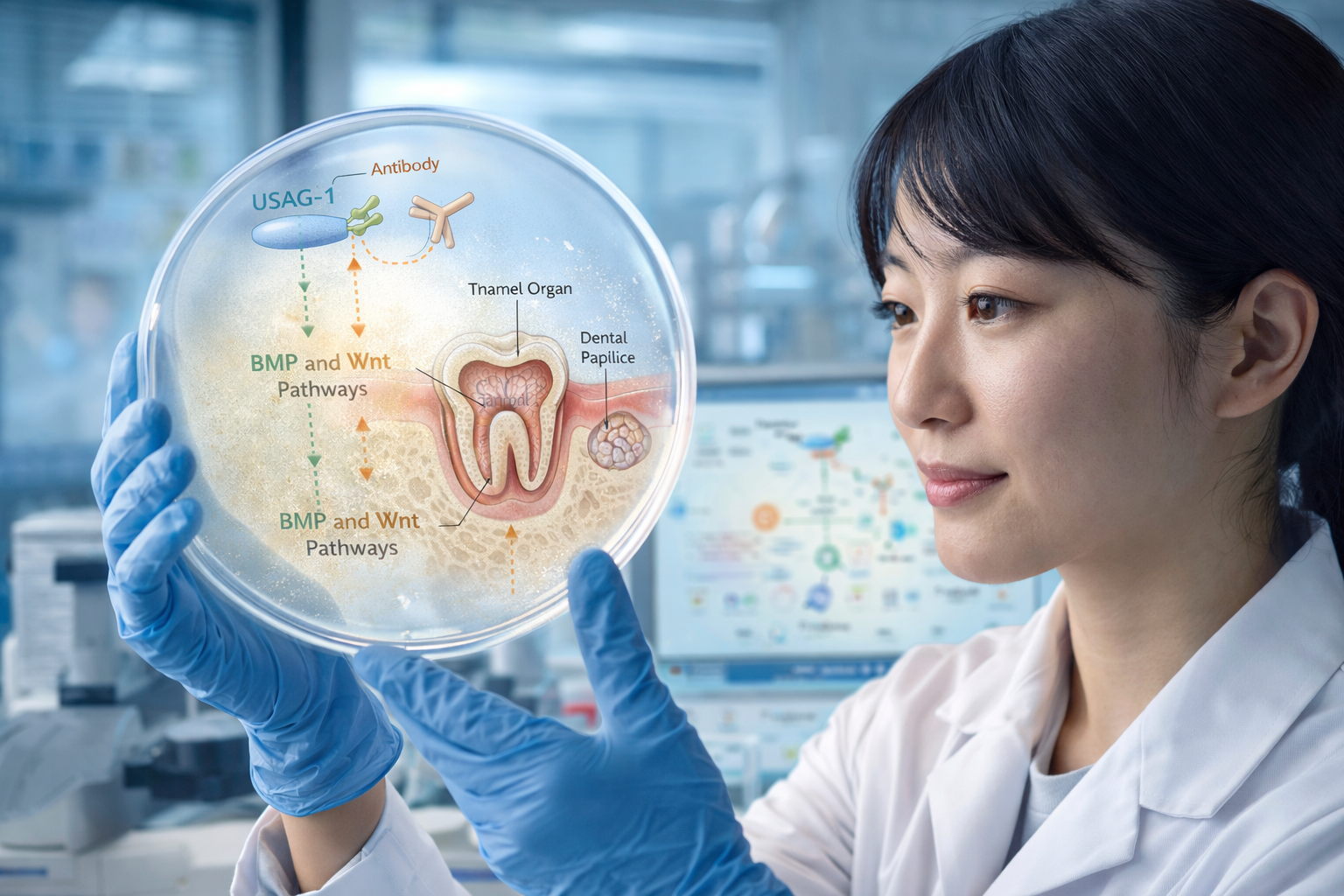
The most advanced approach to tooth regeneration today does not involve stem cell injections, PRF, lasers, or scaffolds. Instead, it targets a developmental regulator called USAG-1 (also known as SOSTDC1). USAG-1 is a protein that acts as a molecular brake on tooth development, primarily by inhibiting two key signaling pathways:
-
BMP (Bone Morphogenetic Protein)
-
Wnt signaling
These pathways are essential during embryologic tooth formation. When USAG-1 activity is high, tooth development can stall or fail entirely.
Key Concept
Rather than trying to “build” a new tooth, this therapy attempts to remove an inhibitory signal, allowing existing but arrested tooth germs to continue developing. That distinction matters.
Proof of Concept: Animal Studies
Murashima-Suginami A, et al.
PMID: 33579703
https://pubmed.ncbi.nlm.nih.gov/33579703
Showed that blocking USAG-1 protein (which normally stops tooth development) with antibodies can rescue missing teeth in mice with genetic tooth defects. The antibody works by enhancing BMP signaling, allowing arrested tooth buds to continue developing into functional teeth.
Main Findings:
-
USAG-1 suppresses tooth development by inhibiting both BMP and Wnt signaling
-
Antibodies selectively blocking USAG-1’s interaction with BMP (while sparing Wnt signaling) allowed arrested tooth buds to resume development
-
Treated mice developed functional teeth corresponding to their genetically programmed tooth type
Crucial detail:
These studies did not create teeth “from scratch.” They rescued developmentally arrested tooth germs that already existed.
Translation to Humans: Early Clinical Trials
Takahashi K, et al.
PMID: 39389160
https://pubmed.ncbi.nlm.nih.gov/39389160
Developed a humanized anti-USAG-1 antibody drug for treating congenital missing teeth (hypodontia and oligodontia). Successfully tested in mice and finalized Phase 1 clinical trial protocols, with human trials planned to regenerate missing congenital teeth.
Target Populations
-
Hypodontia (≤5 congenitally missing teeth; ~10% prevalence)
-
Oligodontia (≥6 congenitally missing teeth; ~0.1% prevalence)
Crucial Detail:
These individuals typically retain tooth germs that failed to erupt, making them biologically appropriate candidates.
What the Human Trial Is (and Isn’t)
-
Goal: Safety, tolerability, pharmacokinetics
-
Population: Healthy adult males with congenitally missing teeth
-
Not designed to prove: Predictable tooth regrowth in adults after extraction
effectiveness in infected or previously root-canal–treated sites -
TRG-035 Phase I is registered in Japan as jRCT2051240154, described as a single IV administration safety/tolerability/PK study in healthy adult males.
-
Takahashi et al. explicitly note the Phase 1 framework is finalized and preparation is underway.
-
Toregem BioPharma’s own materials describe TRG035 as an anti-USAG-1 antibody in Phase I and position it initially for congenital conditions (including severe anodontia) rather than “post-extraction tooth regrowth.”
What This Therapy Does — and Does Not — Do
What the evidence supports
-
Reactivation of existing tooth germs
-
Regeneration of teeth in congenital agenesis
-
A biologic alternative to prosthetics for specific populations
What it does not yet support
-
Regrowing teeth after extraction
-
Regenerating teeth in previously infected sites
-
Creating new tooth buds in adults where none remain
This approach is fundamentally different from regenerative endodontics or stem-cell-based tooth engineering.
Other Regenerative Approaches Worth Knowing About
(And Why They’re Still Not Ready for Prime Time)
When people hear “tooth regeneration,” they often assume there’s one single breakthrough quietly waiting to replace implants. In reality, there are multiple parallel research tracks, each trying to solve a different piece of the problem — and each with its own limitations.
Understanding these distinctions matters, because many misleading claims rely on blending them together.
1. Bioengineered Tooth Germ / Whole-Tooth Organ Replacement
(Not the same thing as 3D bioprinting)
Separate from both anti-USAG-1 therapy and 3D bioprinting is an older, highly sophisticated line of research aimed at growing an entire tooth organ — including dentin, pulp, periodontal ligament, and supporting structures — and then transplanting it into the jaw. This work has shown something important in animal models: a bioengineered tooth can function like a real tooth, including periodontal ligament–mediated proprioception and adaptive response to chewing forces. That said, this approach faces enormous barriers:
-
It requires harvesting or engineering tooth-forming cell populations
-
It involves surgical transplantation
-
It must integrate perfectly with surrounding bone, nerves, and occlusion
-
It raises major regulatory hurdles as a combined cell-and-tissue product
In other words, this is biologically elegant — but logistically and clinically very far from routine human use.
Oshima M, Tsuji T
PMID: 26545754
https://pubmed.ncbi.nlm.nih.gov/26545754
Developed the "organ germ method" where epithelial and mesenchymal cells are combined at high density to mimic natural tooth development. Bioengineered tooth germs successfully erupted with correct structure and performed normal tooth functions including chewing.
Ono M, et al.
PMID: 28300208
https://pubmed.ncbi.nlm.nih.gov/28300208
Successfully transplanted autologous (patient's own) bioengineered tooth germs in dogs. The bioengineered teeth erupted into the jawbone and achieved physiological function equivalent to natural teeth, representing a major advancement toward clinical application.
Zhang W, et al.
PMID: 28118552
https://pubmed.ncbi.nlm.nih.gov/28118552
Created decellularized tooth bud scaffolds from pig tooth buds, then reseeded them with dental cells. After 6 months in mini-pigs, these scaffolds formed organized, full-sized bioengineered teeth with dentin and enamel-like tissues.
Furquim CP, et al.
PMID: 35172636
https://pubmed.ncbi.nlm.nih.gov/35172636
Reviewed over 100 animals (pigs, mini-pigs, mice, dogs) that received bioengineered tooth germs. 44% showed whole tooth eruption around 3.5 months after implantation, with proper tooth structures including dentin, pulp, and blood vessels.
Li L, et al.
PMID: 31493737
https://pubmed.ncbi.nlm.nih.gov/31493737
Reviews approaches to regrow functional teeth including in vitro generation of implantable bioengineered tooth germs. Discusses stem-cell-based repair of damaged teeth and challenges needed to overcome for successful tooth regeneration.
Yelick PC, Sharpe PT
PMID: 31538866
https://pubmed.ncbi.nlm.nih.gov/31538866
Reviews 100 years of progress in tooth bioengineering. Discusses how understanding natural tooth development has led to strategies for engineering functional, living replacement teeth using scaffolds, cells, and growth factors.
Sui BD, et al.
PMID: 36656056
https://pubmed.ncbi.nlm.nih.gov/36656056
Explains how mesenchymal condensation (cells clustering together) during tooth development can be mimicked by aggregating dental stem cells. This condensation-mimetic approach has achieved functional tooth regeneration in animals and humans.
Thesleff I
PMID: 30178557
https://pubmed.ncbi.nlm.nih.gov/30178557
Reviews how understanding tooth development genes and signaling has enabled tooth bioengineering. Discusses using induced pluripotent stem cells (reprogrammed patient cells) to potentially grow new teeth in dental clinics.
Gao X, et al.
PMID: 33478323
https://pubmed.ncbi.nlm.nih.gov/33478323
Reviews tooth organoids—3D structures grown from stem cells that self-organize into tooth-like structures. Discusses two approaches: self-organization in culture or seeding stem cells on scaffolds with tooth-forming signals.
Monteiro N, et al.
PMID: 27565550
https://pubmed.ncbi.nlm.nih.gov/27565550
Created biomimetic 3D tooth buds using cell sheets combined with hydrogel layers mimicking enamel and pulp organs. After implantation, constructs formed mineralized tissue of specified size and shape with proper tooth markers.
Baranova J, et al.
PMID: 32512908
https://pubmed.ncbi.nlm.nih.gov/32512908
Reviews whole-tooth regeneration approaches using adult stem cells, induced pluripotent stem cells, or tooth germ cell transplantation. Discusses novel scaffolds and signaling factors that guide dental tissue formation.
Key Distinction from Other Approaches
Bioengineered tooth germ transplantation differs fundamentally from both anti-USAG-1 therapy and 3D bioprinting:
-
Anti-USAG-1 therapy rescues existing, developmentally arrested tooth buds in patients born with missing teeth
-
3D bioprinting fabricates scaffolds layer-by-layer and seeds them with cells
-
Organ germ method recreates the entire embryonic tooth development process by combining epithelial and mesenchymal cells at high density to self-organize into a complete tooth germ, which is then transplanted
The organ germ approach has achieved the most advanced functional outcomes in large animal models, with bioengineered teeth demonstrating eruption, proper structure, mastication ability, periodontal ligament function, and response to stimuli. The successful autologous transplantation in dogs (PMID: 28300208) represents the closest approximation to clinical translation for whole-tooth replacement.
2. Enamel “Regeneration” Is Not Tooth Regeneration
(And this distinction protects patients from false hope)
Another frequent source of confusion is enamel repair. There are technologies being developed that can:
-
remineralize early enamel lesions
-
repair white spot lesions
-
improve surface hardness using peptides or mineralizing matrices
What these technologies do not do is:
-
regenerate dentin
-
recreate pulp
-
restore periodontal ligament
-
regrow missing teeth
They are valuable tools for early disease management, not solutions for tooth loss. When enamel repair is marketed as “tooth regrowth,” patients are being misled — sometimes unintentionally, sometimes not.
3. Off-Target Biology: Teeth Do Not Exist in Isolation
One of the most under-discussed issues in tooth regeneration research is systemic and off-target effects. USAG-1 (SOSTDC1), BMP signaling, and Wnt pathways:
-
do not act only in teeth
-
are involved in bone remodeling
-
participate in broader craniofacial and skeletal biology
Any systemic therapy that modulates these pathways raises legitimate questions:
-
Could bone remodeling be altered elsewhere in the body?
-
Could craniofacial structure be affected in younger patients?
-
Could periodontal or alveolar bone behavior change in unintended ways?
These are not reasons to abandon the research — but they are reasons to move slowly, deliberately, and with long-term surveillance.
4. What Does “Success” Actually Mean?
This may be the most important question of all. A tooth erupting is not the same thing as a successful outcome. From a biological and clinical standpoint, success would need to include:
-
the correct tooth type
-
correct position and orientation
-
appropriate root anatomy
-
stable periodontal attachment
-
functional proprioception
-
long-term occlusal harmony
-
durability measured in decades, not months
Dentistry has already lived through one era where radiographic “success” did not always equal biological success. (Root Canals or Titanium implants, anyone?) We should not repeat that mistake with regeneration.
The Blind Spots: What We Still Don’t Know
1. Will it grow the right tooth?
Tooth identity matters. A molar is not a canine. Animal data suggest rescued teeth follow their genetically programmed identity, but we do not yet have human data confirming:
-
predictable tooth type
-
normal crown morphology
-
appropriate root anatomy
A biologically real tooth that is anatomically wrong can still be clinically problematic.
2. Will it erupt in the right place and orientation?
Eruption requires:
-
spatial guidance
-
bone remodeling
-
interaction with adjacent teeth
Open questions:
-
Will regenerated teeth erupt ectopically?
-
What happens when neighboring teeth have already drifted?
-
Will orthodontic intervention be required?
A tooth that erupts incorrectly may compromise function rather than restore it.
3. Will it produce a fully functional tooth?
A functional tooth requires more than enamel:
-
Periodontal ligament (PDL) for proprioception and shock absorption
-
Stable occlusal integration
-
Adequate root length and bone support
Animal data suggest periodontal structures can form, but long-term human biomechanics are unknown.
4. What about previously infected or root-canal sites?
This is one of the most important unanswered questions. Chronic infection can alter:
-
bone architecture
-
inflammatory signaling
-
stem-cell niches
-
vascular supply
There is currently no evidence that anti-USAG-1 therapy works in sites that have undergone:
-
long-standing infection
-
extraction
-
surgical curettage
5. Will it grow more than one tooth?
Because USAG-1 influences tooth number, animal models lacking this protein can develop supernumerary teeth. The studies are really only being done on people who are congenitally missing a tooth, so the assumption is that it will only work on teeth that are pre-programmed to be there but didn't develop due to generational nutritional injury. So the assumption is for example that if a person is congenitally missing their lateral incisors or their second bicuspids, or their wisdom teeth, which are usually the most common congenital missing teeth, THOSE would be the teeth that would develop. There are MANY open questions:
-
Could multiple dormant tooth germs respond simultaneously?
-
Can dose and timing control how many teeth develop?
-
Could this unintentionally trigger extra teeth?
This could be a feature — or a complication.
6. Cancer risk: theoretical but not dismissible
USAG-1 interacts with BMP and Wnt signaling, pathways involved in cell proliferation and tumor biology. Research suggests SOSTDC1 may function as a tumor suppressor in some tissues. Blocking it does not mean cancer will occur — but it demands long-term surveillance.
At present:
-
No human cancer-risk data exist
-
Phase 1 trials are not designed to assess long-term oncogenic risk
This remains a theoretical concern, not a proven one. But any research involving stem cells of any kind needs to have long term studies (more than 25 years in active human studies) to be able to determine long term risk. We are definitely not there yet.
7. Teratogenicity and pregnancy risk
BMP and Wnt signaling are central to embryologic development. Notably:
-
Early human trials enroll men only
-
Pregnancy would be an exclusion
-
Reproductive safety studies will be required before broader use
Until proven otherwise, this therapy should be considered potentially teratogenic. My position remains the same. Until it's been out for 25+ years, we will have no proof of long term safety. While there are always plenty of people willing to be guinea pigs for science, the long term outcomes for those people have not been studied AT ALL. It's a huge blind spot in scientific research.
8. Longevity and durability
Even if a tooth forms:
-
Will enamel quality match natural teeth?
-
Will caries risk be normal?
-
Will periodontal stability persist for decades?
We simply don’t know yet.
What This Means for Patients Right Now
Anti-USAG-1 therapy represents:
-
a potential but real scientific breakthrough
-
proof that adult tooth regeneration is biologically possible
-
a promising future option for congenital tooth absence
It does not yet represent:
-
a predictable alternative to implants
-
a solution after root canal removal
-
a therapy ready for routine clinical use
Anyone offering “tooth regrowth” today outside formal clinical trials is ahead of the evidence.
What can you do now if you want to keep future options open?
-
Preserve bone and space (because biology needs scaffolding, whether it’s yours or printed)
-
Avoid rushed permanent decisions when possible (temporary solutions can buy time)
-
Document baseline (CBCT/photos/periodontal data) so later comparisons are meaningful
-
Be allergic to clinics claiming ‘tooth regrowth’ today outside trials
The Questions That Don’t Get Asked Enough (But Should)
When people talk about “tooth regeneration,” they usually focus on whether it can be done. In biological dentistry, we care just as much about how, for whom, and at what cost—biologically, ethically, and practically. These are the questions that tend to show up after a technology is already in use, when it’s much harder to put guardrails back in place. So they’re worth asking now.
-
Who owns the cells?
This question sounds abstract until it suddenly isn’t. Depending on the approach, regenerated dental tissues could involve:
-
Autologous cells (your own cells, harvested and reused)
-
Donor-derived cells
-
Induced pluripotent stem cells (iPSCs) made by reprogramming adult cells back into a stem-like state
Each raises different ethical and biological questions:
-
If cells are harvested, who controls them afterward?
-
Can they be stored, reused, or patented?
-
What consent is required if cells are expanded or modified?
-
What happens if donor cells are used—biologically or immunologically?
We’ve already seen how murky this gets in other areas of medicine. Tooth regeneration will not be exempt from those same ethical gray zones.
-
What will this cost—and who actually gets access?
This is a big one, and pretending otherwise doesn’t help anyone. Early-stage regenerative therapies are almost always:
-
extremely expensive,
-
limited to specialty centers,
-
and inaccessible to most people.
So we have to ask:
-
Will this be available only to the wealthy?
-
Will it widen existing gaps in oral health?
-
Will insurance ever touch it?
-
Will “regenerative dentistry” become another luxury marketed as inevitability?
Account required
Sign in to see more
Create an account or sign in to unlock the full list.