Resource Libraries
How to Prepare for Amalgam Removal: Support the Body First
How to prepare the body before amalgam removal, from bowel regularity and glutathione to minerals and timing, and why mobilizing mercury too soon backfires.
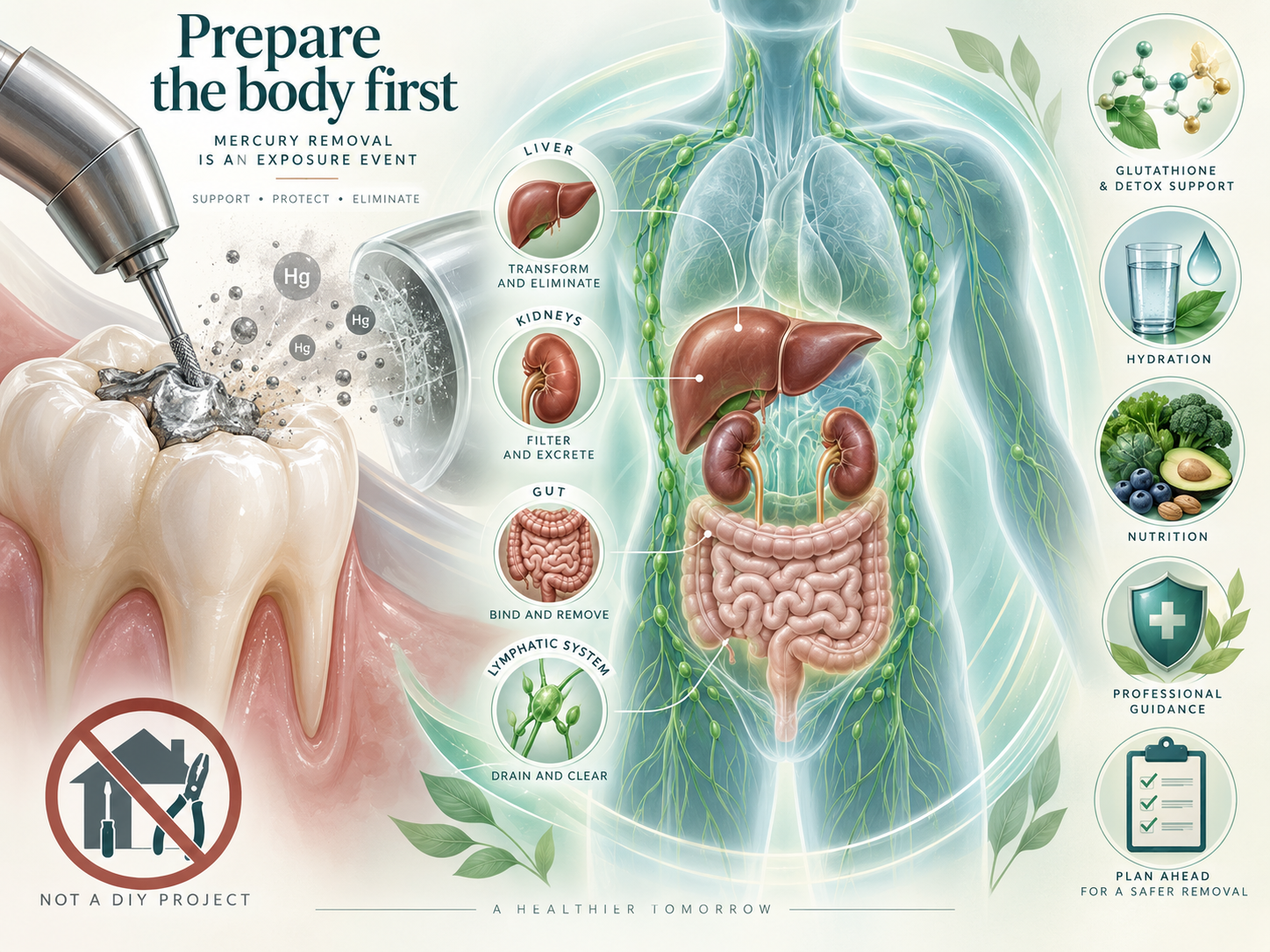
Part 11 of 12 in the Mercury Series
Prepare the Body Before You Mobilize Mercury
Part 11 of the Mercury Amalgam Series
In Part 10, we established something that I think everybody considering amalgam removal needs to understand BEFORE they schedule the appointment: Amalgam removal is itself a mercury exposure event. Even excellent SMART or PROTECT removal can’t make that exposure zero. We can dramatically reduce the mercury vapor, particulate, contaminated water, and debris that reach the patient. But we can’t make every molecule disappear. And once mercury gets into the body, the dentist isn’t controlling what happens next.
The BODY is.
- Mercury has to be transported.
- Bound.
- Distributed.
- Excreted.
And depending on the person, some of it may be retained in tissues and organs for a very long time. So your goal isn’t simply: “Get the mercury out of the tooth.”
Your goal needs to be: Get yourself through the process with the least additional biological burden your biological dentist can reasonably create. And that means preparation matters.
A Quick Note About the Reference Numbers
Just like the other articles in this series, references shown with regular numbers—such as [31] or [101]—use the exact same numbers as the complete master mercury article. So reference [101] here is exactly the same reference [101] there. That means the numbers are going to skip. I haven’t misplaced 70 references somewhere between articles 10 and 11. They support other parts of the master mercury story.
If I add a source specifically to one of these shorter articles, it’ll have an A before the number. At the bottom, I’ll give you the complete citation and direct link for every source used here.
“Detox” Is Actually Physiology
I think the word detox has become almost useless because people use it to describe everything from normal liver physiology to drinking celery juice. But the human body really DOES have systems for processing and eliminating toxic substances.
Mercury elimination involves several of them. Inorganic mercury is eliminated substantially through: urine and feces. [101].
- The kidneys play a major role in urinary elimination.
- The liver and biliary system participate in moving mercury toward the gastrointestinal tract.
- Sulfur-containing molecules, including glutathione, participate in mercury binding, transport, distribution, and elimination. [31,101]
So when I talk about preparing the body before amalgam removal, I’m asking something incredibly practical: Are the physiologic systems this patient is going to need functioning reasonably well BEFORE we deliberately create another mercury exposure?
That’s a completely different statement from pretending there’s some magical blood test that tells us whether somebody’s “detox pathways are open.” There isn’t.
The Order Matters Because Removal Mobilizes Mercury
This is the part I want people to understand before they ever sit down in the dental chair. If the amalgam is already sitting in the tooth, there’s an ongoing exposure. We’ve spent ten articles establishing that. But drilling through that amalgam creates a very different, short-term exposure.
- We’ve measured acute increases in blood, plasma, urine, saliva, and fecal mercury after removal.
- We’ve measured respirable particulate.
- We’ve measured mercury vapor.
- And we’ve seen that the post-removal mercury kinetics can continue for weeks to months.
So if somebody is already struggling physiologically, I don’t want to add another exposure first and ask questions later. Preparation belongs BEFORE removal. Not afterward when the patient is already overwhelmed and everybody is suddenly trying to figure out what to do.
And This Is NOT a DIY Project
This is where I get particularly concerned. Someone reads about mercury. They panic. They decide every filling has to come out immediately and they go to a dentist who isn't vetted or trained in toxicology and ask them to remove their amalgams. Then they start ordering binders, glutathione, selenium, charcoal, chelators, herbs, powders, drops, enemas, saunas, or whatever else somebody on the internet told them belongs in a “mercury detox.” And then they schedule removal.
All without anybody medically evaluating whether their body is actually in a reasonable position to handle the exposure we KNOW removal can create.
That's backwards. And potentially dangerous. By DIY, I don’t mean somebody is standing in their bathroom with a dental drill removing their own fillings. God help us all.
I mean trying to manage the systemic side of mercury removal completely by yourself because somebody online handed you a supplement list. Mercury removal is not a supplement project. It's dental exposure management PLUS human physiology.
If You’re Already Symptomatic, I Want a Physician Involved BEFORE Removal
This becomes even more important if someone is already having symptoms that could be consistent with mercury toxicity or significant toxicant burden. Mercury toxicity can be incredibly nonspecific.
- Neurological symptoms.
- Cognitive symptoms.
- Mood changes.
- Tremor.
- Fatigue.
- Weakness.
- Sleep problems.
- Paresthesias.
- Oral changes.
- GI symptoms.
- Kidney effects.
- And many others.
We’re going to do a completely separate article on the full documented symptom inventory because the list is long enough that trying to cram it into this article would turn Part 11 into another monster.
And more importantly, symptoms like fatigue, anxiety, brain fog, pain, insomnia, weakness, or GI problems are NOT mercury diagnoses by themselves. A LOT of illnesses can cause those symptoms.
So if somebody already has a meaningful exposure history and a collection of symptoms that could be consistent with mercury toxicity, I don’t want them trying to diagnose and treat themselves. I want a functional medicine physician involved before removal.
My Preference Is a Functional-Medicine Physician Who Actually Understands Heavy Metals
For patients who are medically complicated, significantly symptomatic, have known toxicant burdens, or are considering chelation, my preference is a knowledgeable functional-medicine physician who is genuinely experienced with heavy-metal detoxification and chelation. And I mean genuinely experienced.
Not somebody who sells a $2,000 “detox package” to every patient who walks through the door.
I want someone who understands:
- kidney function,
- liver and biliary function,
- bowel elimination,
- nutritional status,
- mineral balance,
- mercury testing,
- the limitations of provoked urine testing,
- mercury kinetics,
- chelation pharmacology,
- and what can happen when you mobilize metals faster than that particular patient can handle them.
Because THAT is the physician who can help decide whether the patient needs medical support before, during, or after dental removal. The dentist’s job is to minimize the dental exposure. The physician’s job is to manage the medical physiology. Those aren’t the same job. And I think patients do better when everybody stays in their lane AND communicates.
The Kidneys Matter Because Mercury Has to Get Out
We spent an entire article on the kidneys, so I’m not going to teach the whole subject again. But the clinical implication matters. Inorganic mercury is handled substantially through the kidneys. [101]. So if somebody has significant kidney dysfunction, I want that known BEFORE we intentionally create another mercury exposure.
That doesn’t mean every healthy person replacing one small failing amalgam needs an enormous renal workup. But someone with known kidney disease? That belongs in the decision. The mouth is attached to the rest of the human being.
I know. Revolutionary dentistry.
The Liver, Biliary System, and GI Tract Matter Too
Urine isn’t mercury’s only exit. Mercury can also move through the liver and biliary system into the gastrointestinal tract and ultimately leave through feces. [101]. So bowel function matters. If somebody is profoundly constipated, my first thought isn’t: “Perfect. Let’s mobilize mercury tomorrow.”
I’m not going to tell you there’s a perfect clinical trial proving that one bowel movement every day lowers somebody’s mercury burden by exactly 17.3%. There isn’t. . But feces are a recognized route of mercury elimination.
So if the gastrointestinal tract is barely functioning, I’d rather address the obvious problem before adding another toxicant exposure. That’s not mystical detox language. That’s common sense layered onto known physiology.
Glutathione Really Does Belong Here
Glutathione gets talked about constantly in detox circles. But unlike a lot of wellness terminology, glutathione genuinely belongs in mercury toxicology. Mercury has a strong affinity for sulfur-containing molecules. Glutathione contains sulfur and participates in mercury binding, transport, intracellular handling, and elimination. [31]. And people don’t all handle that chemistry exactly the same way.
Research in 309 mercury-exposed people found that genetic variation involving GCLM, a gene involved in glutathione synthesis, was associated with differences in mercury concentrations and retention. [83]. So when somebody says: “I don’t detox well,” there may actually be biology underneath that statement.
What I DON’T want is somebody finding one SNP highlighted red on a consumer genetics report and deciding: “Well, apparently I can never eliminate mercury.” Human physiology is considerably more complicated than one gene.
But genetics can influence mercury handling. So can kidney function. Nutrition. Exposure history. And the rest of the person’s physiology.
We aren’t cookie cutters.
Lordy, this concept just keeps following us through all twelve articles.
Nutrition Matters, but There Is No Magic Mercury Supplement Stack
The body needs:
- amino acids,
- minerals,
- enzymes,
- energy,
- and functioning organs
to run normal physiology.
Glutathione itself has to be synthesized. Many antioxidant and redox enzymes depend on nutrients including selenium.
- Protein status matters.
- Iron matters.
- Zinc matters.
- Selenium matters.
- And severe nutritional deficiencies can matter for completely legitimate medical reasons.
So if somebody is profoundly depleted, I’d rather correct meaningful deficiencies BEFORE deliberately creating another toxicant exposure when possible.
But correcting a deficiency is NOT the same thing as proving: “If 100 mcg is good, 800 mcg must detox more mercury.” More is not automatically better.
Selenium, for example, is essential. It can also be toxic in excess. So when I say: “Get nutritionally prepared,” I mean: Identify meaningful deficiencies and correct them appropriately with someone who knows what they’re doing.
I do NOT mean: Buy everything ever recommended in a mercury Facebook group.
The Total Exposure Picture Matters
Mercury may not be the only thing somebody’s body is dealing with. They may have:
- occupational exposures,
- chemical exposures,
- mold exposure,
- Lyme disease
- medications,
- significant illness,
- nutritional depletion,
- poor sleep,
- major GI dysfunction,
- kidney disease,
- or several of those things at once.
I’m not saying those factors mathematically predict exactly how mercury will move through somebody’s body. But they absolutely affect the clinical picture. If someone is already physiologically overwhelmed, my instinct isn’t: “Fantastic. Let’s mobilize some mercury.”
My instinct is: Can we get this human being more stable first? That’s where working with the RIGHT physician becomes just as important as working with the right biological dentist.
There Isn’t One “Ready to Detox” Test
The internet LOVES packages. There's no validated Mercury Detox Readiness Panel™ that turns green when somebody is ready for removal. I want to know the patient’s actual health status.
Depending on the person, that may include incredibly ordinary medical information:
- kidney function,
- liver function,
- blood counts,
- iron status,
- nutritional deficiencies,
- medications,
- bowel function,
- and relevant medical conditions.
A complicated patient may need considerably more evaluation. A healthy person replacing one failing amalgam may not. That's what individualized care looks like. Not everybody gets the same 47 laboratory tests because somebody put them into a package.
Provoked Urine Testing Is Easy to Misinterpret
This deserves its own section because people get into trouble here. A provoked urine test means somebody gives a chelating agent before collecting the urine. Chelators bind metals and increase metal excretion. So guess what happens to the amount of mercury in the urine after a chelator?
It goes up.
That’s literally what the medication is supposed to make happen. The problem starts when somebody compares that post-chelation urine value with a reference range created using people who were NOT given a chelator. Now we’re comparing completely different biological conditions.
There aren’t validated reference ranges that allow us to take a provoked urine concentration and calculate somebody’s total preexisting mercury body burden. [102]. So:
“Your urine mercury became very high after we gave you a mercury-mobilizing drug”. does not equal:
“We have now measured exactly how much mercury was stored in your body.” We haven’t.
That Doesn’t Make Provoked Testing Completely Meaningless
A provoked test tells us something specific:
Under this chelator, at this dose, with this timing and collection period, this amount of mercury appeared in the urine. That’s information. It’s just not the same thing as a validated measurement of total mercury stored throughout the body.
And I think that distinction matters enormously. Because the moment somebody interprets the test as something it isn’t, the entire treatment plan can go off the rails.
Chelation Is Real Medicine
Chelation isn’t fake. Chelating agents are legitimate medical drugs used in appropriately diagnosed metal intoxication. Agents including DMSA and DMPS can increase mercury excretion. [103]. But chelation has real pharmacology.
- The chelator matters.
- The mercury species matters.
- The dose matters.
- The timing matters.
- Kidney function matters.
- The patient’s medical status matters.
Chelators can bind essential minerals. They can produce adverse effects. And mobilizing mercury isn’t the same thing as magically vacuuming every mercury atom out of every tissue in the body. [103]. That’s why:
Account required
Sign in to see more
Create an account or sign in to unlock the full list.