Resource Libraries
Are Dental Materials Toxic? Why Dose and Build-Up Matter
How dental toxicology weighs dose, timing and accumulated load from fluoride, mercury and BPA rather than one exposure, and why resilience shapes the risk.
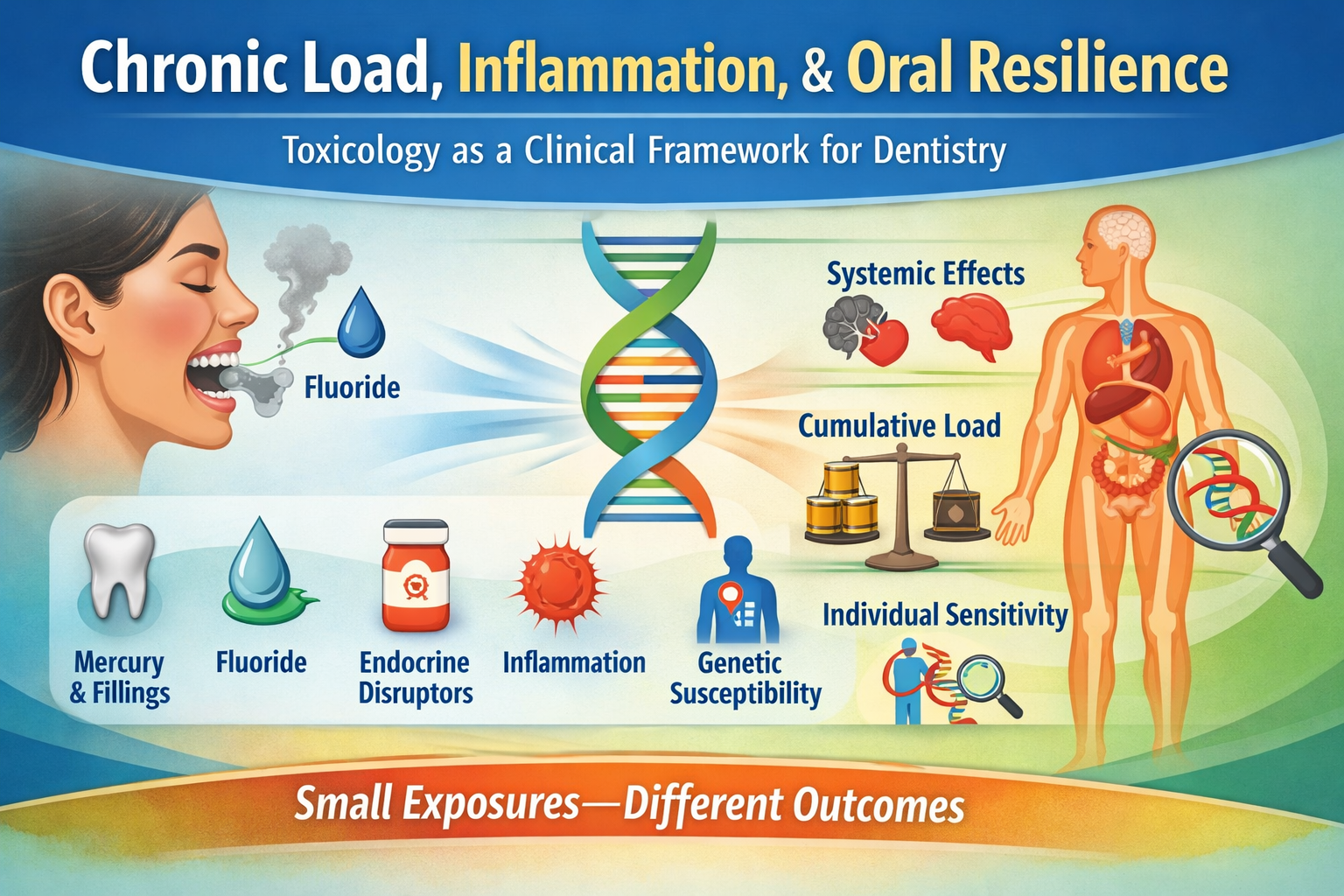
Beyond Fluoride: Toxicologic Load, Oral Resilience, and Why Context Matters
Our resource library would be incomplete without a discussion of toxicology as a clinical framework. Over the last 150 years, dentistry has contributed a meaningful toxic burden to the global population—almost always unintentionally, and often long before the science existed to understand long-term or cumulative effects. Mercury, fluoride, endocrine-disrupting materials, early radiation practices, chemical solvents, and chronic occupational micro-exposures have all been part of dentistry’s evolution.
That does not make dentistry “bad.”
It makes dentistry human—operating at the edge of the knowledge available at the time.
Scientific progress has never been linear. New observations are often recognized first by a small number of people who notice patterns before the broader scientific community has the tools, data, or frameworks to fully explain them. History is filled with examples where early insights were initially dismissed or minimized, only to be validated years—or decades—later as understanding caught up.
Alfred Wegener’s theory of continental drift was ridiculed for decades before plate tectonics explained it.
Eunice Foote identified the greenhouse effect in the 1850s, long before climate science existed to contextualize it.
Rosalind Franklin’s data underpinned the discovery of DNA’s structure, though her contribution was minimized for years.
Lise Meitner explained nuclear fission but was excluded from the Nobel Prize.
Gregor Mendel’s work on genetics was ignored entirely during his lifetime.
These were not fringe thinkers. They were observing real phenomena before science had the tools to explain them.
Dentistry has its own versions of these forward thinkers. Throughout the history of dentistry, clinicians who raised early concerns about toxicity, chronic oral infections, focal infection theory, mercury exposure, systemic effects of dental materials, or cumulative occupational exposures were often viewed as controversial—not because they lacked clinical observation, but because the biologic mechanisms had not yet been mapped.
Figures such as Dr. Weston A. Price, who documented nutritional depletion and systemic degeneration long before modern epigenetics and microbiome science existed; Dr. Hal Huggins, who raised early questions about mercury exposure and immune dysregulation; Dr. Boyd Haley, who brought biochemical rigor to mercury toxicity research; and later biologically oriented clinicians who questioned chronic oral infections, cavitation pathology, and material biocompatibility were often working ahead of the available explanatory tools.
In retrospect, the issue was rarely that nothing real was being observed. More often, effects were being recognized before science could quantify dose thresholds, genetic variability, detoxification capacity, immune resilience, or cumulative lifetime burden. Early warnings were dismissed not because they violated science, but because they challenged prevailing models, economic momentum, and the assumption that population averages adequately protect every individual.
Modern toxicology helps reconcile this historical tension. It explains why identical exposures can produce dramatically different outcomes depending on genetics, detoxification capacity, inflammatory load, hormonal state, timing, and total lifetime exposure. Toxicology is not an indictment of dentistry, medicine, or innovation. It is an acknowledgment of biological variability.
When applied responsibly, toxicology moves the conversation away from binary thinking—safe versus toxic—and toward clinical judgment grounded in thresholds, tradeoffs, susceptibility, and resilience.
The lesson is not that earlier critics were always right, nor that established practices were inherently wrong, but that progress depends on the willingness to examine emerging signals without reflexive dismissal. Dentistry, like every scientific discipline, advances not by defending certainty—but by refining it.
Toxicology provides the framework for doing exactly that. It helps explain why identical exposures can lead to very different clinical outcomes, and why results don’t always match expectations—even when protocols are followed correctly.
When applied correctly, toxicology is about understanding thresholds, tradeoffs, and resilience.
Dentistry Does Not Stay “Local”
Dentistry does not operate in isolation from the rest of the body. Oral tissues are metabolically active, highly vascular, richly innervated, immune-responsive, and directly connected to systemic circulation. The mouth is not a sealed compartment. What we place in it does not remain isolated in the way dentistry was once taught to believe.
In fact, the concept of a purely “topical” application in the mouth is largely a misnomer.
The oral mucosa is designed for rapid absorption. Substances placed in contact with gingival, sublingual, and buccal tissues can enter systemic circulation quickly—which is precisely why these routes are intentionally used for drug delivery in medicine. The mouth is an absorption surface.
This matters clinically because it means materials and agents applied orally are not biologically neutral simply because they are labeled “topical.” Exposure still occurs. The relevant questions are not whether absorption happens, but:
how much
how often
over what period of time
and in which physiologic context
Fluoride is a clear example. When described as “topical,” the term implies a local effect without systemic relevance. In reality, fluoride applied to oral tissues is absorbed, swallowed, and incorporated into systemic circulation to varying degrees depending on dose, frequency, age, and individual physiology. Calling it topical does not make it non-systemic. This is not about alarm.
It is about precision.
Relevant Science
1. Hearnden V et al. PMID: 21371513
https://pubmed.ncbi.nlm.nih.gov/21371513
The mouth's rich blood supply allows drugs to bypass liver metabolism and enter the bloodstream quickly, making it useful for delivering medications both locally and throughout the body.
2. Zhang H et al. PMID: 12126458
https://pubmed.ncbi.nlm.nih.gov/12126458
Drugs absorbed through mouth tissues go directly into the bloodstream, skipping the digestive system and liver, which can make them work faster than pills you swallow.
3. Harris D, Robinson JR PMID: 1619560
https://pubmed.ncbi.nlm.nih.gov/1619560
Drug delivery through mouth membranes can achieve good absorption for certain molecules, with the area under the tongue being particularly effective for rapid uptake.
4. Madhav NV et al. PMID: 19665039
https://pubmed.ncbi.nlm.nih.gov/19665039
The mouth's surfaces are rich in blood vessels, allowing drugs to be absorbed rapidly into circulation while avoiding breakdown in the stomach and liver.
Micro-Exposures, Variability, and Oral Resilience
This is why one patient may tolerate an exposure with no apparent consequence, while another develops inflammation, immune dysregulation, neurologic symptoms, or impaired healing.
It is also why micro-exposures—levels far below what most people would ever notice—can significantly affect certain individuals.
Across toxicology, this pattern is well recognized: the same external exposure does not produce the same internal dose or biologic response in every person. Differences in absorption, metabolism, clearance, immune signaling, mitochondrial function, and cumulative exposure history all matter. Some people simply have less physiologic margin.
They may have:
reduced detoxification capacity
higher baseline inflammatory burden
impaired barrier function (oral, gut, nasal)
mitochondrial or oxidative stress vulnerability
genetic variability in metabolism
significant cumulative exposure already “in the bucket”
For these individuals, micro-exposures matter. I often refer to these patients as our “canaries in the coal mine.” Not because they are fragile—but because they respond earlier, at lower thresholds, and reveal biologic stress long before it becomes obvious in the general population.
Most safety standards are built around population averages. That means they can miss what happens at the lowest thresholds—especially in people already carrying inflammatory or toxic load. If we want biologic safety, not theoretical safety, we have to ask:
Who is affected first?
At what threshold does resilience begin to fail?
What changes long before overt disease appears?
Relevant Science
1. Zeise L et al. PMID: 23086705
https://pubmed.ncbi.nlm.nih.gov/23086705
People respond differently to chemicals because of genetic differences, age, diet, stress, and other exposures—making it important to understand who might be more vulnerable when setting safety standards.
2. Emeny RT et al. PMID: 33549591
https://pubmed.ncbi.nlm.nih.gov/33549591
Social factors like poverty, stress, and pollution exposure can change how cells work inside the body, affecting inflammation and immune function, which helps explain why some people get sicker than others.
3. Genuis SJ . PMID: 20920818
https://pubmed.ncbi.nlm.nih.gov/20920818
After a major toxic exposure, some people become sensitive to very low levels of chemicals, foods, or allergens they previously tolerated, developing symptoms affecting multiple body systems.
4. Hausman-Cohen SR et al. PMID: 32027241
https://pubmed.ncbi.nlm.nih.gov/32027241
Genetic differences in detoxification enzymes make some people more affected by toxins than others, and understanding these differences can guide personalized nutrition and lifestyle changes to improve detoxification.
Why This Is Personal for Me
This framework isn’t abstract for me. If there were a profession that could have been worse for my genetics, it would have been dentistry. Mercury. Fluoride. Endocrine disruptors. Chemical solvents. Radiation exposure in earlier decades. Genetically, I do not detoxify well. My detox pathways are more blocked than a highway during hurricane evacuation orders—and I’m not exaggerating. I am one of the canaries. The problem was never dentistry itself. The problem was that safety standards were never designed with people like me in mind.
Most occupational exposure limits assume an average ability to metabolize, clear, and tolerate exposure. But biology is not average. It is variable. OSHA standards should be designed for the canaries. Because when safety thresholds protect the most sensitive biology, everyone benefits: clinicians staff patients future generations Making an occupation safe enough for the canaries does not weaken it. It raises the baseline. It reduces cumulative harm. It prevents injuries that often only become visible decades later.
Dentistry’s Major Toxicology Categories (A Clinical Overview)
This article is not about assigning blame. It is about acknowledging exposure categories that matter for oral resilience.
Mercury (Legacy + Current Context)
Dental amalgam remains one of the most studied sources of chronic "low-dose" mercury exposure. (News flash - there is no such thing as a SAFE level of mercury. Which means none of is actually "low dose".) Mercury vapor is readily absorbed through inhalation and oral tissues, crosses the blood–brain barrier, and accumulates in tissues over time. I've discussed mercury being toxic multiple times on our resource library. You can read more about that if you wish in these resources:
SMART/PROTECT Protocol:
The Science on Mercury Amalgam and the Damage it has in the Human Body - Why SMART / PROTECT Protocols Are Non-Negotiable https://www.orabiologics.com/resource-library/the-science-on-mercury-amalgam-and-the-damage-it-has-in-the-human-body---why-smart-%2F-protect-protocols-are-non-negotiable
What is SMART? What is PROTECT? What's The Difference? https://www.orabiologics.com/resource-library/what-is-smart%3F-what-is-protect%3F--what's-the-difference%3F
Steps of Safe Amalgam Removal Based on IABDM and IAOMT Guidelines:
https://www.orabiologics.com/resource-library/smart%2Fprotect-protocol-explained
What SMART/PROTECT Protocol look like at Holistic Dental Associates when our anesthesiologist is present, so that people know what it needs to look like even when other people are in the room:
https://www.orabiologics.com/resource-library/smart%2Fprotect-protocol-overview
What SMART/PROTECT Protocol looks like at Holistic Dental Associates every time we remove amalgam, so that people know what it needs to look like in general. Includes all steps taken in the office of Holistic Dental Associates:
https://www.orabiologics.com/resource-library/safe-amalgam-removal-steps
Relevant science
1. Clarkson TW, Magos L, Myers GJ . PMID: 14585937
https://pubmed.ncbi.nlm.nih.gov/14585937
Mercury from dental fillings releases vapor that is breathed in and absorbed into the bloodstream, making amalgam fillings the main source of mercury vapor exposure for most people.
2. Bjørklund G, Dadar M, Mutter J, Aaseth J . PMID: 28889024
https://pubmed.ncbi.nlm.nih.gov/28889024
Mercury is a neurotoxin and immune toxin that accumulates in the brain for years or decades, and can cross into the brain and harm the nervous system.
3. Jirau-Colón H, González-Parrilla L, et al PMID: 30909378
https://pubmed.ncbi.nlm.nih.gov/30909378
Mercury constantly releases from dental fillings as vapor, can form organic mercury in the mouth, affects how genes work in cells, and has been linked to brain diseases like Alzheimer's and Parkinson's.
4. Yin L, Lin S, Summers AO, et al . PMID: 34453845
https://pubmed.ncbi.nlm.nih.gov/34453845
Children with more than five amalgam fillings had over twice the mercury levels in their blood and urine compared to children without fillings, with the highest levels found in children under age six.
5. Cariccio VL, Samà A, Bramanti P, Mazzon E . PMID: 29777524
https://pubmed.ncbi.nlm.nih.gov/29777524
Mercury vapor from dental fillings can cross the blood-brain barrier and accumulate in brain cells, causing oxidative stress, cell death, and has been studied for its role in neurodegenerative diseases.
6. Geier DA . PMID: 41109985
https://pubmed.ncbi.nlm.nih.gov/41109985
People with amalgam fillings have significantly higher mercury levels in their blood, and the amount of mercury in blood increases with the number of filling surfaces and estimated mercury vapor dose.
Fluoride (Cumulative Exposure)
Fluoride is biologically active. It accumulates in bone and calcified tissues and interacts with endocrine, neurologic, and mitochondrial systems depending on dose and duration. I've discussed the toxicology issues of fluoride on these library resources:
Fluoride:
The Science of Why Fluoride is Bad for us:
https://www.orabiologics.com/resource-library/the-science-on-why-fluoride-is-harmful-to-human-health
More Science on Fluoride Toxicity:
Relevant science
1. Green R, Lanphear B, Hornung R, et al. PMID: 31424532
https://pubmed.ncbi.nlm.nih.gov/31424532
Higher fluoride exposure during pregnancy was linked to lower IQ scores in children, with boys showing a 4.5-point decrease per 1 mg/L increase in maternal urine fluoride levels.
2. Adkins EA, Brunst KJ . PMID: 34948493
https://pubmed.ncbi.nlm.nih.gov/34948493
Fluoride can damage mitochondria in cells, reducing their energy production and causing structural problems, which may explain how fluoride affects brain development and mental health.
3. Skórka-Majewicz M, Goschorska M, Żwierełło W, et al. PMID: 32758781
https://pubmed.ncbi.nlm.nih.gov/32758781
Fluoride disrupts hormone production in multiple glands including the thyroid, reproductive organs, parathyroid, pancreas, and adrenal glands, affecting fertility, puberty, blood sugar control, and metabolism.
Account required
Sign in to see more
Create an account or sign in to unlock the full list.