Resource Libraries
Mercury Fillings and Thyroid, Immune and Gut Health
How mercury from amalgam affects the thyroid, immune system and gut microbiome, including links to Hashimoto's, autoimmunity and antibiotic resistance.
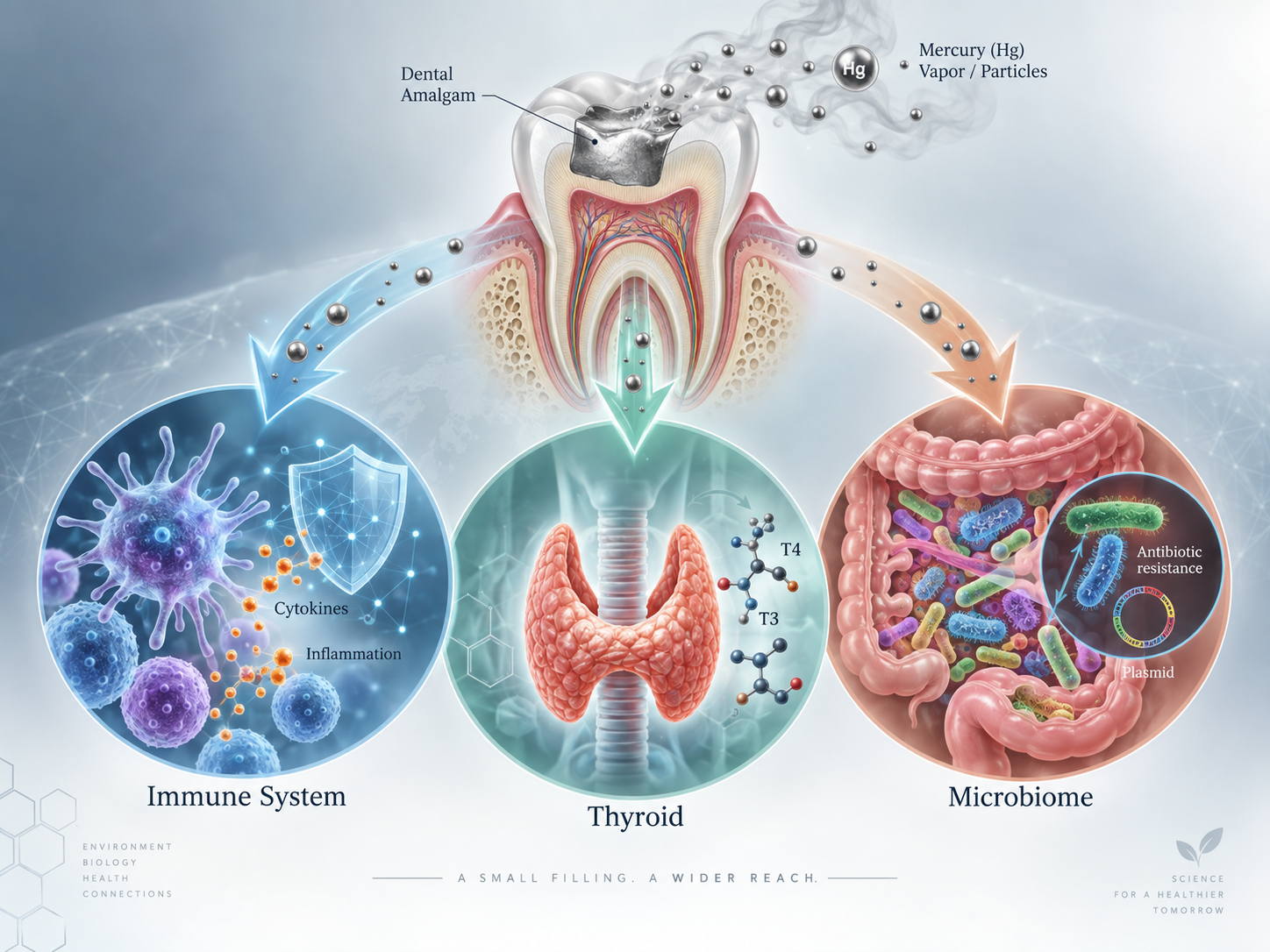
Part 8 of 12 in the Mercury Series
Mercury, the Immune System, the Thyroid, and the Microbiome
Part 8 of the Mercury Amalgam Series
So far, we’ve spent a lot of time talking about mercury as though the major story happens in the brain and kidneys. Those organs absolutely matter. But mercury doesn’t arrive in the body, politely choose one organ system, and stay in its lane. It interacts with proteins, enzymes, immune cells and the thyroid. And apparently, because mercury toxicology wasn’t complicated enough already, it also interacts with the trillions of bacteria living in and on us.
That opens up three incredibly interesting questions:
- Can mercury alter immune regulation?
- Can mercury affect thyroid physiology or thyroid autoimmunity? And
- Can mercury change the microbial communities living in our mouths and intestines?
The answer to all three is that there is real science worth understanding. The human disease question is considerably harder. It's a distinction that matters. I’m not going to tell somebody with Hashimoto’s, rheumatoid arthritis, lupus, dysbiosis, or inflammatory bowel symptoms that an amalgam filling caused their disease. We don’t have evidence that allows me to make those individual causal claims.
But mercury is not biologically invisible to these systems either. And THAT is what I want to discuss in this article.
A Quick Note About the Reference Numbers
Just like the other articles in this series, references shown with regular numbers—such as [68] or [74]—use the exact same numbers as the complete master mercury article. So reference [68] here is reference [68] there. That means the numbers may skip. I haven’t lost references 1–67, and once again, I promise I still know how to count. They support the other parts of the mercury story.
You’ll also see references beginning with an A, such as [A1]. Those are studies I added specifically while expanding this shorter article because they help explain this particular subject more completely. At the end, I’ll give you the complete citations and direct links for every reference used here.
Mercury Is an Immunotoxicant Too
We’ve already established that mercury is neurotoxic. It is also capable of altering immune function. And the immune system is MUCH more complicated than simply being “strong” or “weak.”
- A healthy immune system has to know when to attack.
- It has to know what to attack.
- It has to know how aggressively to respond.
- And then it has to know when to STOP.
Autoimmune reactions are fundamentally a failure of immune tolerance—the mechanisms that normally help the immune system distinguish “me” from “not me.” Once the immune system begins recognizing the body’s own molecules as targets, it can produce autoantibodies and inflammatory responses directed against its own tissues. Mercury has been studied as one environmental stimulus capable of disturbing that immune balance.
A systematic review specifically examining mercury and autoimmunity looked at elemental, inorganic, and organic mercury exposures. [68]. The strongest causal evidence comes from animal models. In genetically susceptible animals, inorganic mercury can produce:
-
immune-cell activation,
-
increased immunoglobulins,
-
autoantibody production,
-
inflammatory signaling,
-
immune-complex formation,
-
and autoimmune disease features. [68,69]
And there’s something about that research I think is especially important: Not every animal responds the same way.
Genetic background can dramatically change whether mercury exposure produces an autoimmune response and what that response looks like. [69]. Sound familiar? We keep finding our way back to individual susceptibility because biology keeps taking us there.
How Can a Metal Affect the Immune System?
This is where the biochemistry we discussed earlier starts connecting to immunology. Mercury binds strongly to sulfur-containing groups in proteins. When mercury interacts with proteins, it can alter their structure and function. The immune system is constantly examining molecular structures and deciding what belongs and what doesn’t. Mercury can also promote oxidative stress and inflammatory signaling, alter cytokine production, affect lymphocyte activity, and influence antigen presentation and autoantibody production. [68,69]. So there are several biologically plausible ways mercury exposure can disturb immune regulation.
This doesn’t require mercury to behave like a virus or bacterium. It can interfere with the chemistry controlling how immune cells communicate, how proteins are handled, and how tolerance is maintained. That’s why mercury-induced autoimmunity is such a well-established experimental model.
Human Autoimmunity Is Much Harder to Prove
Humans, unfortunately for researchers, are not genetically identical laboratory mice living in controlled cages. We have different genetics.
- Different diets.
- Different infections.
- Different microbiomes.
- Different medications.
- Different occupational exposures.
- Different dental histories.
- Different selenium levels.
- Different kidney function.
- Different exposure mixtures.
And usually nobody started measuring all of those things twenty years before someone developed an autoimmune disease. So the human epidemiology is much messier. The systematic reviews reflect that. Human studies have reported associations between mercury exposure and inflammatory markers or autoantibodies, but the results are much less consistent than the experimental animal literature. [68,69]. That is why I think the scientifically accurate statement is pretty straightforward:
Mercury can produce autoimmune and inflammatory effects experimentally, and human studies provide evidence of immune dysregulation, but we do not currently have evidence that mercury is the single cause of most human autoimmune disease.
Human autoimmune disease is almost certainly a gene-environment interaction involving multiple exposures and biological vulnerabilities.
But There ARE Interesting Human Data
One human study examined mercury-exposed mining populations in Amazonian Brazil and looked much deeper than simply asking whether somebody had been diagnosed with lupus or rheumatoid arthritis. [A1]. Researchers studied serum autoantibodies—antibodies directed against the body’s own proteins. In their initial proteomic screening, people with higher mercury exposure and higher antinuclear antibodies showed increased reactivity against thousands of proteins.
The investigators then focused on several candidate autoantibodies associated with inflammatory and immune pathways and tested a much larger group. Mercury-exposed gold miners had substantially higher levels of an autoantibody directed against glutathione S-transferase alpha—GSTA1 than the comparison group. [A1]. That is particularly interesting because glutathione biology has already appeared repeatedly in mercury toxicology. Again, this was a mining population. These exposures were NOT dental-amalgam exposure. But it WAS exposure to elemental mercury, which is the same FORM as dental amalgam, as opposed to the fish's methylmercury.
So I’m not going to hijack the study and pretend it proves amalgam causes autoimmune disease. It does show something much more defensible:
Human mercury exposure can be associated with measurable autoimmune dysregulation. That fits the biological mechanisms seen experimentally.
Now Let’s Talk About the Thyroid
The thyroid deserves its own attention because mercury can actually accumulate there. We already looked earlier in this series at human autopsy research showing that mercury concentrations in the thyroid were associated with dental-amalgam burden. [28]. So this is not simply a theoretical question about whether mercury could ever reach the gland. It can.
The thyroid controls metabolism through an elegant hormonal feedback system involving the hypothalamus, pituitary, thyroid gland, TSH, T4, and T3. And like practically every elegant system in human biology, there are approximately nine thousand ways for it to become complicated.
A 2021 meta-analysis examined mercury exposure and thyroid hormones across human studies. [70]. Higher blood mercury was significantly associated with changes in: TSH, total T4, and free T4. Some relationships differed by age and pregnancy status. [70]. Those studies included mercury from multiple sources. So this is evidence about mercury and thyroid physiology, not proof that amalgam causes thyroid disease. But it tells us that mercury exposure is associated with measurable changes in the endocrine system controlling thyroid function. And then the autoimmune side of the thyroid story gets even more interesting.
More Mercury, More Thyroglobulin Antibodies in a Large U.S. Study
An NHANES analysis looked at 2,047 U.S. women and compared total blood mercury with thyroid autoantibodies. [A2]. The researchers adjusted for things including demographics, menopausal status, nutrient intake, and urinary iodine.
Women in the highest mercury group—blood mercury above 1.81 μg/L—had about 2.24 times the odds of being positive for thyroglobulin antibodies compared with women whose mercury was at or below 0.40 μg/L. [A2]
The relationship was NOT found for thyroid peroxidase antibodies. If mercury simply made every thyroid-autoimmune marker rise, we would expect both antibodies to behave the same way. They didn’t.
The study found a specific association with anti-thyroglobulin antibodies, not a universal thyroid-autoantibody effect. And because NHANES measured total blood mercury, this study cannot tell us whether that mercury came from fish, amalgam, occupational exposure, or some combination. Still, in more than two thousand women, mercury exposure correlated with one measurable marker of thyroid autoimmunity. That deserves to be part of the conversation.
Then There’s a Very Small but Fascinating Amalgam-Specific Thyroid Study
This next one is one of those studies I find intriguing while simultaneously wishing it were ten times larger. Researchers studied 39 people with autoimmune thyroiditis and dental amalgam fillings.[71]. They tested the patients for mercury hypersensitivity. Among the mercury-sensitive patients who had their amalgams removed, both: anti-TPO antibodies and anti-thyroglobulin antibodies decreased significantly over the following six months. [71]. Patients who retained their amalgams did not show the same decrease. THAT's interesting. VERY interesting.
But this is also where sample selection matters enormously. These weren’t 39 random people with Hashimoto’s. The apparent response occurred in the subgroup identified as mercury-hypersensitive. And 39 people is tiny.
We also don’t get the level of detail I would want today about genetics, microbiome, nutrient status, other toxic exposures, or exactly how safely the amalgam was removed.
So I would LOVE to see this study repeated with hundreds of patients, modern mercury-safe removal, thyroid-antibody measurements, mercury speciation, genetics, selenium status, and long-term follow-up. Because the signal is interesting enough to deserve a MUCH better experiment.
Hypersensitivity Is Another Example of Why “Average Exposure” Isn’t the Whole Story
Mercury allergy and mercury hypersensitivity are not the same thing as systemic mercury toxicity. It's important to understand that. Some people develop immune reactivity to mercury compounds at exposures that may not produce the same response in someone else. That gives us another example of why a material cannot be evaluated solely by asking what happens to the average person.
A hypersensitive immune system, a genetically susceptible immune system, and an immune system without those susceptibilities may respond very differently to the exact same exposure. We aren’t cookie cutters. That phrase keeps surviving every article because the science keeps making the point for me.
And Then Mercury Meets the Microbiome
Now we get to one of my favorite pieces of this entire subject because it is SO biologically interesting. Mercury doesn’t only interact with our cells. It also interacts with bacteria. Your mouth and gastrointestinal tract contain enormously complex microbial ecosystems. And microorganisms have been dealing with toxic substances for billions of years. They adapt.
If you expose a mixed bacterial population to something toxic, organisms capable of surviving that substance have an advantage over organisms that cannot. That is called selective pressure. So if bacteria carrying mercury-resistance genes survive mercury exposure more successfully, the environment can begin selecting for mercury-resistant organisms. Makes sense. But then it gets MUCH more interesting.
Bacteria Can Carry Mercury Resistance and Antibiotic Resistance Together
Bacteria are incredibly good at sharing genetic information. Some resistance genes sit on mobile pieces of DNA called:
- plasmids,
- transposons
- integrons.
Think of a plasmid like a little portable genetic thumb drive that bacteria can sometimes pass around. And that thumb drive may contain more than one useful survival program. A gene allowing resistance to mercury can sit on the same mobile genetic element as genes providing resistance to antibiotics. [72,74]. So if mercury kills off susceptible bacteria while allowing mercury-resistant bacteria to thrive, it can potentially help select bacteria that ALSO happen to carry antibiotic-resistance genes. No antibiotic has to be present for the metal to create that selective pressure. That is called co-selection. And researchers have actually demonstrated this with dental amalgam.
Six Monkeys, Amalgam Fillings, and No Antibiotics
Researchers studied six adult monkeys before and after placing amalgam restorations. [72]. And there’s a REALLY important detail: The animals were fed an antibiotic-free diet. Researchers wanted to know whether mercury exposure itself could alter bacterial resistance patterns. After amalgam was placed, mercury-resistant bacteria increased significantly in both the oral and intestinal microbiomes. [72]
When amalgams were later removed and replaced with mercury-free glass ionomer restorations in four of the monkeys, another increase occurred around the removal period. That makes sense biologically because removal can create a large temporary mercury exposure. The mercury-resistant bacteria weren’t necessarily resistant only to mercury.
Many also became resistant to antibiotics including:
-
ampicillin,
-
tetracycline,
-
streptomycin,
-
kanamycin,
-
and chloramphenicol. [72]
Some bacteria could actually transfer mercury-resistance and antibiotic-resistance genes together to other bacteria. THAT is the important part of this experiment. The mercury wasn’t just affecting mercury. It was shaping which bacteria had a survival advantage, and some of those survival genes were physically linked to antibiotic-resistance genes.
Researchers Reproduced the Selective Effect in Dental Plaque
A later laboratory study grew complex dental-plaque biofilms either on amalgam or on enamel. [A3]. The biofilms growing next to amalgam developed a higher number and proportion of mercury-resistant bacteria. The increase was most apparent during the first 48 hours and then returned toward baseline by 72 hours.
Researchers isolated 42 mercury-resistant bacteria. And 71% of those mercury-resistant isolates were also resistant to one or more antibiotics, most commonly tetracycline. [A3].
This was an in-vitro biofilm model, not somebody’s actual mouth. But it directly demonstrates selective pressure from the material itself. Put the microbial community next to amalgam. Mercury-resistant organisms gain an advantage. And many of those organisms also carry antibiotic resistance. That’s a fascinating biological mechanism.
Human Research Is More Complicated
Human studies don't give us one neat answer. One study followed 10 people having all of their amalgams removed and compared them with 10 people who had no amalgam. [73]. Mercury concentrations in saliva and feces correlated significantly with the number of amalgam surfaces. After removal, researchers observed temporary increases in intestinal organisms resistant to mercury and several antibiotics.
Those increases were NOT statistically significant compared with the normal variation seen in the controls. But within the intestinal bacteria themselves, mercury resistance was significantly associated with resistance to multiple antibiotics. [73]. So the genetic relationship between metal resistance and antibiotic resistance showed up even though the overall human microbial shift was less dramatic than the monkey experiment. And another human study gives us useful negative evidence.
Children With Amalgam Did NOT Have More Mercury-Resistant Oral Bacteria in One Study
Researchers compared oral bacteria from 41 children with amalgam fillings with bacteria from 42 children without amalgam. [A4]. Mercury-resistant bacteria were common in BOTH groups. About 78% of children with amalgam and 74% of amalgam-free children carried mercury-resistant bacteria. That difference was not statistically significant. There was also no significant difference in the proportion of mercury-resistant organisms between the two groups. [A4]
So there is a human study that did NOT demonstrate greater mercury-resistant oral flora simply because children had amalgam fillings. That belongs in this article. Interestingly, many of the mercury-resistant organisms in BOTH groups were also antibiotic-resistant. So the biological link between metal resistance and antibiotic resistance still existed even though amalgam status did not significantly change the prevalence in these children. That’s exactly the kind of result that keeps us from oversimplifying the science.
Account required
Sign in to see more
Create an account or sign in to unlock the full list.