Resource Libraries
Are Amalgam Fillings Safe for Children? The Developing Brain
Whether amalgam fillings are safe for children, what the Casa Pia and New England trials missed, and why variants like APOE4 make the average child a myth.
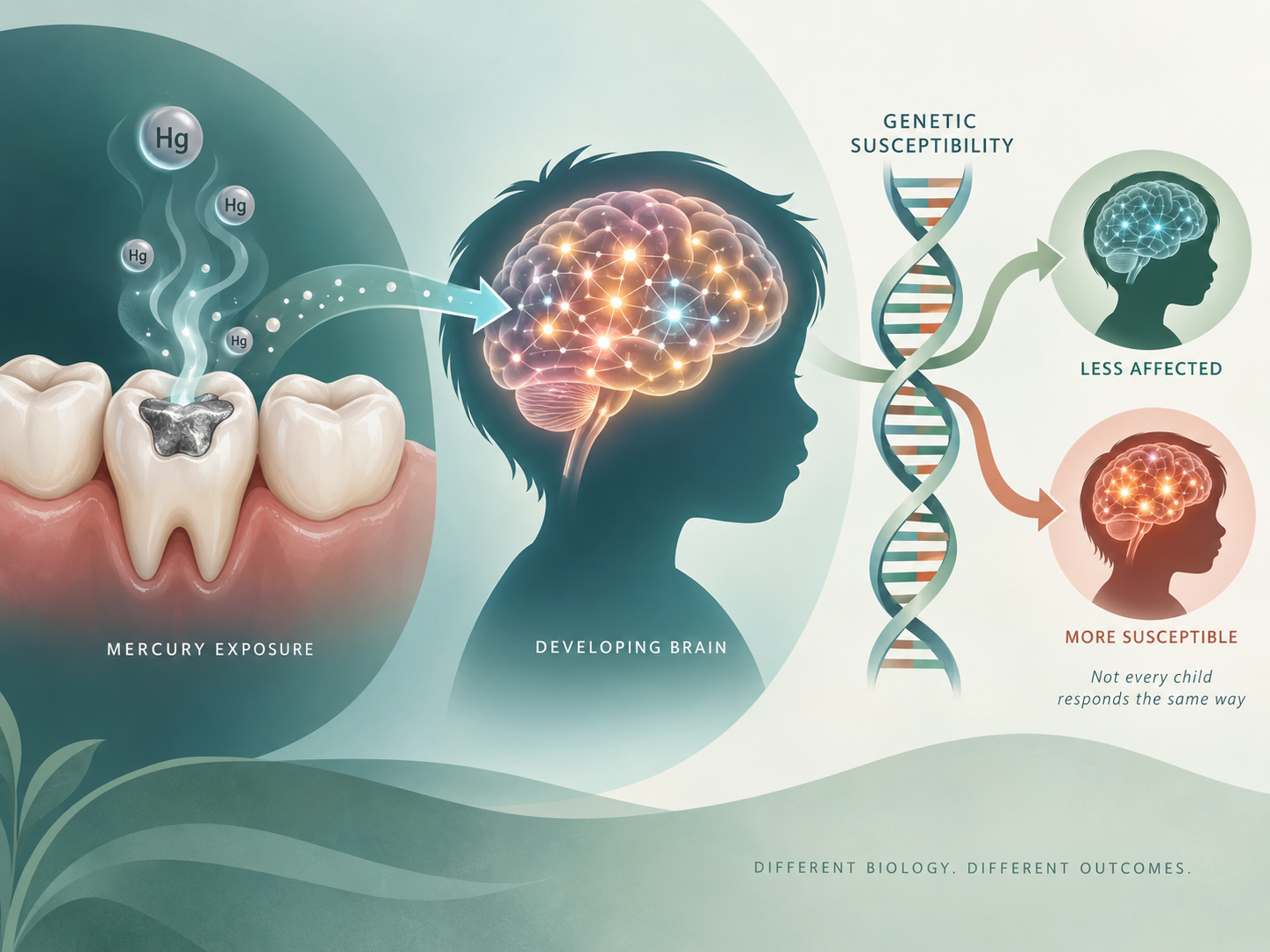
Part 6 of 12 in the Mercury Series
Mercury and the Developing Brain: Why the Average Child Isn't Every Child
Part 6 of the Mercury Amalgam Series
In Part 5, we talked about something that should make every parent and every dentist sit up a little straighter: Mercury associated with maternal dental amalgam can reach the placenta, fetal circulation, and breast milk. So now we have to ask the next question:
What happens when mercury exposure occurs while the brain is still developing? And this is where the word average makes me VERY uncomfortable. Because two of the largest pediatric amalgam trials are routinely used to say:
“See? Amalgam was proven safe in children.” Except that isn’t actually what those trials proved.
What they showed was that when researchers compared the amalgam-treated children with the composite-treated children as groups, they didn’t find statistically significant average differences in the major neurological outcomes they were measuring. That matters. But it’s NOT the same sentence as:
“Every child exposed to mercury responded exactly the same way.”
And years later, researchers went back into the biological samples from those same children and discovered something incredibly important: They didn’t.
A Quick Note About the Reference Numbers
Just like the earlier articles, regular numbers in brackets—like [55] or [59]—use the exact same numbering as the giant master mercury article. So reference [55] here is reference [55] there. The numbers may skip because I’m only using the master references that apply to this particular subject. I haven’t forgotten how numbers work.
You’ll also see a few references beginning with an A. Those are article-only references I added because I found additional science while expanding this particular topic. The complete references and direct links are at the bottom.
First, Mercury Is a Neurotoxicant
Let’s establish the thing that should NOT be controversial before we get lost in statistical weeds. Mercury is neurotoxic. We've talked about this in every mercury article, but people jump around, so sometimes I have to say things again.
The nervous system is one of the major targets of mercury toxicity, and the developing brain is especially complicated because it isn’t simply a smaller version of an adult brain. It is actively being BUILT.
- Neurons are dividing and differentiating.
- Cells are migrating to where they belong.
- Axons are growing.
- Synapses are forming.
- Neurotransmitter systems are developing.
- Myelination is occurring.
- The architecture that will eventually support learning, memory, attention, emotion, movement, language, and behavior is being constructed in real time.
That’s why developmental timing matters so much with neurotoxic exposures.
A chemical exposure that an adult nervous system may compensate for isn’t automatically biologically equivalent to that same exposure during fetal life, infancy, or childhood. A 2023 systematic review summed this up pretty plainly: mercury is a toxic metal capable of crossing the placenta and the blood-brain barrier and disrupting cellular processes involved in neurodevelopment. [A3]
And remember what we’ve already established in this series:
- Dental amalgam releases elemental mercury vapor.
- That vapor is absorbed through the lungs.
- Elemental mercury can cross the blood-brain barrier.
- Inside tissues, much of it is converted into inorganic mercury.
- And inorganic mercury can remain in the brain for years and potentially decades. [1,28–30]
So when we talk about mercury and the developing brain, we aren’t talking about some imaginary biological pathway. The toxicant can get there.
The First Big Pediatric Trial Didn’t Find an Average Neurological Difference
The New England Children’s Amalgam Trial randomized 534 children ages 6–10 to receive either mercury-containing amalgam restorations or mercury-free composite restorations and followed them for five years. [34]. The amalgam group had significantly higher urinary mercury.
So once again: The dental material increased mercury exposure.
But the researchers did NOT find statistically significant differences between the treatment groups in the major neuropsychological outcomes they measured, including full-scale IQ, memory, and visuomotor function. [34]
That's important evidence. If somebody tells you this trial showed obvious neurological impairment across the entire amalgam-treated group, that isn’t what happened. But look carefully at the question the trial answered. It asked: “Does the amalgam group, on average, perform significantly worse than the composite group?” That's a useful question.
It is NOT the only useful question. That's the problem with scientific research that doesn't ask the right questions. It leads us in directions that make us think we are safe, when we may not be as safe as we think.
Because a group average can hide enormous biological differences between the people inside the group. Imagine ten children take a test. Nine children have no measurable change. One child has a very large change. Average all ten together, and that one child’s result can become surprisingly small. The average is mathematically correct. But it doesn’t tell you what happened to that child. And THAT distinction becomes incredibly important when we get to Casa Pia.
And Yes, We Need to Talk About Casa Pia AGAIN
The second major pediatric amalgam trial was the Casa Pia Children’s Amalgam Trial in Portugal. And I cannot use these data without reminding you how deeply I object to the ethics of the experiment. Casa Pia enrolled 507 children who had never previously had amalgam restorations and randomized them to receive amalgam or composite fillings so researchers could study what chronic mercury exposure did to them. [55,A1]
These were CHILDREN.
Casa Pia served vulnerable institutionalized children, including orphans and wards of the institution. The documentation reviewed in Dr. David Kennedy’s presentation on the trial reports that one Casa Pia employee signed 175 consent forms for orphaned children, and that the Portuguese consent materials did not disclose that the restorations contained mercury or adequately disclose the risks associated with mercury exposure. [A2]
I went into this in much greater detail in Part 4 because the kidney studies also rely heavily on Casa Pia. But I am NOT going to use these children’s neurological data and suddenly forget how the information was obtained. A signature is not automatically informed consent. If the child—or the person signing for that child—isn’t told what substance is actually being placed into the child’s body and what the foreseeable risks are, I personally don’t consider that meaningful informed consent. And the research question itself makes this especially difficult for me.
The researchers were studying whether mercury exposure from amalgam harmed children. So they took a vulnerable population of children who had never previously had amalgam and created the exposure without remotely employing informed consent. I find that horrifying. Publication does not wash the ethics clean. But those children were exposed, and the data now exist. Ignoring what their bodies taught us doesn’t undo what happened to them. So I’m going to use the data. I’m just not going to forget the children while I do it.
The Original Casa Pia Results Looked Reassuring Too
The original Casa Pia trial followed those 507 children, who were ages 8–10 when enrolled, for seven years. [55]. The children receiving amalgam had higher urinary mercury. But when researchers compared the amalgam and composite groups, they found no statistically significant average differences in:
-
memory,
-
attention and concentration,
-
visuomotor function,
-
or nerve-conduction velocity. [55]
Again, that finding matters. And this became one of the major pieces of evidence used to argue that amalgam had been shown to be neurologically safe in children. Except researchers later went back into those SAME children and asked a much better question. Instead of asking only:
“What happened to the average child?”
they asked:
“Did some children respond differently to mercury because their biology was different?” And THAT is when this trial became considerably more interesting.
CPOX4: Same Mercury, Different Child
Researchers had stored biological samples from 330 Casa Pia participants. They tested those samples for a genetic variant called CPOX4. [56]. CPOX is involved in heme production, and this particular variant had already been associated with differences in mercury susceptibility. Among girls, researchers found relatively few significant mercury-genotype interactions. But among boys carrying the CPOX4 variant? It was a completely different story.
As mercury exposure increased, performance worsened across ALL FIVE neurobehavioral domains examined. [56]. ALL FIVE.
And every significant dose-response relationship went in the same direction: more mercury exposure was associated with poorer performance.
This tells us something unbelievably important: The group average did not describe every child in the group.
The exact same dataset that had been used to say, “We didn’t find a significant neurological difference between treatment groups,” later contained a subgroup of boys whose relationship between mercury exposure and neurological performance looked VERY different. This is what I mean by science not asking the right questions. If we don't ask the right questions, then we won't get the answers we actually need.
Then Metallothionein Showed the Same Basic Problem
Researchers next looked at variants in metallothionein genes, particularly MT1M and MT2A. [57]. Metallothioneins help cells bind and handle metals. So this isn’t some random gene researchers pulled out of a hat. It has a biological reason to matter in mercury toxicology. And again, among girls there were relatively few significant findings. But among boys carrying certain variants? Mercury exposure interacted with genotype across multiple areas of neurobehavioral function.
And once again, the significant dose-response relationships consistently moved in the direction of worse performance as mercury exposure increased. [57]
- Same toxicant.
- Same general population.
- Different genotype.
- Different relationship with neurological performance.
This is why the phrase: “The trial showed no effect.” drives me absolutely crazy. No. The original treatment-group comparison showed no statistically significant average difference. Those are NOT the same statement.
Then COMT Entered the Conversation
Researchers also looked at COMT—catechol-O-methyltransferase. [58]. COMT helps regulate dopamine and other catecholamines in the brain. Those chemical messengers are involved in things like attention, executive function, motivation, working memory, and other neurological processes. Again, among boys, several common COMT variants significantly modified the relationship between mercury exposure and neurobehavioral performance across multiple domains. [58]. Among girls, the interactions were much less common. I don’t want to invent a biological explanation for the sex difference that these studies themselves cannot prove.
- Maybe hormones matter.
- Maybe sex-linked biology matters.
- Maybe mercury toxicokinetics differ.
- Maybe the study design happened to detect effects more easily in boys.
There are a number of possibilities. What we can say is what they actually found: The mercury-genotype relationships were much stronger and more widespread in boys than girls in these analyses.
That deserves more research. Not dismissal. And because I'm female, AND I understand how poorly I detox myself, I want to know when the girls were affected, how badly were they affected. Those are questions that haven't been asked either.
Then Researchers Stepped Back and Looked at the Whole Genetic Picture
Eventually the investigators looked across 27 genetic variants in 13 genes associated with neurological function or mercury handling. [59]. Among boys, variants in four genes substantially modified mercury-associated neurobehavioral outcomes across broad neurological domains. Variants in another eight genes modified a smaller number of outcomes. [59]
And some of the differences were HUGE.
In one example, mercury exposure explained only around 1% of the variation in performance among boys without a particular susceptibility variant. Among boys carrying the variant? Mercury exposure explained approximately 25% of the variation. In another learning-and-memory example, mercury explained less than 1% of performance variation in boys without a metallothionein variant but about 21% in boys who carried it. [59]
A COMT analysis showed a similar pattern, with mercury exposure explaining around 18% of performance variation in boys with one susceptibility genotype compared with almost none in boys without it. [58,59]. That is NOT a trivial difference. That is why I keep coming back to:
We aren’t cookie cutters.
And a 2024 review of mercury genetics makes the larger point even stronger. Researchers reviewed studies involving 8,124 people and identified multiple genetic variants associated with higher mercury levels or greater neurological susceptibility. Metallothionein variants again appeared among the genes associated with neurotoxicity risk. [A4]. So the concept that genetics can substantially alter mercury toxicokinetics or neurological susceptibility didn’t begin and end with Casa Pia. Human beings genuinely handle mercury differently.
But There Is a REALLY Important Limitation Here
The later Casa Pia genetic analyses generally used urinary mercury as the mercury-exposure marker. [57,59]. And urinary mercury reflects mercury exposure from ALL relevant sources. The researchers couldn’t take one urinary mercury value and prove that every microgram came specifically from the child’s dental amalgams. That limitation matters. These were children from an amalgam trial, and the randomized amalgam group had higher urinary mercury overall, but the genetic analyses themselves correlated neurobehavioral outcomes with the mercury measured in urine rather than simply with treatment assignment.
So I’m not going to rewrite those studies into: “CPOX4 proves amalgam neurologically damaged these boys.” That is stronger than the data allow. Here is what the data DO tell us:
Common genetic differences dramatically changed the relationship between mercury exposure and neurological performance in some children.
And that completely changes the way I hear the phrase: “No significant effect was found on average.”
The Developing-Brain Literature Goes Far Beyond Amalgam
At this point we need to widen the lens. Mercury and neurodevelopment have been studied in many exposure settings. And we need to keep our mercury forms straight. A prenatal methylmercury-from-fish study is NOT an amalgam study. Fish primarily exposes people to methylmercury. Dental amalgam primarily exposes people to elemental mercury vapor, which becomes largely inorganic mercury after absorption. I am NOT going to take a tuna study and pretend it proves that amalgam caused neurological injury. We just spent an entire article separating those exposures during pregnancy.
But the broader literature can still answer another important question: Is the developing nervous system vulnerable to mercury exposure? Absolutely. A 2023 systematic review of mercury and neurodevelopmental disorders identified 31 eligible studies. The literature was limited and heterogeneous, but the review identified learning problems, ADHD, autism, and other neurobehavioral outcomes among the concerns studied in relation to mercury exposure. [A3]. Again, that review included multiple mercury sources. It isn’t an amalgam verdict. It’s developmental toxicology.
And Here’s Where the Literature Gets Annoyingly Complicated Again
A high-quality 2022 systematic review looked at prenatal mercury exposure and neurodevelopment through age five. [60]. Overall, the evidence linking dietary mercury exposure during pregnancy with poorer early-childhood neurodevelopment was generally weak. Some of the positive studies were more vulnerable to bias, multiple comparisons, or incomplete control of confounding. That belongs here.
And there’s a huge reason fish studies can be difficult to interpret: Fish contains BOTH mercury and nutrients that are good for a developing brain.
- Omega-3 fatty acids.
- Selenium.
- Protein.
- Micronutrients.
So researchers can be trying to measure the harmful effect of mercury while beneficial nutrients traveling in the exact same meal are pushing development in the other direction. Good grief. Biology refuses to make anything easy. . That does NOT make mercury good for the developing brain. It makes fish epidemiology complicated.
Account required
Sign in to see more
Create an account or sign in to unlock the full list.