Resource Libraries
Does Mercury Cause Autism? What We Know and Don't Know
What research shows on mercury and autism, from maternal amalgam studies to thimerosal, where evidence is strong, where it is weak, and what to stop claiming.
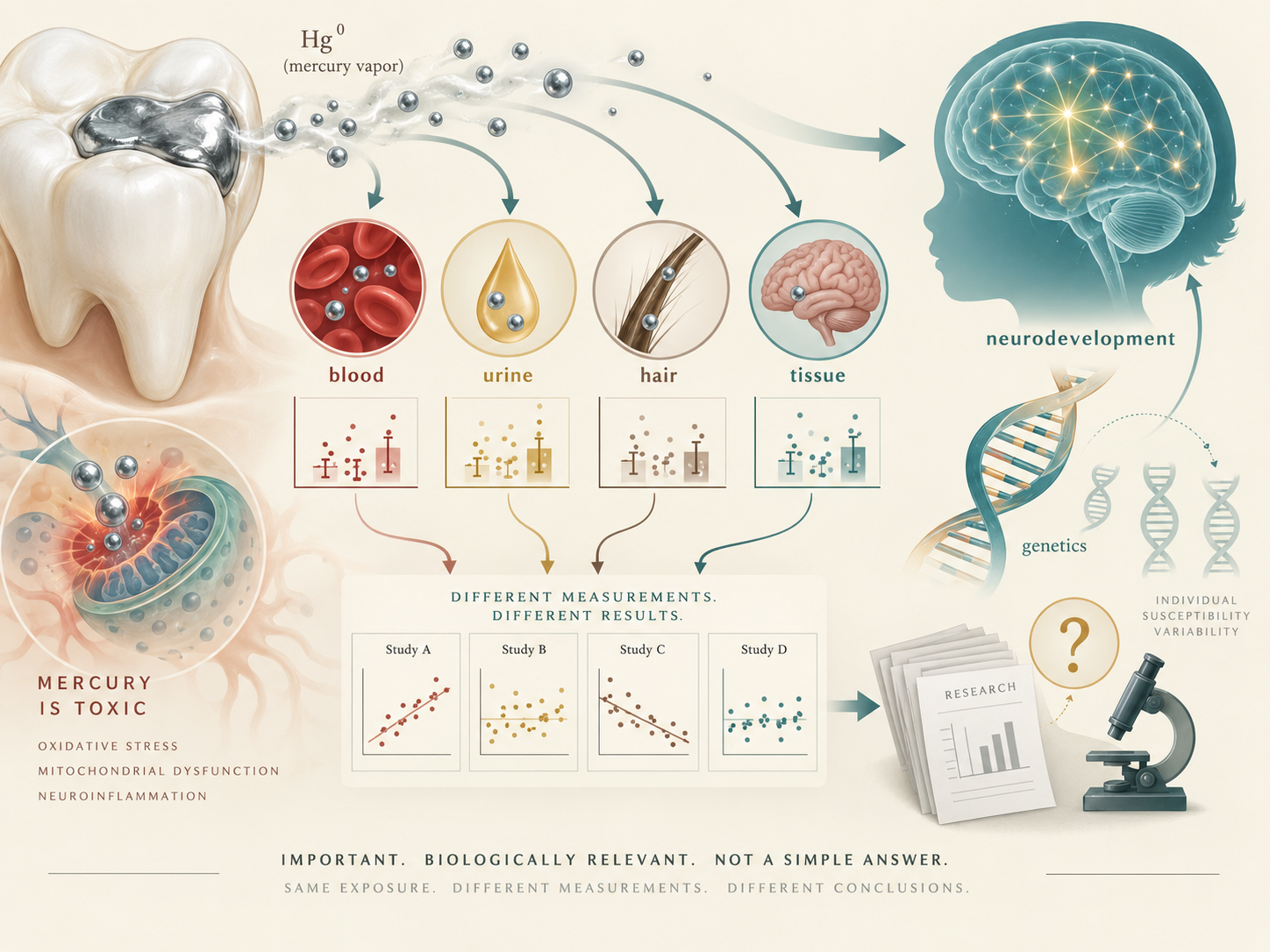
Part 7 of 12 in the Mercury Series
Mercury and Autism: What We Know, What We Don’t, and What We Should Stop Pretending.
Part 7 of the Mercury Amalgam Series
Okay. Now we’re walking straight into one of the most emotionally loaded conversations in all of mercury toxicology:
Mercury and autism.
And because this subject has been screamed about from practically every direction for decades, I think the only useful thing we can do is look carefully at what the science actually shows, what it can't show, and why so much of the existing literature was never particularly well designed to answer the root-cause question in the first place.
Here’s where I’m starting: Mercury is neurotoxic. We've talked about this before. Autism is a neurodevelopmental condition. So asking whether mercury exposure during vulnerable periods of brain development could contribute to autism risk or autistic traits is an absolutely legitimate scientific question.
I cannot look at an autistic child and tell their parents: “Mercury caused your child’s autism.” I'm a dentist and that's not my job. BUT, I'm also a mom. I'm on the spectrum myself, as are my two youngest children. So I come at this from a very personal perspective myself.
The current evidence doesn’t allow me to make that leap that mercury caused all of our autism issues. But I’m equally unwilling to say: “Mercury has nothing to do with autism. Science settled that years ago.” Because science most certainly has NOT settled it that neatly. And when you look at how this research has actually been conducted, you begin to understand why. Good grief. This is exactly why these shorter articles exist. . The real answer takes more than a meme.
A Quick Note About the Reference Numbers
Just like the rest of this series, the regular numbers in brackets—such as [64] or [67]—use the exact same reference numbers as the giant master mercury article. So reference [64] here is exactly the same reference [64] there. The numbers may skip because I’m only using the master references that apply to this particular subject. I promise I still know how numbers work.
You’ll also see references beginning with an A, like [A1]. Those are article-only references I found while expanding this particular question beyond what I covered in the master article. The master article is still the spine. These shorter articles just let us chase one question farther.
Before Anything Else: Mercury Is a Neurotoxicant
We’ve already spent several articles looking at mercury toxicology, so I’m not going to reteach the whole thing here. Elemental mercury vapor can be absorbed through the lungs. It can cross the blood-brain barrier. Mercury can interfere with sulfur-containing proteins, glutathione biology, selenium-dependent enzymes, mitochondria, intracellular calcium, oxidative balance, and other cellular systems that the nervous system depends on.
And in Part 6 we looked at something especially important: Different children can respond VERY differently to mercury exposure because of genetics. [56–59]. So the biological question is completely reasonable. The harder question is:
Does mercury actually contribute to autism in human beings—and if it does, in whom, from what source, during which developmental window, and with what genetic susceptibility?
THAT is where things get difficult.
The Biggest Problem Is That Much of the Literature Was Never Built Very Well to Find Root Cause
This is the part that frustrates me the most. If you genuinely want to know whether an environmental toxicant contributes to a neurodevelopmental condition, there are several things you really need to know.
- You need exposure measurements before and during the developmental window that matters.
- You need to know which chemical form of the toxicant was involved.
- You need repeated measurements rather than one random sample years later.
- You need to know the major exposure sources.
- You need to account for genetics.
- And you need to follow the child forward long enough to see what actually develops.
A huge amount of the mercury-autism literature doesn’t do that. Instead, researchers often measure mercury in blood, urine, or hair after the child is already autistic and then compare those levels with neurotypical children. That can tell us whether the groups differ at the time of testing. It cannot reconstruct what happened in the fetal brain six, eight, ten, or fifteen years earlier.
A 2017 evidence-based review of environmental autism research said essentially this same thing. Compared with the genetics literature, environmental-risk research was still in its infancy, and the authors specifically called for prospective studies, precise exposure measurement, accurate timing relative to critical developmental periods, and genetically informed study designs. [A4]
And incredibly, we’re still saying essentially the same thing now. A 2026 critical review of heavy metals and autism again identified major problems with:
-
exposure assessment,
-
study design,
-
timing,
-
population differences,
-
residual confounding,
-
and the lack of large prospective cohorts with repeated measurements. [A6]
So of course the literature is inconsistent.
The field hasn’t EVER consistently measured the same exposure, in the same biological compartment, during the same developmental period, with the same outcome, while accounting for the same susceptibility factors. Inconsistency is almost baked into the way much of the literature has been designed.
And Research Priorities Matter
I also don’t think we can talk about this honestly without talking about what science has historically chosen to prioritize. NIH itself acknowledged this problem. In 2014, NIH issued a funding announcement specifically designed to stimulate research into environmental contributors to autism. [A5]. The announcement stated that genetic and genomic research had largely been proceeding in parallel with environmental research, with relatively little attention to the interaction between genes and environment.
NIH specifically called for more work on:
-
environmental etiologies,
-
vulnerable developmental periods,
-
metals and other toxicants,
-
biomarkers of susceptibility,
-
and gene-environment interaction. [A5]
So I don’t have to invent some conspiracy theory to say environmental root-cause research has historically lagged behind genetics. NIH said additional attention was needed.
- Research priorities are choices.
- Funding priorities are choices.
- The questions researchers are encouraged and financially able to ask are choices.
- And the literature we ended up with reflects those choices.
I can't prove what was inside the head of every person deciding what got funded. I CAN look at the research record and say that we spent decades building an enormous autism literature while repeatedly failing to collect the kinds of prospective environmental data we would need to answer causation well. That matters.
Autism Diagnosis Can Occur LONG After the Exposure Window
There’s another reason post-diagnosis biomarker studies have such serious limitations. Autism begins in neurodevelopment. Diagnosis happens later. Sometimes MUCH later. Heck, I didn't get my diagnosis until 2026!
A 2025 systematic review examined 420 studies involving late autism diagnosis. Definitions of “late” varied dramatically, extending in some literature to diagnosis at age 55. [67]. Fifty-five. I was 57 at diagnosis. They didn't extend the research enough.
So imagine measuring mercury in an autistic adult at age 35 and then trying to use that sample to determine what their exposure was during fetal brain development. You can’t. The mercury level measured when autism is finally recognized may have very little relationship to the exposure during whatever developmental period ultimately mattered. That is why prospective research is so important.
There's a wrinkle in any kind of research, and that is consumer TRUST. Consumers rarely want to cooperate with ANY kind of invasive questioning that might be asked for prospective studies. So I completely get that researchers are often stuck between a rock and a hard place.
The Biomarker Studies Are All Over the Place—and the Sample Type Helps Explain Why
Now we get to the studies comparing mercury levels in autistic and neurotypical children. A 2020 systematic review and meta-analysis examined 23 mercury studies and found significant overall associations between mercury biomarkers and autism. [64]
But the results changed depending on the biological sample being measured. That's important, because blood, urine, and hair are NOT interchangeable mercury containers.
- Blood reflects circulating mercury.
- Urine is especially useful for elemental and inorganic mercury exposure and tells us something about excretion.
- Hair is used much more often as a marker of methylmercury exposure, particularly from seafood.
So if different studies measure different compartments, they may get different answers even when they’re all technically measuring “mercury.” And then there’s another wrinkle that I think gets missed FAR too often: People do not all excrete mercury equally well.
A urine test measures mercury that is actually making it into the urine. It does not measure every bit of mercury sitting somewhere else in the body. We already looked earlier in this series at a controlled human mercury-vapor experiment where people received essentially the same exposure and then showed enormous differences in how much mercury they eliminated over the following month.
- Same exposure.
- Different human beings.
- Different elimination.
So a person who is excreting a lot of mercury may show a higher urinary mercury level than somebody retaining more of it. That does NOT automatically mean the person with the higher urine level has the larger tissue burden.
And the opposite is equally important: A low urine mercury level does not prove there is very little mercury in the body. The person may be what I call "a hoarder".
Mercury can distribute into tissues including the brain, kidneys, thyroid, pituitary, and even muscle, and some forms can remain in those tissues far longer than they remain elevated in blood or urine. That distinction becomes incredibly important when researchers compare autistic and neurotypical children using a single urine sample and then treat that number as though it represents the child’s entire mercury history. It doesn’t. It represents mercury being excreted in that specimen at that moment.
Which means two children could conceivably have very different tissue retention and still produce urinary mercury numbers that do not tell the whole story. And THAT is another reason I think the future research needs to measure exposure prospectively, repeatedly, and in more than one biological compartment rather than pretending one urine cup can tell us what happened in a developing brain years earlier.
A 2024 systematic review looked at 57 studies involving mercury and autism. [65]. Of those: 35 studies—about 61%—reported a positive association. 22 did not. That gets my attention.
But studies aren't votes.
Thirty-five positive papers do not automatically defeat twenty-two negative ones. Study design, sample size, timing and exposure measurements matter.
The 2024 authors concluded that mercury may be relevant, particularly during critical developmental periods and in susceptible individuals, while emphasizing that the literature remains inconsistent and better research is needed. [65]
Then another 2024 meta-analysis pooled 37 studies and found no statistically significant overall differences in blood, hair, or urinary mercury between autistic and neurotypical children. [66]
That belongs here too. If somebody tells you every study finds higher mercury in autistic children, they’re wrong. But then your question should be - are they trying to compare apples and oranges? Because what did they actually test for?
Because now look what happens when researchers divide the biological samples more carefully.
A 2023 meta-analysis included 60 case-control studies and examined mercury separately in hair, whole blood, plasma, red blood cells, and urine. [A3]. They found no significant difference in:
hair
or
urine.
But mercury was significantly higher in autistic children in: whole blood, plasma, and red blood cells. [A3]
Clearly, they measured different things. They covered the same general subject with a different biological compartment. So they got a different result. That doesn’t tell us WHY those differences existed. But it gives us a pretty obvious explanation for some of the apparent inconsistency.
If you only measure urine, you may conclude: “Nothing here.” If you measure blood, you may see something completely different. That’s why “mercury level” is far too vague a phrase for serious toxicology.
Prospective Studies Are Much More Useful
If we really want to understand whether mercury contributes to autism or autistic traits, the strongest human studies measure mercury before the developmental outcome is known. One useful study came from the Korean Mothers and Children’s Environmental Health cohort. [A2]. Researchers followed 458 mother-child pairs and measured blood mercury:
- during early pregnancy,
- during late pregnancy,
- in cord blood,
- at age two,
- and at age three.
Then they assessed autistic behaviors at age five. Higher mercury during late pregnancy, in cord blood, at age two, and at age three was associated with higher autistic-behavior scores at age five. [A2]. Mercury measured during late pregnancy and in cord blood was also associated with a greater likelihood of children crossing a higher Social Responsiveness Scale threshold.
This study still wasn’t specific to dental amalgam. Blood mercury can reflect multiple sources. And autistic behaviors measured on a screening scale are not identical to a clinical autism diagnosis. But the timing is MUCH more useful. The mercury was measured first. The behavioral outcome came later. That gives us a much better temporal relationship than collecting a urine sample after diagnosis.
Then Another Large Prospective Study Found No Overall Association
Now let’s look at the other side. The British ALSPAC cohort measured maternal total blood mercury during early pregnancy and followed the children prospectively. [A1]
Among 3,840 pregnancies, 45 children were later diagnosed with autism. Researchers found no overall association between higher prenatal total blood mercury and diagnosed autism. [A1]. That’s important negative evidence. There was one interesting wrinkle. Among mothers who ate no fish, higher mercury was associated with poorer social cognition in their children. That relationship didn't appear the same way among mothers who ate fish. [A1]
Account required
Sign in to see more
Create an account or sign in to unlock the full list.