Resource Libraries
Should a Cracked Tooth Be Treated or Watched?
When a cracked or worn tooth can safely be monitored, when waiting becomes risky, and why restraint in dentistry is not the same as neglect.
Short answer: It depends on the crack. Some small cracks and worn areas can be safely monitored, while cracks that cause pain, grow, or reach the nerve need treatment before the tooth splits. Ask your dentist what they are watching for and how often they will recheck it.
Just Because We Can Doesn’t Mean We Should: When Dental Treatment Helps, and When It Harms
One of the hardest concepts for patients to understand is this: Not every dental finding should be treated immediately. And not every problem is safer once it’s “fixed.” At the same time, watching something that later fails can feel catastrophic: especially when that failure happens suddenly, from something as ordinary as biting an almond or hitting a hard seed in a salad.
Both truths matter.
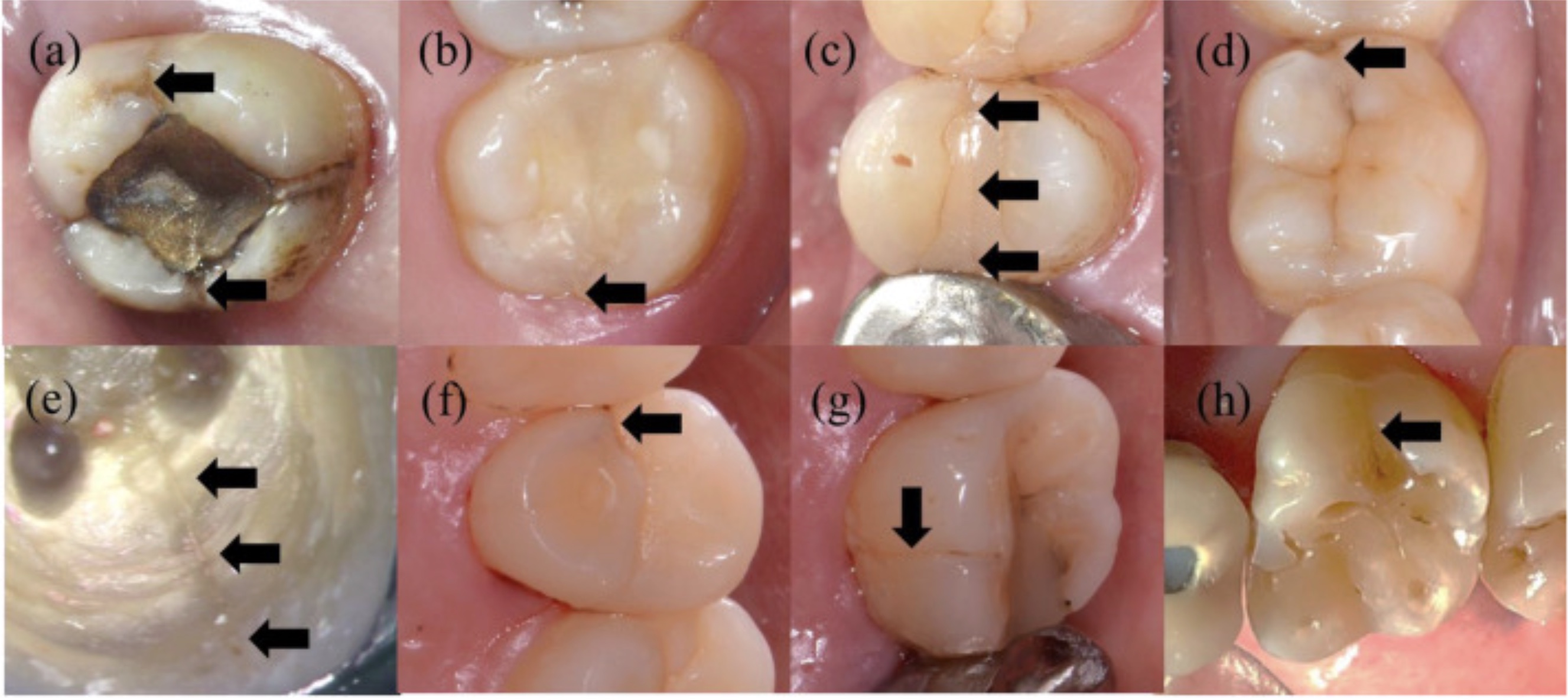
This article exists to explain when active monitoring is appropriate, when it becomes risky, and why restraint in dentistry is not the same as neglect. To give you a pubmed source, here is this one that has some GREAT pictures that I borrowed because they are so very telling about what I am discussing in this article:
Cracked Teeth: Distribution, Characteristics, and Survival After Root Canal Treatment. Journal of Endodontics. 2016. Kang SH, Kim BS, Kim Y. PMID is 26944835
https://www.sciencedirect.com/science/article/pii/S092966462100125X?via%3Dihub
https://pubmed.ncbi.nlm.nih.gov/26944835/
This retrospective study analyzed 175 cracked teeth over a 5-year period and found that the 2-year survival rate after root canal treatment was 90.0%. The most commonly affected teeth were lower second molars (25.1%), and cracks were frequently found in intact teeth (34.3%) or teeth with class I cavity restorations (32.0%). Probing depth greater than 6 mm was identified as a significant prognostic factor, with cracked teeth having deeper probing depths shorter survival rates.
Ferreira Zandoná A et al. (2012) - The Natural History of Dental Caries Lesions: A 4-Year Observational Study. PMID: 22821238.
https://pubmed.ncbi.nlm.nih.gov/22821238
This study tracked 338 children's teeth for four years to see how early cavities progress. Not all early cavities turned into actual holes, only 19% of the mildest lesions progressed to cavitation, while more severe early lesions progressed at higher rates (32-68%). Molars and chewing surfaces were most likely to worsen, showing that cavity severity at detection helps predict future progression.
“Watching” Is Not Doing Nothing
Active monitoring is a deliberate clinical decision, not avoidance. It means:
the finding is understood
the risk is known
the patient is informed
and the situation is being re-evaluated over time
Common examples include:
tiny crazeline cracks without symptoms (not the same as a hairline crack, which can be a warning sign of something imminent)
early wear patterns that are stable
VERY early and mild recession without inflammation or force
asymptomatic root-canaled teeth
bony defects that are inactive, asymptomatic and non-progressive
In these cases, intervening too early can create damage that didn’t yet exist: loss of tooth structure, nerve injury, chronic pain, or irreversible complications.
But Let’s Be Clear: Monitoring Is Not Risk-Free
This is the part that often gets glossed over, and it shouldn’t be. Some monitored conditions can fail suddenly. A tooth with a crack that has been stable for years may:
split during normal chewing
fracture when biting something unexpectedly hard
become non-restorable without warning
That does not mean monitoring was “wrong.” It means biology does not give us guarantees.
Dentistry does not operate in a padded environment. Dentists are not fortunetellers nor are we clairvoyant. People chew. Life happens.
The Real Question Is Not “Treat or Watch”.
It’s “What Are We Risking Either Way?”
Every decision carries tradeoffs.
Treat too early, and you risk:
unnecessary nerve involvement
crown-induced cracks
long-term pain syndromes
irreversible structural loss
committing a tooth to a restoration cycle it may not have needed
Wait too long, and you risk:
sudden fracture
emergency loss of the tooth
Account required
Sign in to see more
Create an account or sign in to unlock the full list.