Resource Libraries
What Is a Jawbone Cavitation? Hidden Infection in the Jaw
What jawbone cavitations are, how the 2025 term Covered Socket Residuum (CSR) describes under-mineralized bone under healed gums, and why it is controversial.
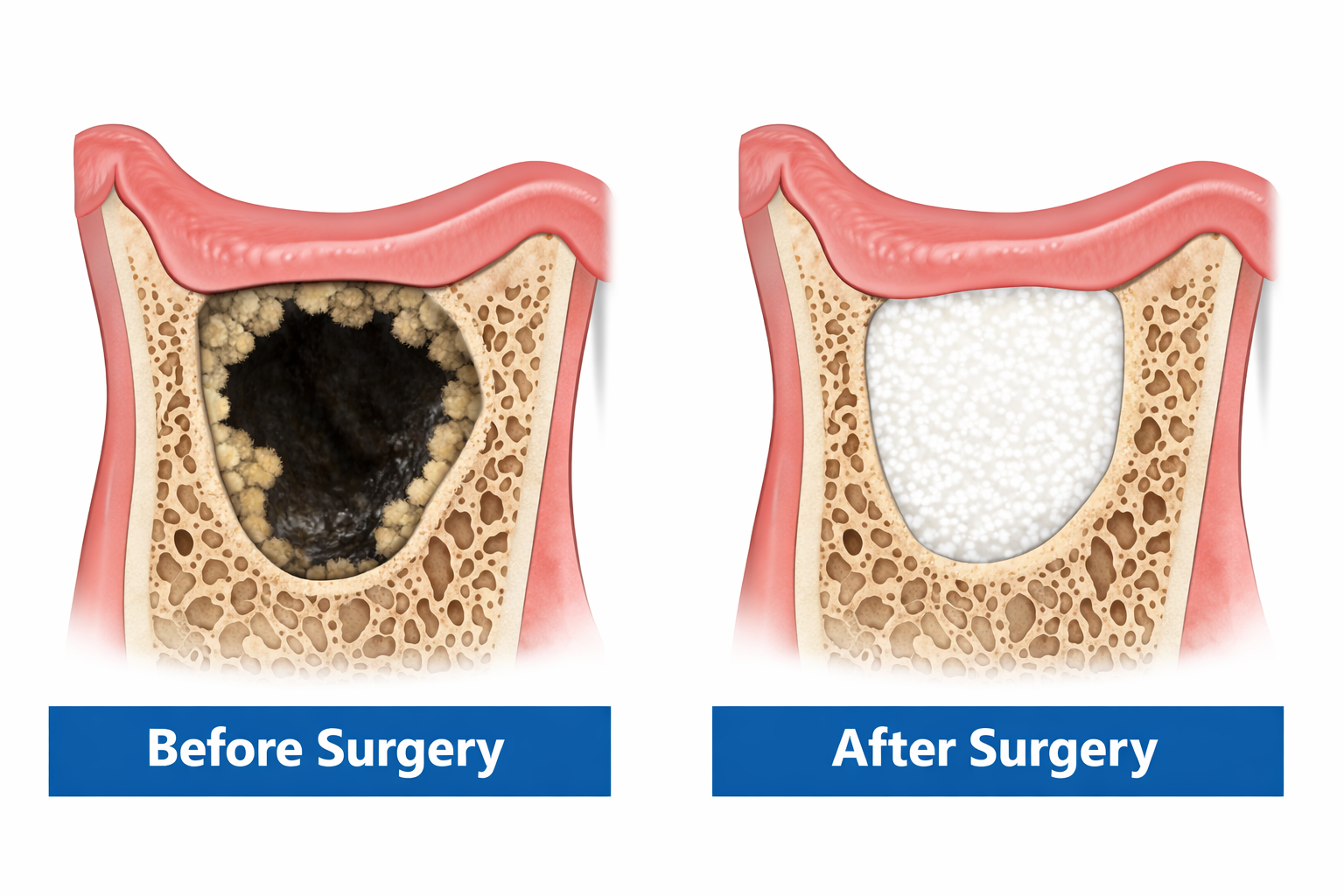
Jawbone "Cavitations" and the New Term CSR: What They Are, Why They Matter, and Why This Topic Causes So Much Grief
If you’ve spent any time in biological dentistry circles, you’ve heard the word cavitation. For some patients it’s the missing puzzle piece that finally explains years of pain or inflammation. For other clinicians, it’s a controversial label that’s been used too loosely — often without clear diagnostic standards - and it gets those of us who do cavitation surgeries and have seen a patient's health turn around, mocked because the conventional world simply doesn't understand.
Based on today’s peer-reviewed literature, here is the fairest way to frame it:
-
“Cavitation” is a catch-all word people use for low-density / under-mineralized areas inside jawbone, often at old extraction sites. Basically, it's a hole in the bone from less than ideal healing when a tooth was extracted.
-
Not all low-density areas are the same thing.
-
A major new idea in 2025–2026 literature is that some of what we’ve been calling “cavitations” may actually be a common healing pattern after extractions, not automatically a disease.
That’s where the term Covered Socket Residuum (CSR) comes in.
1) What people usually mean by “cavitations”
In plain language: a “cavitation” usually refers to an area inside the jawbone that didn’t heal into normal solid bone, even though the gums look closed and healthy on top.
The controversy is that the word gets used for different biological situations, including:
-
A radiology finding (something seen on CBCT or another imaging method)
-
A histology diagnosis (something proven under a microscope after surgery)
-
A symptom story (pain, neuralgia, systemic symptoms) that may or may not match what’s in the bone
When those get blurred together, patients get confused, clinicians argue, and everyone gets cranky.
2) What CSR is (and why it matters)
CSR = Covered Socket Residuum is a descriptive radiology term proposed to reduce confusion.
THE CORE IDEA: after a tooth is removed, the socket can “collapse” and close at the top, while a deeper zone remains under-mineralized (less solid bone). So you end up with:
-
Healed gum surface
-
Mineralized bone near the crest
-
A “hidden” low-density zone deeper in the old socket
The 2025–2026 Ghanaati group argues that CSR may often be a physiologic (normal-ish) outcome of unassisted socket healing, not automatically infection, necrosis, or “osteomyelitis.”
Why CSR can still be clinically important
Even if CSR is “just a healing pattern,” it can still matter because:
-
Implants need dense bone for primary stability. A hidden low-density zone can compromise stability, increase micromovement risk, and complicate planning.
-
2D X-rays can miss internal bone quality problems, so a site can look “fine” until you’re in it.
-
Some low-density sites are not just “soft bone.” In selected cases—especially when symptoms, radiographic patterns, and clinical history raise suspicion—surgical exploration with appropriate sampling may reveal findings such as fatty-degenerative changes, fibrous tissue, cyst-like voids, necrotic bone, or bacterial presence. The important point is: you don’t get to assume which one it is from imaging alone. Imaging can suggest; tissue can confirm.
3) Why this topic causes patients so much grief
Three reasons:
A) The gums can look healed while the bone isn’t fully mineralized
Socket healing is a multi-stage process—clot → granulation tissue → immature bone → remodeled bone. The outside can close while the inside is still remodeling or incomplete.
B) Imaging disagreements are real
-
Conventional 2D films often don’t show these changes well.
-
CBCT can show internal density patterns, but interpretation standards for “what counts” are still evolving.
C) Terminology has been a mess. Historically, the same “bucket” included:
-
NICO (a proposed pain-linked osteonecrosis entity),
-
FDOJ/BMDJ (fatty-degenerative jawbone marrow defects),
-
and generic “cavitations.”
The CSR concept is basically an attempt to say:
“Some of these findings may be normal socket-collapse healing outcomes, and we should stop labeling them as disease by default.”
4) Where Lechner’s work fits (BMDJ/FDOJ as an osteo-immune pattern)
Lechner’s research focus is different from CSR: it’s less about “common socket collapse patterns” and more about a jawbone marrow defect phenotype that may show:
-
very high RANTES/CCL5
-
low TNF-α and IL-6
-
sometimes minimal classic signs of infection on imaging or histology
This is one reason the debate persists: two different frameworks may be looking at overlapping clinical terrain—but they are not identical claims, and the diagnostic standards differ.
5) A Sane Way To Communicate About This Topic:
Here’s the responsible middle path:
-
“Cavitation” is not a single diagnosis. It’s a nickname.
-
Some under-mineralized zones may be a normal outcome (CSR). That’s why symptoms and context matter—not just the picture.
-
Some jawbone defects may represent true pathology (like BMDJ/FDOJ/NICO), but those require more than a casual label—ideally including clinical context and, in selected cases, tissue diagnosis.
-
The best evidence-based “why it matters” today is implant planning, bone regeneration decisions, and avoiding surprises in surgical sites.
About symptoms (and why patients feel gaslit)
Patients with chronic symptoms often feel dismissed when standard X-rays look normal. And when they’ve been bounced around for years with labels—but no root-cause exploration—it can feel like medical gaslighting.
Our vetted biological dentists take symptoms seriously. We look for:
-
symptom timing (Did it start after extractions?)
-
local and regional patterns (jaw pain, neuralgia-type symptoms, chronic facial discomfort)
-
unexplained systemic patterns that persist despite reasonable medical workup
Some biological dentists also consider meridian-based symptom patterns as an additional observational layer. That framework is not considered conventional medical evidence, so we treat it as adjunctive, not diagnostic—but many patients relate to it, and it can help guide the clinical history.
Most importantly, all a biological dentist can do is reduce oral contributors to systemic burden.
We cannot guarantee systemic improvement, because health is multifactorial. Our job is to improve the oral terrain responsibly—and measure outcomes honestly.
What the Science Says (Study Summaries)
Below is the current body of peer-reviewed science most relevant to cavitations, CSR, socket healing, and jawbone immune regulation. The evidence is limited but real, and it is still evolving.
1. Ghanaati, S., Heselich, A., Lechner, J., Sader, R., Bouquot, J. E., & Al-Maawi, S. (2026).
PMID is coming but not available as of the writing of this article
https://www.mdpi.com/2306-5354/13/1/106
Summary:
This review explains that “jawbone cavitations” have been described under many names, causing confusion. The authors propose Covered Socket Residuum (CSR) as a radiology description for under-mineralized zones that can remain inside healed extraction sites. They argue CSR may often be a normal outcome of socket collapse and incomplete ossification, not automatically a disease. CSR still matters for implant planning, because hidden low-density zones may reduce implant stability. They stress that 2D X-rays often miss CSR, CBCT helps, and better prospective studies are needed.
2. Ghanaati S, Kamalov A, Bouquot J, Sader R, Heselich A, Al-Maawi S (2025)
PMCID: PMC12650417
https://pmc.ncbi.nlm.nih.gov/articles/PMC12650417/
Summary:
This randomized split-mouth clinical trial studied healing after wisdom tooth extraction. One side was treated with platelet-rich fibrin (PRF) alone, while the other side received bone substitute material plus PRF. Six-month CBCT scans showed that PRF-only sites often had covered socket residuum (CSR)—areas of incomplete bone mineralization under healed surface bone—while grafted sites showed more complete bone formation. Pain and swelling were similar between groups. The study suggests CSR is a common healing outcome after unassisted socket healing and may matter for implant planning.
3. Udeabor SE, Heselich A, Al-Maawi S, et al. (2023)
PMID: 37892875
Account required
Sign in to see more
Create an account or sign in to unlock the full list.