Resource Libraries
Informed Consent in Dentistry Is a Process, Not a Form
What real informed consent in dentistry requires, why a signed form is not consent, and how a dentist explains risks, alternatives and the option to decline.
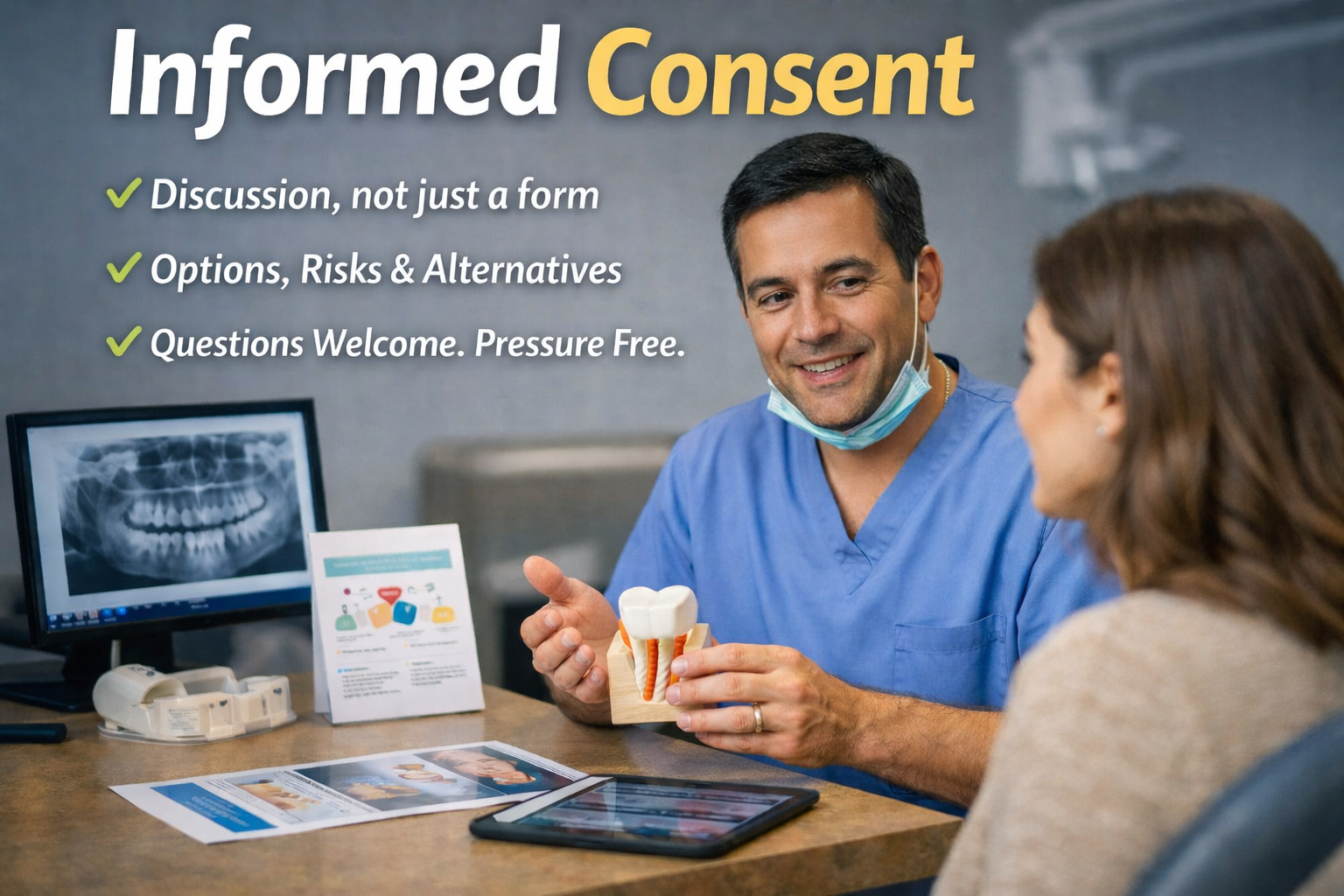
Informed Consent in Dentistry Is Not a Form — It’s a Process
What Ethical, Transparent Dental Care Should Actually Include
In dentistry, informed consent is often treated as paperwork.
A signature.
A checked box.
A form handed to you five minutes before treatment that you just rush to sign without reading.
But true informed consent is not a document — it's a process — one that respects patient autonomy, acknowledges uncertainty, and treats patients as active partners in decision-making rather than passive recipients of care. This article outlines what informed consent should include across all areas of dentistry: general dentistry, specialty care, oral surgery, orthodontics, periodontics, endodontics, implant dentistry, and airway-centered orthodontics. The purpose is to ensure patients have clarity before they are sitting in the chair. Many patients only realize what they don’t fully understand days after a treatment plan has been presented — or sometimes the night before an appointment. No one should ever feel that they are going in for a procedure without having had all of their questions answered.
After reading this article, you will have a better understanding of what the process of informed consent is, and will understand how important it is to ask questions – at ANY point in the process – to ensure you are fully aware of and comfortable with all aspects of any procedure or treatment.
What Informed Consent Actually Means
True and valid informed consent can only be accomplished via a fully-transparent dialogue between patient and dentist. It is imperative that the dentist spends the time necessary to ensure the patient fully understands:
-
what is being recommended
-
why it is being recommended
-
what the realistic alternatives are (including doing nothing)
-
what the risks and limitations are, even when care is performed correctly
-
what uncertainties exist
-
what could change mid-procedure
-
what responsibilities the patient has after treatment
-
that consent can be refused or withdrawn
True informed consent cannot involve pressure or coercion. If a patient still has unanswered questions or lingering hesitation, consent has not been achieved. A critical, but rarely discussed, part of informed consent is emotional readiness. There are times when a patient may intellectually understand a procedure but does not yet feel ready to proceed. If the patient is not yet emotionally there and at peace with the process, consent is not complete.
Consent must be given before treatment begins.
A dentist is ethically and legally obligated to refuse treatment if a valid consent is not in place. If consent is to be withdrawn, it must happen prior to the procedure starting. Once the drill has started, we can't undo the destruction of tooth structure. Once a tooth is pulled, it can't be put back. So consent MUST be achieved prior to the beginning of the process. It must be understood that when a person is sedated, they cannot consent properly, as they are under the influence of a drug. As sedation removes awareness, your ability to stop mid-procedure is limited. Therefore, pre-procedure clarity is essential.
Some patients believe they can cross out sections of an informed consent form and still proceed with care. That is not how informed consent works in any legitimate medical or dental setting. A consent form is a legal and ethical agreement—not a menu. Period.
Informed Consent Is a Process, Not a Moment
Ethical consent happens before treatment begins—not after instruments are out. It involves:
-
dialogue, not monologue
-
time, not urgency
-
transparency, not reassurance-by-omission
Patients do not need certainty. They need clarity.
A critical—but rarely discussed—part of informed consent is emotional readiness. There are times when a patient intellectually understands a procedure but does not yet feel ready to proceed. In those situations, the ethical response is not persuasion. It is PAUSE.
I have refused to perform procedures when it was clear a patient was not emotionally settled or fully comfortable—even when the treatment was clinically appropriate. Not because the procedure was wrong, but because consent was incomplete without the emotional consent.
If a patient still has unanswered questions, lingering hesitation, or a sense of pressure, consent has not been achieved. The correct response is to slow down, stop, and revisit the conversation later. No dental procedure is so urgent that it justifies overriding a patient’s internal “not yet.” Dentistry isn't a car crash where a person is impaled on the steering wheel. Dentistry has room for the PAUSE.
Why This Article Exists
This article exists to give patients clarity before they are sitting in the chair. Many patients only realize what they don’t fully understand after a treatment plan has been presented—sometimes days later, sometimes the night before an appointment. That is not a failure of intelligence. It is a failure of timing. This resource is meant to:
-
answer common questions in advance
-
explain why treatment plans sometimes evolve
-
help patients identify what matters most to them
-
empower patients to ask better questions
-
prevent last-minute cancellations driven by uncertainty rather than disagreement
When patients back out at the last minute, it is often because informed consent happened too late in the process—not because the treatment itself was wrong.
The Reality No One Likes to Say Out Loud: Dentistry Is Also a Business
Dental offices are businesses.
Time matters.
Time is finite.
And Time is money. The longer things take, the more expensive they get. The dentist would have to make up the money they need to cover the business's expenses. And we realize better than most the costs involved in high-quality biological dentistry. So, in an effort to save consumers time and money, our goal is to help the consumer in THIS space to help our vetted providers out.
True and valid informed consent takes time—time to explain, time to answer questions, time to revisit uncertainty, and time to pause when someone isn’t ready. Modern dentistry operates under real constraints: tight schedules, high overhead, insurance pressures, and staffing realities. Acknowledging this does not excuse poor consent—but pretending it doesn’t exist helps no one.
The ethical failure occurs when time pressure is resolved at the patient’s expense.
This article exists to offload time pressure without offloading responsibility by moving complex explanations earlier in the timeline—where they belong.
This does not replace conversation.
It makes conversation better.
The Complexity of a Procedure Increases the Obligation for Consent
More invasive or complex procedures do not justify shortcuts in consent.
They demand more transparency, not less. This applies especially to specialty and surgical care, including:
Specialty & Surgical Procedures
-
wisdom tooth extractions
-
impacted tooth removal
-
sinus lifts and advanced bone grafting
-
implant placement and restoration
-
sequestrectomy and jawbone surgery
-
biopsies
-
endodontic (root canal) therapy
-
IV or oral sedation
Each carries increased biologic variability, higher risk profiles, and greater dependence on patient aftercare and systemic health. Patients deserve adequate time and information before consenting.
Airway-Centered Orthodontics: The Most Overlooked Consent Failure
One of the largest gaps in informed consent today is in airway-centered orthodontics. Most patients are never told:
-
they may have an inadequate airway
-
clenching, grinding, crowding, fractures, and relapse may be airway-driven
-
orthodontic decisions influence facial growth, jaw position, tongue posture, and long-term breathing
Procedures requiring robust consent include:
-
palatal expansion (children and adults)
-
orthodontic appliances intended to create airway space
-
orthodontic camouflage that narrows arches or retracts teeth
-
non-surgical vs. surgical expansion decisions
Patients cannot consent to risks they were never told existed.
What Patients Are Actually Consenting To
Risks of Common Procedures
Common, Less Common, and Rare Possibilities — Explained Without Fear
This section is not meant to scare you. It is meant to remove surprises. Dentistry involves living tissue, bone, nerves, blood supply, immune response, airway dynamics, and an individual’s healing capacity. As with any medical procedure, outcomes vary even when procedures are performed correctly. The following is a list of procedures and their associated risks:
Oral Surgery (extractions, impacted teeth, jawbone access, sequestrectomy)
Common Issues or Complications (expected, usually temporary)
-
pain, swelling, bruising
-
bleeding during early healing
-
soreness when opening mouth
Less Common (manageable, but important)
-
dry socket
-
infection
-
sinus communication (upper teeth)
-
temporary numbness or tingling of lips, tongue, chin, or gums
Rare Issues and Complications (must be disclosed)
-
prolonged or permanent nerve disturbance
-
jaw fracture
Jaw fracture is rare and related to bone quality, infection, ankylosis, or anatomy—not typically poor technique.
Sedation & Anesthesia (local, oral, IV)
Common Issues and Complications
-
prolonged numbness
-
grogginess or nausea
-
transient anxiety or heart-racing
Less Common Issues
-
allergic reactions
-
blood pressure or heart rate changes
Rare Issues
-
serious respiratory or cardiovascular reactions
Sedation removes awareness—and your ability to stop mid-procedure—making pre-procedure clarity essential.
Bone Grafting & Sinus Lifts
Common Issues
-
post-operative soreness
-
extended healing timelines
Account required
Sign in to see more
Create an account or sign in to unlock the full list.