Resource Libraries
Mercury Exposure in Dental Hygienists and Dentists
What decades of studies show about mercury exposure in dental hygienists and dentists, including tremor, memory and fertility effects, and why it was ignored.
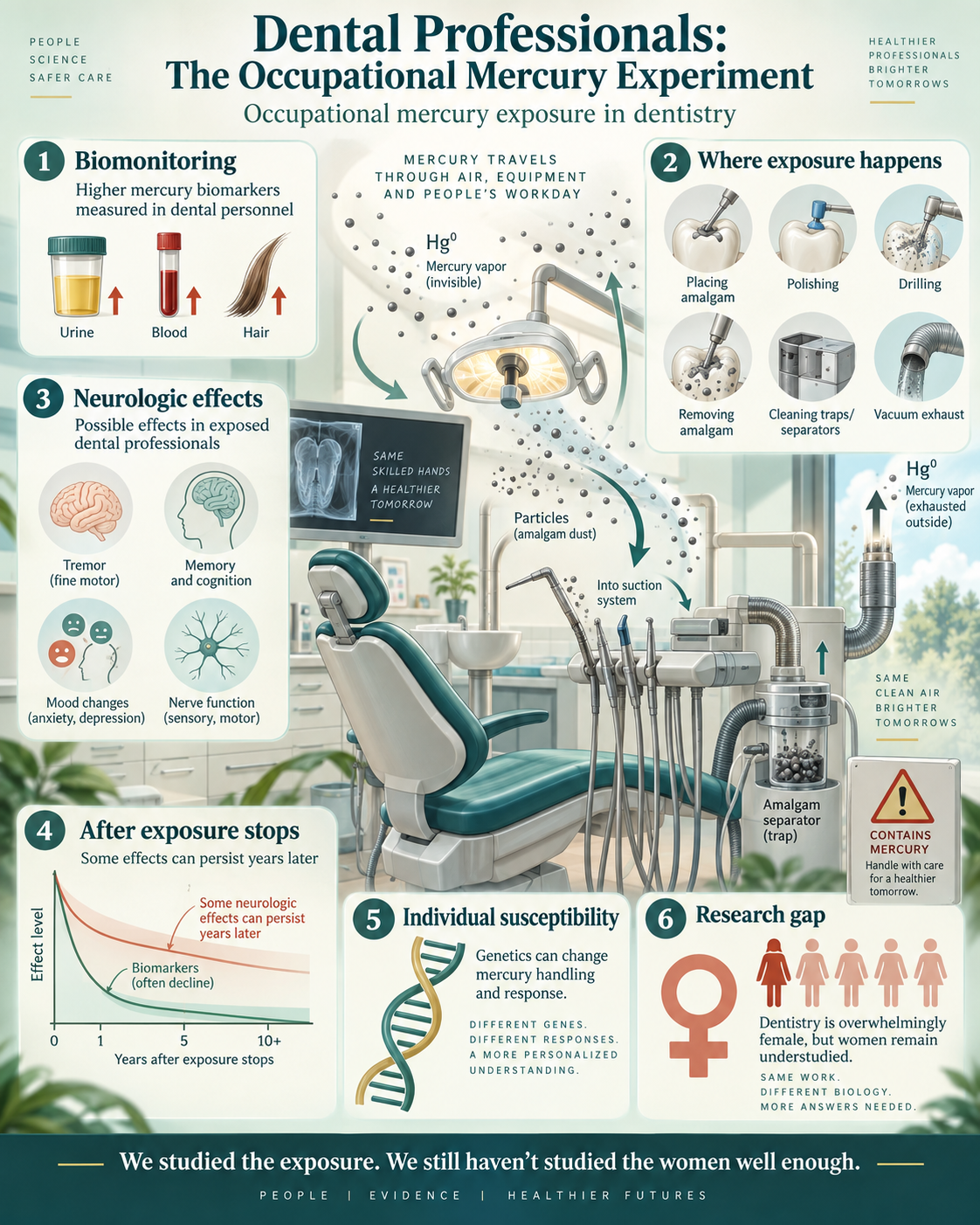
Part 9 of 12 in the Mercury Series
Dentistry’s Mercury Blind Spot: Dental Professionals Have Been the Occupational Experiment
Part 9 of the Mercury Amalgam Series
For most of this series, we’ve been talking about the patient.
- How much mercury leaves an amalgam filling.
- Where it goes.
- What happens during pregnancy.
- What happens in children.
- What happens in the brain, kidneys, thyroid, immune system, and microbiome.
But there’s another population we cannot possibly leave out of this conversation: The people who have spent entire careers working around mercury amalgam.
- Dentists.
- Dental hygienists.
- Dental assistants.
- Sterilization staff.
- Business team members.
Yes, even business-team members who may not be standing over the tooth but still work inside the same building where amalgam is placed, polished, drilled, suctioned, removed, stored, and cleaned out of traps and vacuum systems. For decades, dentistry has talked about mercury primarily as a patient-material question. I think we have dramatically underappreciated the fact that it is also an occupational-health question.
And when I look at who actually makes up the dental workforce, one part of that failure bothers me more than anything else: Dentistry is overwhelmingly female, and our occupational mercury science in women is nowhere near good enough.
A Quick Note About the Reference Numbers
Just like the other articles in this series, references shown with regular numbers—such as [76] or [79]—use the exact same numbers as the complete master mercury article. Reference [76] here is exactly the same reference [76] there. That means the numbers may skip. I haven’t misplaced the missing studies, and yes, I still know how to count. They simply support other parts of the mercury story.
You’ll also see references beginning with an A, such as [A1]. Those are article-only references I added while expanding this particular subject beyond what I covered in the master article. At the bottom, I’ll give you the complete citation and direct link for every source used here.
Occupational Mercury Exposure Didn’t Disappear When We Stopped Mixing It by Hand
Dentistry today looks VERY different from dentistry just 4 decades ago. There was a time when dental personnel manually measured liquid elemental mercury and mixed it with alloy powder. BY HAND. WITHOUT GLOVES OR MASKS.
People handled amalgam scrap. Mercury spills happened and there was no real hazmat kind of procedure. Floors, carpets, cabinets, instruments, traps, and vacuum systems could become secondary contamination sources. Encapsulated amalgam was an enormous improvement because it removed one very obvious opportunity for direct exposure. But encapsulation did not make occupational mercury exposure disappear.
Dental personnel can still encounter mercury while amalgam is:
- placed,
- carved,
- polished, including in hygiene appointments
- drilled,
- removed,
- suctioned,
- collected in traps or separators,
- or discharged through dental vacuum systems.
A major review of occupational mercury exposure in dentistry concluded that exposures have generally fallen as amalgam use and workplace practices have improved, but dental personnel still represent an occupationally exposed population. [76]. So yes, dentistry has gotten better. That's GREAT. But better exposure control is not the same thing as no exposure.
We Can Actually Measure the Occupational Contribution
One of the most useful studies involved 630 dental professionals recruited at an American Dental Association meeting. [77]. Researchers measured mercury in: urine, blood, and hair. As we’ve already discussed, those biomarkers don’t tell us exactly the same thing.
- Urinary mercury is especially useful when looking at elemental and inorganic mercury exposure.
- Blood and hair are influenced much more strongly by methylmercury from seafood.
The dental professionals had higher mercury concentrations in urine, blood, and hair than the general U.S. population. [77]. More importantly, urinary mercury was associated with occupational variables. It increased with things including:
- years working in dentistry,
- hours worked and
- amalgam handling.
- Their own amalgam fillings also contributed.
Fish consumption, meanwhile, predicted blood and hair mercury much more strongly. [77]. That separation is incredibly useful because it makes it harder to wave away every mercury biomarker in a dental professional with: “Maybe they just eat a lot of tuna.” The dietary and occupational patterns looked different.
Now We Need to Talk About WHO the Dental Workforce Actually Is
This part makes me crazy. In 2025, approximately 95% of U.S. dental hygienists were women. About 92% of dental assistants were women. [88]. Women also represented approximately 39.6% of professionally active dentists in 2024, and the female proportion is much higher in younger age groups. Roughly half of dentists age 35 and younger are women. [89]. Among first-time, first-year U.S. dental-school enrollees in fall 2024. 58.1% were women. [90]
So the future of dentistry is not merely “including more women.” The incoming dental profession is now majority female. And many hygienists, assistants, and younger dentists are working during exactly the decades in which they may be:
- menstruating,
- trying to conceive,
- pregnant,
- breastfeeding,
- or moving through major hormonal transitions.
That should matter enormously when we design occupational-health research. Instead, much of the mercury literature historically studied men, mixed-sex populations without enough women for meaningful analysis, or dental workforces from eras that looked completely different from the workforce we have now.
I think it's a DEPLORABLE gap in the science.
Female Reproductive Health Is Exactly Where We Needed Better Research
Mercury isn't the only reproductive hazard that has ever existed in a dental office. Nitrous oxide, sterilizing chemicals, radiation, disinfectants, and other occupational exposures have all been studied. That makes dental reproductive epidemiology difficult because multiple exposures can exist at the same time. But mercury absolutely belongs in the conversation.
One of the most interesting studies examined 418 female dental assistants who had become pregnant within the previous four years. Researchers asked about amalgam work and how many menstrual cycles it took them to conceive. [A1]. Women with the highest estimated occupational mercury exposure—those preparing at least 30 amalgams per week while also reporting five or more poor mercury-hygiene practices—had a fecundability only about 63% that of unexposed women.
In normal English, it means their probability of conceiving during any given menstrual cycle was SIGNIFICANTLY lower. [A1]. But here’s where the study got weird. Women in the lower-exposure categories actually appeared MORE fertile than the unexposed group. That U-shaped pattern is one of the reasons the authors themselves called for better research using actual biological mercury measurements rather than relying solely on questionnaire-based exposure estimates.
So I’m not going to turn this into: “Mercury exposure makes dental assistants infertile.” That isn't what the study proves. But the high-exposure finding absolutely gave researchers a reason to investigate further. And we should have.
Some Studies Found No Reproductive Signal
There is negative evidence too, and it belongs here.
A 1985 study surveying dentists and dental assistants did not find increased rates of spontaneous abortion or congenital abnormalities when comparing workers with lower versus higher occupational mercury exposure. [A2]. And a 2006 review of reproductive outcomes among dental personnel concluded that evidence linking elemental mercury exposure with spontaneous abortion, congenital abnormalities, or impaired fertility remained limited.
The strongest reproductive occupational evidence in dentistry at that time involved nitrous oxide rather than mercury. [A3]. That's important. I’m not interested in cherry-picking only the studies that concern me. But “the evidence is limited” is also not the same thing as: “We thoroughly studied women in dentistry and found nothing.” Those are VERY different statements.
Then a Pregnancy Cohort Found Something Concerning
A 2018 cohort study followed 64 pregnant dental staff members and 60 pregnant workers without dental mercury exposure. [A4]. The dental staff had significantly higher urinary mercury throughout pregnancy. They also had lower measured antioxidant activity.
And compared with the unexposed group, the dental workers experienced more:
- spontaneous abortions,
- preeclampsia, and
- babies who were small for gestational age.
Those findings are concerning. But the study was small. It was observational. Dental employees WILL have multiple workplace exposures. And a study of 124 pregnant women is nowhere near large enough for me to declare that occupational mercury caused those outcomes.
Still, it measured actual urinary mercury during pregnancy rather than trying to reconstruct exposure years afterward. And I think those findings deserved replication in much larger cohorts. Where are they? This is exactly what I mean when I say the science in women is not nearly good enough.
What About Women Decades After Working With Mercury?
Another study followed a particularly interesting group: New Zealand school dental nurses. These women had worked with both silver and copper amalgam decades earlier, often without gloves or modern ventilation systems. Researchers located 43 mercury-exposed women and 32 matched controls approximately 30 years later. [A5]
On cognitive testing, the two groups were generally similar. That's important negative evidence. The exposed group did NOT show sweeping cognitive impairment three decades later. But the mercury-exposed women reported significantly more current health symptoms and showed differences in reproductive-health history, particularly early hysterectomy. [A5]
- Small study.
- Retrospective history.
- Old workplace conditions.
Definitely not enough to prove mercury caused those reproductive outcomes. But this is one of the relatively rare long-term studies specifically involving women who actually worked around dental mercury. And THAT'S exactly the population we should have studied much more extensively.
The Neurological Occupational Literature Is Interesting Too
A study involving 13,906 U.S. dentists examined occupational mercury exposure over more than two decades. [78]. There was no association between occupational elemental-mercury exposure and multiple sclerosis. That's useful negative evidence.
But urinary mercury was associated with a higher prevalence of tremor, and cumulative occupational exposure was associated with tremor among dentists younger than 51. [78]. A broader occupational review also found that chronic low-level mercury exposure in dental personnel had been associated across studies with complaints including:
- fatigue,
- weakness,
- memory problems,
- mood changes,
- and other neurological symptoms. [76]
Not every study finds every effect. And occupational conditions have changed enormously over time. But collectively, the literature makes one thing very hard to argue:
Dental personnel have experienced measurable occupational mercury exposure. The debate is over exactly how much harm that exposure produces, in whom, at what dose, and under which workplace conditions.
Suction Doesn't Make Mercury Vanish
This next study fascinates me because it shows how easy it is to misunderstand engineering controls. We use suction. Great. Where does what we suction actually GO? Researchers measured mercury vapor coming from the exhaust of three dental vacuum systems. [79]
Mean mercury concentrations in the exhaust ranged from approximately: 35 to 74 μg/m³. Ambient outdoor air measured roughly 1,000 feet away contained about: 0.013 μg/m³. That's an ENORMOUS difference. [79]. The lesson isn’t that suction is bad. Suction is essential. The lesson is that capturing the mercury is only one part of containing it.
If mercury-containing material enters a vacuum system, the design, filtration, separation, maintenance, trapping, and exhaust of that system all matter. The mercury doesn’t cease to exist because it disappeared down a suction line. That will become VERY important in Part 10 when we talk about what happens during actual amalgam removal.
What Happens When Occupational Exposure Stops?
One study followed 10 dentists and dental nurses before and after a long summer break from work. [80]. After researchers accounted for environmental exposure and mercury from the workers’ own amalgam fillings, they estimated that the occupational contribution to urinary mercury had a median half-time of approximately 41 days.
That sounds pretty encouraging, right? Stop the exposure and urinary mercury falls. GOOD. That's exactly what I want to happen. But remember what urine measures. It measures mercury being excreted. It doesn't give us a complete inventory of mercury that may already have distributed into tissue.
A larger review of approximately 30 studies of recovery following elemental-mercury neurotoxicity found that most people improved at least partially after exposure ended, but the degree and speed of recovery varied tremendously. [81]. Psychomotor functions often improved substantially in the first several months. Some neuropsychological effects improved more slowly or incompletely.
And one thing the researchers could NOT adequately explain was why recovery varied so much from person to person. [81]. That question should sound familiar by now.
Genetics Changes Mercury Handling in Workers Too
Human research has shown that genetic variation in glutathione-related pathways can affect mercury retention and elimination. One study involving 309 people with varying elemental-mercury exposure examined genes involved in glutathione production and mercury metabolism. [83]
A variant in GCLM, a gene involved in glutathione synthesis, was associated with differences in mercury concentrations in blood, plasma, and urine. The elimination half-time differed dramatically by genotype—in one comparison, approximately 34 days versus 77 days. [83]. More than twice as long. Same toxic element. Different human biology.
Account required
Sign in to see more
Create an account or sign in to unlock the full list.