Resource Libraries
Dental Amalgam Is Not Inert: What Makes Mercury Leave the Filling?
Whether mercury leaks from amalgam fillings, how chewing, grinding and brushing raise vapor release, and why a 50 percent mercury filling is never inert.
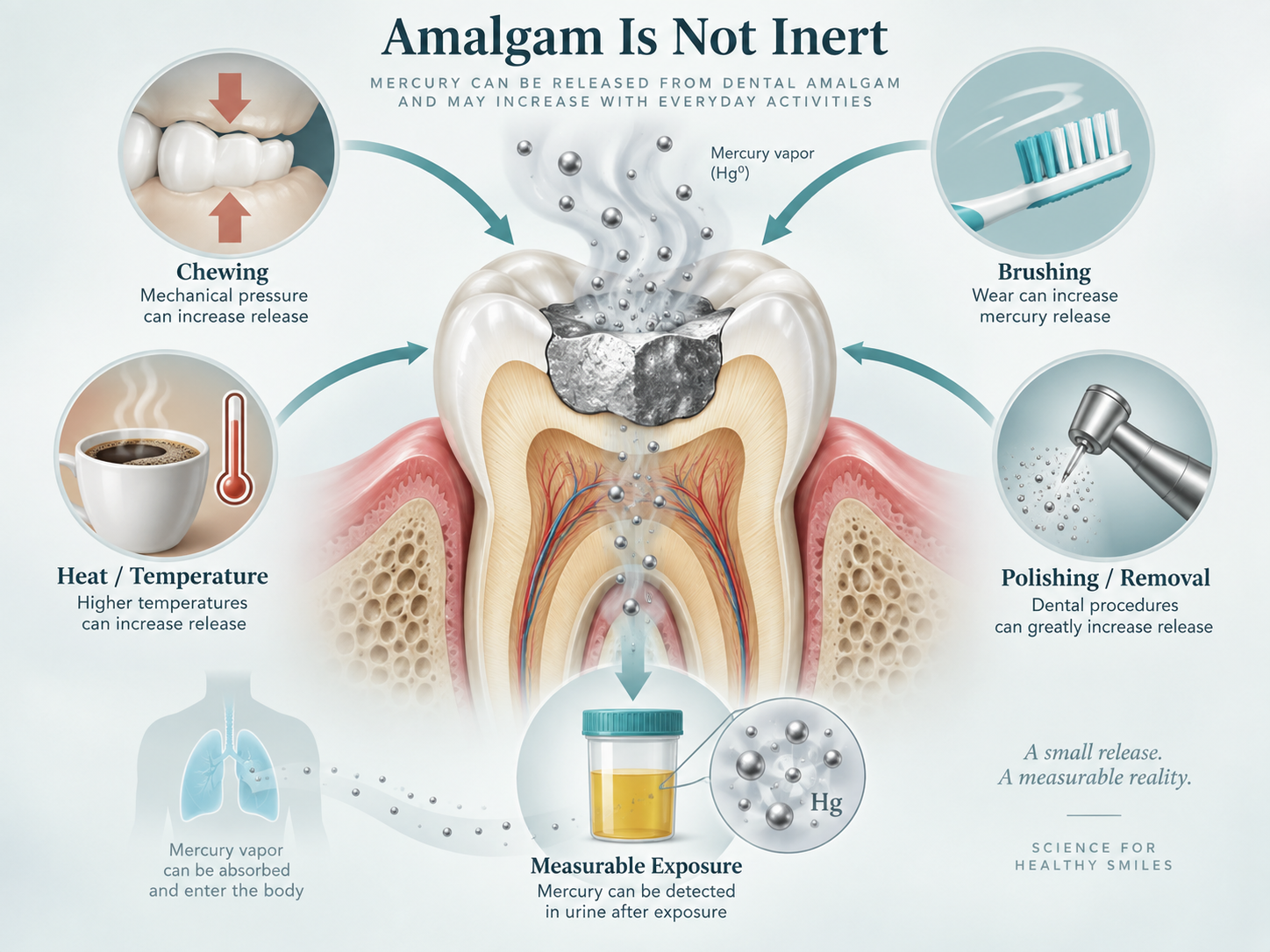
Short answer: Amalgam is not inert. Studies have measured mercury vapor coming from set fillings, and chewing, grinding, brushing, heat and polishing can increase the release. That does not mean everyone with a silver filling is mercury toxic or should rush to have it removed.
I originally sat down to write one article about dental amalgam and mercury. Then I kept finding more science. And more science. And MORE science. Eventually the thing turned into a roughly 30,000-word, 90-page monster with 107 references covering mercury release, blood and urine levels, tissue accumulation, kidneys, pregnancy, breastfeeding, childhood development, genetics, autoimmunity, the microbiome, occupational exposure, mercury-safe removal, and what happens after removal. That is a ridiculous amount of information to expect anyone to absorb in one sitting. 😂
This website was originally written primarily for consumers, but dentists, hygienists, assistants, physicians, and other health professionals read these articles too. So I’m trying to do two things at the same time: explain the science in language a normal human can understand, while still putting the actual research right there for the people who want to check me.
That’s why I divided the master review into 12 shorter articles. These don’t replace the master article. They let us slow down and look at one piece of the mercury story at a time. And we have to start with the most basic question:
Once an amalgam filling hardens, does mercury still come out of it? Yes. Researchers have measured it and published it, and I've got it in this article, for your reading pleasure.
A Quick Note About the Reference Numbers
You’ll see two kinds of citations in this series. Regular numbers such as [10] or [14] are the exact same reference numbers used in the 107-reference master mercury article. I’m keeping them that way on purpose, which means the numbers in an individual article may skip. I haven’t forgotten how to count. Those missing numbers simply belong to studies used in other parts of the master article.
You may also see references such as [A1] or [A2]. Those are article-only references I added while expanding this particular topic. They weren’t in the original 107-reference bibliography, but they help us answer the narrower question more completely. Every source used here is listed at the end with a direct link and a short summary so you can see very quickly what the study actually found.
First, What Is Dental Amalgam?
Dental amalgam is what most people were taught to call a silver filling, which is a pretty spectacular marketing name for a material that is approximately 50% elemental mercury by weight. The other half is primarily a powdered alloy containing silver, tin, and copper. The dentist mixes that alloy with liquid elemental mercury, the metals react, and the material hardens into a restoration. The FDA says all of that plainly. It also says that completed amalgam restorations release low levels of mercury vapor that can be inhaled and absorbed through the lungs. [1]
That last part matters because people often hear the word hardens and mentally translate it into sealed forever. It's not the same thing, but I can see where people might think it is. So let's discuss it.
The mercury doesn’t disappear when the amalgam sets. It becomes part of a solid metallic material, but that material can still release elemental mercury vapor. Even reviews that ultimately conclude that the epidemiologic evidence is reassuring for many health outcomes acknowledge that small amounts of mercury are continuously released from amalgam restorations. [2]
This is also why comparing amalgam with a ceramic simply because both contain elements with scary-sounding names doesn’t make chemical sense. In zirconia, for example, zirconium is present as zirconium dioxide in a ceramic crystal structure. Alumina-containing ceramics contain aluminum in oxidized, chemically bound forms, not little reservoirs of elemental aluminum metal sitting there waiting to evaporate.
Amalgam is different. It begins with liquid elemental mercury, and some of that mercury remains capable of reaching the surface and leaving as vapor. So the useful scientific question isn’t whether mercury can leave a hardened amalgam. That part is already established. The useful questions are
- how much comes out,
- what changes the amount released,
- how much is absorbed,
- where it goes, and
- what that means biologically.
Part 1 of this 12 part series is about the first two.
Chewing Changes Mercury Release
One of my favorite experiments in this entire subject is wonderfully simple. Björkman and Lind measured mercury evaporation directly from the mouths of people with amalgam fillings. After five minutes of chewing gum, mercury release increased substantially and reached as high as 2.7 nanograms per second. Then the researchers covered the individual amalgam teeth with plastic covers. Mercury evaporation dropped immediately by 89–100%. [10]
I love this study because there isn’t much room for philosophical gymnastics. When you cover the amalgam surfaces and almost all of the measured mercury evaporation disappears, you have done a pretty impressive job of identifying the source. And that wasn’t the only human study to find a chewing effect.
Vimy and Lorscheider compared people who had amalgam restorations with people who had none. Before chewing, mercury-vapor concentrations in the amalgam group were about nine times higher than in the controls. After ten minutes of chewing, mercury vapor in the amalgam group increased roughly six-fold over its own baseline and reached about 54 times the concentrations measured in people without amalgam. Release also increased with the number and type of amalgam restorations. [11]
An earlier study by Svare and colleagues found the same basic pattern. People with amalgam had more mercury in expired air before chewing, and after chewing their levels increased an average of 15.6-fold. The people without amalgam did not show that increase. [A1]. Another study took a slightly different approach. Ahmad and Stannard measured mercury release and then covered amalgam with a sealant. Covering the amalgam significantly reduced mercury release during mechanical agitation in the laboratory and significantly reduced mercury vapor after chewing in patients. [A2].
These were several different investigators, using different methods who experienced the same general observation. Mechanical activity changes mercury release.
Brushing and Heat Matter Too
Brushing has been tested as well. Dérand studied amalgam under controlled laboratory conditions and found that brushing the surface with toothpaste produced an immediate increase in mercury-vapor release. Higher temperature increased release too. [12]. And before anybody takes the wrong message from that sentence: please brush your teeth. For the love of everything holy, I am NOT recommending plaque as a mercury-reduction strategy. The point is that abrasion matters.
Temperature matters too. In the Björkman and Lind human study, raising the rinse-water temperature from 35°C to 45°C, about 95°F to 113°F, increased average mercury evaporation about 1.7 times. [10]. That doesn’t mean a cup of hot coffee gives someone mercury poisoning. That would be an absurd leap from the data. It means something much simpler: amalgam doesn’t sit in the mouth as a biologically isolated little brick whose mercury content never changes its interaction with the environment.
Real mouths chew. They brush. They grind. They drink cold water and hot coffee. Temperature and mechanical forces change all day long. A controlled artificial-mouth study reached a similarly useful conclusion. Berdouses and colleagues measured mercury release from amalgam restorations while simulating chewing and brushing. They found measurable release, while also estimating a very low steady-state daily dose from a single filling under their model. [A3]
I actually like including that study precisely because the authors’ dose estimate was reassuring. The question in this article is not, “Does every measurable molecule of mercury automatically cause disease?” It doesn’t. Dose matters. The question is whether the mercury stays permanently locked inside the filling. The answer has conclusively shown it doesn't.
What About Grinding and Clenching?
Bruxism is more complicated. A human study of women with multiple occlusal amalgam restorations objectively measured nighttime bruxism and looked at mercury biomarkers. When bruxism was examined by itself, there wasn’t a significant effect. After the researchers accounted for amalgam burden, chewing-gum use, and other variables, they found a limited association with plasma mercury. The effect appeared smaller than the effect of chewing gum. [13]
The study suggests that mechanical wear from nocturnal bruxism may increase mercury uptake, but it doesn't justify claiming that every person who clenches or grinds is dramatically increasing mercury exposure. I’d also love to see better research separating true grinding from people who mainly clench or grit, because those are mechanically different behaviors. Still, it fits the larger pattern: how an amalgam restoration is physically treated changes what happens at its surface.
Old Amalgams Still Release Mercury
Another argument that I was taught in dental school is that mercury release is only an issue while a filling is new and setting. In fact, the exact explanation given to us in dental school verbatim was "Mercury vapor only releases from an amalgam when it's being put in and when it's being taken out". Unfortunately, that's not actually true. The studies show otherwise. Berglund followed people through a standardized 24-hour period while they ate, drank, and brushed their teeth, repeatedly measuring mercury vapor released into the mouth. Importantly, all of the amalgam restorations in that study were more than one year old. Mercury release was still measurable. [A4]
Skare and Engqvist studied 35 healthy people and found that the number of amalgam surfaces was related both to the rate of mercury emission into the oral cavity and to urinary mercury excretion. [A5]. That study is also a nice bridge into Part 2, because once we establish that amalgam can release mercury, the next obvious question is whether people with more amalgam actually have more measurable mercury in their bodies.
Spoiler alert: that's exactly where we’re going next.
Polishing Is Not Biologically Neutral
Now let’s talk about something dental professionals do all the time without giving it much thought: polishing an amalgam. Polishing sounds harmless. You’re just making an old restoration smooth and shiny, right? Except polishing is mechanical abrasion, and mechanical abrasion of a mercury-containing material can change mercury release.
Engle and colleagues measured total mercury vapor generated during common amalgam procedures. Placement released approximately 6–8 micrograms. Wet polishing released about 2–4 micrograms. Removal under water spray and high-volume evacuation generated about 15–20 micrograms. Dry polishing produced 44 micrograms. [14]. That was roughly five to seven times the amount measured during placement.
The same paper also reported that continuing evacuation for an additional minute after cutting reduced residual mercury substantially. [14] That matters enormously when we eventually get to mercury-safe removal, but I don’t want to drag Part 12 into Part 1. It's hard enough to keep the articles separate - that's why I ended up with the monster 90 page thing in the first place! Another clinical study analyzed 242 samples of intraoral air before and during amalgam placement, removal, and polishing. Mercury vapor was measurable during all three procedures, with mean concentrations ranging from approximately 85 to 326 micrograms per cubic meter, and the concentration increased with restoration size. [15]
Then another group looked not just at the air, but at what happened in the patient afterward. Haikel and colleagues measured 24-hour urinary mercury before and after amalgam removal, placement, or polishing. Baseline excretion averaged 18.5 micrograms over 24 hours. The day after treatment, average excretion increased to 56.3 micrograms after removal, 45.9 micrograms after placement, and 56.25 micrograms after polishing. The researchers reported that values remained below the WHO urinary thresholds they were using at the time. [16]
I’m not going to conveniently delete the reassuring part because it doesn’t fit a scary story. The authors said the measured urinary values stayed below the threshold they were comparing them with. But I’m also not going to pretend the other finding isn’t there. Polishing changed mercury exposure enough that researchers could measure the difference in the patient’s urine afterward. "Completely inert" doesn't look like that. So telling the public that it is completely inert is a lie.
What This Evidence Actually Proves
These studies do not prove that every person with amalgam is mercury toxic. They don’t prove that drinking hot coffee over an amalgam causes neurological disease. They don’t prove that one polishing appointment makes someone sick. They certainly don’t mean everybody with an old silver filling should panic and have it drilled out next week. In fact, removing amalgam is itself a mercury-exposure event. Later in this series we’re going to spend an entire article on why the removal method matters and why I do not believe amalgam should be casually drilled out without proper protection.
But the opposite statement is just as hard to defend. Conventional dentistry would have us believe that once amalgam hardens, the mercury is permanently locked inside and biologically irrelevant. That's simply not true.
Account required
Sign in to see more
Create an account or sign in to unlock the full list.