Resource Libraries
Do Amalgam Fillings Damage Kidneys? What the Evidence Shows
Whether amalgam fillings damage the kidneys, why the kidney is the main organ that stores inorganic mercury, and what urinary mercury and kidney studies show.
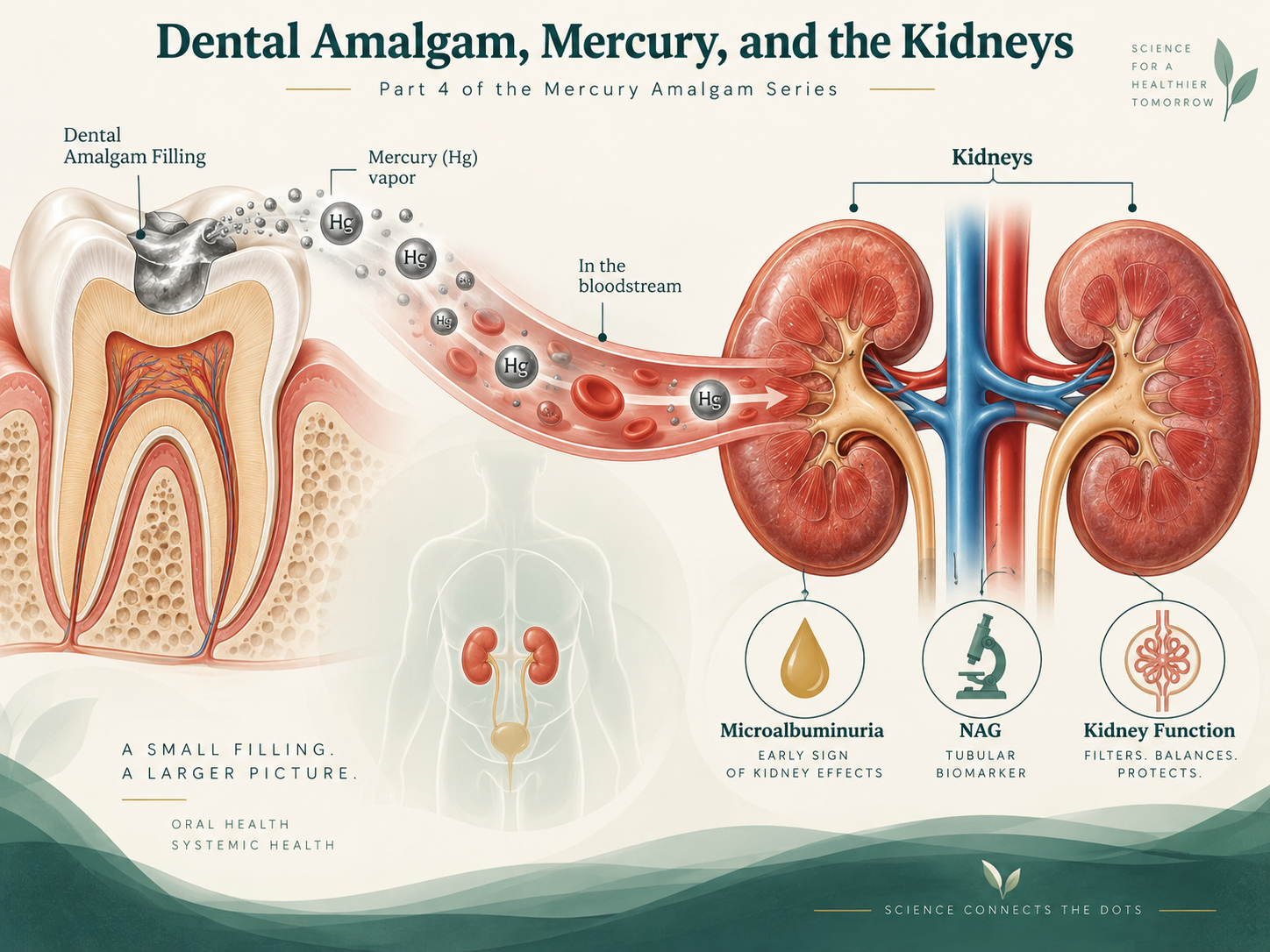
Part 4 of 12 in the Mercury Series
Dental Amalgam and the Kidneys: What the Evidence Actually Shows
Part 4 of the Mercury Amalgam Series
In Part 3, we followed mercury beyond the tooth. We looked at human autopsy research showing inorganic mercury in tissues, tracer studies that literally followed mercury from dental fillings into other organs, and research showing that inorganic mercury can remain in some tissues FAR longer than a blood or urine test might lead you to believe. And one organ kept showing up over and over again:
The kidneys.
That isn’t some bizarre coincidence. The kidneys are one of the major organs responsible for handling and eliminating inorganic mercury. So once mercury gets into the body, circulates, and eventually has to be dealt with, the kidneys are going to see it. They don’t really get a vote. And mercury is a renal toxicant. That part isn’t controversial.
The harder question is: How much kidney effect can we actually demonstrate in humans from mercury exposure associated specifically with dental amalgam? And THAT is where the literature gets messy. We have studies that are reassuring. We have studies showing early kidney changes. We have one major randomized trial that found a concerning kidney signal, another major randomized trial that didn’t reproduce it, a later reanalysis that found yet another signal, and then the original investigators arguing about whether that signal represented meaningful injury. Welcome to science.
This is what the literature actually looks like when you read ALL of it instead of finding one abstract that happens to agree with whatever you already wanted to believe. And I really am trying to be fair and balanced about the issues involving mercury here.
A Quick Note About the Reference Numbers
You’ll see two kinds of citations in these shorter articles. References shown as regular numbers—like [34] or [42]—use the exact same numbers as the master mercury article. I’m doing that on purpose so you can move back and forth between these shorter articles and the gigantic master article without having to figure out which study is which. So reference [34] here is exactly the same study as reference [34] in the master article. That means the numbers may skip. This article uses [1] and [34–42] because those are the master references dealing with the kidney question. References [2–33] didn’t disappear, and I promise I still know how to count. They simply belong to the earlier parts of the story.
Sometimes I’ll add a source specifically because one of these shorter articles needs an explanation that wasn’t included in the original monster article. Those are labeled separately as article-only references, like [A1]. You’ll get the full citation and direct link for every source I use at the bottom.
The First Big Randomized Trial Looked Pretty Reassuring
If I’m going to tell you the kidney story honestly, I have to start with evidence that doesn’t particularly help my argument. Because that’s how this is supposed to work. The New England Children’s Amalgam Trial randomized 534 children between ages 6 and 10 to receive either amalgam restorations or mercury-free composite restorations and followed them for five years. [34]. The children who received amalgam had significantly higher urinary mercury.
The amalgam increased their mercury exposure.
That isn’t speculation. They measured it. But when the researchers looked at the main kidney measurement they had chosen—urinary albumin—they didn’t find a statistically significant difference between the amalgam group and the composite group. [34]. That is genuinely reassuring evidence.
If somebody tells you this trial proved that amalgam caused obvious kidney damage across the entire group of children, that isn’t what the study showed. But then researchers went back and looked harder, because they already KNEW that mercury caused issues for kidneys. And suddenly things got more interesting.
Then the Kidney Started Throwing Up a Little Red Flag
A later analysis of those same children looked at kidney biomarkers in considerably more detail. [35]. On average, the groups still didn’t show significant differences across most of the kidney measurements. But researchers found something else. During years three through five, the children in the amalgam group were about 1.8 times as likely to have microalbuminuria. [35]. Microalbuminuria means more albumin is leaking into the urine than should be.
Normally, your kidneys do a really good job of keeping albumin in your bloodstream. When more albumin starts leaking through the kidney’s filtration system, it can be an early sign that the filtration barrier is under stress. And then there was this: Ten children in the amalgam group had microalbuminuria at BOTH the three-year and five-year measurements. Only two children in the composite group did. [35]. That gets my attention.
Now, the researchers themselves said the finding might have happened by chance because they were looking at multiple kidney outcomes. Fine. That is an appropriate limitation to acknowledge. But “this could have happened by chance” is NOT the same thing as “nothing happened.” A signal appeared. You don’t turn that signal into kidney failure. But you also don’t pretend you never saw it.
And Then We Get to Casa Pia
Before I tell you what the Casa Pia trial found about kidneys, I need to tell you something about the trial itself. Because I won't keep citing this study like it was simply another nice, clean randomized clinical trial without talking about WHO these children were and HOW this experiment was done. And frankly, the more I learned about it, the angrier I got.
The Casa Pia Children’s Amalgam Trial involved 507 children in Lisbon, Portugal who had dental decay and had never previously had amalgam restorations. They were randomized to receive either mercury-containing amalgam restorations or mercury-free composite restorations and then followed for years so researchers could study neurological and physical health effects. [36,A3]. These weren’t adults volunteering for an occupational toxicology study.
They were CHILDREN.
Casa Pia was an institution serving vulnerable children, including orphans and wards of the state. And according to the documentation reviewed in Dr. David Kennedy’s Casa Pia presentation at the IAOMT meeting in Columbus in September 2026, one Casa Pia employee signed 175 consent forms on behalf of orphaned children. [A4]
One employee.
One hundred seventy-five children.
And then it gets worse. The Portuguese consent forms reportedly didn’t tell them that the amalgam restorations contained mercury. They also didn’t adequately disclose the risks associated with the material. [A4]. I’m sorry, but I have a REALLY big problem with anyone casually calling that informed consent. A signature is not informed consent. Putting the word “consent” at the top of a piece of paper doesn’t magically make it informed. If you don’t tell the person—or the person signing for the child—what you are actually putting into that child’s body and what the known risks are, exactly what are they supposedly giving informed consent TO?
And remember why the study existed. Researchers were trying to determine whether chronic mercury exposure from amalgam caused measurable neurological or physical harm in children. That uncertainty was literally the reason for the experiment. These children had never previously had amalgam. Then researchers deliberately placed a restorative material containing approximately 50% elemental mercury into half of them so they could watch what happened.
I find that HORRIFICALLY unethical. I don’t care how many institutional stamps appeared on the paperwork. These were vulnerable children. Some were orphans. Some were wards of the institution. They had unmet dental needs. They depended on the very system enrolling them in the experiment. And they certainly weren’t independent adults sitting across a table saying: “I fully understand that you want to place mercury-containing restorations into my teeth so you can spend the next several years studying whether that mercury affects my brain or kidneys, and I freely choose to participate.” That's not the situation we’re talking about.
The documentation Kennedy reviewed also describes substantial differences between the English and Portuguese consent materials and reports that concerns about the consent process were eventually taken to the U.S. Office for Human Research Protections. [A4]. So no, I’m not going to sanitize this into some bland sentence about “ethical concerns surrounding enrollment.”
These children were deliberately exposed to mercury so researchers could find out what that exposure did to them, and I do not believe the process provided them the kind of meaningful informed consent that human research demands.
And yet those data are now in the scientific literature. The children were exposed. The experiment happened. Ignoring the results now doesn’t undo what happened to them. History has already taught us that data don’t become ethically clean simply because they later appear in a scientific paper. Nazi physicians generated observations from human beings who could not meaningfully consent, and some of that information entered the scientific literature afterward. We don’t erase what was learned, because the victims already paid the price for those data. But neither do we allow publication to sanitize how the information was obtained. I feel the same responsibility when I discuss Casa Pia: if I’m going to use the findings, I’m also going to tell you what happened to the children who generated them.
So yes, I’m going to use the data. But I am NOT going to turn those children into anonymous numbers on a spreadsheet and pretend we don’t know how those numbers were obtained. They were human beings first. And they deserved better.
So What Did Casa Pia Find About the Kidneys?
The original Casa Pia kidney analysis followed those 507 children for seven years and looked at several measures of kidney integrity. [36]. Researchers evaluated markers associated with different parts of the kidney, including albumin and markers associated with the kidney tubules. And the original analysis did not find significant treatment-group differences in those renal biomarkers. It also did not reproduce the microalbuminuria signal from the New England trial. [36]
So if we stopped right there, the randomized evidence would look reasonably reassuring:
-
The New England trial didn’t find a significant difference in its primary kidney outcome. [34]
-
A deeper analysis of that trial found a microalbuminuria signal. [35]
-
Casa Pia didn’t reproduce that particular signal. [36]
Except the Casa Pia kidney story didn’t end there.
Then Other Human Studies Started Finding Tubular Changes
A study of 101 healthy adults compared people with amalgam fillings to people without them. [37]. The amalgam group had significantly higher mercury in both blood and urine. Again, we shouldn’t be surprised anymore. But they ALSO had significantly higher urinary NAG, gamma-glutamyltransferase, and albumin. [37]. Those are kidney-related biomarkers.
And within the amalgam group, urinary NAG and albumin increased as the number of amalgam fillings increased. Albuminuria also correlated with mercury levels in both blood and urine. [37]. Does that mean every one of those people was headed toward kidney failure? No. That would be ridiculous. Kidney failure is a VERY late endpoint. The more interesting question is:
Can the kidney be showing biological stress long before somebody’s creatinine starts screaming that there’s a problem? Yep. It can.
Another study looked at 182 children and found that urinary NAG was significantly associated with BOTH amalgam restorations and urinary mercury. [38]. And the relationship followed a dose-effect pattern. More urinary mercury. More NAG. That gets my attention because NAG is associated with the proximal tubules, and inorganic mercury has a particular relationship with kidney tissue. The authors said the findings suggested that low-level mercury exposure from amalgam affected tubular function and that the results needed further confirmation. [38]. Fine. Absolutely. Confirm it. Do more studies.
That's what science SHOULD do. But while we’re waiting for the perfect final study, let’s not miss what this one actually found: More mercury was associated with more evidence of tubular stress.
Then the Casa Pia Data Got Messier Too
Later investigators went back into the Casa Pia data and looked at cumulative amalgam exposure rather than simply asking whether the entire amalgam group looked different from the entire composite group. [39]. And they found a statistically significant dose-dependent relationship between cumulative amalgam exposure and urinary GST-alpha, another marker associated with proximal-tubule integrity. At average amalgam exposure, GST-alpha was estimated to increase about 10% over eight years compared with no amalgam exposure. [39].
And then the original Casa Pia investigators pushed back. They challenged the statistical approach and argued that the randomized group comparison was more appropriate. They also argued that a change in GST-alpha could represent the kidney responding to mercury exposure without necessarily proving clinically significant kidney injury. [40]
And you know what? I actually think that distinction is fascinating. Because an organ can absolutely be responding to a toxicant before that response has progressed all the way to diagnosable disease. That is kind of the ENTIRE POINT of looking at early biomarkers. So I’m fine telling you both sides.
The reanalysis found a renal signal. The original investigators argued about how that signal should be interpreted. What I’m not willing to do is pretend a biological response becomes irrelevant just because the child doesn’t yet have chronic kidney disease. Especially when these were children who were intentionally exposed to mercury in the first place.
And Yes, There Are Negative Studies Too
Another study compared 403 children in Shanghai, including 198 children with amalgam and 205 without. [41]. The children with amalgam had slightly higher urinary mercury. But researchers did NOT find significant differences in NAG or microalbumin. They also didn’t find significant differences in the neurobehavioral measures they examined. [41]. So there you go. A negative study. It belongs here. If I tell you about every study that finds something and conveniently forget the studies that don’t, I’m not educating you. I’m selling you something. And I have absolutely ZERO interest in doing that.
Then Somebody Tried to Put All the Randomized Evidence Together
In 2020, researchers performed a systematic review, meta-analysis, and trial-sequential analysis of randomized clinical trials involving dental amalgam. [42]. The pooled evidence did not show statistically significant nephrotoxicity from amalgam compared with composite. And if you stop reading right there, you can walk away saying: “See? Amalgam doesn’t affect the kidneys.”
Except keep reading. Only six publications met the inclusion criteria. Five of those six were judged to have a high risk of bias. And only two studies could actually be combined in the meta-analysis. [42]
Then the investigators asked another pretty important question: Do we actually have enough data to draw a reliable conclusion? Nope. Their trial-sequential analysis found that the research had not reached the required information size. In normal-human language:
We don’t have enough good randomized data to close the case.
That is NOT the same thing as: “Randomized trials proved mercury from amalgam has no effect on the kidneys.” They didn’t.
What the review found was: We haven’t proven clinically significant nephrotoxicity with the randomized trials we currently have.
AND:
The randomized evidence is too limited to confidently rule out an effect.
Both things can be true at exactly the same time. Science does that constantly.
Your Creatinine Isn’t a Complete Report Card on Your Kidneys
This is another place where I think people get lulled into a false sense of security. Say “kidney function” and the immediate thought is: Creatinine. eGFR. Done. And that's if they understand those words at ALL. Which most of us don't. And your kidneys are WAY more complicated than that.
Serum creatinine is useful primarily because it helps us estimate glomerular filtration—how effectively the kidneys are filtering blood. But creatinine is influenced by things besides kidney filtration, including muscle mass and diet. That’s one reason cystatin C can sometimes give us additional information when creatinine alone doesn’t tell the whole story. [A1]. And here’s the REALLY important part for a mercury discussion:
Mercury has a particular relationship with the proximal tubules.
Those are microscopic structures inside the kidneys that reclaim nutrients and electrolytes, process chemicals, and help move waste toward elimination. A kidney can show tubular stress or injury before serum creatinine necessarily becomes abnormal. Which is exactly why mercury researchers don’t just stare at creatinine and call it a day.
They look at things such as:
-
NAG
-
GST-alpha
-
gamma-GT
-
albumin
-
microalbuminuria
because those markers tell us different things about what is happening inside the kidney. [35,37–39]. NAG, for example, is concentrated in proximal-tubule cells. When those cells are stressed or injured, more NAG can show up in the urine. [A2]. GST-alpha is another marker associated with proximal-tubule integrity. Albumin and microalbuminuria tell us something different again: whether protein that should mostly remain in the bloodstream is beginning to leak through the kidney’s filtration barrier. None of these tests means exactly the same thing.
Account required
Sign in to see more
Create an account or sign in to unlock the full list.