Resource Libraries
Amalgam Fillings During Pregnancy and Breastfeeding
How mercury from amalgam crosses the placenta and enters breast milk, what cord blood and infant studies show, and why the placenta is no barrier to vapor.
Part 5 of 12 in the Mercury Series
Mercury, Pregnancy, and Breastfeeding: The Placenta Is Not a Force Field
Part 5 of the Mercury Amalgam Series
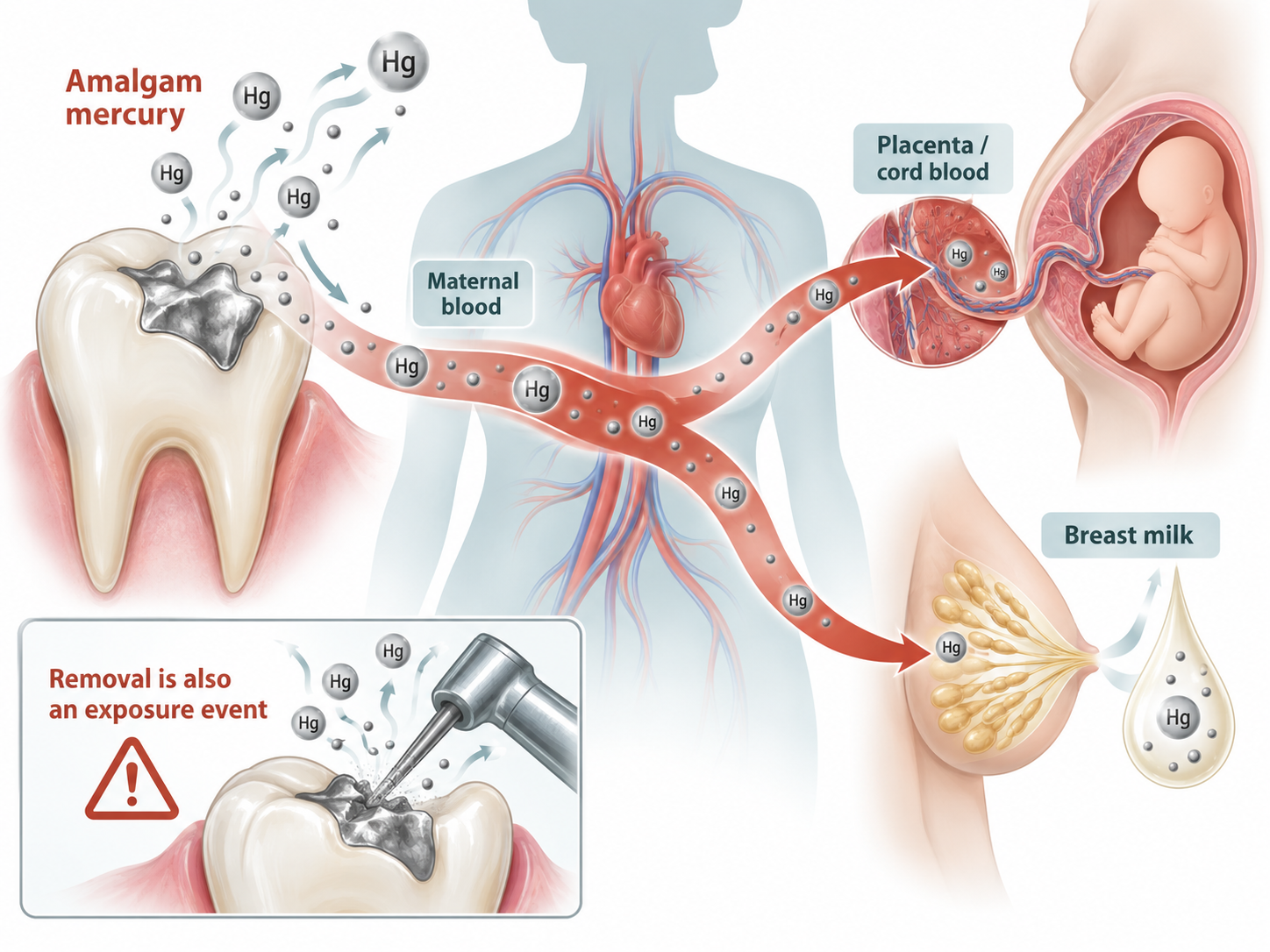
Pregnancy changes this conversation. Up to this point in the series, we’ve talked about mercury leaving amalgam, showing up in blood and urine, moving into tissues, interacting with cells, and affecting organs that have to process and eliminate it. But pregnancy gives us an entirely different problem. Now we aren’t talking about one human being. We’re talking about two. The question becomes: Can mercury associated with a mother’s dental amalgam reach her developing baby? And once that baby is born: Can mercury associated with maternal amalgam enter breast milk?
Yes. Both happen.
And I want to be really clear about something from the beginning, because I don’t want this article wandering off into a giant conversation about tuna. This article is about mercury from DENTAL AMALGAM. Mercury is toxic. That isn’t the controversial part. Different forms of mercury behave differently, and toxicity depends on things like the chemical form, dose, route of exposure, timing, duration, and the biology of the individual person. But none of that transforms mercury into a biologically harmless substance. Mercury can bind to important cellular molecules, interfere with proteins and enzymes, disrupt mitochondrial function, alter calcium signaling, and contribute to oxidative stress. [101]
So the question I’m asking isn’t: “Is mercury toxic?” We already know it is. The question is: “Does mercury from dental amalgam actually reach a pregnant woman, her placenta, her developing baby, and later her breast milk?”
And THAT answer is also yes.
A Quick Note About the Reference Numbers
You’ll see regular reference numbers throughout this article, such as [43] or [53]. Those are the exact same numbers used in the complete master mercury article. I’m keeping them consistent throughout this entire 12-part series so that reference [43] here is exactly the same source as reference [43] in the master article. That means the numbering may skip. Nothing is missing, and I still know how to count.
Occasionally, I’ll add science specifically to one of these shorter articles because something needs a little more explanation than it received in the 30,000-word monstrosity. Those sources are labeled separately as article-only references, using an A before the number, like [A1]. At the bottom, I’ll give you the complete citation and direct link for every study I’ve used here.
First, Let’s Deal With the Tuna
Lordy, mercury and pregnancy almost automatically turn into a conversation about fish. And YES, fish can absolutely be a source of mercury. But the form matters. Fish—particularly larger predatory fish like the tuna sashimi most of us love to eat—are primarily associated with methylmercury.
Dental amalgam releases elemental mercury vapor. We inhale that vapor through our lungs, and after it enters the body, much of it is converted into inorganic mercury. That gives researchers a really useful way to start separating exposure sources. One longitudinal study followed pregnant and lactating women and measured methylmercury and inorganic mercury separately. As women reduced certain fish during pregnancy, their methylmercury went down. But inorganic mercury in blood and mercury in urine were strongly associated with the number of amalgam fillings the women had. [A1]
Another pregnancy study found essentially the same split. Fish consumption tracked with methylmercury. But inorganic mercury in the baby’s cord blood increased significantly with the number of maternal amalgam fillings. [A2]
THAT is an incredibly important distinction. The tuna can take responsibility for the methylmercury. It does not get to take the fall for inorganic mercury that increases with the mother’s amalgam burden.
There’s also a very large British pregnancy study involving 4,484 women. Dental variables explained approximately 6.47% of the variation in maternal total blood mercury, compared with about 8.75% from seafood consumption. The number of amalgams present at the beginning of pregnancy accounted for most of the dental contribution. [A3]. So seafood mattered. And amalgam mattered. Both can be true.
I would LOVE to have a beautiful study of pregnant vegetarians where researchers could practically remove seafood from the equation altogether. I went looking for one because that would make the explanation even cleaner. I didn’t find a pregnant-vegetarian study that answered this specific amalgam question well enough for me to hang an argument on it. Somebody, please do one. One of the things I am good at is identifying the science still missing from the literature. And I’m not going to manufacture evidence because I wish somebody had done the study. Fortunately, we don’t actually need it.
When researchers chemically separate methylmercury from inorganic mercury, they can distinguish the exposure patterns far better than simply asking whether somebody ate fish.
The Placenta Is NOT a Force Field
People talk about the placenta as though it’s some magical shield between the mother and the baby. It isn’t. It's an extraordinary organ, and it absolutely protects the developing baby from some things remarkably well. But mercury doesn’t politely stop at the door. Researchers measured inorganic mercury and methylmercury in placental tissue from 119 women. [43]. The result that matters here is very specific:
The amount of inorganic mercury in the placenta increased significantly as the number of maternal amalgam fillings increased. [43]
That is not a tuna result. That is an amalgam relationship. And the placenta didn’t simply capture all of that mercury and prevent it from moving farther. Maternal inorganic mercury still reached fetal circulation. [43]. So now we have mercury that began as a dental exposure showing up in the organ literally connecting mother and developing baby. That matters. A lot.
More Maternal Amalgam Meant More Mercury in the Baby’s Cord Blood
Another study followed 99 mother-infant pairs. [44]. Researchers found a strong relationship between mercury in the mother’s blood and mercury in the baby’s umbilical-cord blood. But here’s the finding I care about most: The more amalgam fillings the mother had, the more mercury researchers tended to measure in her baby’s cord blood. [44]
Timing mattered too. The longer it had been since the mother’s most recent amalgam had been placed, the lower the mercury tended to be in the baby’s cord blood. In other words, more recent amalgam placement was associated with greater fetal mercury exposure. [44]. The investigators also compared those measurements with a neurodevelopmental reference value derived from methylmercury that was being used at the time. In other words, they were basically comparing apples and oranges—but at least they were both fruit.
Both involve mercury, but methylmercury and the elemental/inorganic mercury associated with dental amalgam are not the same chemical form, they don’t behave identically in the body, and a reference value developed from methylmercury research does not magically become a proven safety threshold for fetal exposure to inorganic mercury from amalgam. So I’m not going to interpret “below that reference value” as meaning safe.
What matters to me in this study is much simpler: The more amalgam the mother had, the more mercury researchers measured in her baby’s cord blood. [44].
A fetus doesn’t suddenly become biologically protected because a laboratory number falls on one side of an administrative or population-derived reference line. And there is no cord-blood mercury number that allows me to guarantee: “Below this number, mercury has absolutely no biological effect in every developing human being.”
We aren’t cookie cutters. I will repeat that until you can say it in your sleep. The important finding for this article is much simpler: Maternal amalgam burden predicted mercury measured in the developing baby. [44]. And a separate prospective study found the same general pattern. Pregnant women who had amalgam restorations had significantly higher mercury concentrations in both maternal blood and umbilical-cord blood than women without amalgam. [48]. That study didn't find significant differences in the fetal biometric measurements it evaluated. And I’m going to tell you that too. Because exposure is not automatically the same thing as clinically obvious injury.
But PLEASE don’t flip that sentence around and make it say something it doesn’t. “This study didn’t demonstrate a particular fetal abnormality” does not mean “therefore mercury exposure to the fetus is biologically irrelevant.” Those aren’t the same statement. The mercury reached the baby. That is what the study demonstrated.
Mercury Is Toxic Before Somebody Gives It a Diagnosis
This is one of the things that frustrates me about the way we sometimes talk about toxicology. We seem to want to wait until someone can prove a particular exposure caused a particular disease before we’re willing to acknowledge that exposing a developing human being to a toxic substance might not be a fabulous idea. That makes no sense to me.
Mercury has known toxicological effects. ATSDR describes multiple mechanisms through which mercury can interfere with normal biology, including disruption of mitochondrial function, intracellular calcium, proteins dependent on sulfur-containing groups, and oxidative balance. Neurological and renal effects are among the repeatedly identified targets of mercury exposure. [101]
That does NOT mean one atom of mercury causes disease. Nor does it mean every fetus exposed to mercury will develop a detectable problem. It means mercury is a toxicant, not a nutrient. And pregnancy is occurring during one of the most extraordinary periods of biological construction that will ever happen in a human being.
- The brain is developing.
- The kidneys are developing.
- The endocrine system is developing.
- The immune system is developing.
- The nervous system is wiring itself.
- Millions upon millions of cells are dividing, differentiating, migrating, and communicating.
That is NOT the time in life when my preferred toxicological strategy is: “Well, we haven’t proven exactly how much this particular fetus can tolerate, so let’s add some more.” Especially when adding it is completely optional AND PREVENTABLE.
After Birth, The Exposure Route Changes
Then the baby is born. The placenta is gone. But maternal mercury exposure doesn’t suddenly become irrelevant. Now we have breast milk. And this is another place where separating the mercury forms becomes REALLY useful. One human study measured both total mercury and inorganic mercury in maternal blood and breast milk. [53]. In maternal blood, approximately 26% of the total mercury was inorganic mercury. In breast milk, inorganic mercury made up approximately 51% of the total mercury. [53]. So inorganic mercury represented a much larger proportion of the mercury in milk than it did in maternal blood.
The concentration of inorganic mercury in breast milk averaged approximately 55% of the inorganic-mercury concentration in maternal blood, and the two were strongly correlated. And then we get to the part that matters most here: The number of maternal amalgam fillings correlated with inorganic mercury in both maternal blood and breast milk. [53]. The investigators concluded that dental amalgam was the major source of the inorganic mercury found in the milk in that study population. Again: That is NOT the tuna.
More Amalgam, More Mercury in Breast Milk
Another study looked at 38 nursing mothers who had no occupational mercury exposure. [49]. Average mercury concentrations in breast milk were:
-
2.87 μg/L in mothers with no amalgam fillings
-
5.47 μg/L in mothers with 1–3 amalgam fillings
-
13.33 μg/L in mothers with 4–8 amalgam fillings [49]
Look at those numbers. As maternal amalgam burden increased, mercury in breast milk increased dramatically in that study. Dental amalgam was the only measured factor significantly associated with milk mercury. [49]. Then a much larger Norwegian study looked at breast milk from 300 mothers. [50]. Seafood predicted mercury. And maternal amalgam predicted mercury.
Seafood by itself explained approximately 10% of the variation in breast-milk mercury. When amalgam exposure was added to the model, together they explained approximately 46% of the variation. [50]. Again, tuna doesn’t get blamed for everything simply because it’s the mercury source everybody has heard about.
Dental amalgam is a measurable mercury source too. A 2026 systematic review looked across 15 studies examining mercury exposure during pregnancy or lactation and mercury concentrations in human milk. Overall, greater maternal mercury exposure was associated with greater mercury in breast milk. The certainty of that evidence was rated low because the studies differed considerably in design, exposure sources, timing, and methods. [51]. That limitation matters.
I can’t count five amalgam surfaces in a woman’s mouth and calculate exactly how much mercury her individual baby will ingest. Science isn’t there yet. But I also don’t need that level of precision to acknowledge the obvious: Amalgam-associated mercury can get into breast milk.
And NO, I Am Not Telling Mothers to Stop Breastfeeding
Absolutely not. I’m an AVID supporter of extended breastfeeding. Breastfeeding has enormous established nutritional, immunologic, developmental, and health benefits. The American Academy of Pediatrics recommends exclusive breastfeeding for approximately six months and continued breastfeeding with complementary foods for two years or longer, when mutually desired by mother and child. [52]. So please don’t read everything I just wrote and decide:
“I have amalgam. I have to stop breastfeeding.”
That isn’t my recommendation. The problem isn’t that breast milk is suddenly bad. The problem is that the mother has an ongoing mercury source. And unfortunately, pregnancy and breastfeeding are usually not the time I want to create a giant temporary mercury exposure trying to remove it. Which brings us to the really frustrating part.
It Just Is What It Is During Pregnancy and Breastfeeding
If somebody is reading this while she is pregnant or nursing and realizing for the first time that she has eight amalgam fillings, I know exactly where her brain is going: GET THEM OUT. Please don’t. At least not simply because you’ve become scared after reading this article.
Removing amalgam is itself a mercury-exposure event. Drilling into amalgam creates heat, vapor, aerosol, and mercury-containing particulate. Human studies have measured substantial increases in mercury release during drilling, polishing, and removal. [14,16,92]. Mercury biomarkers WILL rise after removal. [16,94,95]. It's considered a "temporary" rise, but since we aren't cookie cutters, different people excrete or eliminate it at different rates. I'm 18 years out from my last pregnancy and I'm still extremely mercury toxic. My youngest daughter is still mercury toxic 18 years after her birth because she detoxes worse than I do. All I can say is thank goodness we eliminated other toxic exposures as much as we could.
That is exactly why the FDA advises against removing intact amalgam restorations during pregnancy or breastfeeding solely for the purpose of preventing disease unless there is a clinical reason they need to be replaced. [1]. Does that create an annoying biological catch-22? Yep. The amalgam is an ongoing source of mercury exposure. But drilling it out also creates an acute mercury exposure. So if the restoration is intact and clinically stable and the woman is already pregnant or breastfeeding, this generally isn’t the time I decide to stir everything up simply because we’ve finally acknowledged what the filling contains. It just is what it is for the moment.
Mercury didn't magically became safe because she got pregnant. So it means timing matters. The goal is to reduce exposure, not dramatically increase it at exactly the wrong biological moment. If an amalgam is fractured, infected, has recurrent decay, is compromising the tooth, or absolutely has to be treated during pregnancy, that becomes a different clinical conversation. And I go a step further. I would rather NOT remove amalgam AT ALL during pregnancy or breastfeeding unless it's quite literally an emergency. And at that point, I'm doing my level best to NOT drill on the mercury amalgam AT ALL.
Necessary dentistry still has to happen even if sometimes we have to get a bit creative to avoid disturbing a toxicant. But elective wholesale removal because somebody just discovered mercury toxicology? I would wait. And when the timing is appropriate, I’d want the removal done using a comprehensive mercury-safe protocol specifically designed to minimize exposure. We’ll get to that later in this series.
This Is Why I Want Us to Stop Creating the Problem in the First Place
Here’s the part that makes me nuts. We spend all this time arguing about exactly how much mercury reaches the placenta. How much reaches the fetus. How much reaches breast milk. Whether a particular biomarker crossed somebody’s regulatory comparison number. Whether this fetus is more susceptible than that fetus. Whether one genetic variant changes mercury handling.
And meanwhile there is one spectacularly simple way to prevent dental amalgam from becoming part of this pregnancy conversation at all:
DON’T PUT MERCURY INTO THE TOOTH IN THE FIRST PLACE.
That doesn't solve environmental mercury nor does it eliminate methylmercury from seafood. And it doesn't magically remove every toxicant a human being encounters. It eliminates one completely avoidable source. And THAT is my point.
I’m not telling pregnant women with existing amalgam to panic nor am I telling breastfeeding mothers to stop nursing. And I’m definitely not telling either of them to run out tomorrow and have somebody pulverize every amalgam restoration in their mouth. I’m saying we should stop creating this situation for future patients.
What the Science Actually Lets Me Say
Account required
Sign in to see more
Create an account or sign in to unlock the full list.